

What is an AI Visibility Score and How Does It Measure Brand Presence?
Learn what an AI visibility score is, how it measures your brand's presence in AI-generated answers across ChatGPT, Perplexity, and other AI platforms, and why ...
11 min read

Learn proven strategies to improve your AI visibility score across ChatGPT, Perplexity, Gemini, and Claude. Discover how to optimize content, build authority, and increase brand mentions in AI-generated answers.
Improve your AI visibility score by optimizing content structure with schema markup, building topical authority through high-quality content, earning authoritative backlinks, maintaining consistent brand information across platforms, and monitoring your mentions across ChatGPT, Perplexity, Gemini, and Claude. Focus on creating clear, fact-dense content that AI models recognize as credible and trustworthy sources.
Your AI visibility score represents how prominently your brand appears, gets cited, and is recommended across AI-powered search platforms like ChatGPT, Perplexity, Google Gemini, and Claude. Unlike traditional search engine rankings that measure your position on a results page, AI visibility scores measure whether AI models mention your brand at all when answering relevant user queries. This fundamental shift means that appearing in AI-generated answers has become the new metric of authority and trust in the digital landscape. With AI-driven search experiences expected to reach over a billion users by the end of 2025, understanding and improving your AI visibility score is no longer optional—it’s essential for maintaining competitive advantage in your industry.
Your overall AI visibility score is built on several interconnected metrics that work together to determine your presence in AI-generated answers. Citation frequency measures how often your website appears as a source in AI responses, while brand mention rate tracks how frequently AI models reference your brand by name when answering relevant queries. Share of voice compares your visibility against competitors within AI answers for the same topics, revealing whether you’re gaining or losing ground. Cross-platform performance evaluates your visibility across different AI platforms, since each system draws from different data sources and uses unique retrieval methods. Additionally, sentiment and positioning matter—AI doesn’t just mention brands, it characterizes them, so understanding how AI describes your business helps identify perception gaps and optimization opportunities.
| Metric | Definition | Impact on Score |
|---|---|---|
| Citation Frequency | How often your site appears as a source in AI responses | Direct—higher citations increase visibility score |
| Brand Mention Rate | Frequency of brand name mentions in AI answers | Direct—more mentions boost overall score |
| Share of Voice | Your visibility compared to competitors in AI answers | Comparative—determines competitive positioning |
| Cross-Platform Performance | Visibility across ChatGPT, Perplexity, Gemini, Claude | Comprehensive—measures total AI presence |
| Content Authority | Recognition as expert source in your domain | Foundational—influences all other metrics |
| Backlink Quality | Citations from authoritative third-party sources | Indirect—builds credibility signals for AI |
AI models process information differently than traditional search engines, requiring a deliberate approach to content structure. Clear heading hierarchies using H1, H2, and H3 tags help AI understand your main topics and subtopics, making it easier for the model to extract relevant information for its responses. When you structure content with logical progression, AI systems can more effectively parse your information and determine whether it’s suitable for inclusion in generated answers. Lists and tables are particularly valuable because they present information in easily digestible formats that AI can quickly scan and extract key features, steps, or data points. Bulleted lists work well for advantages or characteristics, while numbered lists suit step-by-step processes, and data tables excel at presenting comparative information. Concise, factual language without unnecessary jargon makes your content more accessible to AI models, which favor short paragraphs that directly answer questions or address specific user needs. This structured approach signals to AI systems that your content is authoritative and reliable, increasing the likelihood of citation.
Topical authority is one of the strongest factors influencing whether AI models mention your brand. AI systems favor brands and sources recognized as experts in specific domains, meaning you need to consistently publish high-quality, in-depth content that demonstrates deep knowledge of your subject area. This goes beyond creating individual blog posts—it requires developing comprehensive content clusters that cover your core topics from multiple angles, addressing related questions and adjacent concepts that users are likely to ask. When your brand consistently publishes authoritative content and is cited by other reputable sources within your industry, AI models recognize you as a credible authority worth referencing. Author credentials matter significantly; clearly display author biographies with relevant expertise, certifications, and experience. Your “About Us” page should comprehensively explain your brand’s mission, credibility, and what makes you unique in your field. Additionally, original research and data give AI models unique information they can’t find elsewhere, making your brand an indispensable source. Publishing industry surveys, detailed case studies, customer success stories, and trend analyses positions your brand as a primary source of truth that AI systems will naturally want to cite.
Schema markup is the most direct way to communicate with AI search engines, providing a standardized format that explicitly labels your content and tells AI exactly what your information is and how it relates to other entities. By structuring your data with schema, you make your brand’s information machine-readable, allowing AI to process, verify, and feature it in responses with confidence. Organization Schema serves as your brand’s digital identity card, helping AI confidently identify and differentiate your brand from competitors. Product Schema details your products’ names, descriptions, brands, SKUs, prices, availability, and ratings—structured information that helps AI pull products into comparisons and recommendation carousels. Service Schema works similarly for services, defining what you offer, geographic areas served, and service inclusions. FAQPage Schema marks up frequently asked questions on your pages, providing AI with ready-made, concise answers to common queries about your brand or products, making your content a prime source for direct inclusion in AI answers. Review Schema marks up genuine customer reviews with author information, feeding directly into AI’s understanding of your brand’s reputation and trustworthiness. Implementing these schema types creates a comprehensive data structure that AI models can easily understand and reference.
Backlinks remain a critical credibility signal for both traditional and AI search engines, with high-authority sites serving as votes of trust that influence your brand’s perceived reliability. AI models prioritize content from sites with strong backlink profiles, especially from news media, .gov, .edu, and other trusted domains. Focus your public relations efforts on earning citations from high-authority outlets in your industry, as media mentions and press coverage significantly enhance your overall online presence and AI visibility. Create linkable assets like comprehensive guides, original infographics, research reports, and industry analyses that other websites naturally want to reference and link to. Participate in industry collaborations, expert roundups, and thought leadership opportunities that generate backlinks from relevant, authoritative sources. The quality of backlinks matters more than quantity—a single mention from a major industry publication or government resource carries far more weight than dozens of links from low-authority sites. By building a strong backlink profile, you strengthen your standing with AI search systems and increase the likelihood of being cited as a credible source.
Inconsistent brand information confuses AI models and significantly hurts your chances of being accurately cited in AI-generated answers. AI systems cross-reference information across multiple sources to verify accuracy, so discrepancies between your website, social media profiles, business directories, and third-party listings create confusion and reduce your credibility score. Claim and optimize your business profiles on Google Business Profile, Yelp, LinkedIn, and industry-specific platforms, ensuring all information is current and accurate. Update your website’s core pages regularly—your About page, Contact page, Services page, and product pages should reflect your current offerings, team, and positioning. Maintain consistent NAP information (Name, Address, Phone) across all directories and listings, as AI systems use this consistency as a trust signal. Monitor third-party mentions on industry websites, product review sites, and partner platforms to ensure your brand information is represented accurately. When AI models encounter consistent, verified information about your brand across multiple authoritative sources, they develop higher confidence in citing you as a reliable source.
AI models are trained to synthesize information and provide direct answers to user queries, making question-focused content particularly valuable for improving your visibility score. Identify the specific questions your target audience asks at each stage of their customer journey and create comprehensive content that directly addresses these questions. Long-tail keywords and specific queries are especially important because they often have less competition and higher intent, making it easier for your content to become the primary source AI references. Structure your content to answer the “who, what, why, and how” for common questions in your industry, providing complete, authoritative answers that leave no room for ambiguity. FAQ sections on your website are particularly effective because they present questions and answers in a format AI models readily extract for inclusion in generated responses. When your content provides the best, most direct answer to a user’s question, AI has a strong incentive to use it as a primary source, directly improving your visibility score.
Continuous monitoring is essential because AI visibility changes faster than traditional search rankings, and you need to spot trends and opportunities early. Perform regular manual checks by asking common questions related to your brand and industry on various AI search platforms—ChatGPT Search, Perplexity, Google Gemini, and Claude. Track whether your brand is mentioned, the context in which it appears, the sentiment of the response, and whether you’re receiving citations. Document your baseline metrics including mention rates, citation frequencies, and competitor comparisons so you can measure progress over time. When you identify gaps—such as queries where competitors appear but you don’t—you’ve found optimization opportunities. If an AI provides incorrect information about your brand, it’s a clear signal that you need to create and structure content that provides the correct information more clearly. Establish quarterly audits of your AI visibility to identify trends, track competitor movements, and adjust your strategy accordingly. This feedback loop transforms raw data into actionable insights that guide your content and optimization efforts.
AI models favor content packed with statistics, verifiable details, and credible citations because these elements signal reliability and authority. Research from leading institutions suggests that adding citations and quotes to your content can boost AI visibility by more than 40%, making this one of the highest-impact optimization tactics available. When you include specific data points, research findings, expert quotes, and citations from authoritative sources, you create content that AI models recognize as trustworthy and citation-worthy. Original data and statistics are particularly valuable because they provide unique information that AI can’t find elsewhere, making your brand an essential source. Expert quotes and interviews add credibility and provide diverse perspectives that enrich AI-generated answers. Case studies with measurable results demonstrate real-world impact and provide concrete examples that AI models can reference. By increasing the fact density of your content and supporting claims with credible citations, you make your content more attractive to AI systems and increase the likelihood of being featured in generated answers.
AI search is fragmented across multiple platforms, each with different strengths, user bases, and data sources, requiring a multi-platform optimization strategy. ChatGPT dominates with 800+ million weekly users and draws from diverse web sources, making it essential for broad visibility. Google AI Overviews appear on billions of Google searches, making optimization for Google’s AI crucial for mainstream visibility. Claude is growing rapidly with integration into Safari and appeals to users seeking detailed, nuanced responses. Perplexity attracts research-oriented users and emphasizes real-time information and source transparency. Gemini is Google’s standalone AI assistant experiencing rapid growth, particularly for specific query types. Since each platform uses different retrieval methods and data sources, your content strategy should account for these differences. Some platforms prioritize recent content, others favor established authority, and some emphasize specific content formats. By monitoring your performance across all major platforms and adjusting your strategy accordingly, you ensure maximum visibility across the entire AI search landscape.
Track how your brand appears across all major AI search engines and get actionable insights to improve your visibility score. Start monitoring your AI presence today with amicited.
Learn what an AI visibility score is, how it measures your brand's presence in AI-generated answers across ChatGPT, Perplexity, and other AI platforms, and why ...

Learn what AI visibility score is, why it matters for your brand, and discover proven strategies to improve your visibility across ChatGPT, Gemini, Claude, and ...
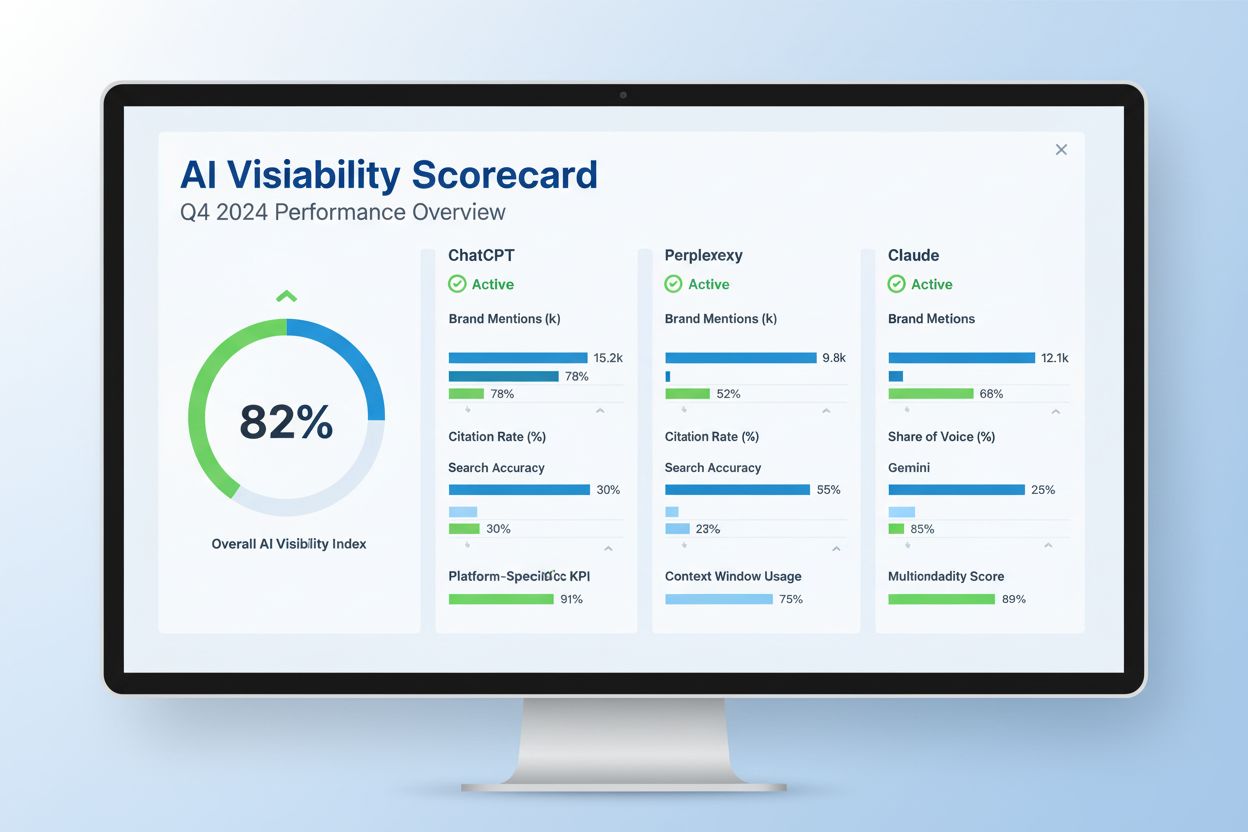
Learn what an AI Visibility Score is and how it measures your brand's presence across ChatGPT, Perplexity, Claude, and other AI platforms. Essential metric for ...