
Content Restructuring for AI: Before and After Examples
Learn how to restructure your content for AI systems with practical before and after examples. Discover techniques to improve AI citations and visibility across...
10 min read

Learn how to optimize content readability for AI systems, ChatGPT, Perplexity, and AI search engines. Discover best practices for structure, formatting, and clarity to get cited in AI-generated answers.
Improve readability for AI by using clear structure with headings, short paragraphs, bullet points, and tables. Write concise sentences with active voice, avoid jargon, and use schema markup. AI systems parse content into chunks based on semantic meaning, so consistent formatting and explicit terminology help them understand and cite your content accurately.
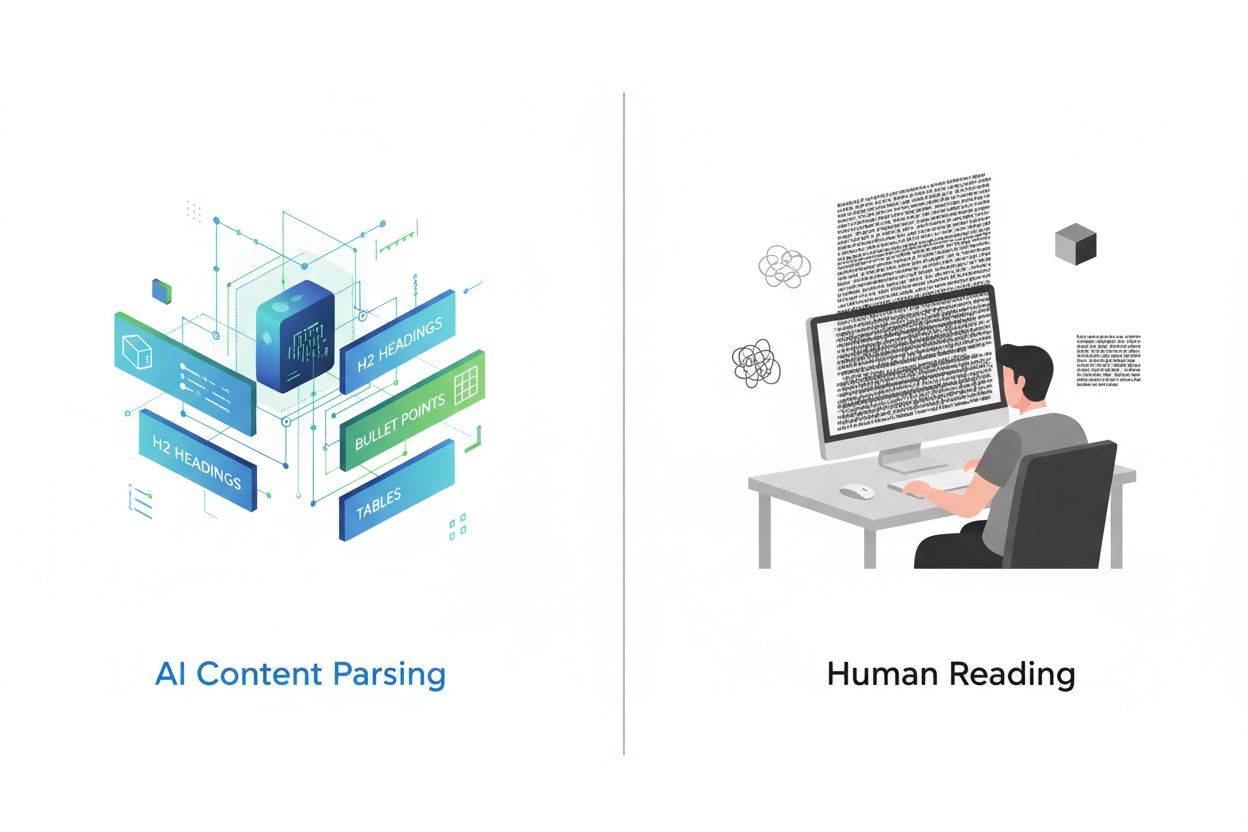
AI systems do not read content the way humans do. Instead of scanning a page from top to bottom, artificial intelligence breaks your content into smaller, structured pieces through a process called parsing. These modular chunks are then evaluated for relevance, authority, and semantic meaning. Understanding this fundamental difference is critical to optimizing your content for AI visibility. When AI systems like ChatGPT, Perplexity, or Google’s AI Overviews process your content, they convert text into tokens—small units of words, punctuation, or code snippets. If your content lacks clear structure, AI may struggle to separate related ideas from unrelated ones, making it less likely to be cited in AI-generated answers. The better organized your content is, the easier it becomes for AI to extract valuable information and include it in responses to user queries.
Clear structure is the foundation of AI-readable content. AI systems rely heavily on heading hierarchy, paragraph breaks, and visual formatting to understand content boundaries and topic relationships. When you use consistent H2 and H3 tags, you create clear semantic divisions that help AI identify where one topic ends and another begins. This is fundamentally different from traditional SEO, where structure primarily serves human readers. For AI systems, structure directly impacts how content is chunked and retrieved. Long walls of text without clear headings confuse AI algorithms because they cannot determine where one concept ends and another begins. By contrast, well-structured content with descriptive headings allows AI to create distinct chunks that can be evaluated and cited independently. Each heading should be specific and descriptive, answering the question that users might ask. Vague headings like “Learn More” or “Additional Information” provide no semantic value to AI systems.
| Structure Element | Impact on AI Readability | Best Practice |
|---|---|---|
| Heading Hierarchy | Defines content chunks and topic relationships | Use H2 for main topics, H3 for subtopics; never skip levels |
| Paragraph Length | Affects tokenization and semantic chunking | Keep paragraphs to 2-3 sentences maximum |
| Bullet Points | Signals clear separation of ideas | Use for lists, steps, or key takeaways; avoid overuse |
| Tables | Organizes structured data for AI extraction | Use for comparisons, statistics, or multi-variable data |
| Bold Text | Emphasizes key terms and concepts | Mark important keywords and definitions |
Sentence length directly impacts AI comprehension and human readability. Research shows that sentences under 17 words achieve optimal clarity for both AI systems and human readers. When sentences exceed 25 words, comprehension drops dramatically—to just 4.5% for very long sentences. AI systems struggle with complex sentence structures because they must parse multiple clauses and relationships simultaneously. Active voice is significantly more effective than passive voice for AI readability. Active voice clearly identifies the subject performing the action, making it easier for AI to extract meaning. For example, “The team wrote the report” is far clearer to AI than “The report was written by the team.” Passive voice obscures the actor and requires AI to infer relationships, increasing the likelihood of misinterpretation.
Avoid vague pronouns like “it,” “this,” or “they” because AI cannot always determine what these pronouns reference. Instead of saying “Update the config file and save it,” specify: “Update the config.yaml file and save the config.yaml file.” This repetition may seem redundant to human readers, but it provides explicit clarity that AI systems require. Similarly, avoid jargon and technical terms unless absolutely necessary. If you must use specialized terminology, define it immediately after introducing it. This ensures that AI systems understand the context and can accurately extract and cite your content.
Schema markup is a critical but often overlooked component of AI readability. Schema is structured code—typically in JSON-LD format—that tells AI systems exactly what type of content you’re providing. Instead of AI having to infer that a section is an FAQ, a product review, or a how-to guide, schema markup explicitly labels it. This dramatically improves the chances that your content will be selected for inclusion in AI-generated answers. Common schema types include FAQ schema for question-and-answer content, HowTo schema for step-by-step guides, Article schema for blog posts, and Product schema for ecommerce items. When you implement schema markup, AI systems can parse your content more efficiently and with greater confidence. This is especially important for featured snippets and AI overviews, where AI systems need to quickly identify and extract the most relevant information. Schema markup also helps AI understand the relationships between different pieces of content on your page, improving semantic clarity.
AI systems extract content in small, self-contained snippets that can be repurposed in answers without additional context. This means your content must be written in a way that makes sense even when pulled out of context. Each section should deliver a complete thought that stands alone. Start each section with the most important information—the answer to the question posed in your heading. This approach, called leading with the answer, ensures that AI systems capture the key takeaway even if they only extract the first sentence or two. Avoid burying important information in the middle or end of paragraphs. Instead, structure your content so that the most critical information appears first, followed by supporting details and examples.
Consistency in terminology is essential for AI understanding. If you refer to the same concept by different names throughout your content, AI may treat them as separate ideas. For example, if you sometimes call it “config file,” sometimes “configuration document,” and sometimes “settings file,” AI cannot reliably connect these references. Choose one term and use it consistently throughout your content. This consistency helps AI build accurate semantic embeddings—numeric representations of meaning that allow AI to understand relationships between concepts. When terminology is inconsistent, these embeddings become fragmented, reducing the likelihood that AI will correctly retrieve and cite your content.
Several common content mistakes significantly reduce AI readability. Hiding important information in tabs, expandable menus, or images makes it invisible to AI systems. While some advanced AI can interpret images, it adds unnecessary complexity and often reduces accuracy. Always provide critical information in plain HTML text with descriptive alt text for images. Avoid decorative symbols, arrows, and excessive punctuation that break parsing. Symbols like “→,” “★★★,” or “!!!” distract from content and can confuse AI tokenization. Similarly, avoid overusing em dashes and parentheses, which can disrupt sentence structure interpretation. Long strings of punctuation or unusual formatting may cause AI to misinterpret or skip content entirely.
Unanchored claims significantly reduce credibility with AI systems. Saying something is “innovative,” “cutting-edge,” or “next-generation” without providing specific evidence or context leaves AI unable to verify or cite your claim. Instead, anchor all claims in measurable facts, data, or expert credentials. For example, instead of “This dishwasher is very quiet,” write “This dishwasher operates at 42 dB, which is quieter than most models on the market.” This specificity allows AI to extract concrete information that can be cited with confidence. AI systems increasingly prioritize content from authoritative sources with strong E-E-A-T signals—Experience, Expertise, Authoritativeness, and Trustworthiness. Content backed by data, research, and expert credentials is far more likely to be selected for inclusion in AI-generated answers.
Bullet points and numbered lists are powerful tools for AI readability when used strategically. These formatting elements signal clear separation of ideas, allowing AI to extract individual items as distinct concepts. However, avoid overusing lists—they should be reserved for key steps, comparisons, or important takeaways. A page filled entirely with bullet points loses semantic structure and becomes harder for AI to parse. Tables are particularly effective for AI readability because they organize information into structured rows and columns. AI systems can easily extract data from tables and repurpose it in summaries or comparisons. Use tables for statistics, feature comparisons, pricing information, or any data that benefits from side-by-side comparison.
Code examples must be properly formatted to prevent tokenization errors. Inline code without backticks may be split into meaningless fragments. Instead, wrap code examples in fenced code blocks with language indicators. This ensures AI treats each command or code snippet as a single unit. For example, instead of writing “Use auth_token=hmb123 to access the API,” write it in a code block:
auth_token=hmb123
This formatting prevents AI from tokenizing the code into separate, meaningless pieces. Similarly, provide plain-text alternatives for all multimedia content. Include descriptive alt text for images and transcripts for videos. This ensures that AI systems can access and understand all information on your page, not just text content.
The best way to verify that your content is AI-readable is to test it directly with AI systems. Use ChatGPT, Claude, Perplexity, or other LLMs to ask questions about your content. If the AI can accurately summarize your content, extract key information, or cite specific sections, your structure is working. If the AI returns incorrect information, mixes up concepts, or misses important details, your content needs restructuring. Start with questions tied to your core workflows or key topics. For example, if you’re writing API documentation, ask the AI to “Summarize the steps to authenticate using this API” or “Give me a sample curl request based on this documentation.” Check whether the AI returns the correct steps, code samples, or section references. If it fails to find the right section or mixes up endpoints, adjust your headings, labels, or examples accordingly. Repeat this testing process as you make changes to ensure continuous improvement.
AI systems prioritize content that directly answers user questions. This means your content should be written in a question-based format whenever possible. Use headings that mirror natural search language—the way people actually ask questions. Instead of “Overview of Authentication Methods,” use “How do I authenticate with the API?” This alignment between user intent and content structure makes it far more likely that AI will select your content for inclusion in answers. Freshness is another critical factor for AI visibility. AI systems favor recent, relevant content over outdated information. Update key sections of your content every 6-12 months to maintain freshness signals. Even if the core information hasn’t changed, refreshing publication dates and adding recent examples or statistics signals to AI that your content is current and reliable. This is particularly important for rapidly evolving fields like technology, healthcare, and finance, where outdated information can be actively harmful.
Track when your content appears in AI-generated answers from ChatGPT, Perplexity, and other AI systems. Get alerts when your brand, domain, or URLs are mentioned in AI responses.
Learn how to restructure your content for AI systems with practical before and after examples. Discover techniques to improve AI citations and visibility across...

Learn how to structure your content to get cited by AI search engines like ChatGPT, Perplexity, and Google AI. Expert strategies for AI visibility and citations...
Learn essential strategies to optimize your support content for AI systems like ChatGPT, Perplexity, and Google AI Overviews. Discover best practices for clarit...