Understanding Brand Lift in AI Search
Brand lift from AI mentions represents a fundamental shift in how companies measure visibility and influence in the digital landscape. Unlike traditional search engine optimization that focuses on rankings and click-through rates, brand lift in AI search measures how often your brand appears, is cited, and influences decisions within AI-generated answers. This metric has evolved from a vanity metric tracked by PR teams into a critical business indicator that directly impacts revenue and market positioning. When AI systems like ChatGPT, Perplexity, and Google’s AI Overviews mention your brand, they’re essentially endorsing your authority to millions of users actively seeking information and making purchasing decisions.
The importance of measuring this lift cannot be overstated. McKinsey research shows that half of consumers now use AI-powered search, and by 2028, an estimated $750 billion in revenue will flow through AI search channels. Brands that fail to track and optimize for AI visibility risk experiencing a 20 to 50 percent decline in traffic from traditional search channels. This represents a seismic shift in how discovery happens, making AI mention tracking as essential as monitoring Google rankings was in the early 2000s.
The Brand Visibility Score Framework
The most fundamental metric for measuring brand lift from AI mentions is the brand visibility score, a simple yet powerful calculation that reveals your presence across AI-generated answers. This metric provides a baseline understanding of how often your brand appears when relevant queries are asked across multiple AI platforms.
Brand Visibility Score = (Answers mentioning your brand ÷ Total answers for your space) × 100
For example, if you test 100 high-intent prompts like “best project management tools” or “top CRM solutions” across ChatGPT, Perplexity, and Google AI Overviews, and your brand appears in 22 of those responses, your brand visibility score would be 22 percent. This percentage becomes your baseline for tracking improvement over time. A higher score indicates greater exposure during critical decision-making moments when prospects are actively comparing solutions and evaluating options.
To calculate this effectively, you should focus on 10 to 20 prompts that mirror how your best customers actually think and search. Rather than generic queries, use specific intent-driven searches like “best SME lending platforms in Singapore” or “top clinic groups for aesthetic dermatology.” Run each prompt consistently across all major AI platforms on a fixed cadence—weekly or monthly—and log four critical data points: whether your brand is absent, mentioned, recommended, or cited with a direct link. This structured approach transforms brand visibility from an abstract concept into a measurable, trackable asset.
| Metric | Definition | Why It Matters |
|---|
| Brand Visibility Score | Percentage of AI answers mentioning your brand | Shows overall presence and reach in AI-generated content |
| Citation Rate | Percentage of answers that cite your brand as a source | Indicates trust and authority recognition by AI systems |
| Share of Voice | Your mentions ÷ (your mentions + competitor mentions) × 100 | Reveals competitive positioning within your category |
| Sentiment Score | Positive, neutral, or negative context of mentions | Measures quality of brand perception in AI answers |
| Citation Quality | Authority level of sources citing your brand | Determines impact on brand credibility and trust |
Ready to Monitor Your AI Visibility?
Track how AI chatbots mention your brand across ChatGPT, Perplexity, and other platforms.
Key Metrics Beyond the Visibility Score
While the brand visibility score provides your primary measurement framework, several complementary metrics offer deeper insights into how AI systems perceive and promote your brand. Citation rate specifically measures the percentage of AI answers that cite your brand as a source, which differs from simple mentions. A mention might say “Company X offers project management tools,” while a citation actively links to your website or attributes information to your brand. Citations drive actual traffic and signal stronger authority recognition by AI systems.
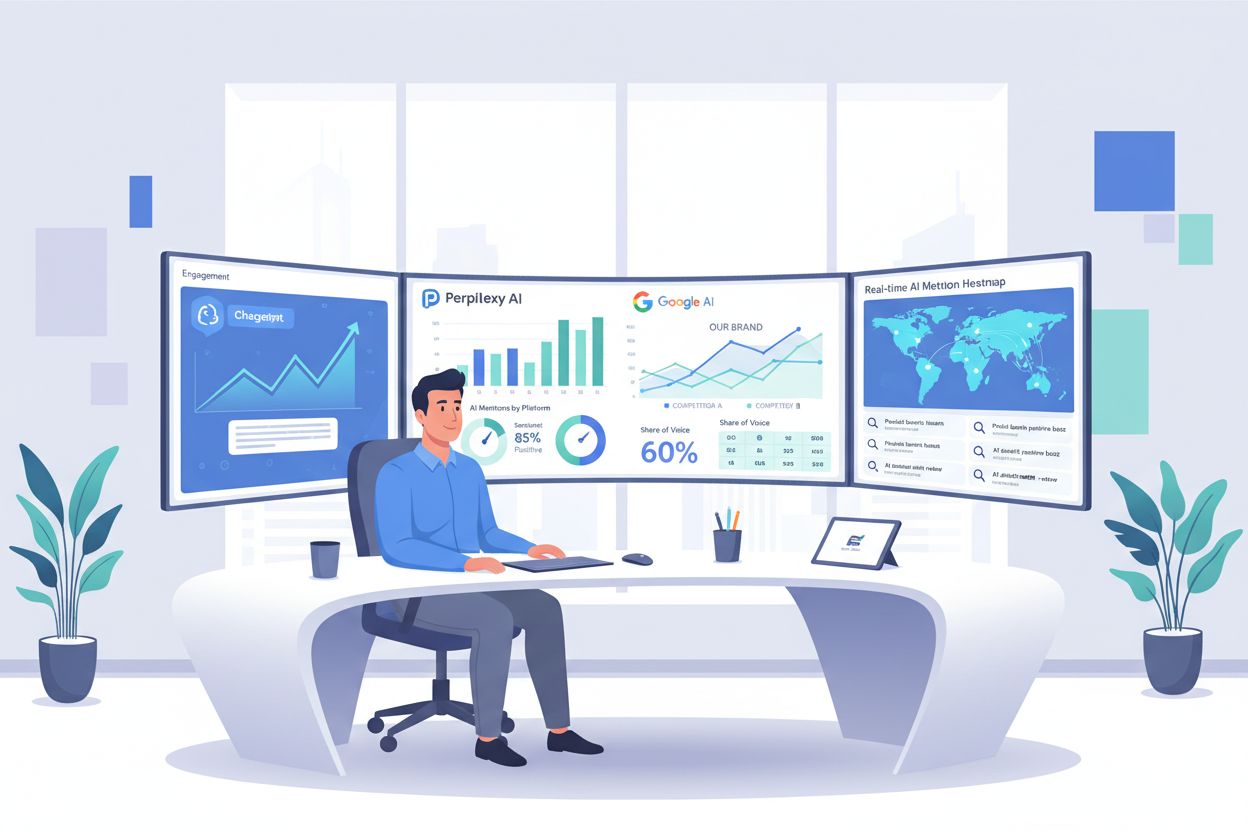
Share of voice represents your competitive positioning within your category. This metric calculates your brand mentions divided by the total mentions of your brand plus all competitor mentions, multiplied by 100. If your brand appears in 15 answers and competitors appear in 35 combined answers, your share of voice would be approximately 30 percent. This competitive benchmark reveals whether you’re gaining or losing ground in the AI-driven conversation about your industry. Tracking share of voice over time shows whether your content strategy is working relative to competitor efforts.
Sentiment analysis adds crucial context to your visibility metrics. Not all mentions are created equal—a mention that says “Company X is a leading solution” carries different weight than “Company X is one option, though users report issues with…” Monitoring the sentiment of your AI mentions reveals whether your brand is being positioned as a preferred solution, a neutral alternative, or a problematic choice. This qualitative dimension transforms raw mention counts into meaningful business intelligence about brand perception.
Implementing a Systematic Tracking Approach
Successful measurement of brand lift from AI mentions requires establishing a consistent operating rhythm that your team can execute without excessive overhead. The most effective approach combines manual auditing with automated tools, starting with a foundation of structured prompts that represent your actual customer journey.
Step 1: Define Your AI Visibility Prompt Set
Begin by identifying 10 to 20 high-intent prompts that mirror how your best customers think and search. These should span different stages of the buying journey—awareness, consideration, and decision. For a B2B SaaS company, examples might include “best project management tools for remote teams,” “how to evaluate project management software,” “top-rated project management platforms,” and “project management tools comparison.” For a healthcare provider, prompts might be “best clinics for aesthetic dermatology in [location]” or “top-rated dermatology services near me.”
Run each prompt consistently across ChatGPT, Gemini, and Perplexity on a fixed schedule—weekly for highly competitive categories, monthly for less competitive spaces. Document four critical data points for each query: brand presence status (absent, mentioned, recommended, or cited with link), which competitor domains appear in the answer, the specific language used to describe your category, and any sentiment indicators. Store this data in a shared spreadsheet or dashboard that your team can access and update regularly.
Step 2: Instrument Your Analytics for AI Attribution
Configure your analytics platform—Google Analytics 4 or equivalent—to segment traffic from known AI referrers and browsers. Many AI tools pass identifiable referrers or query parameters that allow you to track traffic sources. Create an “AI Assistants” segment that captures all traffic from ChatGPT, Perplexity, Google AI Overviews, and other AI platforms. Then track critical conversion metrics for this cohort: visit-to-signup conversion rate, visit-to-demo-request rate, and visit-to-opportunity conversion rate.
This step is crucial because it connects visibility metrics to actual business outcomes. You might discover that AI-attributed traffic converts at significantly higher rates than traditional organic traffic—research shows AI traffic often converts six times better than non-branded Google traffic. This data becomes powerful ammunition for securing budget and executive support for AI visibility initiatives.
Step 3: Build Your Content Optimization Backlog
Using your prompt audit results, identify the top gaps where your brand should appear but doesn’t. Prioritize pages that address high-intent queries where competitors are mentioned but you’re absent. For these priority pages, introduce structured FAQ sections, clearer H2 and H3 heading patterns, and consistent schema markup that makes your content easier for AI systems to parse and reuse.
Research shows that pages updated within the past 12 months are twice as likely to retain citations, and 60 percent of commercial queries cite content refreshed within the last six months. Additionally, structured pages amplified this effect—URLs cited in ChatGPT averaged 17 times more list sections than uncited ones, and schema markup boosts citation odds by 13 percent. This means your optimization efforts should focus on freshness, structure, and machine readability.
Stay Updated on AI Visibility Trends
Get the latest insights on AI mentions, brand monitoring, and optimization strategies.
Connecting Visibility to Business Impact
The ultimate measure of brand lift from AI mentions is its impact on your business metrics. Visibility without conversion is merely vanity, so establishing clear connections between AI mention tracking and revenue outcomes is essential for demonstrating ROI and securing ongoing investment.
Track these business impact metrics:
- Sourced pipeline: Opportunities that explicitly mention discovering your company through AI search or AI-generated recommendations
- Influenced deals: Deals where AI mentions played a role in the evaluation process, even if not the initial discovery
- Customer acquisition cost: Compare CAC for customers acquired through AI channels versus traditional channels
- Deal velocity: Measure whether AI-sourced opportunities move through your sales cycle faster than other sources
- Win rates: Track whether prospects who discovered you through AI mentions have higher close rates
When you can demonstrate that “ChatGPT referrals closed three mid-market deals this quarter” or “Perplexity mentions contributed to $500K in pipeline,” you transform AI visibility from an abstract marketing concern into a strategic business lever. This narrative shift moves your organization from anxious observation to confident strategic action.
While manual tracking provides valuable insights and helps your team understand the fundamentals, automation becomes essential as you scale your monitoring efforts across multiple platforms, competitors, and queries. Several categories of tools support different aspects of AI visibility measurement.
Specialized AI visibility platforms like GrowByData, Semrush’s AI SEO Toolkit, and Keyword.com’s AI Visibility Tracker automate brand mention and citation tracking across ChatGPT, Perplexity, Google AI Overviews, and other platforms. These tools maintain large prompt databases, run queries on fixed schedules, and track changes over time. They provide historical trend analysis, competitive benchmarking, and sentiment tracking—capabilities that would be prohibitively time-consuming to manage manually.
Content optimization platforms like AirOps take automation further by not just identifying visibility gaps but automating content refresh campaigns, new content creation, and outreach initiatives. These platforms help you move from insight to action at scale, ensuring that your content strategy continuously evolves to maintain and improve AI visibility.
Analytics platforms like Google Analytics 4 and Mixpanel allow you to segment and analyze traffic from AI sources, track conversion metrics specific to AI-attributed visitors, and build custom dashboards that connect visibility metrics to business outcomes. The key is configuring these platforms correctly to capture AI referrer data and create meaningful segments.
Establishing Your Measurement Cadence
Consistency in measurement is more important than frequency. For most growth-stage organizations, a quarterly deep dive into AI visibility trends is sufficient, supplemented by lighter monthly checks on a small set of strategic prompts. This cadence keeps AI visibility aligned with product launches, marketing campaigns, and go-to-market changes without creating another daily dashboard that teams feel guilty about ignoring.
Your quarterly review should include: analysis of brand visibility score trends across all tracked prompts, competitive share of voice changes, sentiment shifts in how your brand is described, content performance analysis (which pages gained or lost citations), and business impact assessment (pipeline sourced from AI channels, influenced deals, customer feedback about AI discovery). Use these insights to inform your content roadmap for the next quarter, prioritizing pages and topics that will have the greatest impact on visibility and business outcomes.
Monthly check-ins should focus on a smaller set of 5-10 strategic prompts that represent your highest-priority market segments or product categories. This lightweight approach keeps your team connected to AI visibility trends without requiring excessive time investment, while the quarterly deep dive ensures you’re not missing important shifts in how AI systems perceive and promote your brand.