
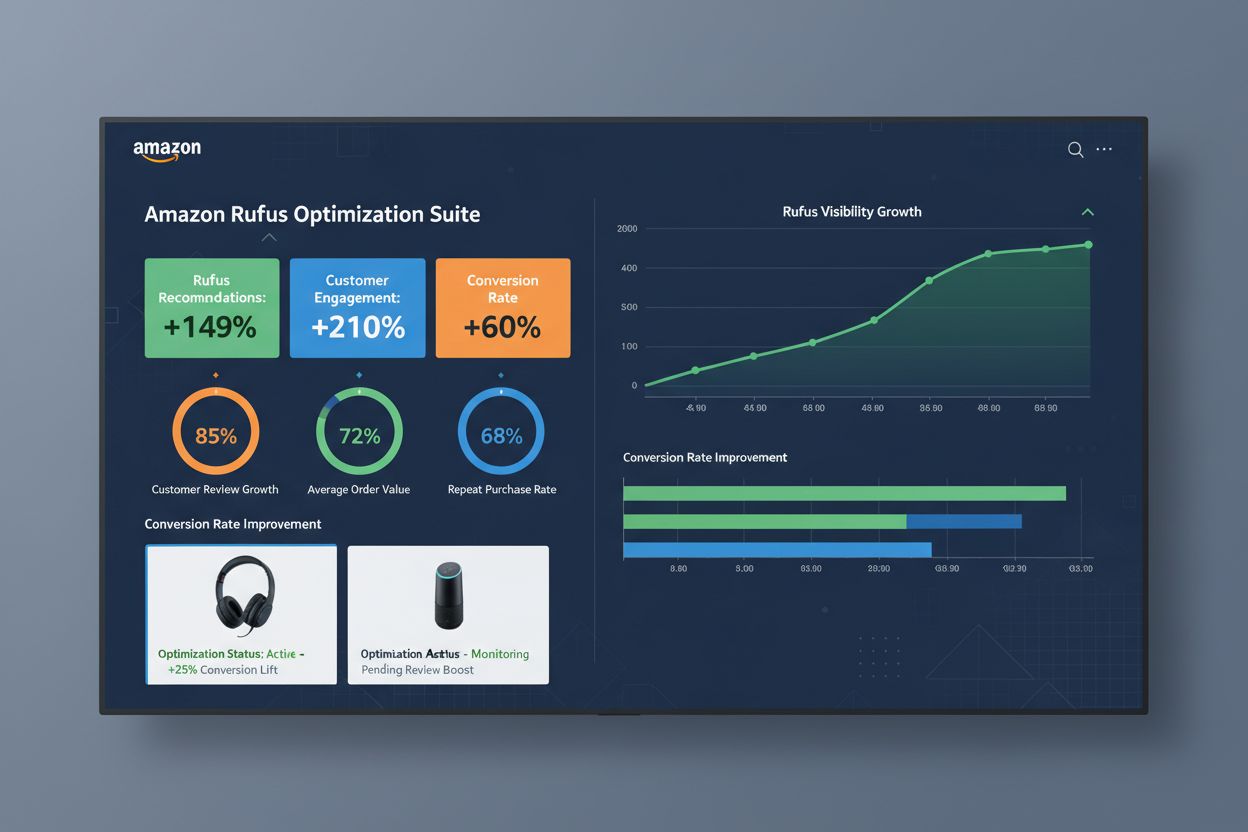
Amazon Rufus Optimization: The Complete Guide for Sellers
Master Amazon Rufus optimization with our complete guide. Learn 5 proven strategies to improve product visibility, increase conversions, and stay ahead in AI-dr...
11 min read

Learn how to optimize your e-commerce store for AI shopping assistants like ChatGPT, Google AI Mode, and Perplexity. Discover strategies for product visibility, metadata optimization, and conversational content.
Optimize for AI shopping assistants by auditing your structured product metadata, creating detailed product descriptions with conversational language, implementing schema markup, joining merchant programs like ChatGPT's, and building high-quality reviews and brand mentions across the web.
AI shopping assistants are transforming how consumers discover and purchase products online. Platforms like ChatGPT, Google AI Mode, Perplexity, and Amazon’s Rufus now enable customers to have conversational interactions where they describe what they need, and the AI system delivers personalized product recommendations. Unlike traditional search engines that return a list of links, AI shopping assistants synthesize information from multiple sources into a single conversational response, compressing what used to be hours of research across review sites, forums, and YouTube into one interaction. This shift from search-based ecommerce to conversational ecommerce represents a fundamental change in how brands need to present their products online. According to recent data, 81% of consumers have used AI tools while shopping, and 60% of consumers who used AI shopping assistants have switched where they shop because another website had better AI integration.
The foundation of AI shopping visibility begins with structured product metadata. AI platforms index your product information similarly to traditional search engines, using various bots like ChatGPT’s GPTBot to crawl and index the raw HTML response of your structured data. By default, GPTBot adheres to your site’s robots.txt file, so you must ensure LLMs can access your product information. Your product information pages should be clear and scannable, load fast, and have mentions on high-authority websites. Most AI shopping assistants pull product data from first-party content owners and third-party sources to gather information on prices, descriptions, and reviews. However, OpenAI has opened applications for merchants to submit their product feeds directly to ChatGPT, which gives brands more control over the accuracy and depth of their product information.
Start by sharing as much of your product data as possible so that shopping platforms can crawl your site and provide accurate recommendations. This data typically includes product names, descriptions, prices, images, and availability. Additionally, focus on data depth by including unique product identifiers like Global Trade Item Numbers (GTINs) and Stock Keeping Units (SKUs) to confirm that your products exist and have accurate representation in LLMs. If these identifiers are incorrect or not included, your products may not show up in search results and recommendations.
| Metadata Element | Importance | Example |
|---|---|---|
| Product Title | Critical | “High-Waisted Black Yoga Leggings with 4-Way Stretch” |
| Description | Critical | Detailed, conversational explanation of features and benefits |
| Price | Critical | Current pricing with currency information |
| GTIN/SKU | High | Unique product identifiers for verification |
| Images | High | Multiple angles, use cases, and high resolution |
| Availability | High | In stock, out of stock, or pre-order status |
| Size/Dimensions | Medium | Specific measurements and fit information |
| Color Options | Medium | All available color variants |
| Return Policy | Medium | Clear return and exchange information |
Traditional product descriptions optimized for keyword-based SEO are no longer sufficient for AI shopping assistants. AI shopping has changed how people search for product information, requiring longer, more conversational queries that resemble actual questions. Instead of searching for “leggings for tall people,” shoppers may ask an AI interface, “Are there leggings that won’t become see-through during hot yoga for someone who’s 5'8”?" These extended queries need detailed information that LLMs can scan and serve up during a product discovery conversation.
When writing AI-ready product descriptions, answer cross-platform questions by addressing what customers would normally ask across multiple sources. Don’t just say “moisture-wicking fabric”—rather, explain how a product “stays dry during hot yoga sessions, based on customer feedback.” Provide comparative context to help AI understand where your product fits among competitors. Instead of saying you use “high-quality materials,” say your product is “lighter than cotton but more breathable than synthetic blends.” Include specific use cases and benefits, as people interacting with AI shopping assistants are often implicitly searching for these. Make sure your product description pages spell out use cases with copy like “Works well for yoga, running, or everyday wear, but our customers report the compression isn’t supportive enough for high-impact activities like CrossFit.”
Structure product details for excerpting, as AI often pulls specific sentences or paragraphs to serve them up alongside pieces of text from other sources. Each product attribute should have enough context to be understandable when quoted on its own. Use consistent naming conventions across all platforms—pick one product name and use it everywhere on your site, in emails, on social media, and in your product feeds. Answer engine optimization experts recommend avoiding name variations to reinforce entity relationships, as AI models struggle to recognize they’re the same product when names vary, splitting your brand presence across AI responses.
Schema markup is essential for helping AI systems understand exactly what you sell, at what price, with what specifications, and how customers rate it. Implement these key schema types on your product pages: Product schema to describe your items, Offer schema for pricing and availability, AggregateRating schema to display overall ratings, Review schema for individual customer reviews, MerchantReturnPolicy schema for return information, and shippingDetails schema for shipping options. Adding schema to WordPress is straightforward if you’re using WooCommerce with SEO plugins like Yoast or Rank Math. For ecommerce platforms like Shopify, you’ll need to edit your theme code to create additional schema properties beyond the basic defaults.
Once implemented, use the Google Rich Results Test tool to check your schema implementation and identify any issues. Google Search Console also reports schema errors, so monitor it regularly. Proper schema implementation makes your product listing more machine-readable and helps AI platforms extract the information they need to recommend your products accurately. This structured data becomes the foundation that AI systems rely on when deciding whether to include your products in their recommendations.
Different AI platforms have established their own merchant programs and product feed systems. ChatGPT’s merchant program allows you to create a product feed and submit it directly, giving you more control over how your products appear. Etsy and Shopify stores are already included in ChatGPT’s merchant programs, so you don’t have to set up feeds separately. For other platforms, you’ll need to prepare your product feed in JSON, CSV, XML, or TSV formats. ChatGPT supports 14 distinct categories of product specifications that you can include to help the LLM match your product with user queries. Many of these product feed fields are required, but certain optional fields like popularity scores and order return rates can give you a ranking edge.
Perplexity also has a merchant program that’s live for sellers in the US, and you can sign up to create product feeds that Perplexity can use to serve products from your store directly. Since Perplexity offers tangible perks like free shipping to Pro customers, it’s a valuable platform that can put your products in front of high-intent shoppers. Google AI Mode likely selects products based on your product feed in Google Merchant Center as well as your general schema properties and on-page content. The takeaway is that you need both strong traditional SEO and LLM-ready content and product optimization for the best chance to maximize your store’s discovery in AI channels.
To see how your brand shows up in AI search results, pretend you’re a shopper and test by asking specific product questions or making general requests. Open ChatGPT, Claude, Perplexity, or Gemini and search for your products using natural, conversational questions. Perform searches in two ways: as someone who’s heard of your brand (mid- to bottom-funnel searches), and someone who hasn’t but is looking for products in your category (top-of-funnel search). Example test queries might include “What are the best waterproof hiking boots for wide feet under $200?” or “I need a moisturizer for sensitive skin that won’t clog pores.”
When analyzing responses, take note of your visibility (do you appear in results at all?), appearance rate (when you do appear, are you in the top 3–5 recommendations?), context (what types of queries surface your products?), accuracy (is the AI providing correct information?), and gaps (what categories or customer needs are you not appearing for?). Review this type of analysis monthly, as AI models evolve and your optimization efforts may compound over time.
Your content strategy needs to be revamped to support AI shopping visibility. Beyond product page optimization, create content that answers frequently asked questions—not the ones you think customers should be asking, but the real ones they’re actually asking AI assistants. Exhaustive and detailed FAQ sections on every product page should address real customer questions. If you sell skincare products, your customers probably aren’t just asking “How will retinol improve my skin?” They’re likely also wondering if using retinol while pregnant is safe, or if it will irritate their skin type. These detailed FAQs are information goldmines for LLMs.
Create comparison guides to help AI tools understand where your product fits in the market. Think “Retinol vs. Vitamin C: Which Should You Use First?” or guides that illustrate how people can use your product step-by-step. These guides provide the context LLMs need to accurately promote your products for the right situations. Develop long-form articles with question-based headers that LLMs can reference in snippets. Structure articles with headers that mirror real customer questions and provide clear, concise answers in the opening sentences. Each section should be structured as its own mini-article that can act as input for an LLM, making it easier for AI systems to extract and cite your content.
Reviews are one of the top use cases for AI shopping, as ChatGPT analyzes reviews and condenses customer opinions into summaries that highlight common likes and dislikes. Traditional reviews focus on star ratings and simple comments, but AI shopping assistants need detailed, specific information. When a customer asks “Will these leggings become see-through during squats?”, the AI searches through reviews for that exact concern. A generic review like “Great quality, 5 stars” provides little value, while an AI-optimized review like “I’m 5'8” and ordered a medium. The high waistband stays put during yoga without rolling down, and the fabric doesn’t go sheer during deep squats like my previous leggings did" gives AI the specific details it needs.
To get high-quality reviews, set up an automated review request flow timed to product usage so people have had time to use and enjoy your product before they leave a review. Instead of asking for general feedback, prompt customers with specific questions like “How does the [size/fit/performance] compare to similar products you’ve used?” or “What specific problem did this solve for you?” Consider offering incentives for customers who provide detailed feedback with photos or videos. Visual user-generated content that shows off the product in the real world gives AI additional context for recommendations. Once you’re collecting reviews, use AI tools to respond to reviews meaningfully and analyze review sentiment to spot patterns in what customers love or complain about.
Brand mentions across the web increase your AI visibility significantly. What you say about your brand matters, but what third-party sources say about you matters even more. AI tools take articles, user reviews, and other content referencing you as a strong signal of your popularity. Boost your mentions through partnerships and PR with other publishers. Focus on getting your products covered in reputable publications in your industry—the more high-quality mentions your brand gets online, the better. Examples of content that can contribute to your AI discoverability include guest posts, product reviews, expert round-ups, and how-to articles that feature your brand.
Unlike traditional SEO’s focus on backlinks, AI tools can extract meaning even from unlinked content. So even unlinked brand mentions will work in your favor if there are enough sources discussing you on the web. Additionally, work on positive sentiment surrounding your brand. If AI platforms see enough positive sentiment around your brand, they’re more likely to recommend you strongly in relevant e-commerce queries. Participate in social media communities like Reddit and Quora where AI tools actively visit for user-generated content. Take care to follow each community’s rules and avoid spam, but genuine participation can spark discussions that naturally lead to more mentions and positive sentiment about your brand.
Nothing hurts your AI shopping visibility faster than outdated inventory data. Use your ecommerce platform’s built-in tools or apps to automatically sync changes when they happen. Connect to feed management services like GoDataFeed that can push product feed updates to multiple channels, including AI platforms. The tools you’re already using for Google Shopping and social commerce will form the foundation of your AI shopping strategy. The key is making sure your feeds are comprehensive, accurate, and up to date. Set up automated syncs to keep product information current across all platforms where your products appear.
Ensure your product feed includes all necessary fields and attributes to improve your chances of showing up in relevant AI queries. For example, ChatGPT supports 14 distinct categories of product specifications that you can include. Many of these product feed fields are required, but certain optional fields can give you a ranking edge. Performance signals like popularity scores and order return rates help OpenAI recommend your popular products more prominently. When you’re ready to integrate your product feed with ChatGPT, fill out the merchant application form. If approved, ChatGPT will index your product feed and enable Instant Checkout, allowing customers to purchase directly from ChatGPT conversations.
Track how your products appear in AI-generated shopping recommendations and ensure your brand gets discovered by AI shopping assistants. Get real-time insights into your AI visibility.
Master Amazon Rufus optimization with our complete guide. Learn 5 proven strategies to improve product visibility, increase conversions, and stay ahead in AI-dr...

Learn how AI is transforming product discovery. Discover strategies for optimizing your brand's visibility in ChatGPT, Perplexity, and Google AI Overviews with ...

Learn how to optimize products for AI shopping platforms. Discover strategies for improving visibility in ChatGPT Shopping, Google AI Overviews, Rufus, and Perp...