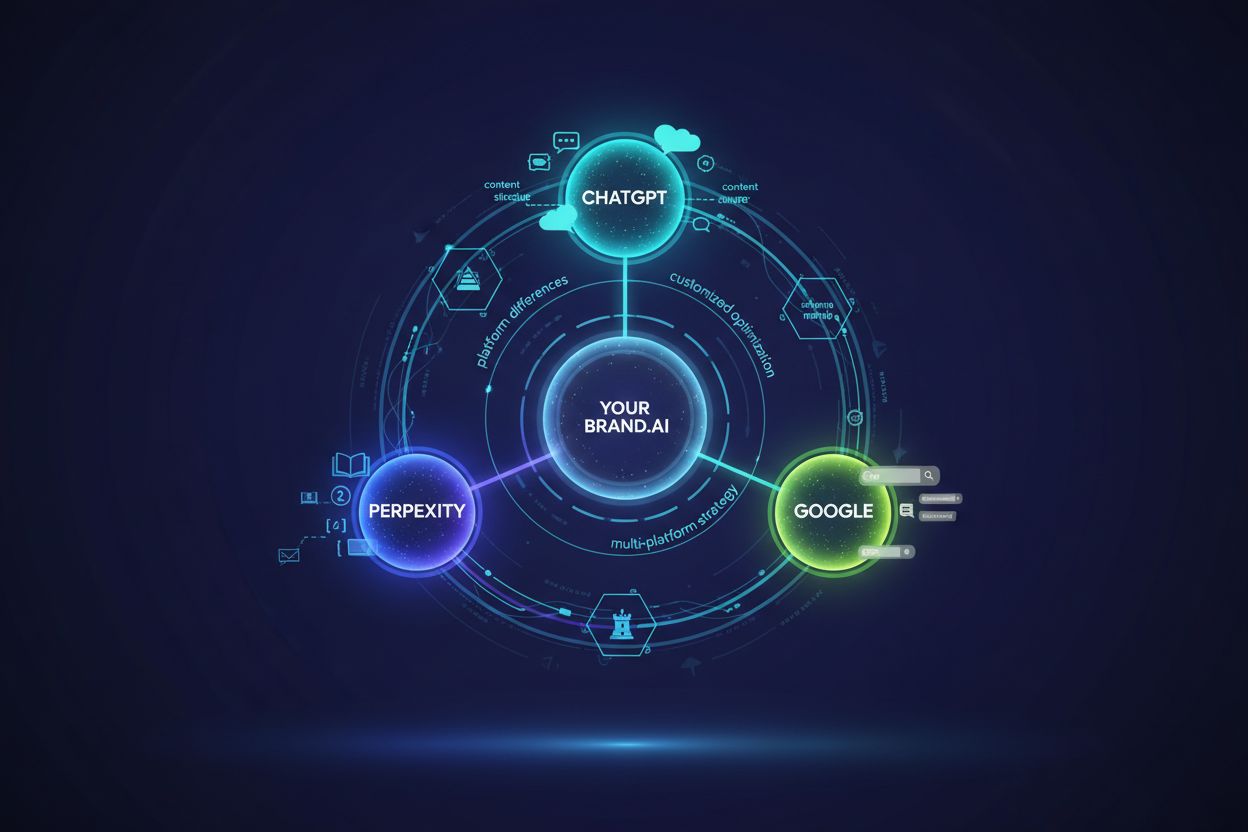
Multi-platform AI optimization refers to the strategic practice of creating and distributing content that appears in AI-generated answers across multiple platforms including ChatGPT, Perplexity, Claude, Google AI Overviews, and emerging AI search engines. Unlike traditional SEO which focuses on a single search engine, multi-platform optimization recognizes that different AI systems use distinct retrieval mechanisms, citation preferences, and ranking algorithms. This approach matters because 400 million people use ChatGPT weekly, Perplexity processes billions of queries monthly, and Google AI Overviews now appear on over 50% of search results. Brands optimizing for only one platform leave massive audience segments invisible while competitors capture visibility across the entire AI search landscape.
The fundamental challenge is that each AI platform operates differently. ChatGPT uses Bing-powered web search, Perplexity uses its own search infrastructure, and Claude uses multiple search providers. These different retrieval systems rank and select sources differently, meaning content optimized for one platform may perform poorly on another. Research analyzing over 129,000 AI citations reveals that only 12% of sources cited match across ChatGPT, Perplexity, and Google AI features. This fragmentation creates both complexity and opportunity—brands can dominate specific platforms while competitors lead on others, revealing strategic gaps worth exploiting.
| Platform | Primary Architecture | Citation Style | Recency Bias | Preferred Sources | Key Ranking Factor |
|---|
| ChatGPT | Model-native + Bing search | Inline citations (when enabled) | Moderate (76.4% updated in 30 days) | Wikipedia (16.3%), News outlets, Authoritative domains | Domain authority & backlinks |
| Perplexity | Retrieval-augmented generation | Explicit source links | Extreme (2-3 day decay) | YouTube (16.1%), Wikipedia (12.5%), Forums | Content freshness & updates |
| Google AI Overviews | Integrated with search index | Source links in UI | Moderate-High | Reddit (3.4% boost), Quora, YouTube (9.5%) | Traditional SEO + E-E-A-T |
| Claude | Model-native + selective search | Minimal citations | Low (relies on training data) | Academic sources, Research papers | Safety & accuracy signals |
Why Traditional SEO Remains the Foundation
Traditional SEO fundamentals haven’t changed—they’ve become more critical. Research from Google’s own statements confirms that to appear in AI Overviews, you need to do the same work that gets you visible in traditional SERPs. Pages ranking in positions 1-10 for relevant keywords have dramatically higher probability of AI citation. Specifically, pages ranking #1 see a 33.07% citation rate, dropping to 13.04% at position #10—a 60% decline from losing just a few spots on page one.
This relationship exists because AI platforms pull from pre-filtered source sets built from search indexes. If Google’s ranking systems haven’t identified your page as authoritative and relevant, AI models working from those indexes won’t find it either. The overlap is substantial: approximately 40.58% of AI Overview citations come directly from Google’s top 10 organic results. However, this creates opportunity—AI platforms also cite pages outside the top 10 when they provide exceptional answers, meaning strong content can achieve AI visibility even without top rankings.
Technical excellence remains non-negotiable. Page speed, mobile optimization, Core Web Vitals, and HTTPS security all influence both traditional and AI rankings. Sites loading in under 2.5 seconds receive significantly more AI citations than slower alternatives. Server-side rendering ensures AI crawlers can access content immediately rather than waiting for JavaScript to execute. Proper robots.txt configuration allowing AI crawlers (GPTBot, PerplexityBot, ClaudeBot, Google-Extended) is essential—blocking these crawlers eliminates citation opportunities entirely.
ChatGPT Optimization: Authority and Depth
ChatGPT dominates with over 400 million weekly active users, making it the largest AI search opportunity. The platform favors authoritative domains with strong backlink profiles, with research showing that traffic volume correlates directly with ChatGPT citations. High-traffic sites receive disproportionate citation share, but this creates opportunity: building content that ranks well traditionally also improves ChatGPT visibility.
Content depth matters significantly—articles exceeding 2,900 words earn an average of 5.1 citations compared to just 3.2 for shorter content. However, length alone doesn’t guarantee success. Structure matters enormously. Pages with clear section headings of 120-180 words consistently outperform both shorter and longer sections. This “Goldilocks zone” provides enough depth to establish expertise while remaining digestible for AI systems to parse and extract.
Citation freshness shows moderate importance for ChatGPT. While 76.4% of most-cited pages were updated in the last 30 days, ChatGPT relies more on training data than live web searches compared to competitors. Implement strategic refresh schedules updating priority content every 2-3 weeks rather than daily. Focus on adding new sections, updating statistics, incorporating recent examples, and expanding based on user questions.
Perplexity Optimization: Aggressive Freshness and Recency
Perplexity represents the most demanding platform for content freshness. Research shows visibility begins dropping just 2-3 days after publication without strategic refreshes. This creates both challenge and opportunity—consistent content updates become a competitive advantage that compounds over time. The platform’s citation behavior differs notably from competitors, with heavy emphasis on domain authority and topic-multiplier subjects (AI, science, marketing receive 3x visibility).
Perplexity optimization requires updating priority content every 2-3 days for top rankings. This aggressive cadence demands dedicated resources but yields measurable results. The platform heavily favors YouTube content (16.1% of citations), making video optimization critical. Create detailed video descriptions with timestamps linking to key sections, include comprehensive transcripts, use descriptive titles matching natural question patterns, and cover topics in depth (15-30 minute videos outperform short clips).
Quality score benchmarks for Perplexity success include: minimum quality score of 0.75 (on 0-1 scale), update frequency every 2-3 days for top rankings, initial impression target of 1,000+ views in first 30 minutes, and click-through rate threshold of 4.2%+ for sustained visibility. These metrics reveal that Perplexity rewards consistent, high-quality content updates more than any other platform.
Google AI Overviews: Blending Search and AI
Google AI Overviews integrate directly with traditional search results, creating hybrid experiences requiring distinct optimization approaches. The platform blends multiple signals: traditional SEO fundamentals, E-E-A-T signals, schema markup, featured snippet optimization, mobile performance, and content freshness. Google’s AI features particularly favor government and educational domains for factual information, medical and academic journals for health topics, recent news articles for current events, YouTube videos for how-to queries, and forum discussions (especially Reddit) for product recommendations.
Since Google AI Overviews draw heavily from traditional search results, prioritizing conventional SEO remains critical. Pages ranking in positions 1-10 have the highest probability of AI Overview citations. Optimize existing high-ranking pages with answer capsule formats—placing comprehensive, standalone answers immediately after primary headings before any introductory context. This structure satisfies users seeking quick answers while providing AI models with extraction-ready content.
Schema markup implementation significantly improves Google AI visibility. Article schema tells AI systems exactly what they’re looking at. FAQ schema makes question-answer pairs explicitly extractable. HowTo schema structures step-by-step instructions. Organization and Person schema establish entity recognition. Review and Rating schema amplifies social proof signals. BreadcrumbList schema clarifies site architecture. Implement using JSON-LD format in the page head section, then validate using Google’s Rich Results Test.
Claude Optimization: Academic Rigor and Safety
Claude attracts B2B decision makers and research-focused audiences, making it valuable for technical and professional content. The platform shows strong preference for academic and research sources, with technical depth valued over surface-level explanations. Claude demonstrates skepticism toward marketing content, preferring neutral, factual presentation. Content that reads like research papers or technical documentation performs better than promotional material.
Claude optimization benefits from academic writing styles—clearly stated claims, supporting evidence, acknowledgment of limitations, and balanced perspectives. Include detailed author bios demonstrating expertise and credentials. Link to academic publications, speaking engagements, or industry contributions. Expert content goes beyond surface-level explanations to provide nuanced insights unavailable in generic articles. Anthropic recently added web search capabilities to Claude, allowing it to access live information when needed, making content freshness increasingly important.
Creating Content That AI Systems Prefer
The Answer Capsule Framework
The answer capsule technique has emerged as one of the most effective AI optimization strategies. This approach places a comprehensive, standalone answer immediately after your primary heading—before any introductory context or background information. Traditional blog structure follows this pattern: introduction establishing context, background explaining the problem, detailed methodology, and finally the actual answer buried 800 words deep. AI-optimized structure flips this model entirely.
For example, if your article addresses “What is Generative Engine Optimization?”, immediately provide a clear definition: “Generative Engine Optimization (GEO) is the practice of creating and optimizing content so that it appears in AI-generated answers on platforms like ChatGPT, Claude, Perplexity, and Google’s AI Overviews. GEO focuses on structured content, authoritative sources, and conversational language that AI models can easily understand, extract, and cite when responding to user queries.” This capsule serves multiple purposes: it satisfies users seeking quick answers, provides AI models with extraction-ready content, and establishes topical relevance immediately.
Analysis from Backlinko’s GEO research shows that pages with answer capsules achieve 40% higher citation rates than those requiring AI to synthesize answers from scattered information. The capsule format works because AI systems can extract precisely what’s needed without parsing unstructured content. This modular approach allows AI to extract different sections for different queries, maximizing citation probability across varied user questions.
Semantic Structure and Entity Optimization
AI models process content by identifying semantic relationships between concepts, entities, and statements. Proper semantic structure amplifies your content’s discoverability and citation potential. Heading hierarchy must follow logical progression: exactly one H1 (primary topic), H2s representing major subtopics, and H3s addressing specific questions within those subtopics. Avoid skipping levels or using multiple H1 tags, as this confuses AI models about content organization.
One concept per section maximizes extraction efficiency. When you combine multiple ideas in a single section, AI models struggle to determine which information answers which query. Break complex topics into discrete sections, each addressing a specific question or aspect. This modular approach allows AI to extract precisely what’s needed for each unique user query. Topic clusters establish topical authority by creating interconnected content around central themes. If you’re optimizing for “email marketing,” create comprehensive resources covering email marketing strategy, email list building techniques, email automation workflows, email deliverability best practices, and email marketing metrics and analytics. Link these resources together with descriptive anchor text.
Entity optimization goes beyond traditional keyword targeting to focus on specific people, places, brands, products, and concepts. Instead of optimizing for “best smartphones 2025,” optimize for specific entities like “Samsung Galaxy S25 Ultra,” “iPhone 17 Pro Max,” and “Google Pixel 10.” AI models use entity recognition to understand context—mentioning recognized entities signals topical relevance and expertise.
Structured Data Implementation
Structured data provides AI models with explicit, machine-readable information about your content’s structure, meaning, and purpose. While AI systems can interpret unstructured content, schema dramatically simplifies this process, contributing approximately 10% to ranking factors on platforms like Perplexity. Implement using JSON-LD format placed in the page head section.
FAQ Schema makes question-answer pairs explicitly extractable. When you implement FAQ schema correctly, AI models can pull your exact answers for relevant queries without needing to parse unstructured content. This dramatically increases citation probability for question-based searches. Article Schema tells AI systems exactly what they’re looking at—article type, headline, author, publication date, and modification date. This foundational schema should appear on every blog post, guide, and resource page. HowTo Schema structures step-by-step instructions for AI extraction, particularly effective for tutorial content. Organization & Person Schema establishes entity recognition for your brand and team members, including founding date, industry, contact details, social profiles, and key team member credentials.
Limiting content to your owned website dramatically reduces AI discovery opportunities. AI platforms pull from diverse sources—YouTube, LinkedIn, Reddit, Medium, industry publications, podcasts, and dozens of other platforms. Every piece of cornerstone content should be adapted for multiple platforms.
- Blog article published on your website with full optimization
- Video version uploaded to YouTube with comprehensive description and transcript
- LinkedIn article covering key insights in professional format
- Reddit discussion initiated on relevant communities
- Twitter/X thread sharing main points
- Podcast episode discussing the topic in depth
- Guest post for industry publication covering unique angle
- Medium article with canonical links to original version
Each distribution channel represents another opportunity for AI discovery while building brand mentions and co-citations that strengthen overall authority. YouTube represents massive opportunity for AI citations—Google’s AI systems heavily favor YouTube content, and videos increasingly appear in ChatGPT and Perplexity responses. Optimize for AI visibility by creating detailed video descriptions with timestamps, including comprehensive transcripts, using descriptive titles matching question patterns, and covering topics in depth.
LinkedIn serves as critical platform for B2B AI visibility. ChatGPT analysis shows that professional content on LinkedIn frequently gets cited for business, marketing, and professional development queries. Reddit has emerged as AI citation goldmine, particularly for product recommendations and user experience questions. AI models value Reddit’s authentic, unfiltered discussions. Podcast appearances generate AI-readable content through transcripts—many podcasts don’t publish transcripts, creating opportunity. When appearing on podcasts, request or create transcripts and share them with the host.
Brand mentions occur whenever other websites, social platforms, forums, or publications reference your company, products, or team members—regardless of whether those mentions include links. When Perplexity encounters your brand name mentioned across dozens of reputable sources, it infers authority even if many mentions lack formal links. Citation frequency accounts for approximately 35% of AI answer inclusions according to GEO research.
Co-citations happen when your brand appears alongside competitors or related concepts on third-party websites. If industry publications consistently mention your project management software in articles also discussing Asana, Monday.com, and ClickUp, AI models infer you’re a comparable solution in that category. Pursue inclusion in industry roundup articles, comparison reviews, expert round-ups, research reports, and conference speaker lists.
Digital PR campaigns earn brand mentions across authoritative publications. Create newsworthy research, controversial opinions, or proprietary data that journalists want to reference. Original research studies generate particularly strong citation potential—both from news articles covering your findings and from AI models citing your original data. Expert contributions position team members as thought leaders through guest posts, expert quotes to journalists, conference speaking, and podcast interviews. Community engagement generates organic brand mentions in forums, social platforms, and user-generated content sites. AI platforms—especially Perplexity and Google’s AI Mode—frequently cite Reddit, Quora, and industry-specific forums where authentic discussions happen.
Traditional SEO metrics tell an incomplete story. Traffic, rankings, and impressions matter, but new KPIs emerge for AI visibility. AI Citation Frequency measures how often your brand gets mentioned in AI responses. Share of AI Voice shows what percentage of AI citations in your category reference your brand versus competitors. AI-Driven Conversion Rate reveals what conversion rate comes from visitors arriving via AI search platforms. Brand Authority Signals including web mentions, branded anchors, and branded search volume show strong correlation with AI visibility.
Currently, only 16% of brands systematically track AI search performance. That measurement gap means most companies can’t identify what’s working or how to allocate resources between traditional and AI search optimization. Establish baseline metrics for AI visibility across platforms using tools like Semrush AI SEO Toolkit (tracks visibility across ChatGPT, Claude, Perplexity, and Google AI Mode), Profound (enterprise-grade AI visibility analytics with real-user data), or Ziptie.dev (focuses on unlinked mentions across AI platforms).
Google Search Console provides limited AI visibility data for Google’s platforms, showing AI Overview appearance rates for your keywords and which pages appear in AI Overviews. Monitor referral traffic from ai.com
, perplexity.ai
, and claude.ai
in Google Analytics or your preferred analytics platform. Segment this traffic to understand which pages receive AI referrals, user behavior from AI sources versus traditional search, and conversion rates from AI traffic.
Multimodal AI capabilities are expanding rapidly. Current AI platforms primarily process text, but multimodal capabilities are advancing quickly. Google’s Gemini, ChatGPT with vision capabilities, and emerging platforms process images, diagrams, charts, and infographics alongside text. Visual optimization becomes increasingly important—high-quality, informative images become ranking factors, alt text and image descriptions gain importance, infographics and data visualizations drive citations, and video content with proper transcripts becomes increasingly valuable.
Personalized AI responses will intensify as platforms increasingly personalize based on user history, preferences, and context. This means citation opportunities become more dynamic—your content might be cited for some users but not others based on individual factors. Create content serving diverse user segments, address multiple experience levels from beginner to advanced, cover various use cases and industries, and develop content for different buyer journey stages.
Real-time information integration creates opportunities for dynamic content to achieve AI visibility that static content cannot. AI platforms increasingly integrate real-time data sources—breaking news, current pricing, live inventory, recent reviews. Implement structured data marking content as time-sensitive, create content addressing current events in your industry, update content immediately when relevant news breaks, and use timestamp schema to indicate freshness.
Practical Implementation Roadmap
Week 1: Audit and Baseline
- Test current AI visibility across ChatGPT, Perplexity, Google AI Mode, and Claude
- Document which queries return your content and where competitors appear instead
- Analyze your top 20 pages using AI-optimization checklists
- Install analytics tracking for AI referral traffic
- Verify AI crawlers can access your site
Week 2-3: Technical Implementation
- Implement priority schema markup (Article, FAQ, HowTo, Organization)
- Validate all schema using Google’s Rich Results Test
- Audit page speed and Core Web Vitals, addressing critical issues
- Ensure server-side rendering for content pages
- Optimize URL structure for semantic clarity
Week 4-6: Content Optimization
- Add answer capsules to your top 10 most important pages
- Restructure headings following proper H1→H2→H3 hierarchy
- Break long paragraphs into scannable sections (120-180 words)
- Implement FAQ sections on relevant pages with proper schema
- Expand top 5 pages to 2,900+ words with comprehensive coverage
Week 7-12: Distribution and Authority Building
- Publish best content on Medium with canonical links
- Create LinkedIn articles covering key topics
- Produce YouTube videos covering priority subjects with full transcripts
- Identify and contribute to relevant industry forums and communities
- Launch outreach campaign to secure guest posting opportunities
- Develop original research or data study to earn citations
- Establish baseline metrics for AI visibility across platforms
Frequently Asked Questions
Why do different AI platforms cite different sources?
Only 12% of sources cited match across ChatGPT, Perplexity, and Google AI features. ChatGPT favors Wikipedia (16.3%) and news outlets, Perplexity prefers YouTube (16.1%), and Google AI Overviews lean toward user-generated content like Reddit and Quora. Each platform has distinct algorithms, training data, and selection criteria. This fragmentation means success requires platform-specific optimization rather than one-size-fits-all approaches.
How important is domain authority for AI citations?
Domain authority significantly influences AI citation decisions, accounting for approximately 15% of ranking factors. High-authority domains receive preferential treatment—AI systems trust established sources more readily than newer websites. However, AI platforms also consider page-specific authority and content quality, creating opportunities for newer sites with exceptional content. Building domain authority requires earning high-quality backlinks from diverse sources, maintaining consistent content quality, establishing topical expertise through comprehensive coverage, and building brand recognition through mentions and citations.
Should I block AI crawlers from accessing my website?
Most businesses should allow AI crawlers access while potentially limiting specific directories. Blocking AI crawlers prevents your content from being cited in AI responses, eliminating a major discovery channel. However, some companies have legitimate reasons to restrict access: proprietary research not intended for public AI training, gated content requiring subscriptions, or user-generated content with privacy concerns. If allowing access, use robots.txt to permit major AI crawlers (GPTBot, ClaudeBot, PerplexityBot, Google-Extended) while blocking sensitive areas.
How often should I update content for AI visibility?
Update frequency depends on content type and platform priorities. For maximum Perplexity visibility, update priority content every 2-3 days. ChatGPT and Google AI are less aggressive but still favor fresh content—weekly updates for important pages maintain strong visibility. For practical implementation, establish tiered update schedules: Tier 1 priority pages every 2-3 days, Tier 2 pages weekly, Tier 3 pages bi-weekly, evergreen foundational content monthly.
Can I rank in AI Overviews without ranking on page one of Google?
Technically yes, but practically difficult. While 24% of AI Overview citations come from pages outside the top 10, only 15% of AI Overviews cite pages not visible in top search results. AI doesn’t rewrite authority rules; it reinforces them. Building traditional SEO foundations remains the most reliable path to AI visibility.
What content formats perform best for AI citations?
Long-form comprehensive guides (2,900+ words) earn the highest average citations for complex topics. FAQ-format content structured with question headings followed by concise answers gets cited frequently for direct question queries. How-to guides with numbered steps perform exceptionally for instructional queries. Comparison tables and structured data make differentiation queries easy for AI systems to extract. Statistical lists with specific numbers and research attributions receive high citation rates for data-oriented queries. Original research and proprietary data become authoritative sources for industry trends.
How do I measure ROI from multi-platform AI optimization?
Start with citation frequency—how often your brand appears in AI responses for target queries. Monitor referral traffic from AI platforms and direct traffic spikes correlating with AI visibility increases. Track branded search volume growth indicating users discovering your brand through AI mentions. For revenue attribution, use UTM parameters on all AI-platform citations you control and segment AI referral traffic in analytics to calculate conversion rates. Survey new customers about discovery channels to understand AI’s role in their journey.
Should I create separate content for AI platforms versus traditional search?
Generally, no—creating unified content optimized for both AI and traditional search proves more efficient than maintaining separate versions. The optimization principles largely overlap: quality information architecture, clear writing, comprehensive coverage, structured formatting, and semantic organization benefit both contexts. However, you might create platform-specific variations: reformatting blog content into LinkedIn articles, adapting written guides into YouTube videos, or repurposing research into interactive tools.