
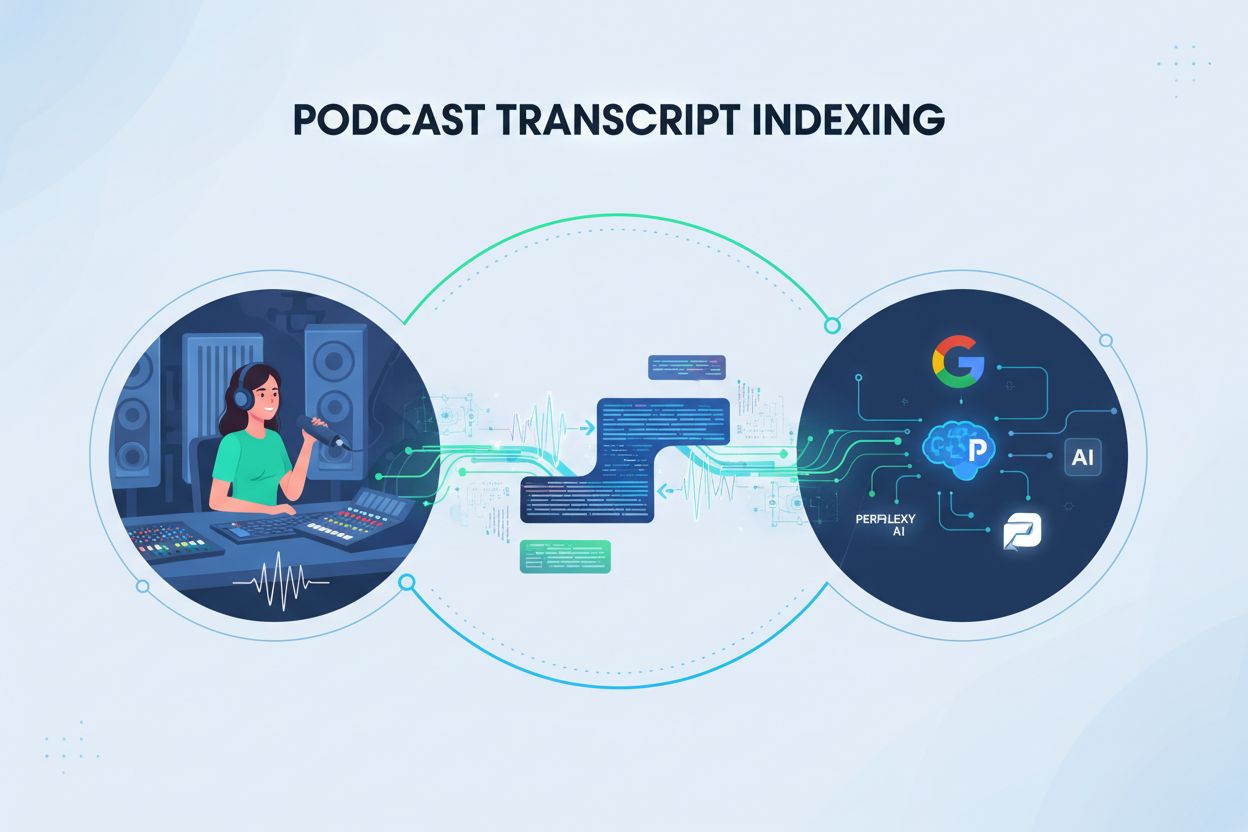
Podcast Transcript Indexing
Learn how podcast transcript indexing enables AI discovery and citation. Understand the process of converting audio to searchable text, its impact on SEO, acces...
11 min read

Learn how to optimize podcast transcripts for AI systems like ChatGPT, Perplexity, and Claude. Master semantic keywords, schema markup, and structured data for better AI visibility.
Optimize podcast transcripts for AI by publishing full, accurate transcripts with clear headers and timestamps, using semantic keywords naturally throughout, implementing schema markup, and ensuring consistency across all platforms. AI systems like ChatGPT and Perplexity read text, not audio, so well-structured transcripts with proper metadata are essential for discoverability in AI-powered search results.
Podcast transcript optimization is the process of structuring and formatting your podcast’s text content to be easily discoverable and cited by artificial intelligence systems like ChatGPT, Perplexity, Claude, and Google AI Overviews. Unlike traditional search engines that primarily index keywords, AI language models (LLMs) read and analyze text to understand context, intent, and semantic meaning. This fundamental difference means that podcasters must rethink how they present their content. When someone asks an AI tool “What’s the best podcast about sustainable business practices?” the system doesn’t listen to audio—it scans transcripts, show notes, website content, and metadata across the web to determine which podcasts are most relevant and authoritative. Without properly optimized transcripts, even exceptional podcast content remains invisible to these increasingly popular AI discovery channels. The stakes are significant: research shows that AI-powered search is growing rapidly, with tools like Google’s AI Overviews now appearing in approximately 13% of searches, and this percentage continues to climb as more users adopt conversational AI for content discovery.
Large Language Models (LLMs) are fundamentally text-based systems that cannot listen to or process audio files. This is a critical distinction that changes everything about podcast optimization strategy. These AI systems are trained on massive amounts of written text data, allowing them to understand language patterns, semantic relationships, and contextual meaning. When an LLM encounters a podcast, it has no ability to hear the host’s voice, understand tone, or process the audio content directly. Instead, the AI relies entirely on text representations of your podcast content—transcripts, episode titles, descriptions, show notes, and any written content mentioning your podcast across the web. This means that a podcast with exceptional storytelling, compelling guests, and valuable insights will be completely invisible to AI discovery systems unless that content is converted to text and properly structured. The implication is profound: your transcript is now as important as your audio. In fact, for AI discoverability purposes, the transcript may be more important than the audio itself, since it’s the only way AI systems can evaluate and recommend your content.
Publishing complete, accurate transcripts for every episode is non-negotiable for AI optimization. Many podcasters still treat transcripts as optional accessibility features, but they are now essential infrastructure for AI visibility. When you publish a full transcript on your episode’s webpage, you’re providing AI systems with the raw material they need to understand your content, extract key information, and determine whether your episode is relevant to user queries. Accuracy matters significantly—AI systems can detect and penalize transcripts with numerous errors, misspellings of names, or incorrect topic references. This is why many podcasters are moving beyond basic automated transcription to include manual review and correction. Tools like Otter.ai, Rev, and Ausha offer AI-powered transcription with accuracy rates of 95% or higher, though human review is still recommended for proper names, technical terms, and specific details that automated systems might misinterpret. The transcript should be published directly on your website, not hidden behind a download link or paywall. Visible, accessible transcripts signal to AI systems that you’re confident in your content and want it to be discoverable. Additionally, transcripts should include speaker labels clearly identifying who is speaking at each point, which helps AI systems understand the structure of conversations and attribute statements to specific individuals.
| Optimization Element | AI Discoverability Impact | Implementation Difficulty | Time Investment |
|---|---|---|---|
| Full, published transcript | Critical—AI cannot evaluate content without text | Low | 30-60 minutes per episode |
| Clear H2/H3 headers | High—helps AI parse content structure | Low | 15-20 minutes per episode |
| Timestamped sections | High—enables AI to point users to specific answers | Medium | 20-30 minutes per episode |
| Semantic keyword integration | High—improves relevance matching for AI queries | Medium | 25-40 minutes per episode |
| Schema markup (JSON-LD) | Very High—provides machine-readable metadata | High | 1-2 hours initial setup |
| FAQ sections | Very High—directly answers AI query patterns | Medium | 20-30 minutes per episode |
| Consistent metadata | High—signals authority across platforms | Low | 15-25 minutes per episode |
| Internal linking strategy | Medium—builds topical authority signals | Medium | 30-45 minutes per episode |
Semantic keyword optimization differs fundamentally from traditional SEO keyword stuffing. Rather than forcing exact-match keywords into your transcript, semantic optimization involves naturally integrating related terms and concepts that help AI systems understand the full context of your content. When someone asks ChatGPT “What podcast teaches remote work productivity for freelancers?”, the AI doesn’t just search for those exact words. Instead, it analyzes the semantic relationships between concepts—understanding that “remote work,” “work from home,” “distributed teams,” “asynchronous communication,” and “freelance productivity” are all semantically related. Your transcript should naturally include these related terms throughout the conversation, not as forced insertions but as genuine parts of the discussion. Long-tail keywords are particularly valuable for AI optimization because they match how people actually phrase questions to AI systems. Instead of just mentioning “productivity,” discuss “how to maintain focus while working from home,” “productivity tools for remote teams,” or “time management strategies for independent contractors.” These longer, more specific phrases are exactly what users ask AI systems, and they’re what AI systems search for when generating recommendations. The key is authenticity—your transcript should sound like a natural conversation, not a keyword-optimized document. AI systems are trained to recognize and penalize content that sounds artificially constructed or overly promotional.
Proper transcript structure is essential for AI systems to extract and understand key information. A transcript dumped as a single block of text, even if accurate, is far less useful to AI systems than one organized with clear hierarchical structure. Start by breaking your transcript into logical sections using H2 and H3 headers that describe the topic being discussed. For example, if your episode covers “Building a Personal Brand on LinkedIn,” your headers might include sections like “Why Personal Branding Matters,” “LinkedIn Profile Optimization Strategies,” “Content Pillars for Consistent Posting,” and “Measuring Your Brand Impact.” These headers serve multiple purposes: they help human readers quickly scan the transcript, they help AI systems understand the content structure, and they create natural breaking points where AI systems can extract relevant information for specific queries. Timestamps are particularly valuable because they allow AI systems to direct users to specific moments in your episode that answer their questions. Rather than recommending an entire 60-minute episode, an AI system can say “Listen to this section from 12:15 to 18:45 where the host discusses LinkedIn algorithm changes.” This dramatically improves user experience and increases the likelihood that people will actually listen to your content. Additionally, use bullet points and numbered lists within your transcript to highlight key takeaways, steps, or important concepts. AI systems can more easily extract and present this information to users, and it makes your content more scannable for both human readers and machine readers.
Schema markup is structured data code that tells AI systems exactly what information appears on your page. While many podcasters are unfamiliar with schema markup, it’s becoming increasingly important for AI discoverability. Schema markup uses JSON-LD format to provide machine-readable information about your podcast, episodes, hosts, guests, and content. The most relevant schema types for podcasts include PodcastSeries (for your overall show), PodcastEpisode (for individual episodes), Person (for hosts and guests), and FAQPage (for FAQ sections). Implementing schema markup doesn’t require coding expertise—you can use tools like Google’s Structured Data Markup Helper, Schema Pro, or even ChatGPT to generate the code. Once generated, you embed this code in the HTML of your episode pages, typically in the <head> section. The benefits are substantial: schema markup helps AI systems quickly understand what your content is about, improves how your episodes appear in search results, and signals authority and credibility. For example, proper schema markup ensures that when an AI system recommends your podcast, it can display the episode title, description, publication date, host name, guest names, and duration—all extracted from your structured data rather than requiring the AI to parse and interpret the information.
AI systems look for consistency signals across multiple platforms to determine authority and trustworthiness. When your podcast description, bio, and key information are identical across your podcast host, website, social media profiles, and directory listings, AI systems recognize this consistency as a signal of legitimacy. Conversely, when information varies significantly across platforms, AI systems may become uncertain about which version is accurate. Create one authoritative description of your podcast and use it consistently everywhere: your podcast hosting platform, your website, Apple Podcasts, Spotify, YouTube, LinkedIn, Instagram, and any other platforms where your podcast appears. This doesn’t mean the description must be identical word-for-word everywhere—you can adapt it slightly for platform-specific character limits or conventions—but the core message, key topics, and value proposition should remain consistent. Additionally, ensure that your host bio, guest information, and episode topics are presented consistently across platforms. When AI systems see the same information repeated across multiple authoritative sources, they assign higher credibility to that information and are more likely to cite your podcast when answering user queries.
A dedicated podcast website serves as the authoritative source that AI systems cite when recommending your show. While podcast hosting platforms provide basic websites, a more comprehensive website gives you greater control over optimization and provides AI systems with richer content to evaluate. Your podcast website should include a homepage with a detailed description of your show, an about page explaining your mission and expertise, and individual pages for each episode. Each episode page should contain the full transcript, a detailed description with relevant keywords, guest information with links to their websites or social profiles, timestamps highlighting key moments, and internal links to related episodes. This structure helps AI systems understand the breadth and depth of your content while also improving user experience for people who discover your podcast through AI recommendations. The website becomes the destination that AI systems link to when recommending your podcast, so it should be professional, well-organized, and easy to navigate. Additionally, a dedicated website allows you to implement schema markup, add FAQ sections, and create internal linking strategies that collectively signal topical authority to AI systems.
AI systems are fundamentally designed to answer questions, so creating FAQ sections that mirror how people actually ask questions to AI is highly effective. Rather than creating generic FAQs, think about the specific questions your target audience asks AI systems about your podcast’s topic. If you host a podcast about personal finance for millennials, your FAQs might include questions like “What’s the best podcast for learning about investing with limited money?” “How do I start building wealth as a freelancer?” or “What should I know about retirement planning in my 20s?” Each FAQ should have a clear, concise answer (1-2 sentences) followed by more detailed explanation. This structure is exactly what AI systems look for when generating answers to user queries. When an AI system encounters your FAQ section, it can extract the question-answer pairs and use them directly in responses to users. Additionally, FAQ sections improve your website’s user experience and can help with traditional SEO, creating a win-win situation. Place FAQ sections on your main podcast page, on individual episode pages (when relevant), and throughout your website content. You can also create dedicated FAQ blog posts that address common questions about your podcast’s topic area.
Metadata—the information that describes your podcast and episodes—is crucial for AI discoverability. Your podcast title should be clear and descriptive rather than clever or vague. Compare “The Success Podcast” (unclear) with “The Success Podcast: Building Profitable Businesses for Solopreneurs” (clear and keyword-rich). Episode titles should similarly prioritize clarity and descriptiveness. Rather than “Episode 47: Great Conversation,” use “Episode 47: How to Raise Venture Capital Without Giving Up Equity.” These descriptive titles help AI systems understand what your content is about and match it to relevant user queries. Episode descriptions should be 150-200 words and should read naturally while incorporating relevant keywords and semantic variations. Start with a hook that explains why someone should listen, then summarize the key topics covered and any guests featured. Avoid keyword stuffing or overly promotional language—AI systems are trained to recognize and penalize this. Instead, write descriptions as if you’re explaining the episode to a friend who might be interested in the topic. Additionally, use tags and categories consistently across platforms. If your podcast is tagged as “business,” “entrepreneurship,” and “marketing” on one platform, use the same tags on other platforms. This consistency helps AI systems categorize your content correctly.
Podcasting 2.0 namespace tags are advanced structured data elements that provide additional information to AI systems and podcast platforms. These tags include <podcast:transcript> (linking to your full transcript), <podcast:chapters> (creating timestamped sections), <podcast:person> (identifying hosts and guests), and <podcast:value> (indicating monetization methods). Many modern podcast hosting platforms like RSS.com, Ausha, and Fireside automatically implement these tags, but it’s worth verifying that your platform supports them. The <podcast:chapters> tag is particularly valuable because it allows you to create timestamped sections with descriptive titles directly in your RSS feed. Rather than requiring AI systems to parse your transcript to find relevant sections, the chapters tag explicitly tells AI systems where key topics are discussed. For example, you might create chapters like “00:04:37 – 00:09:57 Why Personal Branding Matters” and “00:12:15 – 00:20:51 LinkedIn Algorithm Changes in 2025.” These chapters appear in podcast players and are also available to AI systems, making it easier for them to direct users to specific answers within your episodes.
Repurposing your podcast content across multiple platforms reinforces your authority and increases AI visibility. When AI systems see the same expertise discussed across your podcast, a blog post on your website, a LinkedIn article, a Medium post, and Instagram content, they recognize you as a consistent authority on that topic. Start with your podcast transcript and create multiple assets: a blog post (1000-1500 words) that expands on the episode’s main points, a LinkedIn article highlighting key insights, Instagram posts with quotes or key takeaways, a YouTube video (even if it’s just audio with a static image), and an email newsletter segment. Each piece of content should link back to your main podcast page and to related content, creating an interconnected web of content that signals topical authority. This approach serves multiple purposes: it reaches people who prefer different content formats, it creates multiple entry points for AI systems to discover your expertise, and it reinforces your message through repetition. Additionally, when you repurpose content, you naturally create more opportunities for semantic keyword integration and for AI systems to understand the full scope of your expertise.
Tracking how your podcast appears in AI search results is essential for understanding whether your optimization efforts are working. Unlike traditional SEO where you can check rankings in Google, AI visibility requires a different approach. Start by regularly testing your podcast’s visibility in major AI systems. Ask ChatGPT, Perplexity, Claude, and Google’s AI Overview questions related to your podcast’s topic and note whether your podcast appears in the results. For example, if you host a podcast about sustainable fashion, ask “What’s the best podcast about sustainable fashion?” or “Can you recommend a podcast about ethical clothing brands?” Document which AI systems mention your podcast, whether they link to your website, and what information they cite. Additionally, monitor your website analytics for traffic from AI systems. In Google Analytics 4, you can filter for referral traffic from ChatGPT, Perplexity, and Claude to see how much traffic these systems are sending to your site. Track metrics like click-through rate, time on page, and whether visitors click through to listen to your podcast. Over time, you should see increasing traffic from AI systems as your optimization efforts take effect. Tools like AmICited can help you monitor where your podcast and brand appear across AI search results, providing insights into which topics are driving AI visibility and which optimization strategies are most effective.
High-quality transcripts require more than just automated transcription—they need human review and strategic editing. Start with an AI transcription service for speed and cost-effectiveness, but plan to spend 30-60 minutes reviewing and editing each transcript. Focus on correcting proper names (especially guest names and company names), fixing technical terms that the AI might have misunderstood, and ensuring that topic references are accurate. Remove filler words like “um,” “uh,” and “like” if they significantly impact readability, but preserve enough of the natural speech patterns to maintain authenticity. Add speaker labels clearly identifying who is speaking at each point, which is essential for AI systems to understand the conversation structure. Insert timestamps at natural breaking points, typically every 5-10 minutes or whenever the topic changes significantly. These timestamps should be accompanied by descriptive headers that explain what’s being discussed in that section. Finally, review the transcript for flow and readability—break up long paragraphs, add headers and subheaders, and use formatting (bold, italics, bullet points) to highlight important information. A well-edited transcript is more useful to both human readers and AI systems.
Podcast transcript optimization should be integrated into your broader content and marketing strategy rather than treated as an isolated task. Your podcast transcripts, blog posts, social media content, email newsletters, and guest appearances should all work together to establish topical authority and reinforce your expertise. When planning your podcast episodes, think about the keywords and topics you want to rank for in both traditional search and AI systems. Research what questions your target audience is asking AI systems about your topic area, and structure your episodes to answer those questions comprehensively. After recording, use your transcript as the foundation for multiple content pieces: a blog post, social media content, email segments, and potentially a video. This integrated approach means you’re not creating content in silos—each piece of content reinforces and amplifies the others. Additionally, consider how your podcast fits into your overall business goals. Are you trying to establish thought leadership? Build an email list? Drive traffic to your website? Generate podcast sponsorships? Your transcript optimization strategy should support these broader objectives. For example, if your goal is to build an email list, your episode pages should include prominent email signup forms, and your transcripts should be compelling enough that readers want to subscribe for more content.
AI-powered podcast discovery is evolving rapidly, and optimization strategies that work today will need to adapt as AI systems become more sophisticated. Currently, AI systems rely heavily on text-based content—transcripts, descriptions, and written mentions of your podcast. However, future AI systems may develop better audio processing capabilities, allowing them to analyze podcast content more directly. Additionally, as more podcasters optimize their content for AI, the competitive landscape will intensify, requiring increasingly sophisticated optimization strategies. The fundamental principle, however, will remain constant: make your content easy for AI systems to understand and evaluate. This means continuing to publish high-quality transcripts, maintaining consistent information across platforms, building topical authority through interconnected content, and staying informed about how AI systems evaluate and recommend content. Podcasters who establish strong optimization practices now will be well-positioned to adapt as AI discovery mechanisms evolve. Additionally, as AI systems become more prevalent in content discovery, the importance of podcast transcripts will only increase. The podcasters who treat transcripts as essential content infrastructure rather than optional accessibility features will maintain a competitive advantage in AI-powered search results.
Track where your podcast appears in AI search results across ChatGPT, Perplexity, Claude, and Google AI Overviews. Use AmICited to monitor brand mentions and optimize your transcript strategy based on real AI citation data.
Learn how podcast transcript indexing enables AI discovery and citation. Understand the process of converting audio to searchable text, its impact on SEO, acces...

Learn how to optimize content for AI summarization across ChatGPT, Perplexity, Google AI Overviews, and Claude. Master semantic HTML, passage-level optimization...
Learn how AI systems like ChatGPT and Perplexity discover, index, and cite podcast content. Understand the technical mechanisms behind podcast citations in AI-g...