

Position Zero
Position Zero (featured snippet) appears above organic results on Google SERPs, providing direct answers to queries. Learn how P0 impacts SEO, CTR, and AI searc...
11 min read

Learn proven strategies to optimize for position zero (featured snippets) on Google. Discover content structure, schema markup, keyword research, and technical SEO tactics to capture this valuable SERP real estate.
Optimize for position zero by targeting question-based keywords, providing direct 40-60 word answers, implementing proper schema markup, structuring content with clear headers and formatting, ensuring your page ranks in the top 10 results, and regularly updating content with fresh information.
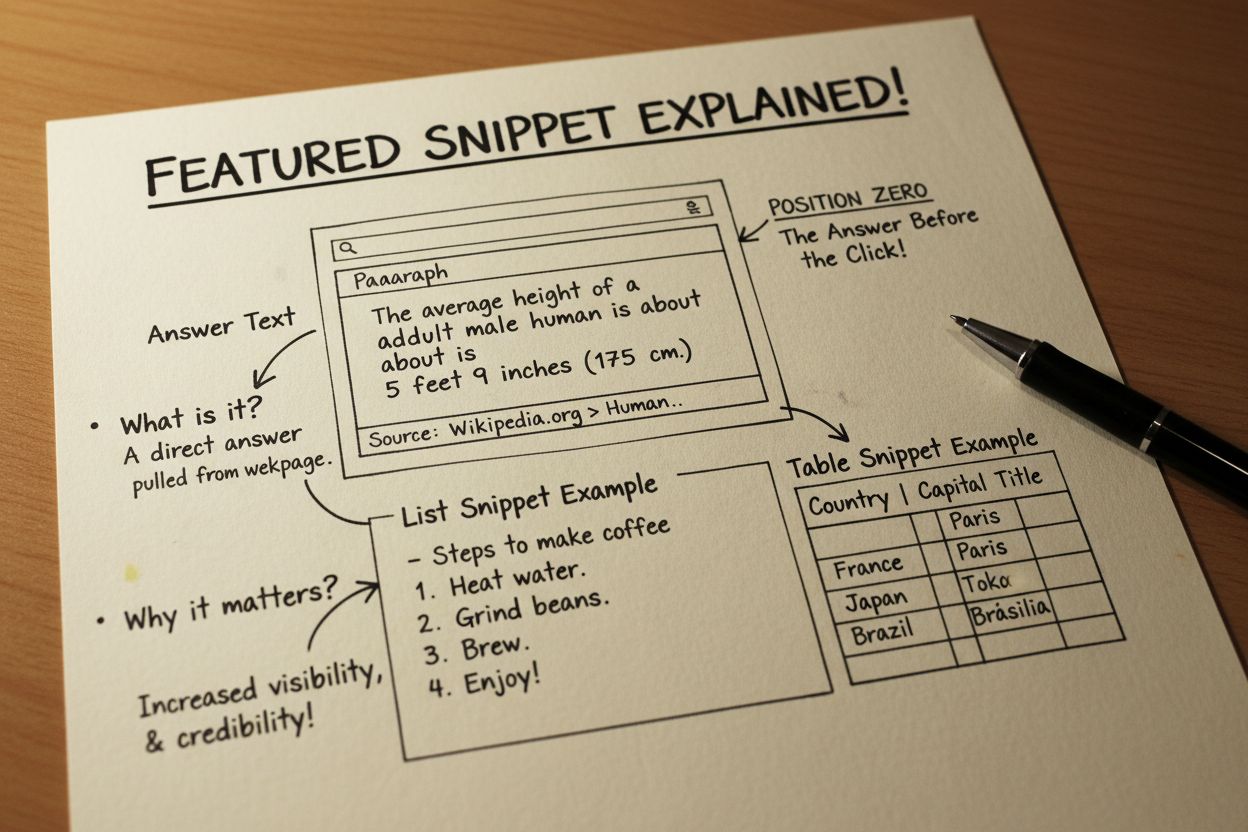
Position zero, also known as a featured snippet, is a special search result box that appears at the very top of Google’s search results, above the traditional first organic ranking. This highlighted answer box provides users with a direct, concise response to their search query without requiring them to click through to a website. Featured snippets come in multiple formats including paragraph definitions, numbered lists, bulleted lists, tables, and video results. Understanding what position zero is and why it matters is the foundation for any successful optimization strategy in today’s search landscape.
The importance of position zero cannot be overstated in modern SEO. According to recent research, featured snippets receive approximately 35-44% of all clicks on search results pages, making them incredibly valuable real estate. When a featured snippet appears on a SERP, the click-through rate for the first organic result actually drops by approximately 5.3%, meaning that if you’re not in the snippet but ranking number one, you’re losing significant traffic to whoever captured that position zero spot. This makes optimizing for featured snippets not just a nice-to-have, but an essential component of any comprehensive SEO strategy.
Capturing position zero offers multiple strategic advantages that extend far beyond simple vanity metrics. Increased visibility is the most obvious benefit—your content appears above all other organic results, dramatically expanding your reach even if your traditional ranking isn’t number one. This premium placement ensures that your brand gets noticed first by users searching for information related to your industry or expertise. Additionally, featured snippets play a crucial role in voice search optimization, as voice assistants like Google Assistant and Alexa frequently read answers directly from featured snippets, making this position vital for capturing emerging voice search traffic.
The credibility and authority benefits are equally significant. When Google selects your content for position zero, it’s essentially giving your brand a powerful endorsement of expertise and trustworthiness. This third-party validation from the world’s largest search engine helps establish your business as an authoritative source in your field. Furthermore, position zero traffic is completely organic and free—you’re not paying for ads, yet you’re capturing premium visibility. The click-through rates from featured snippets are typically higher than standard organic results, meaning users who see your snippet are more likely to visit your website to learn more detailed information, resulting in higher-quality traffic that often converts better than regular organic visitors.
The first critical step in optimizing for position zero is identifying which keywords and topics already have featured snippets or are ripe for snippet opportunities. Question-based keywords are your primary target, as these are the queries most likely to trigger featured snippets. Search terms beginning with “how,” “what,” “why,” “when,” “where,” and “which” are particularly valuable because they indicate informational intent—users are actively seeking direct answers rather than trying to make a purchase or find a specific website.
| Keyword Type | Example Query | Snippet Format | Opportunity Level |
|---|---|---|---|
| Definition Questions | “What is position zero?” | Paragraph (40-60 words) | High |
| How-To Queries | “How do I optimize for featured snippets?” | Numbered List | Very High |
| Comparison Questions | “Featured snippets vs. rich snippets” | Table or Comparison | High |
| List Queries | “Best practices for position zero” | Bulleted List | Medium |
| Long-tail Questions | “How to optimize for position zero in 2025?” | Paragraph or List | Very High |
Use tools like AnswerThePublic, AlsoAsked, and Google’s People Also Ask boxes to discover the specific questions your target audience is asking. These tools reveal related questions that Google considers closely related to your primary keyword, providing a goldmine of snippet opportunities. Check Google Search Console to identify keywords where your site is already ranking on the first page—these are your easiest wins for capturing position zero, as Google already trusts your content enough to rank it highly.
Creating content optimized for position zero requires a specific approach that balances brevity with comprehensiveness. The direct answer is paramount—within the first 40-60 words of your content, provide a clear, concise answer to the question you’re targeting. This snippet-ready answer should be objective and factual, written like a dictionary definition rather than an opinion piece. Google specifically avoids featuring subjective opinions in definition snippets, so maintain a neutral, informative tone that focuses on facts and established information.
After providing the direct answer, expand with detailed supporting content that thoroughly explores the topic. Your full article should typically be 2,000+ words to demonstrate comprehensive coverage and expertise. Structure your content with clear H2 and H3 headers that include your target keywords and questions. This hierarchical structure helps Google understand your content organization and makes it easier for the search engine to extract relevant information for featured snippets. Use bullet points and numbered lists strategically throughout your content—these formatting elements are particularly attractive to Google’s snippet-selection algorithm, especially for how-to guides and step-by-step processes.
Schema markup is structured data code that tells search engines exactly what information your content contains and how it’s organized. While not absolutely required for featured snippets, implementing proper schema markup significantly increases your chances of being selected. The most effective schema types for position zero optimization include FAQ Schema for question-and-answer content, How-To Schema for step-by-step guides, Table Schema for comparison data, and List Schema for bulleted or numbered content.
FAQ Schema is particularly powerful for pages with multiple questions and answers, as it signals to Google that your content is organized in a snippet-friendly format. When implementing schema, use tools like Google’s Rich Results Test to validate your markup and ensure there are no errors. Proper schema implementation not only increases your chances of featured snippets but also enables your content to appear in other rich search features like knowledge panels and AI Overviews, multiplying your visibility across multiple search formats.
While content quality and structure are crucial, technical SEO fundamentals cannot be overlooked. Your page must load quickly—aim for a page load time under 2.5 seconds, as slow-loading pages are less likely to be selected for featured snippets. Mobile responsiveness is equally critical; your content must display perfectly on all devices, as Google prioritizes mobile-first indexing. Ensure your website uses HTTPS with a valid SSL certificate, as security is a ranking factor that affects snippet selection.
Crawlability and indexation are foundational requirements. Make sure Google can easily crawl and understand your content by maintaining a clean site structure, using descriptive heading tags, and avoiding technical issues that prevent indexing. Check Google Search Console regularly for crawl errors, indexation issues, or mobile usability problems. Your page must already rank in the top 10 search results for your target keyword—this is a prerequisite for featured snippet consideration, as research shows that 99% of featured snippets come from pages already ranking on page one of Google’s results.
Securing a featured snippet is not a one-time achievement—continuous monitoring and maintenance are essential for retaining your position zero status. Use Google Search Console to track which queries trigger your featured snippets and monitor any changes in your snippet status. Set up Google Alerts for your target keywords to catch when competitors attempt to steal your position zero ranking. When you notice a drop in featured snippet appearances, investigate immediately to identify what changed—it could be outdated information, formatting issues, or a competitor providing a better answer.
Content freshness is a significant ranking factor for featured snippets. Regularly update your content with current statistics, recent examples, and fresh information. Add a “Last Updated” date to your articles, as this signals to Google that your content is current and reliable. Review your featured snippet content at least quarterly, and update it whenever you discover new information, better examples, or improved ways to explain concepts. This ongoing optimization approach ensures your content remains competitive and continues to capture position zero rankings over time.
The search landscape is rapidly evolving with the introduction of AI Overviews and generative AI in search results. Rather than replacing featured snippets, AI Overviews frequently pull information from well-structured, snippet-optimized content. In fact, optimizing for position zero has become even more important in the AI era, as featured snippet-quality content is exactly what AI systems need to generate accurate, sourced answers. Out of over 18 million domains in the organic search index, only about 274,000 are featured in AI Overviews, making position zero optimization your pathway into this exclusive club.
To future-proof your position zero strategy, focus on natural language patterns that match how people ask questions conversationally. Build comparative content that addresses “which is better” type queries, and structure content for multi-turn conversations to capture follow-up questions. Emphasize E-E-A-T signals (Experience, Expertise, Authoritativeness, Trustworthiness) throughout your content to establish your authority. As AI systems become more sophisticated, they increasingly rely on content that demonstrates genuine expertise and trustworthiness, making these signals more important than ever for maintaining visibility in both traditional featured snippets and AI-driven search experiences.
Track where your brand appears in AI answers and featured snippets across search engines. Get real-time visibility into how AI platforms cite your content.
Position Zero (featured snippet) appears above organic results on Google SERPs, providing direct answers to queries. Learn how P0 impacts SEO, CTR, and AI searc...
Learn what featured snippets are, how they work in Google search results, their impact on CTR, and strategies to optimize your content for position zero visibil...
Discover how featured snippets relate to AI systems, their impact on AI training, and how to optimize content for both traditional snippets and AI Overviews in ...