
Press Release Optimization for AI
Learn how to optimize press releases for AI systems, LLMs, and answer engines. Discover structured formatting, distribution strategies, and best practices for m...
8 min read

Learn how to optimize press releases for AI visibility across ChatGPT, Gemini, Perplexity and other AI search engines. Discover GEO best practices, formatting strategies, and distribution methods to increase AI citations.
Optimize press releases for AI visibility by using clear entity names, front-loading key information in the first 75-100 words, structuring content with headers and bullet points, including specific data points and metrics, writing headlines like search queries, and distributing through major wire services that AI systems index.
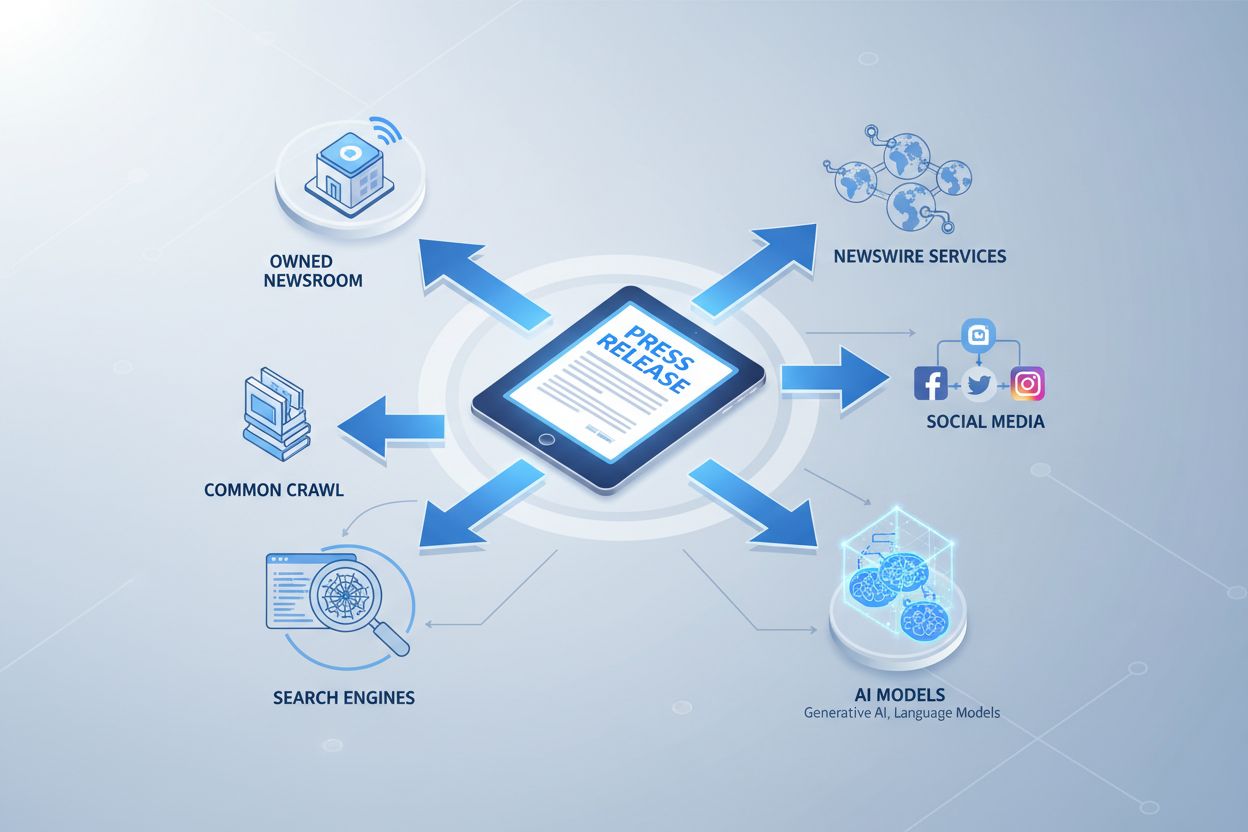
AI search engines like ChatGPT, Gemini, and Perplexity have fundamentally changed how press releases function in the digital landscape. Unlike traditional search engines that prioritize backlinks and keyword density, generative AI systems evaluate press releases based on clarity, structure, factual accuracy, and how well the content fits into their knowledge graphs. When you publish a press release, it becomes part of the training data that feeds these AI models, directly influencing how they understand and discuss your brand. The first 75 to 100 words of your press release are critical because AI engines use this section heavily for summarization and determining relevance to user queries. If your opening paragraph is vague or lacks essential context, the AI system may misinterpret your announcement or fail to surface it entirely when users ask related questions.
AI systems extract entities—company names, product lines, executive titles, locations, and dates—and cross-check them against their existing knowledge graphs. The clearer and more consistent your entity naming throughout the release, the more accurately AI can understand and resurface your announcement. Missing or ambiguous entities create uncertainty in AI systems, lowering your visibility in generative answers. Additionally, AI engines analyze what your announcement is fundamentally about (a launch, partnership, milestone, or policy change) and match that context to potential user intent. If your announcement addresses a likely question that users might ask an AI system, it has a significantly higher probability of being included in generative outputs.
The way you format and structure your press release directly impacts how AI systems parse and summarize your content. Generative engines interpret structure as a signal of importance, meaning a release with a strong lead, clear sections, bullet points, and labeled quotes is far easier for AI to summarize accurately. Messy or overly dense formatting increases the risk of missing key details in AI-generated responses, potentially distorting your message. Use short, digestible paragraphs instead of long blocks of text, as AI systems process information more effectively when it’s broken into scannable sections. Implement clear section headers to separate different topics, and use bullet lists for key points or features. This structural clarity helps AI engines quickly identify the hierarchy of information and extract the most important facts.
| Element | Purpose | AI Impact |
|---|---|---|
| Headline | Communicates core announcement | First signal for summarization |
| Lead Paragraph | Answers who, what, when, where, why | Heavily weighted for AI interpretation |
| Bullet Points | Highlights key features or benefits | Improves extraction accuracy |
| Executive Quotes | Provides authoritative soundbites | Often lifted directly into AI responses |
| Structured Data | Lists facts, metrics, dates | Strengthens credibility signals |
| About Section | Validates entity identity | Helps AI verify company information |
Labeled quotes with speaker name and title are particularly important for AI visibility. When you clearly attribute quotes to specific executives with their titles, AI systems can more confidently incorporate these statements into their responses. The quote itself should be self-contained and factual rather than promotional, answering implied questions that users might ask about your announcement. For example, instead of “We are excited to bring this innovative solution to market,” write something like “Our data shows 89% of customer support tickets can be resolved without human intervention, which is why we built this tool to handle those automatically.” This type of quote provides concrete information that AI systems can cite with confidence.
The opening sentence of your press release is your most valuable real estate for AI visibility. Generative engines often reuse your opening sentence as the summary, so it must include the who, what, and why without vague statements or buildup. Your headline should clearly communicate who is doing what and the outcome, avoiding promotional phrasing like “industry-leading” or “revolutionary.” Instead, write headlines that sound like search queries users would actually type into an AI system. For example, instead of “Company Announces Exciting New Product,” write “Acme Corp Launches Eco-Friendly Widget to Reduce Manufacturing Waste by 30%.” This approach immediately tells AI systems what the announcement is about and why it matters.
Spell out your full company name, product names, and executive titles consistently throughout the release, avoiding abbreviations until after the first mention. This consistency helps AI systems recognize and track entities across your text, building stronger associations between your brand and the information you’re sharing. Include essential facts in the first 75 words: the announcement itself, the entities involved, and the significance of what’s being announced. Provide context early by explaining why this announcement matters and what’s new or unique about it. AI systems deprioritize generic or “business as usual” updates, so emphasize the novelty—whether it’s a product launch, milestone achievement, acquisition, scientific breakthrough, new data, or strategic initiative. When you clearly signal what’s new, AI systems are more likely to surface your announcement in response to relevant user queries.
AI systems evaluate press releases as fact sets, prioritizing unambiguous naming, contextual detail, structured narrative clarity, credible signals, and verifiable claims. This means you should include concrete numbers, percentages, dates, and metrics wherever possible. Specific figures strengthen credibility, improve AI understanding, and increase the likelihood that your release is cited in generative answers. Instead of saying “significant cost savings,” state “Enterprise customers report 47% reduction in support costs within 90 days, saving an average of $2.3M annually.” This level of specificity makes your claims more trustworthy to AI systems and more likely to be included in their responses.
Unverifiable claims lower credibility signals in LLM evaluation, so back up data points with links, references, or clear metrics where possible. When you make claims that can be verified through supporting materials, AI systems gain confidence in your announcement and are more likely to incorporate it into their knowledge base. Include links to high-authority supporting materials such as product pages, executive bios, whitepapers, case studies, and relevant documentation. These links reinforce entity identity and help generative engines verify your claims. Avoid speculation, subjective statements, or unsubstantiated predictions, as AI systems are trained to recognize and deprioritize content that lacks factual grounding. Stick to confirmed facts and provide explicit context to help AI systems interpret your announcement correctly.
Your headline should function as both a human-readable announcement and a machine-interpretable query. Write headlines that answer questions clearly and authoritatively, using natural language aligned with how people actually search. Test your headline phrasing with tools like Google Trends to ensure it matches real search behavior. An optimized headline follows this formula: [Organization Name] + [Announces/Launches/Releases] + [Product/Initiative] + [Outcome/Benefit]. For example: “Meltwater Launches AI-Powered GEO Suite to Improve Brand Visibility Across Generative Search Engines.” This structure immediately tells both humans and AI systems what the announcement is about.
Use plain, clear language and spell out full terms at first mention to ensure proper AI interpretation. Technical terms, abbreviations, or industry-specific jargon can confuse AI systems and lead to inaccurate summaries. Write with confidence and clarity, using an authoritative tone that signals credibility to both AI and human readers. Focus on wording that remains relevant over time—evergreen phrasing increases the likelihood that your release continues to be surfaced accurately in generative search results long after publication. Avoid time-sensitive language that quickly becomes outdated. Instead of “This year’s biggest innovation,” write “A solution designed to address the growing challenge of customer support automation.” This approach keeps your release citable for months or even years after publication.
Press releases must be published via authoritative channels to maximize AI visibility, as generative engines consider source credibility when indexing content. Major wire services like GlobeNewswire, PR Newswire, and Business Wire get your press release into the databases that AI systems access. These platforms have strong indexing across ChatGPT, Gemini, and Perplexity, ensuring your announcement reaches the AI systems that matter most. Publish your release on both wire services and your owned domain to establish canonical authority and ensure multiple indexing pathways. Cross-posting the full release to your company newsroom strengthens your brand’s digital footprint and provides AI systems with multiple sources to verify your information.
Distribution timing and frequency significantly impact AI citation rates. Research shows that 50% of all AI citations come from content published within the last 11 months, with the highest citation rates occurring within 7 days of publication. This means the first week after publication is your highest-opportunity window for AI citations. Maintain a consistent cadence of press releases to sustain ongoing AI visibility, rather than publishing sporadically. When you have new data or updates, consider re-releasing with updated statistics rather than letting old content age out. Additionally, distribute your release internationally through multilingual versions to help AI models build broader semantic context about your brand and offerings. This global approach strengthens your brand’s presence across different language models and regional AI systems.
AI models love content that answers common questions clearly and authoritatively, which is why incorporating FAQ sections into your press releases significantly boosts AI visibility. Structure your press release in an answer-focused format that directly addresses questions users might ask about your announcement. Include 3-5 natural-language questions and answers in the body of your release that map directly to the prompts users type into AI systems. For example, include sections that answer: “What problem does this product solve?”, “How much does it cost?”, “Who is it designed for?”, and “What results can customers expect?” These FAQ-style sections make your content more useful to readers and easier for AI to understand and extract.
A smart strategy is to ask an AI tool to generate questions about your release, then answer those questions within the release itself. This approach ensures you’re addressing the exact queries that AI systems and users are likely to ask. When your release explains the who, what, where, when, why, and how comprehensively, it’s significantly more likely to be surfaced by AI when users ask related questions. Include evergreen anchors beyond the news hook—definitions, statistics, or context that remain relevant beyond the news cycle. If you’re announcing a product launch, include a section on “The State of [Industry] in 2025” with current market statistics. AI will cite this contextual information long after your launch news becomes stale, extending the lifespan of your press release’s visibility.
Traditional PR metrics like impressions, pickups, and media mentions don’t tell you whether AI systems are actually citing your press releases. You need AI-specific measurement to understand your true visibility in generative search. Track key metrics including AI citation count (how many times AI models reference your press release content), platform breakdown (which AI systems cite you—ChatGPT vs. Gemini vs. Perplexity), query coverage (what user questions trigger citations of your content), citation context (whether you’re cited as a primary source or passing mention), and competitor comparison (how your citation rate compares to industry peers). Different AI platforms have different citation preferences, so understanding which systems cite your content helps you refine your strategy. ChatGPT shows the strongest preference for press release citations from major wire services, while Gemini favors evidence-backed claims with verifiable statistics. Perplexity prioritizes freshness and structured, data-dense content, while Claude prefers academic journals and technical documentation over press releases.
Monitor your brand’s appearance in AI-generated answers across all major platforms to understand which press releases are performing well and which need optimization. Set up alerts to track when your brand is mentioned, cited, or recommended by AI systems. This real-time monitoring helps you identify trends in how AI systems understand and discuss your brand, allowing you to adjust your press release strategy accordingly. By consistently measuring AI visibility, you can refine your approach over time, focusing on the elements that drive the most citations and visibility in the AI systems that matter most to your business.
Track where your brand appears in AI-generated answers across ChatGPT, Perplexity, Gemini and other AI search engines. Get real-time alerts when your press releases are cited.
Learn how to optimize press releases for AI systems, LLMs, and answer engines. Discover structured formatting, distribution strategies, and best practices for m...

Discover how press releases influence AI search results on ChatGPT, Perplexity, Google AI Overviews, and Claude. Learn why 57% of companies use them for AI visi...
Learn the writing style AI engines like ChatGPT, Perplexity, and Google AI Overviews prefer. Discover how to structure content for AI citation and visibility.