
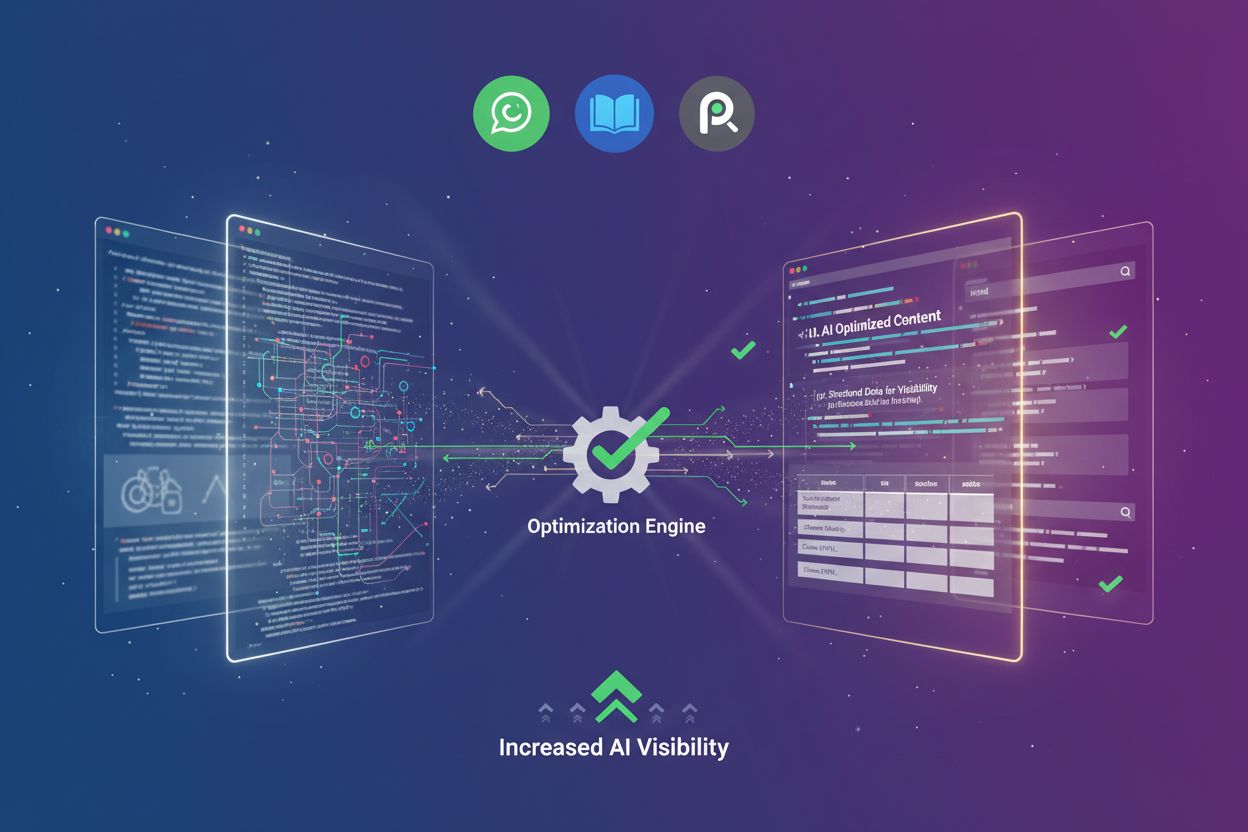
Prerendering for AI Crawlers: Making JavaScript Content Accessible
Learn how prerendering makes JavaScript content visible to AI crawlers like ChatGPT, Claude, and Perplexity. Discover the best technical solutions for AI search...
9 min read

Learn how to optimize SPAs for AI search engines like ChatGPT, Perplexity, and Claude. Discover technical strategies including server-side rendering, prerendering, structured data, and URL optimization to improve your visibility in AI-generated answers.
Optimize Single Page Applications for AI search by implementing server-side rendering or prerendering, ensuring clean HTML structure, using structured data markup, creating SEO-friendly URLs without hash fragments, and allowing AI crawlers in your robots.txt file. AI systems like ChatGPT, Perplexity, and Claude struggle with JavaScript rendering, so making your content accessible through static HTML versions is essential for visibility in AI-generated answers.
Single Page Applications (SPAs) built with frameworks like React, Vue.js, and Angular have revolutionized user experience by providing fast, interactive interfaces without full page reloads. However, this same architecture that delights users creates significant challenges for AI search engines like ChatGPT, Perplexity, Claude, and other large language models. Unlike traditional search engines that have improved JavaScript rendering capabilities, most AI crawlers cannot execute or render JavaScript at all, meaning they only see the initial HTML shell of your SPA without the dynamically loaded content that makes up the actual page.
The fundamental problem is that SPAs render content on the client-side (in the user’s browser) rather than serving pre-rendered HTML from the server. When an AI crawler visits your SPA, it receives minimal HTML with JavaScript instructions to load the real content. Since AI systems lack a full browser environment with a JavaScript engine, they cannot process these instructions and therefore cannot see your actual content. This creates a critical visibility gap where your valuable content remains completely hidden from AI-powered search results, limiting your ability to be cited as a source in AI-generated answers.
Server-Side Rendering (SSR) is the most robust solution for making your SPA content accessible to AI crawlers. With SSR, your application renders the complete HTML on the server before sending it to the client. This means when an AI crawler requests a page, it receives fully rendered HTML with all content immediately visible, exactly as a human user would see it after JavaScript loads. Frameworks like Next.js (for React), Nuxt.js (for Vue), and Remix provide built-in SSR capabilities that make implementation straightforward.
The process works by executing your JavaScript framework against a virtual DOM on the server, converting the result to an HTML string, and injecting it into the page before sending it to the client. When the page reaches the user’s browser, the SPA JavaScript runs and seamlessly replaces the existing content, providing the interactive experience users expect. For AI crawlers, however, they receive the complete, static HTML version that requires no JavaScript execution. This approach ensures that ChatGPT’s GPTBot, Perplexity’s PerplexityBot, Claude’s ClaudeBot, and other AI crawlers can immediately access and understand your content.
The main advantages of SSR include guaranteed content visibility to all crawlers, improved initial page load times for users, and consistent indexing across all search systems. However, SSR does introduce complexity—your code must work in both browser and server environments, implementation requires more development resources, and your application will generate more server requests, potentially increasing infrastructure costs. Despite these trade-offs, SSR provides the most stable and reliable solution for AI search optimization.
When full SSR implementation isn’t feasible, dynamic rendering and prerendering offer effective alternatives for making your SPA content accessible to AI crawlers. Dynamic rendering serves different content versions based on the user-agent: AI crawlers and search engine bots receive pre-rendered static HTML, while regular users continue to experience your fully interactive SPA. This hybrid approach allows you to maintain your dynamic application while ensuring crawlers see complete, indexable content.
Prerendering generates static HTML snapshots of your SPA pages during the build process or on-demand, caching them for quick delivery to crawlers. Services like Prerender.io automate this process by intercepting requests from AI crawlers and serving pre-rendered versions of your pages. This approach is particularly valuable because it doesn’t require changes to your application architecture—you can implement it as middleware without modifying your codebase. When an AI crawler visits your site, Prerender detects the user-agent and serves a cached HTML version that contains all your content in plain text format that AI systems can immediately parse and understand.
The effectiveness of prerendering for AI search is significant. Research shows that after implementing prerendering, websites typically see indexing improvements from less than 25% to approximately 80% of pages, increased crawl budget allocation from search engines, and dramatically improved visibility to AI systems. AI crawlers like GPTBot, PerplexityBot, and ClaudeBot can now access and cite your content in their responses. However, prerendering works best for content that doesn’t change frequently—if your pages update multiple times daily, you’ll need to regenerate snapshots regularly, which can impact performance and freshness signals.
| Rendering Approach | Best For | Complexity | Cost | AI Crawler Support |
|---|---|---|---|---|
| Server-Side Rendering (SSR) | Dynamic, frequently updated content | High | Medium-High | Excellent |
| Prerendering | Static or slowly changing content | Low | Low-Medium | Excellent |
| Dynamic Rendering | Mixed content types | Medium | Medium | Excellent |
| Client-Side Only | Simple static sites | Low | Low | Poor |
Beyond rendering strategies, several technical SEO practices are essential for AI search optimization. Clean, semantic HTML structure forms the foundation—ensure your markup uses proper heading hierarchy (H1, H2, H3), semantic tags like <article>, <section>, and <nav>, and avoids excessive nesting or unnecessary divs. AI crawlers parse HTML structure to understand content hierarchy and importance, so well-organized markup significantly improves how your content is interpreted.
URL structure is critical for both traditional and AI search. Avoid using hash fragments (#) in your URLs, as AI crawlers treat URLs with hash fragments as a single page rather than distinct content. Instead, use the History API and pushState() to create clean, meaningful URLs like /products/red-shoes rather than /products#123. Each view in your SPA should have a unique, descriptive URL that accurately reflects its content. This not only helps AI crawlers understand your site structure but also improves user experience and shareability.
Structured data markup using Schema.org vocabulary is increasingly important for AI systems. Implement JSON-LD format to label content types like products, articles, FAQs, how-to guides, and reviews. AI crawlers use structured data to quickly extract and understand key information, and this markup helps ensure your content is accurately represented in AI-generated answers. For example, a product page with proper Schema.org markup for pricing, availability, and reviews is more likely to be cited accurately in AI responses about that product.
Internal linking architecture deserves special attention in SPAs. Ensure all navigation uses proper <a> tags with href attributes rather than JavaScript onclick events. AI crawlers follow links to discover content, and JavaScript-based navigation may prevent them from finding all your pages. Create a clear internal linking structure that guides both users and crawlers through your content hierarchy, with important pages receiving more internal links from high-authority sections.
Meta tags require special handling in SPAs since they must be dynamically updated for each view. Implement unique, keyword-rich title tags and meta descriptions for every page or view in your application. Use JavaScript to update these tags as users navigate, ensuring that when AI crawlers request different URLs, they receive appropriate metadata. This is particularly important because AI systems use meta information to understand page context and relevance.
Open Graph tags and Twitter Card metadata are increasingly important for AI systems. These tags control how your content appears when shared and how AI systems understand your content’s context. Include og:title, og:description, og:image, and og:url tags on every page. AI crawlers often use this metadata to understand content at a glance, and proper implementation ensures your content is accurately represented in AI responses.
Canonical tags prevent duplicate content issues in SPAs. If your application generates similar content through different URL patterns, use canonical tags to indicate the preferred version. This helps AI crawlers understand which version to prioritize and cite, reducing confusion about content ownership and authority.
Submit a well-formatted XML sitemap to Google Search Console and make it accessible to AI crawlers. Your sitemap should list all important URLs in your SPA, including their last modification dates. This helps crawlers discover content more efficiently and understand your site structure. For large SPAs with thousands of pages, a properly structured sitemap is essential for ensuring comprehensive crawling and indexing.
Include priority and changefreq attributes in your sitemap to guide crawler behavior. Pages that change frequently should have a higher changefreq value, while important pages should have higher priority values. This helps AI crawlers allocate their crawl budget more effectively, ensuring they spend more time on your most important and frequently updated content.
Understanding which AI crawlers visit your site and what content they access is crucial for optimization. Monitor your server logs for AI crawler user-agents including GPTBot (OpenAI), PerplexityBot (Perplexity), ClaudeBot (Anthropic), and others. Tools like Google Search Console provide insights into how Google’s crawlers see your content, and similar patterns often apply to AI crawlers.
Track crawl budget efficiency by monitoring the ratio between pages crawled and pages indexed. A high crawl-to-index ratio (80-90%) indicates that most of the content crawlers see is being indexed and made available to AI systems. If this ratio is low, it suggests content quality or accessibility issues that need addressing. Regularly audit your site to ensure AI crawlers can access the same content as human users.
Beyond technical optimization, your content strategy significantly impacts AI search visibility. AI systems prefer comprehensive, well-structured content that directly answers user questions. Structure your content with clear headings, bullet points, and concise paragraphs that make information easy to extract. AI crawlers are more likely to cite content that presents information in an organized, scannable format.
Include unique, authoritative information that AI systems value. Original research, data, expert insights, and unique perspectives are more likely to be cited in AI-generated answers than generic or duplicated content. Focus on creating content that provides genuine value and differentiates your perspective from competitors.
Use conversational language and question-based formatting. Since AI systems are trained on natural language patterns, content written in conversational tone and structured around common questions is more likely to be selected for AI responses. Create FAQ sections, how-to guides, and definition pages that directly address the questions your audience asks.
Track your AI search visibility by monitoring mentions of your brand and domain in AI-generated answers. Tools that analyze AI crawler activity can show you which pages receive the most AI crawler visits and which content is being cited. Use this data to identify patterns in what content AI systems find valuable and replicate those characteristics across your site.
Monitor traffic from AI sources separately from traditional search traffic. Most analytics platforms can segment traffic by referrer, allowing you to see how much traffic comes from ChatGPT, Perplexity, and other AI systems. Compare this data with your content performance to understand which topics and content types drive the most AI-sourced traffic.
Conduct regular technical audits to ensure your rendering solution is working effectively. Test that AI crawlers can access your content by temporarily disabling JavaScript in your browser or using tools that simulate crawler behavior. Verify that your prerendering or SSR implementation is serving complete, accurate content to all crawler types.
Over-reliance on client-side rendering without any fallback is the most critical mistake. If your entire site depends on JavaScript execution, AI crawlers will see nothing but an empty shell. Always ensure that critical content is available in the initial HTML response, either through SSR, prerendering, or progressive enhancement.
Neglecting mobile optimization can harm AI search visibility. Many AI crawlers use mobile user-agents, so ensure your SPA is fully responsive and provides the same content experience on mobile devices as on desktop. Test your site on mobile devices and verify that all content loads correctly.
Ignoring internal linking structure limits crawler discovery. Without proper internal links using <a> tags, AI crawlers may only find a fraction of your content. Ensure every important page is linked from at least one other page, creating a connected content network that crawlers can easily traverse.
Failing to update content regularly signals to AI systems that your site is stale. Maintain a content update schedule and refresh important pages periodically. AI crawlers prioritize fresh content, so regular updates improve your chances of being cited in current AI-generated answers.
Track how your content appears in AI-generated answers from ChatGPT, Perplexity, and other AI search engines. Get real-time insights into your AI search visibility and optimize your presence.
Learn how prerendering makes JavaScript content visible to AI crawlers like ChatGPT, Claude, and Perplexity. Discover the best technical solutions for AI search...

Learn how JavaScript rendering impacts your website's visibility in AI search engines like ChatGPT, Perplexity, and Claude. Discover why AI crawlers struggle wi...
Learn how JavaScript impacts AI crawler visibility. Discover why AI bots can't render JavaScript, what content gets hidden, and how to optimize your site for bo...