

YMYL Financial Content: What AI Platforms Require for Citation
Learn how AI platforms like ChatGPT, Perplexity, and Google AI Overviews evaluate financial content. Understand YMYL requirements, E-E-A-T standards, and compli...
6 min read

Learn how to optimize Your Money or Your Life (YMYL) content for AI search engines like ChatGPT, Perplexity, and Google’s AI Overviews. Master E-E-A-T signals, content accuracy, and AI visibility strategies.
Optimize YMYL content for AI by prioritizing E-E-A-T signals (Expertise, Experience, Authoritativeness, Trust), ensuring factual accuracy with authoritative sources, implementing structured data, maintaining clear authorship, and aligning with expert consensus. Focus on content quality, transparent monetization disclosure, and robust security measures while monitoring AI Overviews visibility.
Your Money or Your Life (YMYL) content encompasses any material that could significantly impact a person’s financial stability, health, safety, or well-being, or affect society’s welfare. As artificial intelligence becomes increasingly integrated into search experiences through platforms like ChatGPT, Perplexity, and Google’s AI Overviews, optimizing YMYL content for these systems has become critical. Unlike traditional search engine optimization that focuses on ranking in blue-link results, AI content optimization requires a fundamentally different approach that emphasizes trustworthiness, accuracy, and authoritative sourcing. The stakes are higher because AI systems can amplify misinformation at scale, making it essential for YMYL publishers to understand how these systems evaluate and surface content.
E-E-A-T—Expertise, Experience, Authoritativeness, and Trustworthiness—forms the foundation of how both Google’s algorithms and AI systems evaluate YMYL content quality. When optimizing for AI platforms, you must demonstrate these four pillars explicitly throughout your content ecosystem. Expertise means your content should be created by individuals with demonstrable knowledge in the field, whether through professional credentials, years of experience, or recognized authority. Experience refers to first-hand knowledge and practical application of the topic, which adds credibility when properly contextualized. Authoritativeness involves establishing your website or author as a recognized authority through citations, references, and industry recognition. Trust is perhaps the most critical element—it encompasses accuracy, transparency, and alignment with expert consensus.
For YMYL topics, AI systems place even greater emphasis on these signals because the consequences of inaccurate information are severe. A health-related AI answer that contradicts medical consensus could harm users; financial advice that ignores regulatory standards could lead to poor decisions. Therefore, your optimization strategy must make E-E-A-T signals unmistakable and verifiable throughout your content.
Clear authorship and expertise attribution are non-negotiable for YMYL content optimization. Every piece of YMYL content should include a prominent byline with the author’s name, credentials, and a link to a detailed author biography. This biography should explicitly state the author’s qualifications, professional experience, relevant certifications, and any published works or speaking engagements that establish authority. AI systems analyze author information to assess content credibility, and vague or missing authorship signals can significantly reduce your content’s visibility in AI-generated answers.
Beyond individual author bios, your website should feature comprehensive team pages and organizational credentials. If your organization has been featured in reputable publications, received industry awards, or earned certifications from recognized bodies, these should be prominently displayed. For medical content, include information about medical reviewers or advisory boards. For financial content, highlight any regulatory compliance or industry affiliations. This multi-layered approach to demonstrating expertise helps AI systems understand that your content comes from qualified sources, making it more likely to be cited or referenced in AI-generated responses.
Factual accuracy is the cornerstone of YMYL optimization for AI systems. Unlike traditional SEO where some flexibility exists in interpretation, AI systems are trained to identify and penalize factually incorrect information, especially in YMYL categories. Every claim in your content should be verifiable and supported by authoritative sources. This means conducting thorough fact-checking processes before publication and maintaining a systematic approach to updating content when new information emerges.
| Content Element | Accuracy Requirement | AI System Impact |
|---|---|---|
| Medical claims | Must align with peer-reviewed research and medical consensus | High visibility in health-related AI answers |
| Financial advice | Must comply with regulatory standards and industry best practices | Inclusion in financial AI overviews |
| Safety information | Must reflect current best practices and expert recommendations | Featured in safety-related AI responses |
| Legal information | Must be current and compliant with applicable laws | Cited in legal AI answers |
| Statistical data | Must cite original sources with publication dates | Verified in AI-generated summaries |
Your content should explicitly acknowledge when information is based on expert consensus versus emerging research. For YMYL topics, AI systems prefer content that clearly distinguishes between established knowledge and areas of ongoing debate. When discussing controversial topics within YMYL categories, present multiple expert perspectives while clearly indicating which view represents mainstream consensus. This balanced approach demonstrates intellectual honesty and helps AI systems understand the nuance of your content.
Proper sourcing is essential for AI visibility in YMYL categories. Rather than simply linking to other websites, you should cite primary sources whenever possible. If you’re discussing a medical study, link directly to the peer-reviewed journal article rather than a secondary source discussing the study. For financial information, cite regulatory documents, official government resources, or established financial institutions. For legal content, reference actual statutes, court decisions, or official legal resources.
AI systems analyze your citation patterns to assess content reliability. When you consistently cite authoritative, primary sources, AI systems recognize your content as trustworthy and more likely to include it in generated answers. Additionally, your citations should be transparent and verifiable—avoid vague references like “studies show” without providing specific citations. Include publication dates for all sources to help AI systems understand the currency of your information. For YMYL content, outdated information can be as problematic as inaccurate information, so maintaining a clear publication and update history is crucial.
Structured data markup helps AI systems understand and properly contextualize your YMYL content. Implement schema.org markup appropriate to your content type—Article schema for blog posts, FAQPage schema for FAQ content, MedicalWebPage schema for health content, and FinancialProduct schema for financial content. This structured data provides AI systems with explicit information about your content’s purpose, authorship, publication date, and topic classification.
Beyond basic schema implementation, use semantic markup to highlight key concepts, definitions, and relationships within your content. For YMYL topics, consider implementing schema that explicitly identifies expert contributors, fact-checking processes, and editorial standards. This helps AI systems understand not just what your content says, but how rigorously it was created. Additionally, implement breadcrumb schema to establish clear content hierarchy and topic relationships, which aids AI systems in understanding your content’s context within your broader knowledge base.
Explicit disclosure of monetization and potential conflicts of interest is critical for YMYL content optimization. AI systems are trained to identify and downweight content with undisclosed financial incentives, particularly in YMYL categories. If your content includes affiliate links, sponsored content, or recommendations for products or services from which you benefit financially, this must be clearly disclosed. The disclosure should appear near the relevant content, not buried in a footer or privacy policy.
Beyond affiliate relationships, disclose any other potential conflicts of interest. If you’re recommending a competitor’s product, acknowledge this. If you have a financial stake in an industry you’re writing about, be transparent. If your organization receives funding from companies in your industry, this should be disclosed. This transparency doesn’t necessarily harm your AI visibility—in fact, it often improves it by demonstrating integrity. AI systems recognize that transparent disclosure of conflicts is a sign of trustworthy content, whereas hidden conflicts are a major red flag.
Supplementary content that supports your main YMYL content significantly impacts AI visibility. This includes detailed About Us pages, comprehensive privacy policies, clear terms of service, and accessible contact information. AI systems evaluate not just your main content but your entire website to assess trustworthiness. A website with vague ownership information, hidden contact details, or unclear policies appears less trustworthy to AI systems.
Your About Us page should clearly explain your organization’s mission, history, and expertise. Include information about your team members, their qualifications, and their roles. If your organization has partnerships with recognized institutions or has been featured in reputable media, highlight this. Your privacy policy should be clear and accessible, explaining exactly how you handle user data. For YMYL content, consider adding specific disclaimers appropriate to your topic—medical disclaimers for health content, investment disclaimers for financial content, and legal disclaimers for legal content. These aren’t just legal protections; they’re signals to AI systems that you understand the sensitive nature of your content.
AI Overviews and generative search results operate differently from traditional search results, requiring specific optimization strategies. Rather than optimizing for keyword rankings, you’re optimizing for inclusion in AI-generated summaries and answers. This means structuring your content to provide clear, concise answers to common questions within your YMYL category. Use clear headings, bullet points, and summary sections that AI systems can easily extract and synthesize.
For YMYL content specifically, AI systems are more conservative about what they include in generated answers. Google has stated that YMYL queries may receive AI Overviews, but with additional disclaimers and higher accuracy standards. To optimize for this environment, ensure your content provides definitive, well-sourced answers to questions. Avoid speculative language or hedging that might make AI systems hesitant to cite your content. Instead, use confident, evidence-based language supported by authoritative sources. Additionally, structure your content with clear sections that address specific aspects of your topic, making it easier for AI systems to extract relevant information for different query variations.
Regular content updates and maintenance are essential for YMYL optimization in the AI era. AI systems prioritize current information, particularly for YMYL topics where outdated information can be harmful. Establish a systematic process for reviewing and updating your YMYL content on a regular schedule—quarterly for rapidly evolving topics like medical treatments or financial regulations, and at least annually for more stable topics. When you update content, clearly indicate the update date so AI systems understand the currency of your information.
Beyond scheduled updates, monitor your content for accuracy issues and update immediately if you discover errors or if expert consensus changes. For health content, monitor medical journals and professional organizations for new guidelines. For financial content, track regulatory changes and market developments. For safety content, stay informed about emerging risks and best practices. This proactive approach to content maintenance demonstrates to AI systems that you’re committed to accuracy and helps ensure your content remains visible in AI-generated answers as information evolves.
Tracking how your YMYL content appears in AI-generated answers is crucial for optimization. Unlike traditional search rankings where you can easily check your position, AI visibility requires more sophisticated monitoring. Regularly search for your target keywords in ChatGPT, Perplexity, Google’s AI Overviews, and other AI systems to see if your content is being cited or referenced. When your content does appear, analyze how it’s being presented—is it being quoted accurately? Is your authorship being credited? Are important nuances being preserved?
Use this monitoring data to refine your optimization strategy. If your content isn’t appearing in AI answers for relevant queries, analyze why. Is it a sourcing issue? Are your E-E-A-T signals unclear? Is your content too long or complex for AI systems to extract key information? Conversely, if your content is appearing frequently, analyze what’s working and replicate those elements in other content. This iterative approach to optimization helps you continuously improve your AI visibility for YMYL content.
Long-term success with YMYL content in the AI era requires a comprehensive, sustainable strategy. Rather than chasing algorithm changes or trying to game AI systems, focus on creating genuinely authoritative, accurate, and trustworthy content. Invest in expert contributors, rigorous editorial processes, and transparent practices. Build your website’s reputation through consistent quality and ethical practices. These foundational elements create a strong base for visibility across all search and AI platforms.
Additionally, stay informed about how AI systems are evolving and how they evaluate YMYL content. Follow updates from major AI platforms, participate in industry discussions, and monitor how your competitors’ YMYL content is performing in AI systems. The landscape is rapidly changing, and what works today may need adjustment tomorrow. By maintaining a commitment to quality, accuracy, and transparency while staying informed about platform changes, you position your YMYL content for sustained visibility and impact in the AI-driven search environment.
Track how your brand, domain, and URLs appear in AI-generated answers across ChatGPT, Perplexity, Google AI Overviews, and other AI search engines. Get real-time insights into your AI visibility and optimize your content strategy accordingly.
Learn how AI platforms like ChatGPT, Perplexity, and Google AI Overviews evaluate financial content. Understand YMYL requirements, E-E-A-T standards, and compli...

Learn what YMYL topics are in AI search, how they impact your brand visibility in ChatGPT, Perplexity, and Google AI Overviews, and why monitoring them matters ...
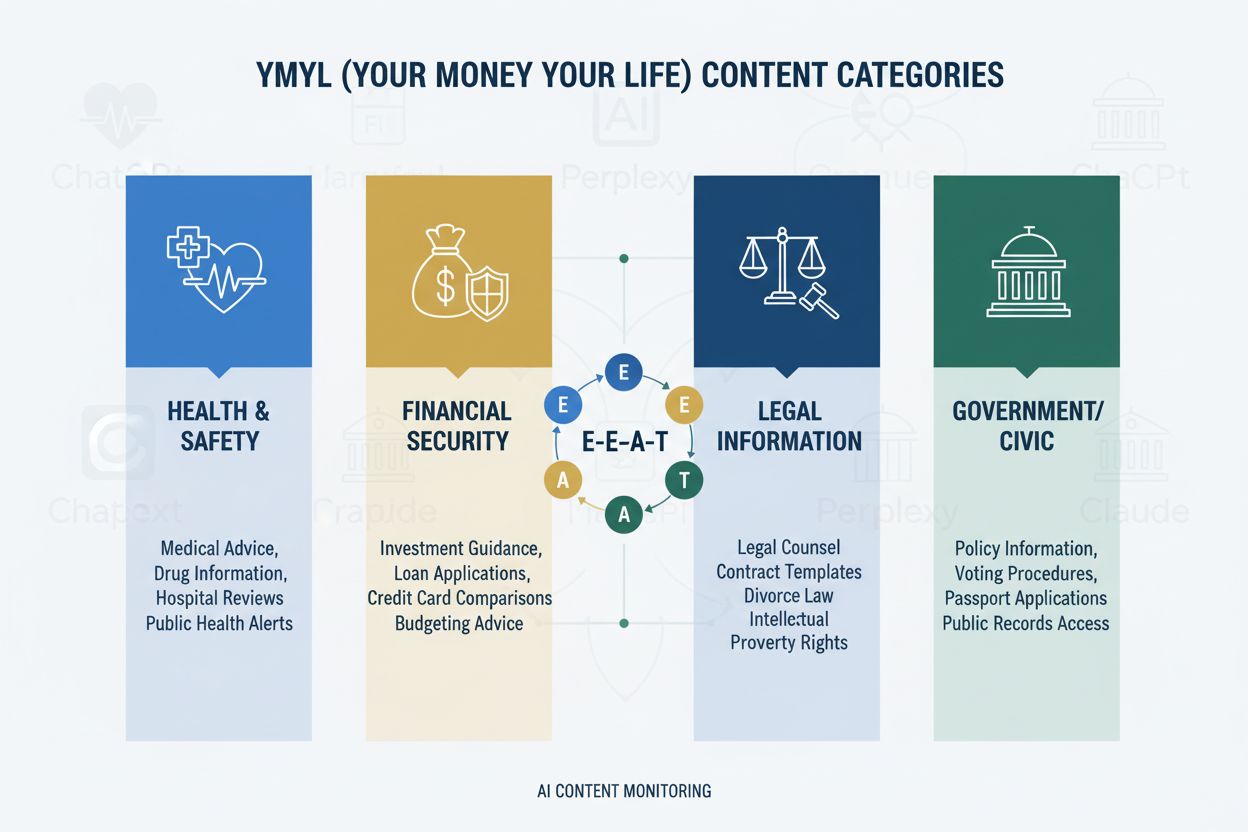
YMYL content requires high E-E-A-T standards. Learn what qualifies as Your Money Your Life content, why it matters for SEO and AI visibility, and how to optimiz...