

What is Crisis Management for AI Search?
Learn how to manage brand reputation crises in AI-generated answers from ChatGPT, Perplexity, and other AI search engines. Discover strategies for monitoring, r...
8 min read

Learn how to prepare for AI search crises with monitoring, response playbooks, and crisis management strategies for ChatGPT, Perplexity, and Google AI.
Preparing for AI search crises requires establishing real-time monitoring systems across ChatGPT, Perplexity, Google AI Overviews, and Claude, creating pre-approved response templates, training spokespersons on AI-specific threats, and building a crisis playbook that addresses AI hallucinations and misinformation. Early detection combined with transparent, fact-based communication is essential to protect brand reputation in the AI era.
An AI search crisis occurs when false information, hallucinations, or misrepresentations about your brand appear in responses from generative AI platforms like ChatGPT, Perplexity, Google AI Overviews, or Claude. Unlike traditional search engine crises where misinformation appears on websites, AI search crises are uniquely dangerous because AI systems synthesize information into authoritative-sounding answers that millions of users trust implicitly. When an AI platform generates false claims about your company, product safety, leadership, or business practices, users often accept these statements as fact without verification. The crisis escalates rapidly because AI-generated misinformation spreads faster and reaches broader audiences than traditional false information. In 2024, global losses attributed to AI hallucinations alone reached $67.4 billion, with one-third of consumers reporting they encountered false information from AI tools. This represents an unprecedented threat to brand reputation that requires fundamentally different preparation strategies than traditional crisis management.
The stakes are particularly high because AI search results now influence purchasing decisions, hiring choices, and public perception in ways traditional search never did. When a potential customer asks ChatGPT “Is this company trustworthy?” and receives a hallucinated response claiming the company has faced lawsuits or safety violations, that false answer directly impacts conversion rates and brand equity. Unlike a negative review on a website that can be reported and removed, AI-generated false information exists in a distributed system where no single platform controls the narrative. Your brand might be invisible in one AI platform while being misrepresented in another, creating fragmented reputation challenges that traditional PR teams aren’t equipped to handle.
AI search platforms operate differently from traditional search engines, creating distinct crisis vectors that require platform-specific preparation. ChatGPT reaches over 800 million weekly users and generates answers by synthesizing information from its training data, which has a knowledge cutoff date that creates opportunities for outdated or false information to persist. Perplexity conducts real-time web searches and cites sources directly, meaning false information from low-authority websites can be amplified if Perplexity’s retrieval system prioritizes them. Google AI Overviews appear directly in Google Search results for billions of queries, making them the most visible AI crisis vector for mainstream audiences. Claude is rapidly growing through Safari integration and enterprise adoption, creating a fourth major platform where your brand’s representation matters. Each platform uses different retrieval-augmented generation (RAG) systems, meaning the same query produces different answers across platforms, and a crisis on one platform may not appear on another.
The crisis vectors differ significantly by platform. ChatGPT hallucinations often stem from training data gaps or conflicting information in its training corpus, leading to fabricated statistics, false product claims, or invented company history. Perplexity crises typically emerge when the platform cites low-quality sources or misinterprets information from legitimate sources, amplifying fringe claims into authoritative-sounding answers. Google AI Overviews have generated notorious crises—including telling users to eat glue on pizza and recommending rocks as a food ingredient—demonstrating how AI can misinterpret or misapply information in ways that damage associated brands. Claude tends to be more conservative but can still generate false information when prompted with leading questions or when training data contains conflicting information. Understanding these platform-specific behaviors is essential for building an effective crisis preparation strategy.
| Platform | User Base | Data Source | Crisis Type | Detection Priority | Response Focus |
|---|---|---|---|---|---|
| ChatGPT | 800M+ weekly | Training data (cutoff date) | Hallucinations, outdated info | High - most visible | Fact correction, source authority |
| Perplexity | 100M+ monthly | Real-time web search | Source misinterpretation, low-quality citations | High - cites sources directly | Source quality, citation accuracy |
| Google AI Overviews | Billions of searches | Google index + synthesis | Misapplication, false synthesis | Critical - mainstream visibility | Authoritative content, structured data |
| Claude | Growing enterprise | Training data + web | Conservative hallucinations | Medium - enterprise focused | Accuracy verification, context |
Real-time monitoring across AI platforms is the foundation of effective crisis preparation. Unlike traditional social media monitoring that tracks mentions on Twitter or Reddit, AI search monitoring requires specialized tools that query AI platforms continuously and track how your brand is represented in generated responses. AmICited and similar GEO monitoring platforms track your brand mentions across ChatGPT, Perplexity, Google AI Overviews, and Claude, alerting you when your brand appears in AI answers and flagging potential misrepresentations. The monitoring system should track not just whether your brand is mentioned, but how it’s characterized—whether the AI is citing accurate information, whether sources are properly attributed, and whether the context is favorable or damaging.
Effective detection infrastructure requires establishing baseline metrics for your brand’s AI visibility before a crisis occurs. Document your current citation frequency (how often AI platforms mention your brand), share of voice (your mentions compared to competitors), and sentiment positioning (how AI describes your brand). This baseline becomes critical during a crisis because it allows you to measure the impact of false information and demonstrate recovery to stakeholders. Set up automated alerts that notify your crisis team immediately when your brand appears in AI responses, particularly for high-risk queries related to safety, legality, financial stability, or leadership. Configure alerts to trigger not just on brand name mentions but on related entity mentions—if an AI platform generates false information about your industry, competitors, or product category, it may indirectly damage your brand through association.
The detection infrastructure should include human verification workflows because automated systems can generate false positives. An AI platform mentioning your brand in a positive context doesn’t require crisis response, but an AI platform generating false claims about your company does. Train your crisis team to distinguish between legitimate criticism (which doesn’t require crisis response), outdated information (which requires clarification), and false hallucinations (which require immediate correction). Establish severity thresholds that determine response urgency—a false claim about your company appearing in ChatGPT to a single user requires different response speed than the same false claim appearing in Google AI Overviews to millions of users.
A comprehensive AI crisis response playbook differs fundamentally from traditional crisis management because you cannot directly remove false information from AI platforms the way you can request removal from websites or social media. Instead, your response strategy focuses on source correction, authority building, and narrative control. The playbook should include pre-approved message templates for different crisis scenarios—false product claims, fabricated company history, misattributed statements from leadership, safety allegations, and financial misinformation. Each template should emphasize transparency, factual accuracy, and source attribution, because AI platforms prioritize authoritative, well-sourced information when generating responses.
Your playbook must address the multi-platform nature of AI crises. A false claim about your company might appear in ChatGPT but not Perplexity, or vice versa. Your response strategy should include platform-specific actions—for ChatGPT, this might involve creating authoritative content that contradicts the hallucination and hoping it influences future training data; for Perplexity, this might involve ensuring your official website ranks highly for relevant queries so Perplexity cites accurate information; for Google AI Overviews, this involves optimizing your content for Google’s AI training systems. The playbook should specify who owns each platform’s response—your PR team, content team, legal team, or external agencies—and establish decision-making authority for when to escalate to executive leadership.
Include escalation procedures in your playbook that define when a crisis requires different response levels. A minor hallucination about your company’s founding date might require only content correction, while a false claim about product safety requires immediate legal review, executive communication, and potentially regulatory notification. Establish communication protocols for different stakeholder groups—customers, employees, investors, regulators, and media—because each group requires different messaging. Your playbook should include holding statements that your crisis team can deploy immediately while gathering facts, preventing the information vacuum that allows false narratives to spread.
Spokespersons trained specifically for AI-era crises are essential because AI crises require different communication approaches than traditional media crises. Traditional crisis communication emphasizes controlling the narrative through media relations, but AI crises require controlling the sources that AI systems cite. Train your spokespersons to understand how AI platforms retrieve and synthesize information, so they can explain to media and stakeholders why a particular false claim appeared and what steps you’re taking to correct it. Spokespersons should be prepared to discuss AI hallucinations as a technical phenomenon, helping audiences understand that false information doesn’t necessarily reflect malice or incompetence but rather limitations in how AI systems process information.
Your spokesperson training should include specific talking points about your brand’s AI visibility strategy. When media asks about false information appearing in AI platforms, your spokesperson should be able to explain your monitoring systems, response protocols, and source correction efforts. This transparency builds credibility and demonstrates that your organization takes AI reputation seriously. Train spokespersons to avoid defensive language that suggests you’re blaming AI platforms—instead, focus on factual correction and source authority. For example, instead of saying “ChatGPT hallucinated false information about us,” say “We’ve identified inaccurate information in AI-generated responses and are working to ensure authoritative sources are cited.”
Establish media protocols that specify how your organization responds to journalists asking about false information in AI platforms. Provide journalists with fact sheets, source documents, and expert commentary that help them understand the issue and report accurately. Consider proactive media outreach when significant false information appears in AI platforms—journalists covering AI topics are often interested in real-world examples of AI hallucinations and how companies respond. This positions your organization as a thought leader on AI crisis management rather than a victim of AI misinformation.
Source authority is the most effective long-term defense against AI search crises because AI platforms prioritize information from authoritative sources when generating responses. If your official website, press releases, and verified business information are the most authoritative sources on your company, AI platforms will cite them rather than false information from low-quality sources. Implement structured data markup on your website that clearly identifies your company information, leadership, products, and key facts. Use schema.org markup for Organization, Product, and Person entities so AI systems can easily extract accurate information about your brand.
Optimize your official website content for AI citation by including specific statistics, expert quotes, and verifiable claims that AI platforms prefer. Research shows that adding citations and quotes to content boosts AI visibility by more than 40%. Create FAQ pages, fact sheets, and explainer content that directly address common questions about your company, products, and industry. These structured content formats are exactly what AI platforms extract when generating responses, so investing in high-quality FAQ content is an investment in crisis prevention.
Build entity authority by ensuring your brand information is consistent across trusted sources that AI platforms rely on. This includes your official website, verified business directories, industry databases, and authoritative third-party sources. When AI platforms encounter consistent information about your company across multiple authoritative sources, they’re less likely to generate hallucinations or cite false information. Establish relationships with industry publications and thought leadership platforms that AI systems recognize as authoritative—when these sources publish accurate information about your company, they become part of the information landscape that AI systems draw from.
Crisis response timing is critical in the AI era because false information can spread to millions of users within hours. Establish a response timeline that specifies actions within the first hour, first day, first week, and ongoing. Within the first hour of detecting a significant false claim in AI platforms, your crisis team should verify the information, assess severity, and notify leadership. Within the first day, you should have initial response messaging prepared and distributed to key stakeholders. Within the first week, you should have source correction efforts underway and media strategy deployed.
Your escalation framework should define when different organizational functions get involved. Minor hallucinations might be handled by your marketing team with content corrections, while false safety claims require immediate involvement from legal, regulatory affairs, and executive leadership. Establish decision-making authority that specifies who can approve different types of responses—your PR director might approve routine corrections, while your CEO must approve responses to serious allegations. Create escalation triggers that automatically elevate a crisis to higher levels of leadership—for example, if false information appears in Google AI Overviews and reaches more than 100,000 users, it automatically escalates to executive leadership.
Include stakeholder notification procedures in your escalation framework. Determine which stakeholders need to be notified of different types of AI crises—your board of directors needs to know about crises that could impact stock price or regulatory standing, your customer service team needs to know about false product claims so they can respond to customer inquiries, your sales team needs to know about false competitive claims. Establish communication cadences that specify how frequently you update stakeholders during an active crisis—daily updates during the first week, then weekly updates as the crisis stabilizes.
| Severity Level | Detection Trigger | First Hour Actions | First Day Actions | First Week Actions |
|---|---|---|---|---|
| Minor | False detail in single platform | Verify accuracy, document | Create correction content | Monitor for spread |
| Moderate | False claim in 2+ platforms | Alert leadership, verify | Prepare response messaging | Launch source correction |
| Major | False claim in Google AI Overviews | Activate crisis team, legal review | Media outreach, stakeholder notification | Comprehensive response campaign |
| Critical | Safety/legal allegations in AI | Full crisis activation, legal/regulatory | Executive communication, media response | Sustained correction effort |
Rapid fact-checking is essential during an AI crisis because your response credibility depends on demonstrating that the AI-generated information is actually false. Establish verification workflows that your crisis team can execute quickly to confirm whether a claim is false, outdated, or partially true. Create fact-checking templates that document the false claim, cite authoritative sources that contradict it, and explain why the AI platform generated the false information. These templates become part of your response messaging and help media, customers, and stakeholders understand the issue.
Implement source verification processes that identify where false information originated. Did the AI platform cite a low-quality source? Did it misinterpret information from a legitimate source? Did it hallucinate information with no source at all? Understanding the origin of false information helps you develop targeted corrections—if the problem is a low-quality source, you work to ensure authoritative sources rank higher; if the problem is misinterpretation, you create clearer, more explicit content; if the problem is pure hallucination, you focus on building source authority so AI platforms cite accurate information instead.
Create visual fact-checking assets that your crisis team can deploy quickly. Infographics, comparison charts, and timeline graphics help communicate complex corrections in formats that are easy to share and understand. These visual assets are particularly valuable for social media and media outreach, where they can help counter false narratives quickly. Consider developing video explainers that your leadership can deploy to address serious false claims—video content is often more persuasive than text and helps humanize your response.
Learning from competitor AI crises helps you prepare for similar threats to your own brand. Establish a competitive monitoring system that tracks when competitors face AI search crises, how they respond, and what outcomes result. Document patterns in AI hallucinations across your industry—if multiple companies in your sector are experiencing false safety claims in AI platforms, this suggests a systemic issue that requires industry-wide response. Participate in industry forums and associations that discuss AI crisis management, sharing best practices and learning from peers.
Monitor emerging AI platforms and new crisis vectors as the AI landscape evolves. New AI platforms like Grokipedia and others are launching regularly, each with different data sources and retrieval methods. Your monitoring system should expand to include new platforms as they gain user adoption. Track regulatory developments around AI accountability and misinformation, as new regulations may create obligations for how you respond to false information in AI platforms. Stay informed about AI platform policy changes—when ChatGPT, Perplexity, or Google update their systems, these changes may affect how false information spreads or how you can correct it.
AI crisis preparation should integrate with your existing crisis management infrastructure rather than replace it. Your traditional crisis team has valuable experience in rapid response, stakeholder communication, and media relations that applies directly to AI crises. However, AI crises require additional expertise in AI systems, content optimization, and source authority that traditional crisis teams may lack. Consider hiring or contracting AI crisis specialists who understand how AI platforms work and can advise on source correction strategies.
Integrate AI crisis scenarios into your crisis simulation exercises. When you conduct annual crisis drills, include scenarios where false information appears in AI platforms—this trains your team to recognize and respond to AI crises before they happen in real situations. Conduct tabletop exercises where your crisis team discusses how they would respond to specific false claims appearing in ChatGPT, Perplexity, or Google AI Overviews. These exercises reveal gaps in your preparation and help your team develop muscle memory for rapid response.
Establish cross-functional crisis teams that include representatives from PR, legal, product, customer service, and technical teams. AI crises often require input from multiple functions—your product team can verify whether false product claims are actually false, your legal team can assess whether false claims create legal liability, your technical team can help optimize your website for AI citation. Regular crisis team meetings ensure that all functions understand their roles and can coordinate effectively when a real crisis occurs.
AI technology is evolving rapidly, and your crisis preparation strategy must evolve with it. Emerging capabilities like multimodal AI (processing images, video, and audio alongside text) create new crisis vectors—deepfakes and manipulated media could appear in AI-generated responses, requiring new detection and response capabilities. Real-time AI integration with live data sources means false information could spread through AI platforms even faster than it does today. Agentic AI systems that take actions on behalf of users could amplify AI crises by automatically spreading false information or making decisions based on hallucinated data.
Prepare for regulatory changes that may impose new obligations on how you respond to false information in AI platforms. Governments are increasingly regulating AI systems, and future regulations may require companies to respond to false information within specific timeframes or face penalties. Stay informed about AI accountability frameworks being developed by industry groups and regulators, and ensure your crisis preparation aligns with emerging standards.
Invest in long-term source authority as your primary defense against AI crises. The companies best positioned to weather AI crises are those that have built strong reputations as authoritative sources in their industries. This means consistently publishing high-quality content, building relationships with industry publications, maintaining transparent communication with stakeholders, and establishing your brand as a trusted source of information. When AI platforms encounter your brand, they should find consistent, authoritative information across multiple sources—this makes hallucinations and false information less likely to appear in the first place.
+++
Detect false information about your brand in AI search results before it damages your reputation. AmICited tracks your mentions across ChatGPT, Perplexity, Google AI Overviews, and Claude in real-time.
Learn how to manage brand reputation crises in AI-generated answers from ChatGPT, Perplexity, and other AI search engines. Discover strategies for monitoring, r...
Learn how to identify, respond to, and prevent AI hallucinations about your brand. Crisis management strategies for ChatGPT, Google AI, and other platforms.
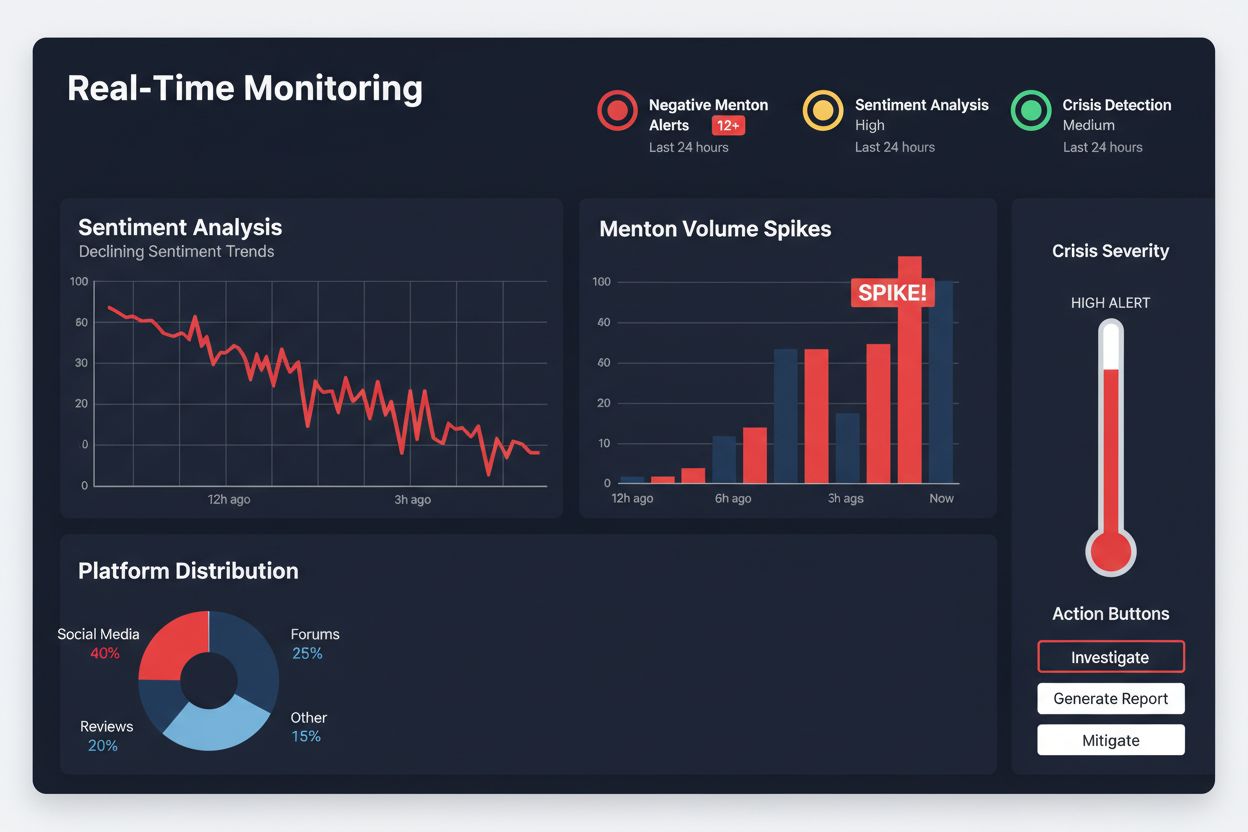
Learn how to detect and respond to negative brand mentions in AI search platforms with real-time alert systems. Protect your reputation before negative content ...