

How to Dispute and Correct Inaccurate Information in AI Responses
Learn how to dispute inaccurate AI information, report errors to ChatGPT and Perplexity, and implement strategies to ensure your brand is accurately represented...
9 min read

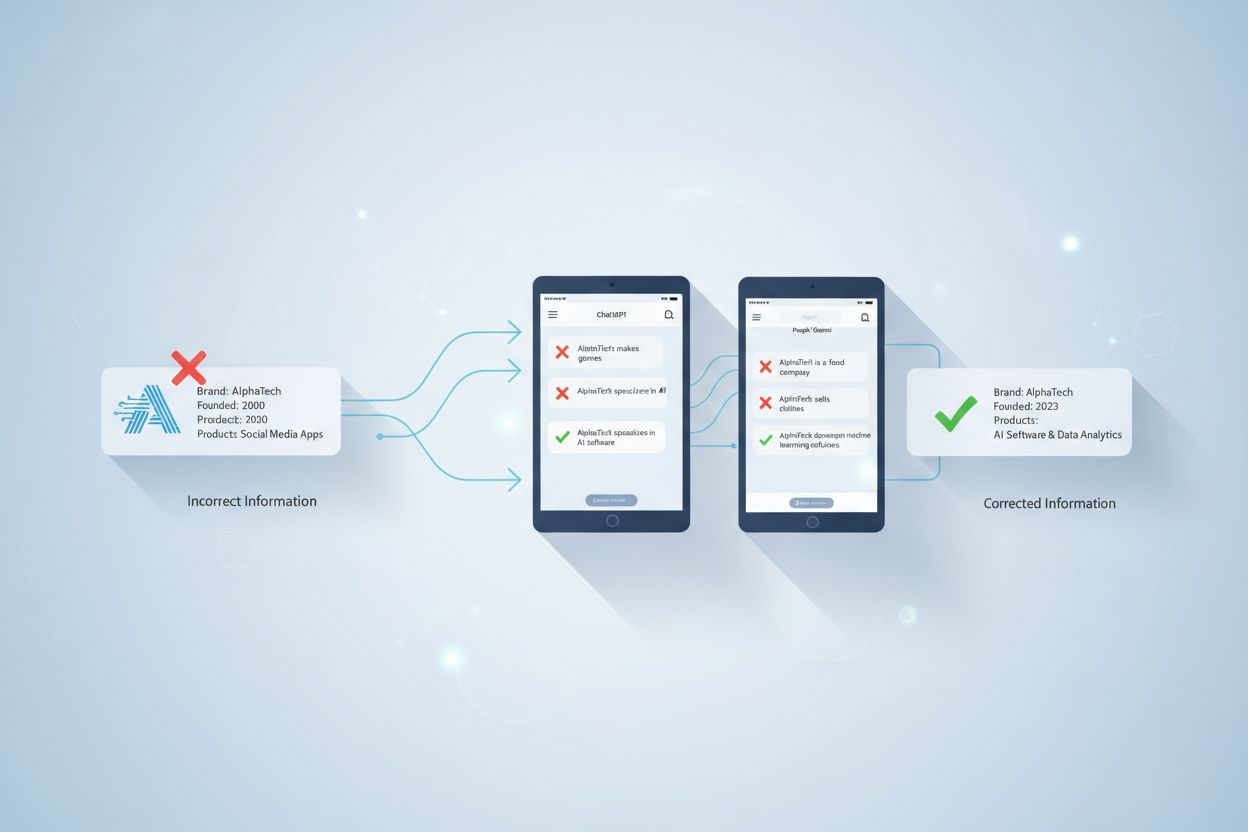
Learn effective strategies to identify, monitor, and correct inaccurate information about your brand in AI-generated answers from ChatGPT, Perplexity, and other AI search engines.
Monitor your brand mentions across AI platforms using dedicated tools, document inaccuracies, optimize your content with structured data, and work with AI developers to correct persistent errors. Focus on building a consistent online presence with accurate, authoritative information.
Incorrect AI mentions occur when large language models and AI chatbots distort your brand’s message, provide outdated information, or confuse your company with competitors. Unlike traditional search engines that display multiple sources, AI systems synthesize information into single, authoritative-sounding responses that users often trust without verification. This creates a significant challenge for brand reputation management because inaccuracies can spread rapidly and influence purchasing decisions without users having the opportunity to explore alternative sources. The stakes are particularly high because AI-generated answers often appear at the top of search results, making them the first impression potential customers have of your brand.
The consequences of incorrect AI mentions extend beyond mere inconvenience. When AI systems provide false information about your products, pricing, features, or company history, it can lead to customer confusion, lost sales, and damaged trust. Real-world cases demonstrate the severity of these issues—Air Canada faced legal liability when its chatbot provided incorrect bereavement fare information, and numerous companies have experienced revenue loss due to AI hallucinations that misrepresented their services or capabilities. The problem is compounded by the fact that AI models update unpredictably and retain errors in their “memory” for extended periods, making corrections more complex than simply updating your website content.
The first critical step in responding to incorrect AI mentions is establishing a systematic monitoring process across all major AI platforms where your customers might encounter information about your brand. This includes ChatGPT, Claude, Google Gemini, Microsoft Copilot, Perplexity, and any industry-specific AI tools relevant to your sector. Rather than waiting for customers to report errors, proactive monitoring allows you to identify inaccuracies early and address them before they damage your reputation. The monitoring process should be structured, documented, and repeated regularly to track how your brand representation evolves over time.
| AI Platform | User Base | Priority Level | Key Metrics to Track |
|---|---|---|---|
| ChatGPT | 200+ million users | Critical | Mention frequency, accuracy, positioning |
| Google Gemini | Integrated in search | Critical | Appearance in AI Overviews, context |
| Perplexity | Growing AI search users | High | Citation accuracy, competitive positioning |
| Claude | Enterprise users | High | Feature descriptions, company details |
| Microsoft Copilot | Windows/Office users | High | Product information, brand sentiment |
| Industry-specific AI | Niche audiences | Medium | Category-specific positioning |
To implement effective monitoring, create a standardized query list containing 10-15 questions your target customers would naturally ask about your products or services. These queries should cover different aspects of your business: product comparisons, pricing information, use cases, company history, and competitive positioning. For example, if you’re a project management software company, your queries might include “What’s the best project management tool for remote teams?” or “Compare [Your Product] vs [Competitor].” Document each response systematically, recording whether your brand was mentioned, its position in the response, the accuracy of information provided, competitors mentioned, overall sentiment, and any factual errors or outdated details.
Understanding the specific types of errors AI systems make about your brand helps you develop targeted correction strategies. Hallucinations represent the most problematic category—these are entirely fabricated facts that seem credible but never occurred, such as fictional product launches, partnerships that don’t exist, or controversies unrelated to your company. These errors are particularly damaging because they appear authoritative and users have no way to distinguish them from accurate information. Another common error type involves confusion with competitors or similarly-named brands, where AI systems conflate your company with others in your industry or companies with similar names in different sectors.
Outdated information represents another significant challenge, as AI models retain training data that may be months or years old. If your company has updated pricing, changed product features, expanded services, or modified company policies, AI systems may continue referencing the old information. Contextual misinterpretations occur when AI systems use factually correct information but present it without proper context, leading to misleading conclusions. For instance, if your company experienced a brief service outage that was quickly resolved, an AI system might emphasize this without mentioning the rapid resolution, creating a false impression of reliability issues. Generic name confusion particularly affects brands using common terms—if your company is called “Delta” and operates in multiple industries, AI systems may struggle to distinguish your specific business from other Delta companies.
Once you’ve identified incorrect AI mentions, thorough documentation becomes essential for developing effective correction strategies. Create a centralized tracking system—whether a spreadsheet, database, or specialized monitoring tool—that records each inaccuracy with specific details: the exact AI platform where the error appeared, the precise incorrect statement, the correct information, when the error was first detected, and whether it persists in subsequent checks. This documentation serves multiple purposes: it helps you identify patterns in how AI systems misrepresent your brand, provides evidence if you need to contact AI developers, and allows you to measure the effectiveness of your correction efforts over time.
Analyze your documented errors to identify recurring themes. Are certain product features consistently misrepresented? Does AI regularly confuse your company with a specific competitor? Are particular aspects of your company history frequently cited incorrectly? These patterns reveal where your brand information is most vulnerable and where you should focus your correction efforts. Additionally, track the sentiment and tone surrounding your brand mentions—even when factually accurate, AI systems might describe your company with qualifiers or caveats that subtly undermine your positioning. For example, an AI might describe your product as “a budget-friendly alternative” when you position yourself as a premium solution, or vice versa.
The most effective long-term strategy for reducing incorrect AI mentions involves optimizing your content to be more discoverable and understandable to AI systems. This goes beyond traditional SEO and requires a deliberate focus on clarity, structure, and comprehensiveness. Start by ensuring your website contains clear, authoritative information about your company, products, pricing, and history. AI systems rely heavily on editorial content—research shows that LLMs depend on editorial content for over 60% of their understanding of brand reputation. This means your official company information should be the primary source AI systems reference.
Implement structured data markup (schema.org) throughout your website to help AI systems understand your content more accurately. Use Organization schema to clearly define your company name, description, founding date, and contact information. Implement Product schema for each offering, including accurate descriptions, pricing, and features. Create comprehensive FAQ pages that address common questions about your products and services—these pages are particularly valuable because they directly answer the types of questions AI systems are trained to respond to. Ensure your content is consistent across all platforms: your website, social media profiles, business directories, and any third-party platforms where your company information appears. Inconsistencies confuse AI systems and increase the likelihood of misrepresentation.
An emerging approach to guiding AI systems involves implementing an llms.txt file on your website, similar to how robots.txt guides traditional web crawlers. This file provides explicit instructions to AI systems about how to handle your brand information, helping prevent common misunderstandings and clarifying ambiguities. While adoption remains limited among AI developers, implementing this standard positions your brand for better representation as the practice becomes more widespread. Your llms.txt file should clearly distinguish your brand from competitors with similar names, provide accurate and up-to-date information about your company, define your brand’s policies and values, and specify any information that should not be used in AI-generated responses.
The llms.txt file can address specific vulnerabilities in your brand representation. If your company name is commonly confused with another brand, explicitly state the distinction. If you’ve recently changed your business model or offerings, clearly document the current state. If certain controversies or issues have been misattributed to your company, address these directly. While there’s no guarantee that all AI systems will follow llms.txt guidelines—unlike robots.txt, which has broad consensus—this proactive approach demonstrates your commitment to accurate representation and provides a clear reference point when contacting AI developers about errors.
When persistent inaccuracies resist correction through content optimization alone, direct engagement with AI developers becomes necessary. Most major AI platforms provide mechanisms for reporting errors or requesting corrections, though these processes vary significantly. Start by identifying the specific AI system generating the incorrect information and locating its feedback or correction process. ChatGPT, for instance, allows users to provide feedback on responses, and while individual feedback may not immediately change the model, patterns of corrections inform future model updates.
When contacting AI developers, provide specific, well-documented evidence of the inaccuracy. Rather than simply stating “your AI got my company wrong,” provide the exact query that generated the error, the incorrect response, the correct information, and links to authoritative sources supporting the correction. Explain the business impact of the error and why accurate representation matters. Some AI platforms are more responsive to correction requests than others, and larger companies with dedicated brand management resources may have better success. However, even smaller companies can make progress by persistently documenting errors and providing clear correction guidance.
An effective response to incorrect AI mentions requires a multi-layered strategy combining monitoring, content optimization, and direct engagement. Begin by establishing a weekly or bi-weekly monitoring routine where team members systematically test your brand across major AI platforms using your standardized query list. Assign ownership of this process to specific team members and establish clear protocols for documenting findings. Create a content audit schedule to ensure your website information remains current and accurate—outdated information on your site directly contributes to AI misrepresentation. Review and update product descriptions, pricing information, company history, and service offerings at least quarterly, or more frequently if your business changes rapidly.
Develop a correction priority system that focuses your efforts on the most damaging inaccuracies first. Errors that directly impact customer purchasing decisions or create legal liability deserve immediate attention. Misrepresentations that affect your competitive positioning warrant high priority. Minor inaccuracies or outdated details that don’t significantly impact customer perception can be addressed through longer-term content optimization. Establish clear escalation procedures: if an inaccuracy persists despite content optimization efforts, escalate to direct contact with the AI platform. If an error causes significant business harm, involve your legal team to determine whether formal action is warranted.
Track the effectiveness of your correction efforts by monitoring whether specific inaccuracies persist or resolve over time. After implementing content changes or contacting AI developers, retest the same queries after 2-4 weeks to determine if the AI system’s responses have improved. Document these results to understand which correction strategies prove most effective for your brand. Additionally, monitor broader metrics like mention frequency across AI platforms, the average position of your brand when mentioned, accuracy scores, sentiment analysis, and competitive share of voice. These metrics provide a comprehensive view of your brand’s AI reputation and help you identify emerging issues before they become widespread problems.
Use your monitoring data to inform your content strategy and SEO efforts. If AI systems consistently misrepresent certain aspects of your business, this indicates a knowledge gap that your content should address more directly. If competitors consistently outrank you in AI mentions, analyze their content strategy to understand why AI systems prefer their representation. If specific product features are frequently misunderstood, create more detailed documentation and educational content about these features. This continuous feedback loop ensures that your brand management efforts evolve with the changing AI landscape and become increasingly effective over time.
Discover how your brand appears in AI-generated answers and take control of your AI reputation with real-time monitoring and actionable insights.
Learn how to dispute inaccurate AI information, report errors to ChatGPT and Perplexity, and implement strategies to ensure your brand is accurately represented...
Learn how to identify and correct incorrect brand information in AI systems like ChatGPT, Gemini, and Perplexity. Discover monitoring tools, source-level correc...
Learn effective methods to identify, verify, and correct inaccurate information in AI-generated answers from ChatGPT, Perplexity, and other AI systems.