
Generative Engine Optimization (GEO)
Learn what Generative Engine Optimization (GEO) is, how it differs from SEO, and why it's critical for brand visibility in AI-powered search engines like ChatGP...
11 min read

Learn how to scale GEO efforts across AI platforms like ChatGPT, Perplexity, and Google AI Overviews. Discover the 12-step framework for maximizing brand visibility in generative AI search results.
Scaling GEO efforts requires a systematic 12-step approach: audit your AI visibility, align objectives with business KPIs, ensure technical infrastructure readiness, implement strategic schema markup, restructure content for AI extractability, build question-based content architecture, establish E-E-A-T authority signals, execute web mentions strategy, map content to customer journey stages, deploy AI-specific tracking, avoid common mistakes, and implement continuous optimization cycles.
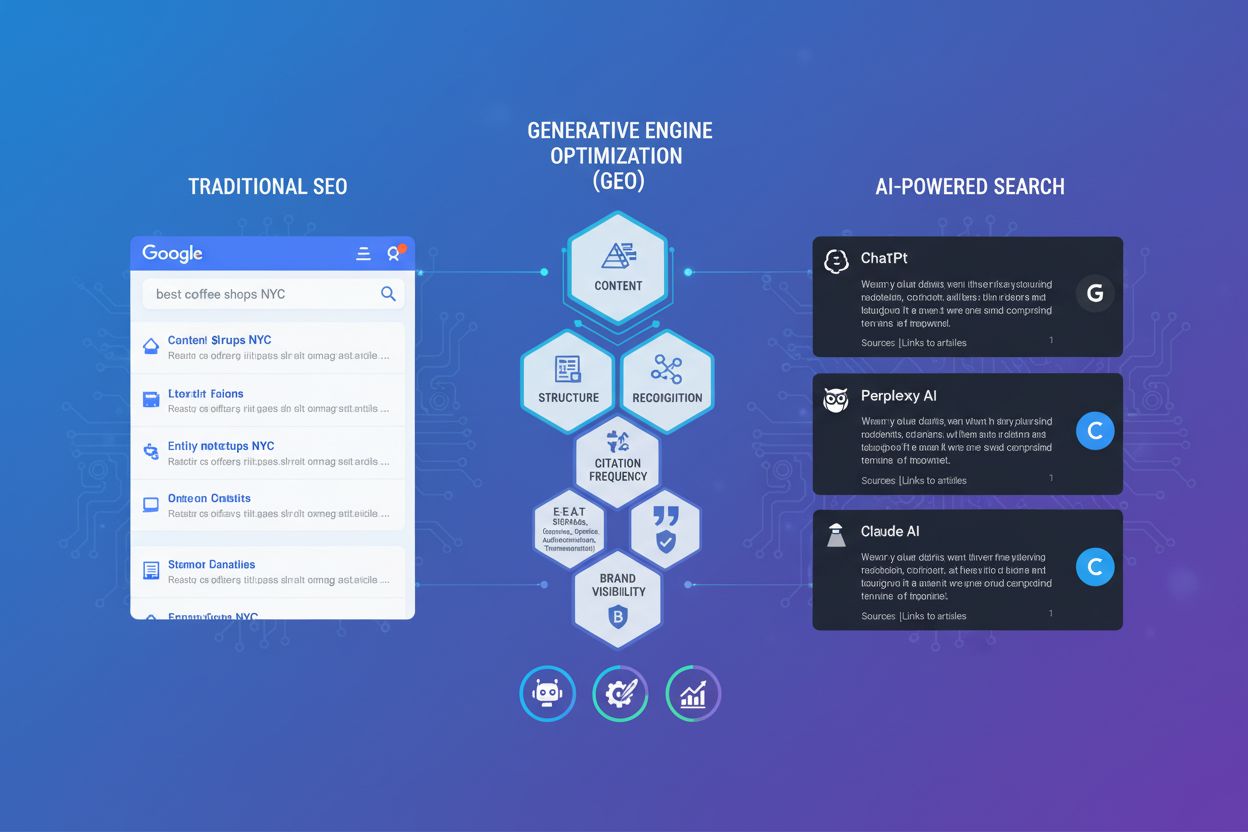
Generative Engine Optimization (GEO) is the process of optimizing your digital content to maximize visibility and citations within AI-powered platforms like ChatGPT, Claude, Perplexity, Google AI Overviews, and similar generative engines. Unlike traditional SEO, which focuses on ranking in search engine results pages, GEO concentrates on ensuring your content is recognized, sourced, and cited by large language models (LLMs) when formulating answers to user queries. Scaling GEO efforts means systematically implementing strategies across your entire content ecosystem to increase your brand’s appearance in AI-generated responses across multiple platforms and query types.
The urgency of scaling GEO cannot be overstated. Since Google launched AI Overviews in 2024, organic click-through rates for informational queries have fallen 61%, dropping from 1.76% to 0.61%. Approximately 60% of queries now end in zero-click answers, fundamentally shifting how users discover information. However, the opportunity is equally significant: AI-sourced visitors convert at 27%, compared to just 2.1% from traditional search traffic—a 12x improvement that fundamentally alters customer acquisition economics. This conversion differential makes scaling GEO efforts not just a marketing initiative but a critical business imperative.
Before scaling any effort, you must establish baseline metrics. Most marketing teams operate without understanding their current AI visibility, making it impossible to measure improvement or identify gaps. Start by querying the major AI platforms directly with searches relevant to your business. ChatGPT and Google AI Overviews average 3-4 brand citations per response, while Perplexity provides wider coverage with 13 average citations. Bing Chat/Copilot often surfaces different sources than Google, so testing across all platforms is essential.
Your audit should answer critical questions: Is your brand mentioned when users ask about your category? Which competitors appear in AI responses where you’re absent? What sources do AI systems cite for topics you should own? How does your visibility differ across platforms? According to Ahrefs research, roughly 26% of brands have zero mentions in AI Overviews, with visibility severely concentrated among top brands. The distribution reveals that the top 25% of brands by web mentions average 169 AI Overview mentions, while the bottom 50% have 0-3 mentions. If you’re in the bottom half, you’re essentially invisible to AI systems, making this audit your critical first step.
GEO isn’t a technical project—it’s a business initiative. Disconnecting AI visibility from revenue metrics leads to optimization without accountability. You must define success metrics that matter to your executive team: pipeline contribution, conversion rate differential, customer acquisition cost, and sales velocity. B2B SaaS companies see average CAC of $249 through GEO, with 40% faster pipeline velocity and 32% of SQLs attributed to AI platforms within 6 weeks. These benchmarks provide the evidence needed to justify continued investment.
The conversion difference changes everything. When comparing traditional search to AI-sourced traffic, the metrics are striking: AI traffic shows 12x higher conversion rates (27% vs 2.1%), 23% lower bounce rates, 12% more page views, and 41% longer visit duration. This data demonstrates that AI-sourced visitors are not just more numerous—they’re fundamentally more valuable. By connecting AI visibility goals to these revenue metrics, you create accountability and ensure your GEO efforts are measured against outcomes that matter to your business.
AI crawlers have stricter requirements than traditional search crawlers. Pages that merely hurt rankings in Google may be completely invisible to AI systems. Critical technical requirements include proper crawler access configuration, rendering approach, and performance standards. You must configure robots.txt to allow AI crawler access and implement llms.txt to communicate policies to AI systems specifically. Verify no accidental blocks on AI user agents, as this is a common oversight that renders entire sections of your site invisible.
Your rendering approach is equally critical. Use server-side rendering (SSR) or static site generation (SSG) rather than relying on client-side JavaScript rendering, which may leave content invisible to AI crawlers. AI crawlers may abandon or deprioritize pages that take longer than a few seconds to render, making Core Web Vitals function as direct ranking signals with stricter latency requirements than traditional crawlers. Ensure LCP (Largest Contentful Paint) is under 2.5 seconds, FID (First Input Delay) under 100ms, and CLS (Cumulative Layout Shift) under 0.1. Mobile rendering must also be verified for AI crawlers, and no JavaScript-dependent critical content should exist.
Structured data helps AI systems understand your content’s context and relationships. Schema markup is used in over 75% of high-performing GEO-optimized pages, making it a critical scaling component. Priority schema types for GEO include FAQPage (directly feeds Q&A to AI systems), HowTo (matches process/step queries), Author (strengthens E-E-A-T signals), Organization (improves brand entity recognition), Product (enables product information extraction), and Article (provides content context).
FAQ schema deserves particular attention. When your content answers questions in FAQ format with proper schema, AI systems can extract and cite those answers directly in response to matching queries. According to research, schema markup adoption among top-ranking websites sits between 30% and 40%, meaning proper implementation creates competitive advantage. Implementation is straightforward through JSON-LD format, which most modern CMS platforms support natively or through plugins.
AI systems extract discrete, citable units—not flowing prose. Content structured as direct answers achieves higher citation rates than narrative content covering the same information. The answer-first principle is fundamental: lead every section with the direct answer rather than burying key insights in paragraph three. Instead of narrative explanations, provide specific data points with clear attribution immediately.
Structural elements that improve extractability include numbered lists for processes and rankings, bullet points for features and benefits, tables for comparisons and data presentation, short paragraphs (2-4 sentences) for explanation, and clear H2/H3 hierarchy matching question structure. Brands using comparison tables and answer tables see up to 35% higher extractability and citation rates. Each major section should lead with a direct answer, paragraphs should average 2-4 sentences, key data points should be in tables or callout format, processes should use numbered lists, features should use bullet points, and headings should mirror how users phrase questions.
Content structured around explicit questions mirrors how users query AI systems. When your content directly answers questions using the phrasing users actually use, AI systems can match queries to answers more accurately. Different query types require different content structures: definitional queries need direct definitions plus key characteristics lists, process queries need numbered steps with brief explanations, comparison queries need comparison tables plus context, evaluation queries need criteria frameworks plus options analysis, and problem/solution queries need problem statements plus causes lists plus solutions.
FAQ development is particularly effective. FAQs directly match conversational query patterns and should be developed by analyzing actual queries users ask AI systems about your category, reviewing AI responses about competitors, mining customer conversations for prospect questions, and checking search data for question-format queries. Structure each FAQ with the question as a heading and the answer in the first 1-2 sentences, with supporting detail following. This structure ensures AI systems can efficiently extract and cite your answers.
AI systems evaluating citation worthiness look for verifiable expertise signals. Brands using author profile optimization and schema markup for creators see up to 50% higher citation rates. Build author profiles that AI systems can verify: dedicated author pages with credentials and expertise areas, author schema markup connecting content to verified profiles, external validation through LinkedIn profiles and industry publications, and consistent attribution across all content with links to author profiles.
Evidence and citation practices significantly improve citation rates by providing verifiable information. Cite primary sources rather than aggregated summaries, include specific data points with clear attribution, link to authoritative external sources that AI systems trust, and develop original research that provides unique, citable data. Original research creates citation-worthy content that competitors can’t replicate, making companies that publish original data, surveys, or analysis become primary sources that AI systems cite rather than secondary sources citing others. This first-party data advantage is particularly powerful for scaling GEO efforts across your entire content ecosystem.
This is the most underutilized lever in GEO. Branded web mentions show a 0.664 correlation with AI Overview visibility—3x stronger than the 0.218 correlation for backlinks. Teams optimized for link-building are systematically misallocating resources. This doesn’t mean backlinks are worthless; it means resource allocation that made sense for traditional SEO needs recalibration for GEO.
High-impact mention platforms include Wikipedia (high authority for training data), Reddit (active discussions influence retrieval and training), industry publications (establish category authority), review sites (product/service-specific visibility), and news media (current event and trend visibility). 40-60% of domains cited in AI answers change within one month, and over longer periods, 70-90% of cited domains change. Mention-building isn’t a one-time project—it requires continuous effort. Prioritize mentions on platforms that influence both training data (massive web snapshots) and retrieval data (current information), as this dual impact maximizes your scaling potential.
Generic content optimization misses stage-specific visibility opportunities. AI citation behavior differs across journey stages, and content optimized for one stage may be invisible to users at others. Awareness stage queries are problem-focused and broad, requiring comprehensive overviews and trend analysis with more citations and wider source variety. Consideration stage queries are solution-focused and comparative, requiring comparison content and evaluation criteria with fewer, more authoritative sources. Decision stage queries are brand/product-focused and specific, requiring specific product information and social proof with brand-specific citations.
Understanding what causes customers to begin AI-assisted research reveals visibility opportunities. These triggers—problems, events, or realizations—represent moments when potential customers first engage with AI systems. Audit existing content against journey stages, identify gaps where you lack visibility at specific stages, analyze competitor visibility at stages where you’re absent, and prioritize development for high-impact gaps. This stage-specific approach ensures your scaling efforts address the full customer journey rather than concentrating resources on a single funnel stage.
Traditional SEO metrics don’t capture AI visibility performance. Rankings, organic traffic, and impressions were designed for a click-through world that’s rapidly changing. AI-specific metrics include Share of Answer (how often your brand appears in AI responses), Citation Rate (how often AI systems cite your specific content), Brand Mention Frequency (how often AI references your brand), AI Referral Traffic (visitors arriving from AI platforms), and AI Conversion Rate (conversion rate of AI-sourced visitors).
Measurement challenges are significant: 56% of marketers don’t have enough time to analyze their data properly, and 38% lack tools to integrate and report it. These challenges intensify for AI visibility, where standard analytics platforms don’t natively track AI-sourced traffic. Implementation requires configuring UTM parameters for AI platform referrals where possible, monitoring AI platforms directly through regular query testing, implementing referrer tracking that identifies AI platform traffic, separating AI traffic in analytics dashboards from traditional organic, and tracking conversion paths that include AI touchpoints. Without tracking, you can’t identify what’s working, justify continued investment, or make evidence-based decisions.
Traditional SEO tactics don’t automatically translate to GEO success—some actively harm AI visibility. Keyword stuffing causes AI systems to penalize content that appears optimized for manipulation rather than user value. Ignoring search intent means ranking for keywords doesn’t help if content doesn’t match what AI users actually ask. Missing structured data prevents AI systems from efficiently parsing your content. Platform-generic optimization fails because ChatGPT, Perplexity, and Google AI Overviews have different citation behaviors.
Strategic pitfalls include the tracking blind spot (54% of marketers cite measuring results as a challenge), content freshness failures (AI assistants favor newer content more heavily than traditional search), and over-optimizing for comprehensiveness (GEO rewards clear, direct answers to specific questions rather than comprehensive coverage of many keyword variations). One practitioner’s experience illustrates this: publishing articles daily initially increased AIO and Copilot visibility, but after 2-3 weeks, visibility dropped sharply due to similar sentence structures and low engagement. Switching to 2-3 well-edited, GEO-optimized posts per week with human-edited data held stable positions in AI results for much longer. Combining automation with human input wins every time for stable, long-term visibility.
GEO isn’t a one-time implementation—it’s an ongoing program. Citation volatility means static optimization quickly loses effectiveness. Optimization cadence should include weekly AI platform query monitoring to track visibility changes, monthly performance metric reviews to assess progress against KPIs, monthly content freshness updates to maintain recency signals, quarterly strategy adjustments to adapt to platform changes, and quarterly competitive visibility analysis to identify new gaps and opportunities.
Triggers for immediate optimization include significant traffic shifts from AI sources, competitor visibility gains in your category, product or service changes requiring content updates, AI platform algorithm or behavior changes, and new competitor entries affecting citation share. When specific content types, structures, or topics achieve strong AI visibility, document the pattern, create templates to standardize the successful format, apply systematically to additional content, and monitor consistency to ensure scaled content maintains quality signals. 70% compliance or higher with GEO checklist items is a recommended target for effective AI visibility, with the goal of iterating toward comprehensive implementation.
| Optimization Activity | Frequency | Purpose |
|---|---|---|
| AI platform query monitoring | Weekly | Track visibility changes |
| Performance metric review | Monthly | Assess progress against KPIs |
| Content freshness updates | Monthly | Maintain recency signals |
| Strategy adjustment | Quarterly | Adapt to platform changes |
| Competitive visibility analysis | Quarterly | Identify new gaps and opportunities |
Phase 1: Foundation (Weeks 1-4) focuses on completing your AI visibility audit, aligning GEO objectives with business KPIs, verifying technical infrastructure, and implementing priority schema markup. Phase 2: Content Optimization (Weeks 5-12) involves restructuring existing content for extractability, building question-based content architecture, establishing E-E-A-T authority signals, and launching your web mentions strategy. Phase 3: Journey Integration (Weeks 13-20) includes mapping content to customer journey stages, deploying AI-specific tracking, auditing for common mistakes, and establishing continuous optimization cycles. Ongoing optimization requires monthly performance reviews, quarterly strategy adjustments, continuous content freshness maintenance, and systematic scaling of successful patterns.
The window for first-mover advantage is narrowing. With only 16% of brands systematically tracking AI visibility and 62% of CMOs already adding it as a KPI, the competitive landscape is shifting quickly. The brands establishing AI visibility now will have compounding advantages over competitors who wait. By following this 12-step framework and maintaining continuous optimization cycles, you position your brand to dominate AI search results and capture the high-value, high-converting traffic that generative AI platforms deliver.
Track how your brand appears across ChatGPT, Perplexity, Google AI Overviews, and other generative AI platforms. Get real-time insights into your AI search performance and optimize your visibility.
Learn what Generative Engine Optimization (GEO) is, how it differs from SEO, and why it's critical for brand visibility in AI-powered search engines like ChatGP...

Learn Generative Engine Optimization (GEO) fundamentals. Discover how to get your brand cited in ChatGPT, Perplexity, and Google AI Overviews with proven strate...

Learn how to get started with Generative Engine Optimization (GEO) today. Discover essential strategies to optimize your content for AI search engines like Chat...