
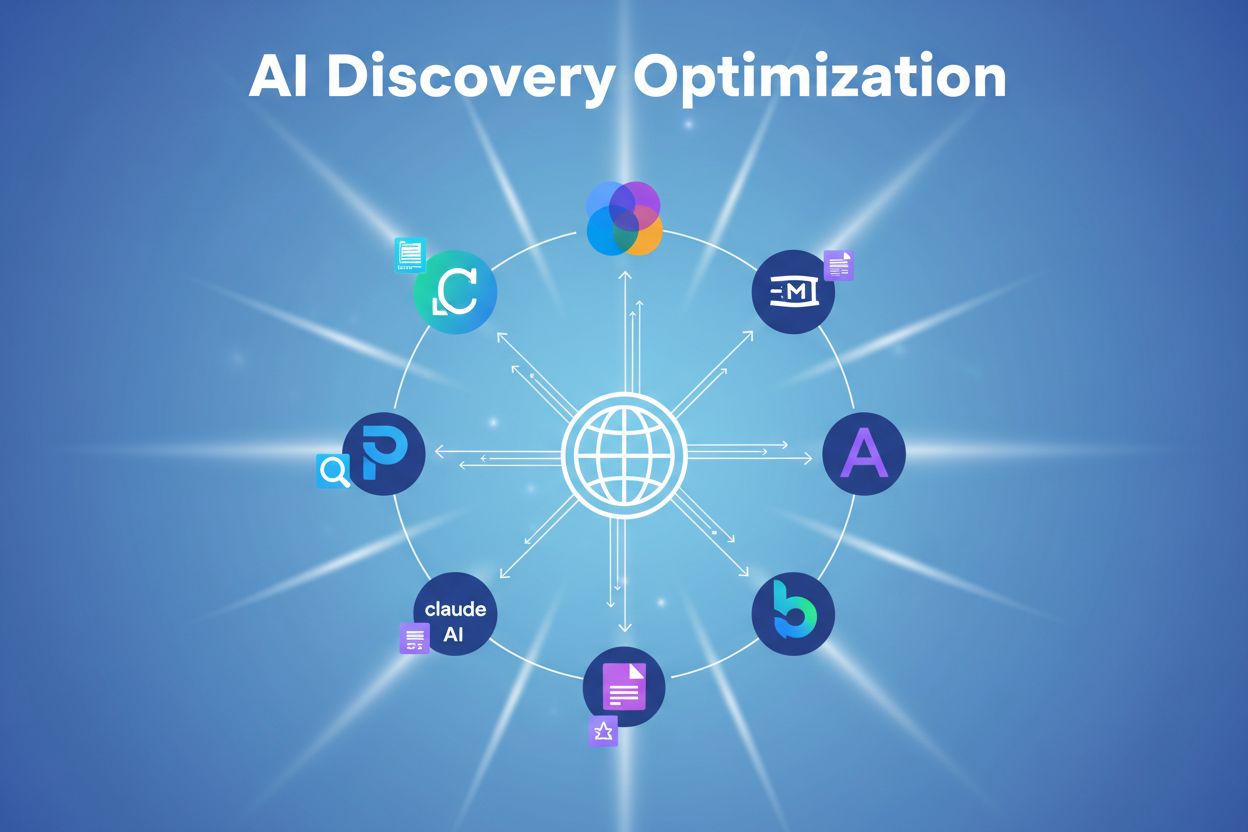
AI Discovery Optimization
Learn how to optimize content for AI discovery. Understand AI crawlers, content structure, and strategies to ensure your brand is found and cited by ChatGPT, Ge...
9 min read

Learn proven strategies to accelerate AI content discovery including content structuring, schema markup implementation, semantic optimization, and technical SEO best practices for faster visibility in AI search results.
Speed up AI content discovery by creating unique, well-structured content with clear headings, schema markup, and optimized formatting. Focus on semantic clarity, ensure technical crawlability, and build topical authority through interconnected content clusters.
AI content discovery has fundamentally changed how audiences find information online. Rather than scrolling through traditional search results, users now receive synthesized answers from AI systems like ChatGPT, Perplexity, Google AI Overviews, and Microsoft Copilot. For brands and content creators, this shift means visibility is no longer about ranking position alone—it’s about being selected as the authoritative source in AI-generated responses. Understanding how to accelerate this discovery process is essential for maintaining competitive advantage in the evolving search landscape.
AI content discovery refers to how artificial intelligence systems find, evaluate, and surface your content when generating answers to user queries. Unlike traditional search engines that rank entire pages, AI systems parse content into smaller, modular pieces and assemble them into comprehensive responses. Speed matters because AI referrals to top websites increased 357% year-over-year in June 2025, reaching 1.13 billion visits. This explosive growth means the competition for visibility is intensifying rapidly. Brands that optimize early gain significant advantages, while those who delay risk becoming invisible to audiences relying on AI-powered search experiences.
The key difference is that traditional SEO focuses on ranking pages, while AI content discovery focuses on being selected as the preferred answer. This requires a fundamentally different approach to content creation, structure, and optimization. Your content must be easy for AI systems to parse, understand, and extract with confidence. When your content is structured correctly, AI systems can lift it directly into answers, dramatically increasing your visibility and driving higher-quality traffic to your site.
AI systems don’t read content the way humans do. Instead, they use a process called parsing to break pages into smaller, structured pieces. These modular segments are then evaluated for relevance, authority, and clarity before being assembled into final answers. Understanding this process is crucial for optimizing your content effectively.
When an AI system encounters your page, it first checks for technical crawlability—can it access the content? Does the page return an HTTP 200 status code? Is the content indexable? These foundational requirements remain essential. However, the real differentiation happens during parsing. The system identifies key structural elements like H1 tags, H2 headings, schema markup, and formatted lists to understand content boundaries and extract relevant information. If your content lacks clear structure, AI systems struggle to parse it effectively, reducing the likelihood of selection.
| Traditional Search Ranking | AI Content Discovery |
|---|---|
| Ranks entire pages in a list | Extracts and assembles content pieces into answers |
| Focuses on keyword matching | Prioritizes semantic clarity and authority |
| Rewards page-level optimization | Rewards modular, structured content |
| Visibility = ranking position | Visibility = being selected as the answer |
| Slower to adapt to new queries | Faster to synthesize multiple sources |
The selection process also considers authority signals. AI systems evaluate whether your content comes from a trusted source, whether it’s current and accurate, and whether it’s backed by credible data or citations. This means building topical authority—establishing your brand as a recognized expert in a specific domain—becomes increasingly important for accelerated discovery.
Structured content is the foundation of AI discovery acceleration. AI systems can only select and surface content they can clearly understand. This means every element of your page—from titles to headings to formatting—must signal meaning and intent to machine learning algorithms.
Your page title, meta description, and H1 tag are the first signals AI systems use to interpret your content’s purpose. These elements should align closely and communicate clear value. A strong title like “Best Quiet Dishwashers for Open-Concept Kitchens” tells both users and AI exactly what to expect. Your H1 should match or closely reflect this title, and your meta description should explain the outcome or value without keyword stuffing. This alignment improves both discoverability and confidence signals for AI systems, making your content more likely to be selected.
H2 and H3 tags act as chapter markers that define clear content slices for AI parsing. Instead of vague headings like “Learn More,” use specific, question-based headings like “What Makes This Dishwasher Quieter Than Most Models?” This approach mirrors how users search and makes it easier for AI to extract relevant segments. Each heading should introduce a distinct idea, allowing AI systems to understand where one concept ends and another begins. This modular structure is essential for accelerating discovery because it gives AI systems clear boundaries to work with.
Direct Q&A pairs are highly effective for AI discovery because they mirror natural search queries. When you structure content as questions with concise answers, AI systems can often lift these pairs directly into responses. For example: “Q: How loud is the dishwasher? A: It operates at 42 dB, which is quieter than most dishwashers on the market.” This format is immediately usable by AI systems and increases the likelihood of selection.
Bulleted lists, numbered steps, and comparison tables break complex information into clean, reusable segments. They’re especially effective for how-to queries and feature comparisons. A bulleted list of top features is far more likely to be selected by AI than the same information buried in paragraph form. Tables are particularly powerful because they present structured data that AI systems can parse with high confidence. When presenting multiple options or comparisons, always use tables to accelerate discovery.
Schema markup is structured data code that helps AI systems understand your content with greater precision. It’s typically added in JSON-LD format as a script in your page’s backend, often through your CMS or by a developer. Schema markup transforms plain text into machine-readable data, allowing AI systems to classify your content as a product, review, FAQ, article, or event with confidence.
For example, if you’re writing product reviews, adding Review schema tells AI systems exactly which elements are ratings, which are reviewer names, and which are review text. This clarity accelerates discovery because AI systems don’t have to guess—they know exactly what they’re working with. Similarly, FAQ schema is particularly valuable because it explicitly marks questions and answers, making your content immediately eligible for AI-generated responses.
Common schema types that accelerate discovery include:
Implementing schema markup doesn’t guarantee selection, but it dramatically improves your chances by removing ambiguity. AI systems can process schema-marked content faster and with greater confidence, leading to accelerated discovery.
Semantic clarity refers to how clearly your content communicates meaning to both humans and machines. AI systems don’t just scan for keywords—they analyze the relationships between concepts, the precision of language, and the consistency of context. Content with strong semantic clarity is discovered and selected faster because AI systems can understand it with minimal processing.
To achieve semantic clarity, write for intent, not just keywords. If a user searches “quiet dishwasher for open kitchen,” your content should directly address this specific need rather than just mentioning “quiet” and “dishwasher” separately. Use precise, measurable language instead of vague terms. Instead of saying a dishwasher is “innovative,” specify that it “operates at 42 dB with AI-powered cycle optimization.” This precision helps AI systems understand exactly what you’re offering and match it to user intent more accurately.
Avoid vague language like “eco-friendly” or “next-generation” without context. Anchor all claims in measurable facts. Add context to every statement—a product page should say “42 dB dishwasher designed for open-concept kitchens” instead of just “quiet dishwasher.” This contextual richness helps AI systems classify your content correctly and increases the likelihood of selection.
Use synonyms and related terms to reinforce meaning. If you’re writing about dishwashers, use terms like “noise level,” “sound rating,” “decibel,” and “quiet operation” throughout your content. This semantic reinforcement helps AI systems connect concepts and understand your content’s full scope, accelerating discovery across multiple related queries.
Content freshness is a critical factor in AI discovery acceleration. AI systems prioritize current, up-to-date information because users expect accurate, relevant answers. Outdated content is less likely to be selected, even if it’s well-structured and authoritative. This means you must establish a content refresh cycle to maintain visibility in AI search results.
Regularly update your content with new statistics, recent examples, and current insights. If you published an article about “Best Dishwashers for 2024,” update it in 2025 with new models and current pricing. Add publication dates and last-updated timestamps to signal freshness to both users and AI systems. When you refresh content, make meaningful updates—not just changing dates. AI systems can detect superficial updates and may penalize them.
Establish a content audit schedule to identify which pieces need updating. Prioritize content that ranks well or receives significant traffic, as these pieces have the most impact on your visibility. For evergreen content, plan quarterly or semi-annual reviews. For time-sensitive content like industry trends or product reviews, update monthly or more frequently. This commitment to freshness accelerates discovery because AI systems recognize your content as a reliable, current source.
Technical SEO remains the foundation of AI content discovery acceleration. Even perfectly structured content won’t be discovered if AI systems can’t access it. Ensure your site meets these technical requirements:
These technical foundations are non-negotiable. Without them, even the best content won’t be discovered quickly. Audit your site regularly using tools like Google Search Console and Rich Results Test to identify and fix technical issues promptly.
Topical authority refers to establishing your brand as a recognized expert in a specific domain. AI systems prioritize content from authoritative sources, making topical authority essential for accelerated discovery. Rather than publishing isolated articles on random topics, create interconnected content clusters that comprehensively cover a specific subject area.
For example, if you’re in the appliance industry, don’t just write one article about quiet dishwashers. Instead, create a cluster of related content: “How Dishwashers Work,” “Noise Levels Explained,” “Best Quiet Dishwashers,” “Dishwasher Maintenance Tips,” and “Energy-Efficient Dishwashers.” Interlink these articles to form a knowledge hub. This approach signals to AI systems that you’re a comprehensive authority on dishwashers, making your content more likely to be selected for related queries.
Update older content to reinforce expertise. When you publish new articles, link back to related older pieces and update those pieces to link forward. This creates a web of interconnected content that demonstrates depth and breadth of knowledge. AI systems recognize these patterns and reward them with faster discovery and higher selection rates.
Understanding what not to do is equally important as knowing what to do. Common formatting mistakes significantly slow down AI discovery:
Avoid these mistakes to ensure your content is parsed quickly and accurately by AI systems.
Snippet optimization is crucial for accelerated discovery. In AI search, snippets are the concise pieces of content that AI systems extract and weave into answers. Content that’s optimized for snippet selection is discovered and surfaced faster because it’s immediately usable.
To optimize for snippets, provide concise answers (one to two sentences) that directly address questions. Use structured formatting like lists, tables, and Q&A blocks that can be lifted cleanly. Ensure your headings are strong and signal where complete ideas start and end. Write with self-contained phrasing—sentences that make sense even when pulled out of context.
For example, instead of: “Dishwashers can be quiet. Some models operate at lower decibel levels. This is important for open kitchens,” write: “The quietest dishwashers operate at 38-42 dB, making them ideal for open-concept kitchens where noise travels easily.” This self-contained, precise phrasing is immediately snippable and more likely to be selected by AI systems.
Multimodal content—combining text, images, and videos—accelerates AI discovery by providing multiple entry points for AI systems to understand and surface your content. High-quality images with descriptive alt text help AI systems understand visual content. Videos with transcripts provide additional text for parsing. Product images with detailed descriptions increase the likelihood of selection in multimodal AI search results.
Ensure your Business Profile and Merchant Center information is up-to-date, as AI systems use this data for local and product-related queries. Add high-quality images to product pages with descriptive filenames and alt text. Create video content with transcripts to provide additional indexable text. This multimodal approach gives AI systems more material to work with, accelerating discovery across different query types.
Monitoring is essential for understanding whether your optimization efforts are working. Track metrics like:
Use tools like Search Console, Google Analytics, and specialized AI monitoring platforms to track these metrics. This data helps you understand what’s working and where to focus optimization efforts for continued acceleration.
Speeding up AI content discovery requires a multifaceted approach combining content structure, semantic clarity, technical excellence, and authority building. Focus on creating unique, valuable content that directly addresses user intent. Structure everything with clear headings, schema markup, and formatted lists to make parsing easy. Ensure technical crawlability and maintain content freshness through regular updates. Build topical authority through interconnected content clusters. Monitor performance and adjust your strategy based on data.
The brands that embrace these practices early will dominate AI search results, capturing attention from audiences relying on AI-powered discovery. Those who delay risk invisibility in this rapidly evolving landscape. Start optimizing today to ensure your content is discovered, selected, and surfaced to the audiences that matter most.
Track how your content appears in AI-generated answers across ChatGPT, Perplexity, Google AI Overviews, and other AI search engines. Get real-time alerts when your brand is mentioned.
Learn how to optimize content for AI discovery. Understand AI crawlers, content structure, and strategies to ensure your brand is found and cited by ChatGPT, Ge...

Discover the best content formats for AI search engines like ChatGPT, Perplexity, and Google AI Overviews. Learn how to optimize your content for AI visibility ...

Learn how to audit your content for AI visibility and prioritize updates. Complete framework for ChatGPT, Perplexity, and Google AI Overviews with actionable st...