
Building Your Brand Entity for AI Recognition
Learn how to build and optimize your brand entity for AI recognition. Implement schema markup, entity linking, and structured data to improve visibility in LLM ...
16 min read

Learn how to strengthen your brand entity for AI search visibility. Optimize for ChatGPT, Perplexity, Google AI Overviews, and Claude with entity SEO strategies.
Strengthen your brand entity by establishing consistent identity across platforms, implementing structured data markup, building topical authority through content clusters, and monitoring your presence in AI search systems. This involves defining your entity clearly in knowledge graphs, earning mentions from authoritative sources, and ensuring semantic alignment across all digital touchpoints.
A brand entity is how search engines, AI systems, and knowledge graphs understand and represent your company as a distinct, recognizable concept. Unlike traditional SEO that focuses on keywords and page rankings, entity optimization treats your brand as a unique “thing” that AI systems can identify, categorize, and relate to other entities across the web. Your brand entity is the foundation of visibility in modern AI search platforms like ChatGPT, Perplexity, Google AI Overviews, and Claude. When these systems generate answers, they don’t just match keywords—they retrieve and connect entities to build meaning. If your brand entity is weak or poorly defined, AI systems struggle to understand who you are, what you offer, and why you’re authoritative. This directly impacts whether your brand appears in AI-generated responses, even when your content is relevant. Strengthening your brand entity means becoming unmistakably recognizable to machines, which translates to better visibility for humans searching through AI interfaces.
Traditional SEO operated on a simple principle: match keywords to queries, earn backlinks, and climb rankings. This model worked because search engines displayed ranked lists of results. However, AI search fundamentally changes this dynamic. Platforms like ChatGPT and Perplexity don’t return ranked lists—they synthesize answers by understanding semantic relationships between entities. Research shows that 21% of all Google searches now display AI Overviews, forcing brands to optimize for entity-level visibility rather than keyword rankings. The shift from keyword-based to entity-based search means your brand must be understood at a conceptual level. AI systems learn from patterns across the entire web, not just your website. When your brand is consistently mentioned alongside relevant topics, integrated into industry discussions, and clearly defined in knowledge sources, these systems internalize your entity’s meaning and relevance. This is why entity optimization has become essential for Generative Engine Optimization (GEO)—the practice of optimizing for AI-driven discovery.
| Component | Definition | Impact on AI Visibility | Implementation Priority |
|---|---|---|---|
| Entity Definition | Clear, consistent description of what your brand is and does | Helps AI systems categorize and understand your brand | Critical |
| Structured Data Markup | Schema.org markup (Organization, Product, LocalBusiness) | Enables machines to parse brand attributes directly | Critical |
| Knowledge Graph Presence | Verified entity in Google Knowledge Graph, Wikidata, Crunchbase | Increases recognition across AI systems | High |
| Topical Authority | Content clusters demonstrating expertise in specific domains | Strengthens semantic relationships with relevant topics | High |
| Consistent Mentions | Brand references across authoritative third-party sources | Reinforces entity credibility and notability | High |
| Entity Relationships | Clear connections to related entities (products, people, locations) | Helps AI understand your brand’s context and relevance | Medium |
| NAP Consistency | Name, Address, Phone data aligned across all platforms | Prevents entity disambiguation issues | Medium |
The first step in strengthening your brand entity is creating a clear, consistent entity definition that you can communicate across all platforms. This definition should answer three fundamental questions: What is your brand? What does it do? Why is it authoritative? Start by crafting a semantic triple—a simple statement that captures your brand’s essence. For example: “Omnisend is an email and SMS marketing platform for ecommerce businesses.” This triple should be concise enough to appear in your About page, social media bios, directory listings, and structured data markup. The consistency matters enormously because AI systems recognize patterns. When they see your brand described identically across multiple authoritative sources, they gain confidence in that definition. Inconsistency—different descriptions on your website versus LinkedIn versus Crunchbase—creates confusion and weakens your entity. Beyond the semantic triple, develop a brand entity bio that expands on your core offering. Include your value propositions, target audience, key differentiators, and relevant history. This bio should be written with machine understanding in mind, using clear language and explicit entity relationships. For instance, instead of “We help businesses grow,” write “We provide marketing automation tools that integrate with Shopify to increase abandoned cart recovery rates by up to 35%.” The second version explicitly connects your brand to relevant entities (Shopify, marketing automation, abandoned cart recovery) that AI systems can recognize and relate.
Structured data markup is how you communicate your brand’s attributes directly to search engines and AI systems in their native language. Using Schema.org markup in JSON-LD format, you can define your organization’s properties, relationships, and characteristics. The most important markup for brand entity strengthening is Organization schema, which should include: your official brand name, alternate names (if applicable), logo, description, contact information, social media profiles, awards, and key people. Research from Schema App shows that pages enriched with entity linking tend to see stronger engagement and visibility in AI-generated results compared to pages without structured markup. When implementing Organization schema, go beyond the minimum required fields. Include properties like sameAs (linking to your Wikipedia, Wikidata, and social profiles), knowsAbout (topics your brand is associated with), and areaServed (geographic regions you serve). These properties help AI systems understand your brand’s scope and relevance. Additionally, implement Product schema for your offerings, Person schema for key team members, and LocalBusiness schema if you have physical locations. Each piece of structured data creates another signal that reinforces your entity’s definition and relationships. Tools like Google’s Natural Language API can help you test whether your markup is being interpreted correctly by machines.
Strengthening your brand entity requires demonstrating topical authority—deep expertise in specific domains relevant to your business. AI systems recognize topical authority through content clusters: interconnected pieces of content that comprehensively cover a topic from multiple angles. Instead of publishing isolated blog posts, create pillar pages that serve as authoritative hubs for major topics, then support them with cluster content that explores specific subtopics. For example, if you’re an email marketing platform, your pillar page might be “Email Marketing for Ecommerce,” with cluster content covering “Abandoned Cart Email Sequences,” “Welcome Series Best Practices,” “Deliverability Optimization,” and “Shopify Email Integration.” This structure signals to AI systems that your brand has deep expertise in ecommerce email marketing. The interconnections between these pieces of content create semantic relationships that strengthen your entity’s association with these topics. Research shows that brands with strong topical authority appear 3-4 times more frequently in AI-generated answers compared to brands with scattered, unrelated content. When building content clusters, ensure each piece explicitly connects to your brand entity. Use your brand name naturally throughout, link to your core offerings, and reference your unique methodologies or frameworks. This reinforces the semantic connection between your brand and the topics you’re covering.
Knowledge graphs are the structured databases that power entity recognition across search engines and AI systems. Google’s Knowledge Graph, Wikidata, Crunchbase, and industry-specific databases all maintain entity records. Your brand entity is stronger when it’s verified and detailed across these platforms. Start by checking whether your brand already exists in these databases. Use the Kalicube Google Knowledge Graph API Explorer to see what Google currently knows about your brand. If your entity exists but is incomplete or inaccurate, update it. If it doesn’t exist, you may need to create it. For Wikidata, you can create an entity record if your brand meets notability criteria (generally, having significant media coverage or being a recognized company). Include properties like industry, founding date, headquarters location, key people, products, and website. For Crunchbase, claim your company profile and ensure all information is current and comprehensive. These database entries serve as authoritative sources that AI systems reference when building their understanding of your brand. The more complete and accurate your entity records across these platforms, the more confidently AI systems can represent your brand. Additionally, ensure your Google Business Profile is fully optimized if you have physical locations. This profile directly feeds into Google’s knowledge panel and influences how your brand appears in AI Overviews.
One of the most powerful ways to strengthen your brand entity is through strategic mentions from authoritative sources. Unlike traditional backlinks, these mentions don’t require hyperlinks—they’re simply references to your brand in relevant contexts. When Perplexity, ChatGPT, or Google AI Overviews generate answers, they often cite brands that appear frequently in authoritative discussions about related topics. Research indicates that authentic mentions in Reddit discussions, podcast transcripts, and industry publications carry significant weight in how AI systems understand your brand’s relevance. Focus on earning mentions in contexts where your brand is genuinely relevant. If you’re an email marketing platform, aim for mentions in ecommerce blogs, marketing technology roundups, and Shopify ecosystem discussions. These co-citations—mentions of your brand alongside related entities like “Shopify,” “email automation,” or “abandoned cart recovery”—create semantic connections that strengthen your entity. The key is authenticity. AI systems are increasingly sophisticated at recognizing genuine mentions versus manufactured ones. A Reddit comment where someone says “We switched from Klaviyo to Omnisend because the Shopify integration actually works” carries more weight than a forced mention in a low-quality directory. Build relationships with industry influencers, contribute to relevant discussions, and create content so valuable that others naturally reference it. This organic approach to earning mentions strengthens your entity far more effectively than any artificial tactic.
AI systems extract entities from content using natural language processing (NLP). To make your content more extractable and useful to these systems, structure it with entity recognition in mind. Use clear, context-rich passages that explicitly establish relationships between entities. Instead of writing “Our platform helps businesses increase revenue,” write “Our SMS automation integrates with Shopify’s abandoned cart data to trigger personalized recovery messages within 2 hours of cart abandonment.” The second version establishes multiple entity relationships (your brand → SMS automation → Shopify integration → abandoned cart recovery) within a single extractable passage. Format your content for easy parsing by AI systems. Use H2 headings as natural language questions that users might ask AI tools. Structure FAQ sections with clear question-answer pairs. Include comparison tables that help AI systems understand how your offering relates to alternatives. Use bullet points to break down complex information into digestible components. These formatting choices make your content more likely to be cited or paraphrased in AI-generated responses. Additionally, test your content using Google’s Natural Language API to see which entities the system recognizes. This helps you identify gaps where you should be more explicit about entity relationships. The goal is to make your content so clearly structured that AI systems can easily extract and understand the information you’re presenting.
Strengthening your brand entity requires ongoing monitoring and adjustment. Unlike traditional SEO where you can track rankings in Google Search Console, AI search visibility requires specialized monitoring tools. Platforms like AmICited allow you to track how your brand appears across ChatGPT, Perplexity, Google AI Overviews, and Claude. These tools simulate queries related to your industry and track whether your brand is mentioned, how it’s positioned relative to competitors, and in what contexts it appears. Regular monitoring reveals important insights: Are you appearing in AI answers for your target keywords? Are you being mentioned alongside the right competitor entities? Is your brand description accurate in AI-generated responses? Are there gaps where you should be appearing but aren’t? By tracking these metrics monthly, you can identify which content strategies are working and where you need to adjust. For example, if you notice your brand appears frequently in AI answers about “email marketing for ecommerce” but rarely in “SMS marketing,” you know you need to build more topical authority in SMS. This data-driven approach to entity strengthening is far more effective than guessing. Additionally, monitor your brand mentions across Reddit, industry forums, and podcast transcripts. Tools that track unlinked mentions help you understand how your brand is being discussed in authentic contexts. These discussions often influence how AI systems understand your brand’s relevance and positioning.
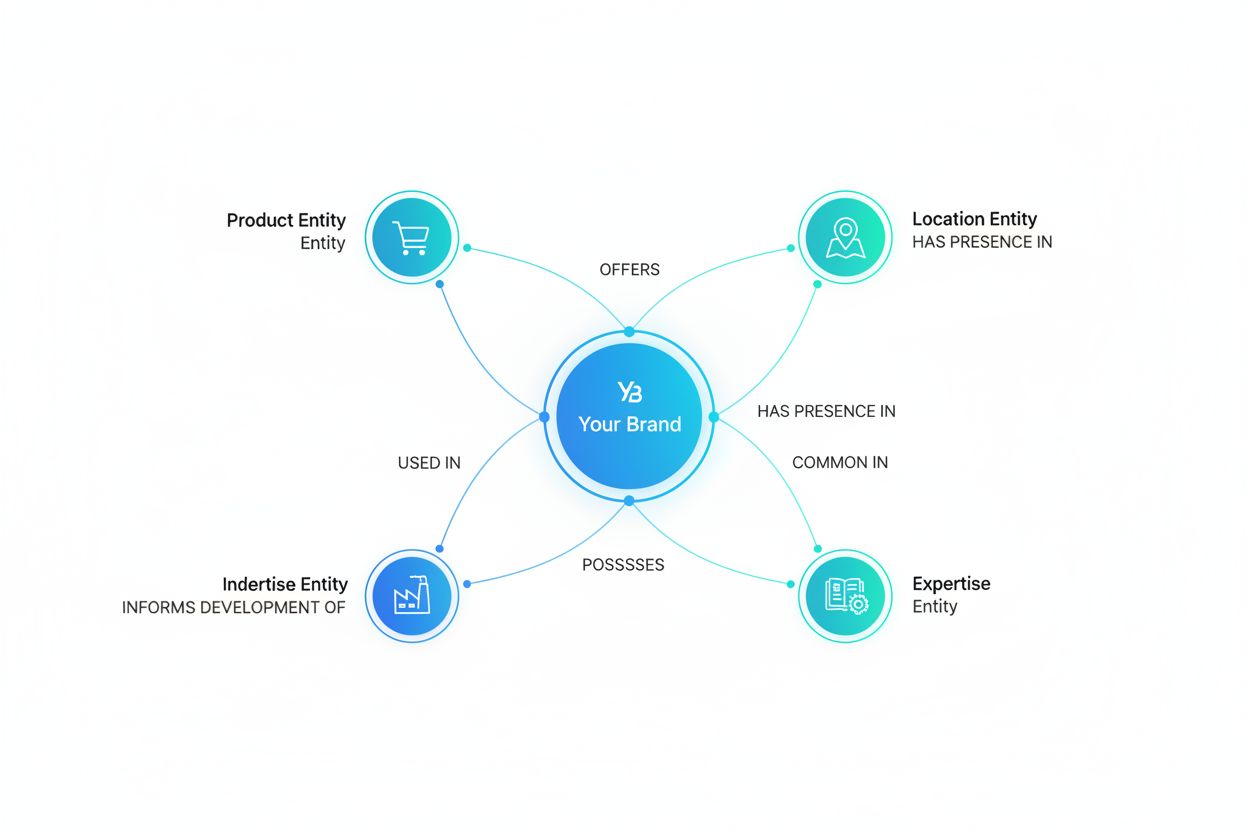
Your brand entity doesn’t exist in isolation—it’s part of a larger network of related entities. Strengthening your brand entity means explicitly establishing relationships with other relevant entities. If you’re an email marketing platform, your entity should be clearly connected to entities like “Shopify,” “ecommerce,” “marketing automation,” “SMS marketing,” and “abandoned cart recovery.” These connections are established through multiple mechanisms: your content explicitly mentions and links to these related entities, your structured data markup includes properties that reference related entities, and third-party sources consistently mention your brand in contexts involving these entities. The strength of these relationships directly impacts your visibility in AI search. When someone asks ChatGPT “What’s the best email marketing tool for Shopify stores?”, the AI system retrieves entities related to “email marketing,” “Shopify,” and “ecommerce,” then ranks them by relevance. If your brand entity has strong semantic connections to all three of these concepts, you’re more likely to appear in the answer. To build these relationships, create content that naturally explores connections between your brand and related entities. Write comparison posts, integration guides, and use-case articles that establish these semantic links. Implement structured data that explicitly defines these relationships. Earn mentions from sources that discuss these related entities. Over time, these efforts create a dense network of semantic connections that make your brand entity more discoverable across multiple query contexts.
As AI search continues to evolve, entity optimization will become increasingly central to digital visibility. The shift from keyword-based to entity-based search represents a fundamental change in how brands are discovered. Currently, approximately 65% of marketers are not yet optimizing for entity-based search, creating a significant opportunity for early adopters. In the coming years, we’ll likely see even greater emphasis on semantic understanding, with AI systems becoming more sophisticated at recognizing entity relationships and context. Brands that invest in entity strengthening now will have a substantial advantage. The infrastructure you build—clear entity definitions, comprehensive structured data, topical authority, and strategic mentions—creates a foundation that becomes more valuable as AI systems become more prevalent. Additionally, the integration of AI automation tools like FlowHunt can help streamline the process of monitoring and optimizing your entity presence. These tools can automate the tracking of brand mentions, monitor entity consistency across platforms, and identify opportunities for strengthening your semantic relationships. The brands that will dominate AI search are those that treat their entity as a strategic asset worthy of ongoing investment and refinement. Your brand entity is no longer just about how humans perceive you—it’s about how machines understand you. By strengthening this foundation, you ensure visibility across the entire spectrum of modern search experiences.
Track how your brand appears in ChatGPT, Perplexity, Google AI Overviews, and Claude. AmICited helps you strengthen your entity presence by monitoring brand mentions and visibility across all major AI systems.
Learn how to build and optimize your brand entity for AI recognition. Implement schema markup, entity linking, and structured data to improve visibility in LLM ...

Learn what entity optimization for AI is, how it works, and why it's critical for visibility in ChatGPT, Perplexity, and other AI search engines. Complete techn...
Learn how entity optimization helps your brand become recognizable to LLMs. Master knowledge graph optimization, schema markup, and entity strategies for AI vis...