
Content Restructuring for AI: Before and After Examples
Learn how to restructure your content for AI systems with practical before and after examples. Discover techniques to improve AI citations and visibility across...
10 min read

Learn how to structure your content to get cited by AI search engines like ChatGPT, Perplexity, and Google AI. Expert strategies for AI visibility and citations.
Structure content for AI citations by using clear question-based headings, breaking content into passage-ready sections of 100-300 words, implementing proper schema markup, and ensuring your content directly answers specific sub-questions that AI systems extract and cite.
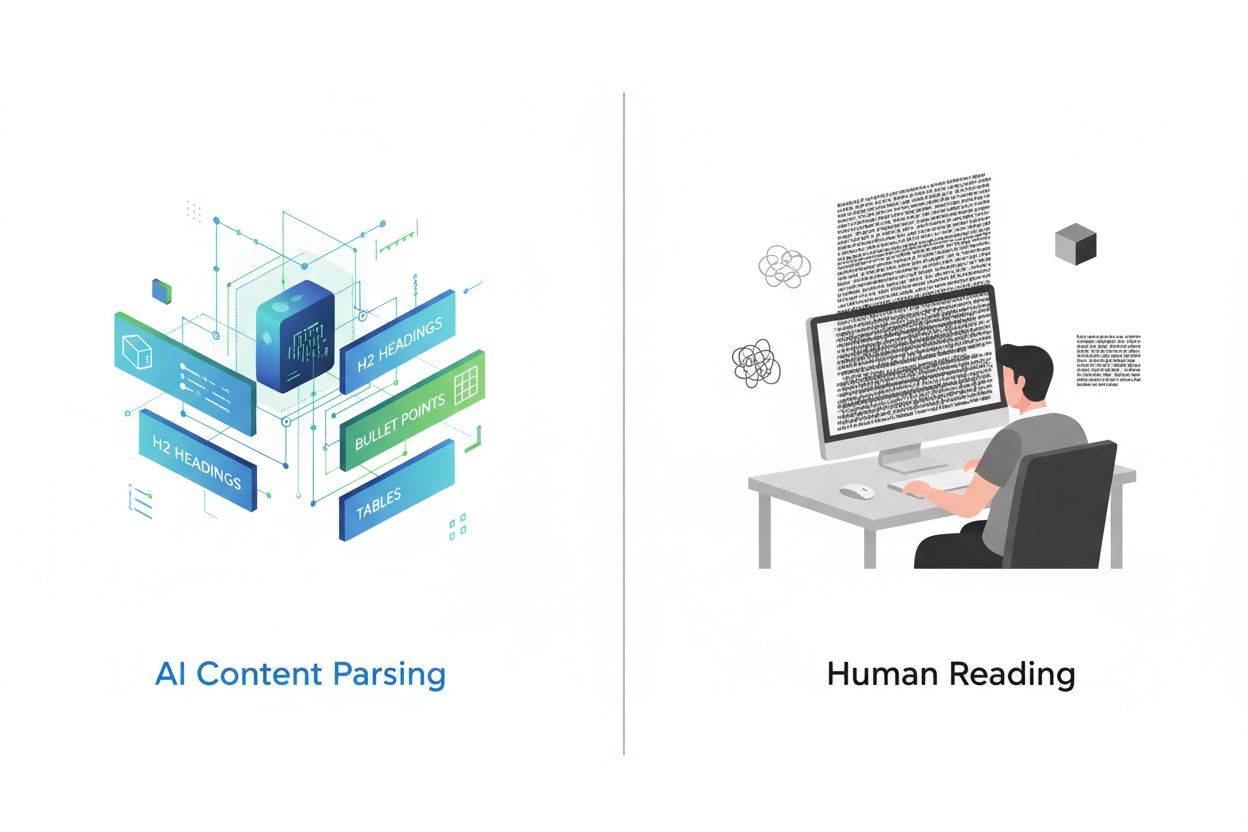
Artificial intelligence systems fundamentally process content differently than traditional search engines, which means your content structure must adapt to how AI models extract, evaluate, and cite information. When AI systems like ChatGPT, Perplexity, and Google’s AI Overviews encounter your content, they don’t read it the way humans do. Instead, they break pages into discrete passages, score each fragment for relevance and quality, and determine which sections cleanly answer specific parts of user queries. This passage-based evaluation means that dense paragraphs and vague topic headings significantly reduce your chances of being cited, while clear, structured content dramatically increases your visibility in AI-generated answers. Understanding this fundamental difference is the first step toward optimizing your content for AI citations and ensuring your brand appears in the AI answers your customers are reading.
The most critical element of AI-citable content is using actual questions as your section headings rather than vague topic labels. AI systems are trained to recognize and extract question-answer pairs, making this structure inherently more compatible with how they process information. Instead of a heading like “Insurance Issues,” use “Which Insurance Policy Covers a Rideshare Accident?” This specificity signals to AI systems that the following content directly addresses a particular query. Each section should function as a standalone passage that can be extracted and cited independently, typically containing 100 to 300 words of focused content. This passage-ready approach means every heading should introduce a complete thought, and the body text should deliver a comprehensive answer without requiring readers to reference other sections. The goal is to make your content so clearly structured that AI systems can confidently extract and cite individual sections without losing context or meaning.
AI systems employ a technique called query fan-out, where they automatically decompose broad questions into multiple sub-questions to provide comprehensive answers. When someone asks “What should I do after a rideshare accident?”, the AI breaks this into component questions: Which insurance policy applies? What should a passenger document? How does liability work? Which deadlines matter? If your article only scratches the surface of these sub-questions, you provide nothing precise for the system to extract and cite. However, when you directly address each sub-question with dedicated sections and clear answers, you become an invaluable source for citation. This means conducting thorough research into the actual questions your audience asks and then creating dedicated content sections for each one. Use tools like search query data, customer support conversations, and AI systems themselves to identify these sub-questions, then structure your content to answer each one explicitly and comprehensively.
| Content Element | Traditional SEO Approach | AI Citation Approach | Impact on Citations |
|---|---|---|---|
| Headings | Keyword-focused, vague topics | Question-based, specific queries | High - AI systems recognize question patterns |
| Paragraph Length | 150-200 words | 100-300 words per section | High - Improves passage extraction |
| Content Depth | Surface-level coverage | Comprehensive sub-question answers | Critical - Determines citation worthiness |
| Formatting | Minimal structure | Heavy use of lists, tables, bold text | High - Improves scannability for AI |
| Schema Markup | Optional enhancement | Essential for context | Medium - Provides machine-readable context |
| Internal Linking | For SEO juice | For topical clustering | Medium - Signals content relationships |
Structured data serves as a bridge between human-readable content and machine-readable information, providing AI systems with explicit context about your content’s meaning and purpose. When you implement schema markup correctly, you’re essentially translating your content into a language that AI systems understand more efficiently. For FAQ pages, use the FAQ schema; for how-to content, implement HowTo schema; for articles, use Article schema with proper author, publication date, and headline information. This markup doesn’t just help AI systems understand your content—it also signals that you’ve invested effort in making your information accessible and trustworthy. Critically, your structured data must match exactly what appears on your visible page. If your schema says one thing but your visible content says another, AI systems will deprioritize your content as unreliable. This alignment between markup and visible content is a trust signal that increases the likelihood of citation. Additionally, ensure your schema includes author information, publication dates, and update dates, as AI systems use these signals to assess content freshness and authority.
AI systems process content more efficiently when it’s formatted for scannability, which means using bold text, bullet points, numbered lists, and short paragraphs throughout your content. While traditional SEO advice emphasized keyword density and paragraph length, AI optimization requires the opposite: break up dense text, highlight key terms with bold formatting, and use lists to present multiple related points. This formatting serves dual purposes—it makes content more useful for human readers while simultaneously making it easier for AI systems to identify and extract key information. When you use bullet points to list related items, you’re essentially pre-processing the information in a way that AI systems find highly valuable. Each bullet point should be a complete thought that can stand alone, not a fragment that requires context from surrounding text. Similarly, numbered lists work exceptionally well for step-by-step processes, as AI systems can easily extract and cite sequential information. Tables are particularly powerful for AI citations because they present structured data in a format that’s both human-readable and machine-parseable.
AI systems increasingly rely on topical authority signals to determine which sources to cite, meaning you need to demonstrate comprehensive expertise across related topics rather than creating isolated articles. This requires building content clusters where a pillar article covers a broad topic, and supporting articles address specific sub-topics, all internally linked to show topical relationships. When AI systems crawl your site and discover that you’ve created extensive, interconnected content about a specific domain, they’re more likely to cite you as an authoritative source. This topical clustering also helps AI systems understand the full context of your expertise. For example, if you’re writing about AI citations, you should also have comprehensive content about AI search engines, content optimization, brand monitoring, and related topics. The depth of your content matters more than the breadth—AI systems prefer sources that thoroughly explore topics rather than those that skim the surface. This means each article should provide genuine value, include specific examples and data, and demonstrate that you’ve invested significant effort in understanding the topic.
Understanding how AI crawlers interact with your site is essential for maximizing citations. Major AI systems deploy their own crawlers—GPTBot for ChatGPT, PerplexityBot for Perplexity, ClaudeBot for Claude, and various Google crawlers for Google’s AI features—and these bots visit pages they find valuable for training data and real-time information retrieval. You can monitor which pages these crawlers visit most frequently by analyzing your server logs or using specialized tools, then use this data to inform your content strategy. Pages that receive frequent AI crawler visits are likely to be cited more often, so analyzing crawler patterns reveals which of your content topics AI systems find most valuable. Additionally, ensure your robots.txt file doesn’t block these AI crawlers, and verify that your site’s technical infrastructure supports efficient crawling. Fresh, regularly updated content receives more frequent AI crawler visits, so maintaining an active publishing schedule signals to AI systems that your site contains current, valuable information worth citing.
Beyond content structure, technical requirements must be met for AI systems to effectively crawl, index, and cite your content. Your pages must return HTTP 200 status codes, contain indexable text content, and be accessible to bot traffic. Avoid blocking Googlebot or other major AI crawlers in your robots.txt file, as this prevents AI systems from discovering and citing your content. Ensure your site loads quickly, as slow-loading pages may be deprioritized by AI crawlers. If you use JavaScript to render content, verify that the rendered content is accessible to crawlers—many AI systems can execute JavaScript, but some may struggle with heavily client-side-rendered pages. Implement proper canonical tags to consolidate duplicate content, as AI systems need to understand which version of a page is authoritative. Additionally, use appropriate meta tags like noindex and nosnippet strategically—while these tags give you control over your content’s visibility, overly restrictive settings will limit your AI citations. The goal is to make your content as technically accessible as possible while maintaining control over how it’s displayed.
Creating AI-citable content is only half the battle—you also need to monitor where and how your content appears in AI-generated answers. Tools like Amicited allow you to track mentions of your brand, domain, and specific URLs across ChatGPT, Perplexity, Google AI Overviews, and other AI search engines. By monitoring your AI citations, you can identify which content topics AI systems find most valuable, understand how your content is being used in AI answers, and discover new opportunities for optimization. This data reveals patterns in what AI systems cite, helping you refine your content strategy over time. Additionally, monitoring AI citations helps you understand the quality of traffic coming from AI sources—research shows that clicks from AI Overviews tend to be higher quality, with users spending more time on sites and being more likely to convert. Rather than optimizing purely for click volume, focus on the overall value of your visits from AI sources, including engagement metrics, conversion rates, and user satisfaction. This holistic approach ensures your content strategy aligns with actual business outcomes rather than vanity metrics.
Track where your brand appears in AI-generated answers across ChatGPT, Perplexity, Google AI, and other AI search engines. Get real-time alerts when your content is cited.
Learn how to restructure your content for AI systems with practical before and after examples. Discover techniques to improve AI citations and visibility across...
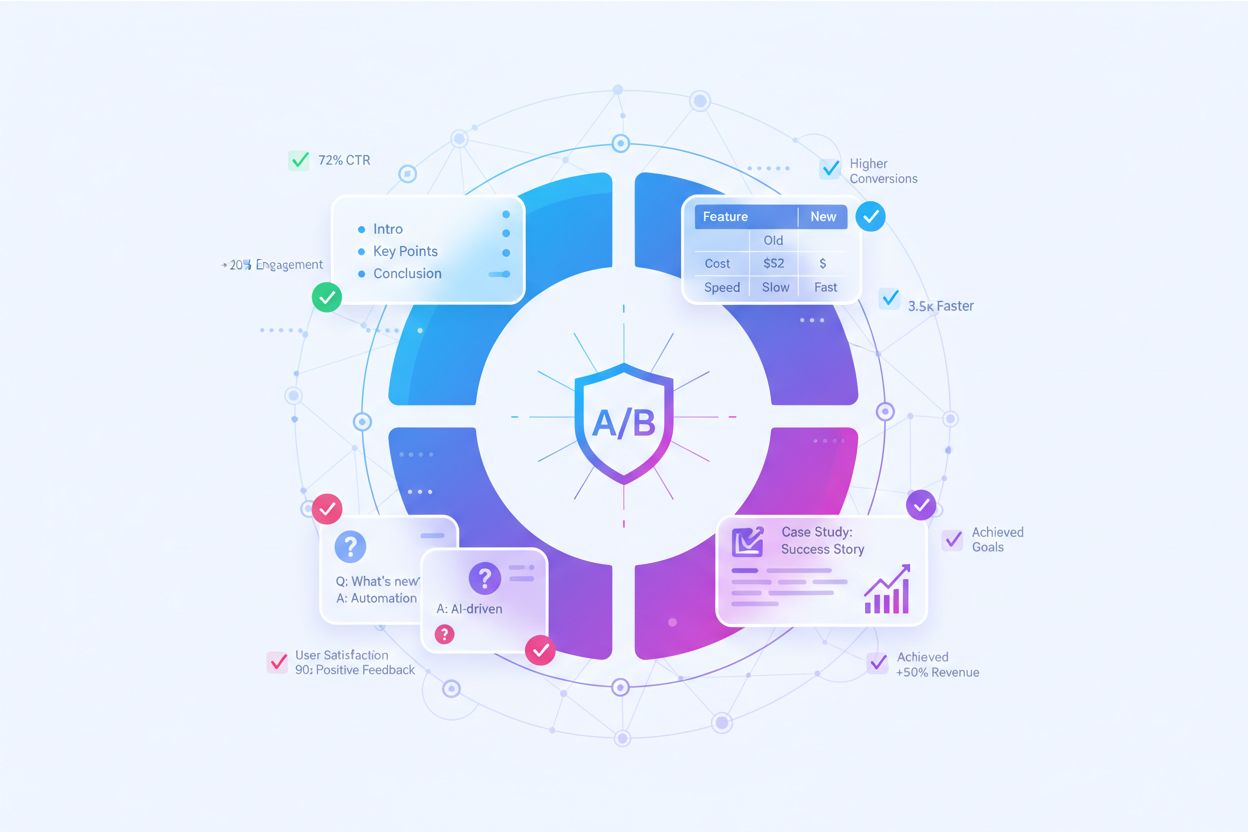
Learn how to test content formats for AI citations using A/B testing methodology. Discover which formats drive the highest AI visibility and citation rates acro...

Learn how to optimize content readability for AI systems, ChatGPT, Perplexity, and AI search engines. Discover best practices for structure, formatting, and cla...