
AI Competitive Intelligence
Learn what AI Competitive Intelligence is and how to monitor competitor visibility across ChatGPT, Perplexity, and Google AI Overviews. Track citations, share o...
8 min read

Learn how to monitor when competitors appear in ChatGPT, Perplexity, Claude, and other AI search engines. Discover tools and strategies for tracking AI visibility and competitive intelligence.
Track competitor mentions in AI chatbots using specialized monitoring tools like Sight AI, Promptwatch, or Peec AI that monitor brand appearances across ChatGPT, Perplexity, Claude, and Google AI Overviews. These platforms provide visibility data, sentiment analysis, and competitive benchmarking to help you understand how AI systems represent your competitors.
Tracking competitor mentions in AI chatbots represents a fundamental shift in competitive intelligence. Unlike traditional search engine optimization where you monitor keyword rankings on results pages, AI search operates differently—it synthesizes information from multiple sources and delivers direct answers to users. When someone asks ChatGPT, Perplexity, or Claude about solutions in your industry, your competitors may be mentioned while you remain invisible. This creates a critical blind spot that most marketers haven’t yet addressed. The challenge is that AI search engines don’t publish their results publicly, making it impossible to manually check where competitors appear. Specialized monitoring tools have emerged to solve this problem by continuously tracking when and how competitors get mentioned across major AI platforms.
The shift toward AI-powered discovery is accelerating rapidly. Research shows that 58% of consumers have replaced traditional search engines with generative AI tools for product recommendations, and traditional organic search traffic is expected to decline by 50% by 2028. This means your competitors could be dominating AI-generated recommendations in your category while you have no visibility into their presence. Unlike traditional SEO where you can see competitor rankings on Google’s results pages, AI search visibility remains completely opaque without dedicated monitoring tools. When users ask AI chatbots for recommendations, they typically receive only a handful of cited sources—often just 3-5 companies. If your competitors appear in those citations and you don’t, you’re losing potential customers at a critical decision point. Understanding competitor positioning in AI answers helps you identify gaps in your own content strategy and reveals opportunities to improve your visibility.
When monitoring competitors in AI chatbots, focus on these essential metrics to understand their visibility and positioning:
| Metric | Definition | Why It Matters |
|---|---|---|
| Mention Frequency | How often competitors appear in AI responses to relevant queries | Shows which competitors dominate AI recommendations in your category |
| Citation Rate | Whether competitor websites are cited as sources in AI-generated answers | Indicates content quality and authority that AI systems recognize |
| Share of Voice | Competitor visibility compared to your brand across AI platforms | Reveals competitive gaps and relative market positioning |
| Sentiment & Positioning | How AI describes competitors (leader, alternative, niche player) | Shows the narrative AI is building around competitor brands |
| Platform Distribution | Competitor visibility across ChatGPT, Perplexity, Claude, Gemini | Identifies which AI platforms favor certain competitors |
| Query Triggers | Specific questions that cause competitor mentions | Reveals content gaps and topic opportunities for your brand |
AI search monitoring platforms use sophisticated technology to track competitor mentions across multiple AI platforms simultaneously. These tools work by submitting hundreds of relevant queries to ChatGPT, Perplexity, Claude, Google AI Overviews, and other AI search engines, then analyzing the responses to identify which brands get mentioned and in what context. The process involves continuous monitoring because AI responses vary based on query phrasing, user location, and the AI model’s training data. Rather than relying on a single query, professional monitoring tools use statistical sampling across variations to build accurate visibility profiles. The data collected includes not just whether competitors appear, but also their positioning within the response, whether their website is cited as a source, and the sentiment of the mention. This comprehensive approach provides competitive intelligence that would be impossible to gather manually.
Understanding where your competitors appear requires monitoring across multiple AI platforms, as each has different user bases and data sources:
ChatGPT dominates with over 800 million weekly users and represents the largest AI search audience. Competitors appearing in ChatGPT responses reach the broadest user base and should be a primary monitoring focus.
Google AI Overviews appear on billions of Google searches, making them increasingly important for visibility. As Google integrates AI answers directly into search results, competitor mentions here directly impact discovery.
Perplexity attracts research-oriented users and has become a preferred platform for detailed information gathering. Competitors visible in Perplexity often appear in responses to complex, research-heavy queries.
Claude is growing rapidly with integration into Safari and other platforms. Competitors appearing in Claude responses reach users who prefer this AI model’s approach to information synthesis.
Gemini represents Google’s standalone AI assistant and is gaining traction quickly. Monitoring competitor visibility here helps you understand their presence in Google’s AI ecosystem.
Each platform draws from different data sources and uses distinct retrieval methods, meaning a competitor might dominate in ChatGPT while being invisible in Perplexity. Comprehensive competitor tracking requires monitoring across all major platforms to get a complete picture of their AI search presence.
Several dedicated platforms have emerged to help marketers monitor competitor visibility in AI chatbots. Sight AI combines monitoring with content creation capabilities, allowing you to track competitor mentions while simultaneously identifying content gaps and creating optimized articles. Promptwatch connects AI visibility to actual business outcomes by tracking whether competitor mentions drive traffic and conversions to their websites. Peec AI specializes in competitive benchmarking and sentiment analysis, showing exactly how AI describes competitors relative to your brand. Nimt AI provides continuous monitoring with strategic recommendations for improving your own visibility based on competitor analysis. Profound serves enterprise organizations managing multiple brands with advanced analytics and custom reporting. Writesonic integrates monitoring with content creation workflows, helping you understand what competitor content gets cited and then create similar high-performing pieces. Scrunch takes a deeper approach by analyzing how AI models fundamentally understand competitors at the semantic level, helping you reshape brand perception. Each tool offers different strengths depending on whether you prioritize basic monitoring, competitive intelligence, attribution to business outcomes, or strategic content guidance.
To effectively track competitor mentions, start by identifying the specific queries where you compete. Map the questions your potential customers ask at each stage of their buying journey, focusing on natural language prompts rather than traditional keywords. These might include questions like “What’s the best solution for [problem]?” or “How do I [accomplish goal]?” Once you’ve identified your core competitive queries, input them into your chosen monitoring platform. Most tools allow you to track 10-50+ competitors simultaneously, so include your direct competitors, indirect alternatives, and emerging players in your space. Configure the platform to monitor across all major AI search engines—ChatGPT, Perplexity, Claude, Google AI Overviews, and Gemini at minimum. Set up regular reporting frequency, typically weekly or monthly, to track how competitor visibility changes over time. Many platforms offer automated alerts when significant visibility changes occur, allowing you to respond quickly to competitive shifts. The initial setup usually takes 30-60 minutes, after which the platform handles continuous monitoring automatically.
When you receive monitoring data showing competitor mentions, the analysis phase determines whether you gain actionable insights. Look beyond simple mention counts to understand how AI describes each competitor. Is the competitor positioned as the market leader, a specialized alternative, or a budget option? Does AI cite their website as an authoritative source, or merely mention them in passing? Examine which specific queries trigger competitor mentions—this reveals the topics and questions where they’ve built visibility. If a competitor appears in responses about “enterprise solutions” but not “small business tools,” that shows their content strategy focus. Compare competitor visibility across different AI platforms to identify where they’re strongest. A competitor dominating in Perplexity but weak in ChatGPT suggests they’ve optimized for research-oriented queries. Track sentiment and context—does AI mention competitors positively, neutrally, or in comparison to alternatives? This contextual understanding reveals whether competitors are winning on features, price, reputation, or other factors. Use this analysis to identify gaps in your own content strategy and opportunities to improve your positioning.
Tracking competitor mentions in AI chatbots reveals strategic opportunities that traditional competitive analysis misses. When you see competitors appearing in AI responses about specific topics, you’ve identified content that AI systems recognize as authoritative and citation-worthy. Analyze what makes their content attractive to AI models—do they include statistics, expert quotes, clear structure, or comprehensive coverage? Use these insights to create competing content that addresses the same topics with equal or greater depth. If competitors appear in responses about problems you solve but you don’t, that’s a clear gap to address. Monitor how competitor positioning changes over time—if a competitor suddenly appears in new query categories, they’ve likely published new content or improved their existing material. Track which competitor content gets cited most frequently, as this indicates the topics and formats that drive AI visibility. Use this intelligence to prioritize your own content creation efforts toward topics where competitors are already winning, giving you a roadmap for improvement. The competitive data also helps you understand market perception—if AI consistently describes competitors using certain language or attributes, that reveals the narrative you need to counter or match.
Effective competitor monitoring only creates value when integrated into your broader marketing strategy. Schedule regular review sessions—weekly or monthly depending on your industry’s pace—to analyze competitor visibility trends and discuss implications with your team. Use competitor data to inform your content strategy, identifying topics where you should create or improve content to compete for AI visibility. When you discover competitors appearing in queries where you should be visible, prioritize creating content that addresses those specific questions comprehensively. Track your own visibility alongside competitor data to measure whether your optimization efforts are working. If competitors are gaining visibility while you remain static, you need to accelerate your content efforts. Use competitor insights to guide your technical SEO and content structure improvements—if competitors’ content is getting cited, study their formatting, depth, and source attribution. Share competitor monitoring insights with your content team to help them understand what types of content drive AI visibility. Connect AI visibility data to business outcomes by tracking whether improved competitor positioning correlates with changes in their website traffic or market share. This integration ensures that competitor monitoring translates into concrete competitive advantages rather than remaining a passive reporting exercise.
Get real-time insights into how your competitors appear in AI-generated answers. Track mentions, analyze positioning, and identify opportunities to improve your own AI search presence.
Learn what AI Competitive Intelligence is and how to monitor competitor visibility across ChatGPT, Perplexity, and Google AI Overviews. Track citations, share o...

Learn how to track competitor mentions in AI search engines. Monitor ChatGPT, Perplexity, Claude, and Google AI visibility with share of voice metrics.
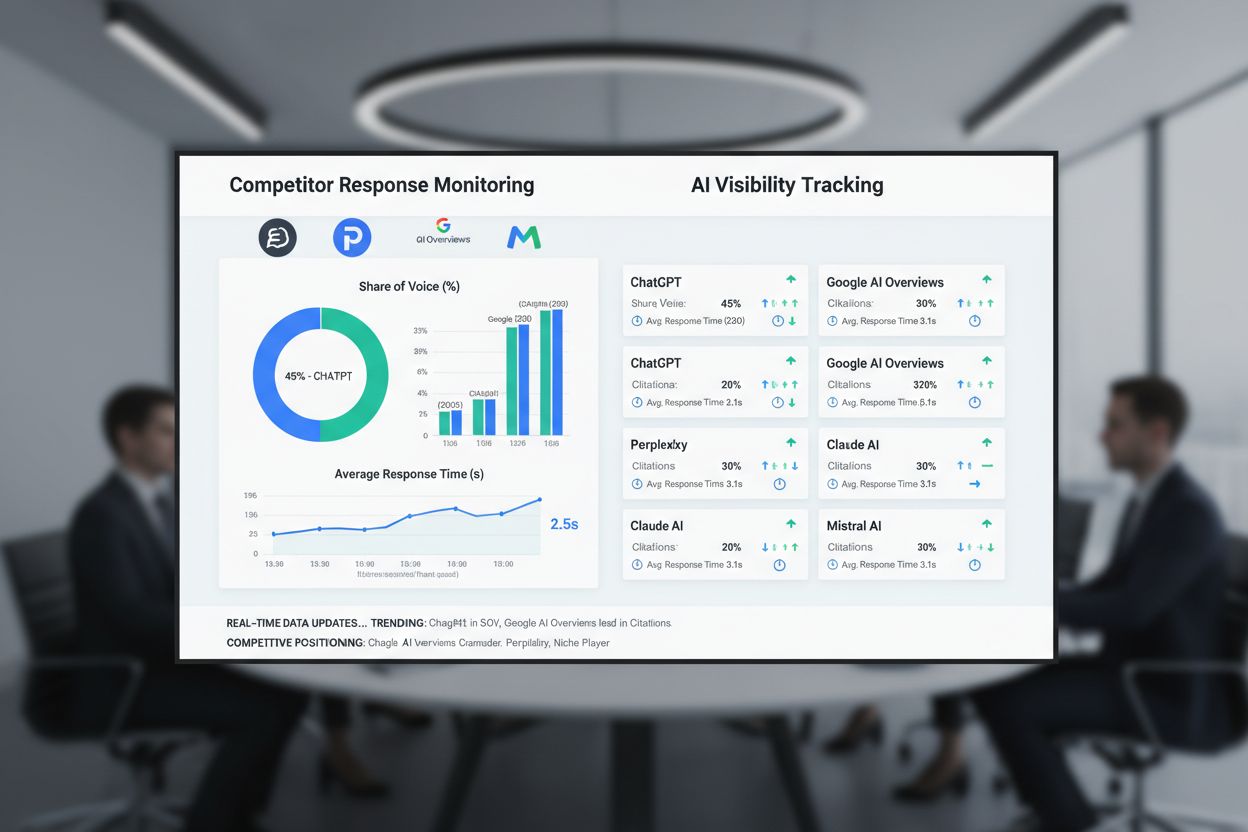
Learn how to monitor and analyze competitor responses to AI visibility changes. Discover metrics, tools, and best practices for tracking competitor reactions ac...