
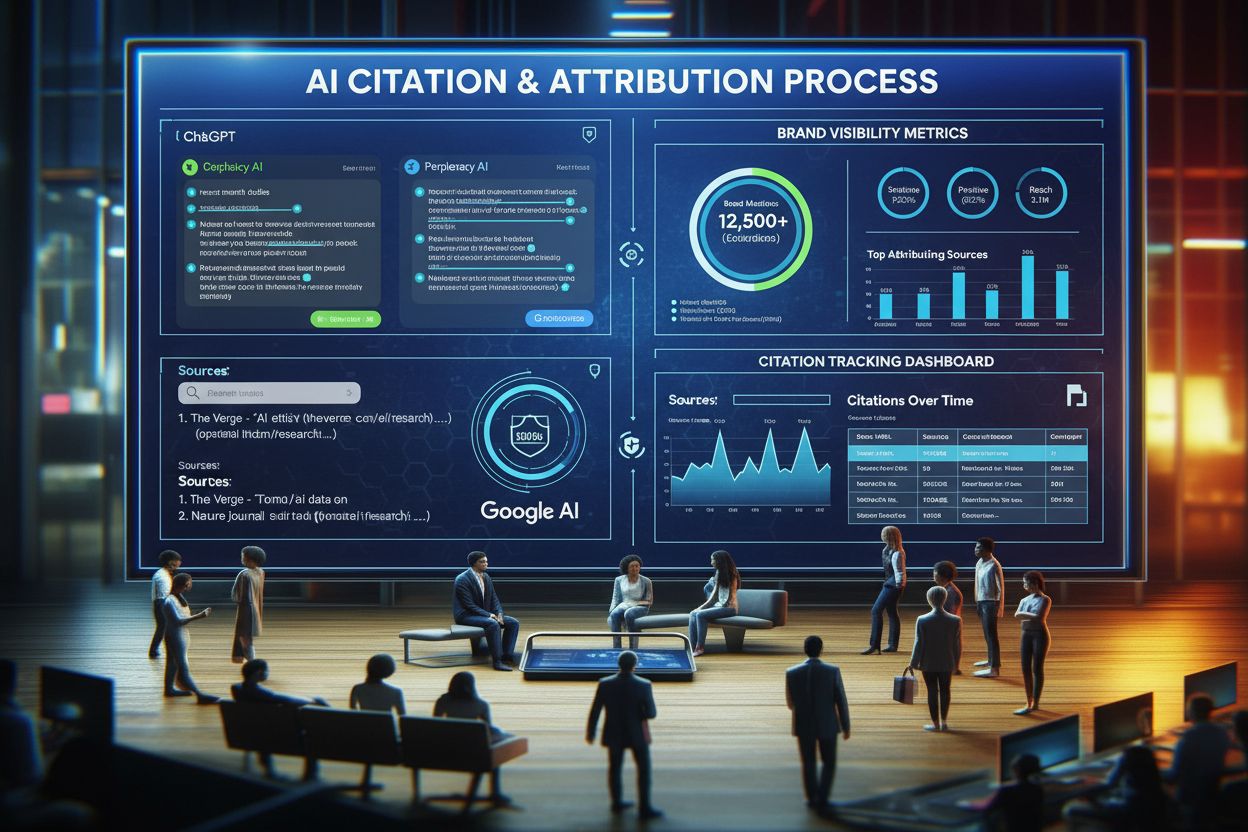
AI Citation
Learn what AI citations are, how they work across ChatGPT, Perplexity, and Google AI, and why they matter for your brand's visibility in generative search engin...
13 min read

Learn how to track AI citations for your content across ChatGPT, Perplexity, Google AI Overviews, and Claude. Monitor brand visibility, measure influence, and optimize for AI search engines.
Track AI citations using specialized monitoring platforms like AmICited, Profound, or SE Ranking that monitor brand mentions across ChatGPT, Perplexity, Google AI Overviews, and Claude. Set up regular audits of your content across AI engines, implement schema markup for better discoverability, and use analytics to correlate AI visibility with traffic and conversions to measure influence beyond traditional clicks.
AI citation tracking is the process of monitoring when and how your content appears in AI-generated answers across platforms like ChatGPT, Perplexity, Google AI Overviews, and Claude. Unlike traditional search engine optimization where visibility means ranking in blue links, AI citations represent instances where AI systems reference, summarize, or recommend your content directly within their synthesized responses. This distinction matters because 78% of organizations reported using AI in 2024, according to Stanford’s AI Index Report, making AI visibility increasingly critical to brand authority and content reach. When your content gets cited by AI, it gains credibility and influence even when users don’t click through to your website. Understanding how to track these citations is essential for measuring your brand’s presence in the emerging AI search landscape.
The traditional metrics of SEO—clicks, impressions, rankings—no longer capture the full picture of content performance in an AI-driven world. Research from Seer Interactive revealed that organic click-through rates (CTR) plummeted 61% for queries with AI Overviews, dropping from 1.76% to 0.61%, demonstrating how AI answers are fundamentally changing user behavior. Your content can now shape decisions and build authority without generating measurable traffic. 86% of AI citations come from brand-managed content, according to Yext research analyzing 6.8 million AI citations across ChatGPT, Gemini, and Perplexity, which means the content you control is your primary asset for AI visibility. This shift requires a new approach to measurement—one that tracks influence rather than just clicks. By monitoring AI citations, you can understand how your brand is being represented, identify which content resonates with AI systems, and optimize your strategy to increase visibility across multiple AI platforms simultaneously.
Each AI platform has distinct citation patterns and behaviors that directly affect how your content gets discovered and referenced. Understanding these differences is crucial for effective tracking and optimization.
ChatGPT demonstrates a strong preference for authoritative knowledge bases, with Wikipedia accounting for 47.9% of citations among its top 10 sources. This platform relies heavily on training data and model-native synthesis, meaning it generates answers from patterns learned during training rather than always pulling from live web sources. When ChatGPT does cite sources, it typically includes them when plugins or browsing features are enabled. Commercial (.com) domains dominate ChatGPT citations at 80.41%, followed by non-profit (.org) sites at 11.29%, indicating that established, credible domains have a significant advantage on this platform.
Perplexity takes a fundamentally different approach as a retrieval-first answer engine that actively searches the web in real-time and displays inline citations. Reddit dominates Perplexity’s citations at 46.7% of its top 10 sources, reflecting the platform’s preference for community-driven, peer-to-peer information. This makes Perplexity particularly valuable for tracking because every answer includes visible source links, making it easier to verify when your content is being cited. Perplexity’s citation patterns show that user-generated content and discussion platforms are heavily weighted in its retrieval algorithm.
Google AI Overviews balances multiple source types, with Reddit at 21% of top citations, YouTube at 18.8%, and Quora at 14.3%, showing a more distributed approach across social and professional platforms. Because Google controls both the search index and the Knowledge Graph, its AI answers are deeply integrated with live search results, meaning your content can appear in AI Overviews if it ranks well in traditional search. Google’s approach emphasizes source diversity and freshness, making it important to maintain strong traditional SEO alongside AI optimization.
Claude (Anthropic) recently added web search capabilities, allowing it to operate in both model-native and retrieval-augmented modes depending on the query. This flexibility means Claude can provide current information when needed while maintaining the coherence of model-native synthesis for other tasks. Claude’s approach emphasizes safety and accuracy, which means well-structured, factually dense content has a higher likelihood of being cited.
| Platform | Primary Citation Source | Citation Display | Data Freshness | Top Domain Type | Best For |
|---|---|---|---|---|---|
| ChatGPT | Wikipedia (7.8%) | Optional with plugins | Training data lag | Authoritative (.com) | Established authority |
| Perplexity | Reddit (6.6%) | Always visible inline | Real-time web | Community platforms | Current information |
| Google AI Overviews | Reddit (2.2%) | Visible with links | Live index | Balanced mix | Integrated search |
| Claude | Varies by query | Depends on mode | Real-time when enabled | Professional content | Accuracy-focused |
Effective AI citation tracking requires a systematic approach combining automated tools, regular audits, and data analysis. Start by selecting a dedicated AI monitoring platform that tracks your brand across multiple AI engines. Platforms like AmICited, Profound, SE Ranking, and Semrush AI Visibility Toolkit provide automated tracking of brand mentions, citations, and visibility across ChatGPT, Perplexity, Google AI Overviews, and Claude. These tools typically offer daily or weekly tracking, allowing you to see exactly when and where your content is cited.
Implement regular manual audits by searching your brand name, key products, and target topics directly in each AI platform. Document where your content appears, how it’s summarized, and whether it’s cited positively or negatively. This qualitative data complements automated tracking and helps you understand the context of citations. Create a simple spreadsheet or dashboard tracking: the query searched, which platform cited you, what content was referenced, and whether a link was provided.
Set up Google Alerts and social listening tools to monitor when your brand is mentioned in contexts that might trigger AI citations. Tools like Mention, Brand24, or Hootsuite can alert you to conversations about your brand across the web, helping you identify emerging topics that AI systems might synthesize into answers. This proactive approach helps you understand what content is gaining traction before it appears in AI citations.
Establish baseline metrics for your current AI visibility. Document your “AI Share of Voice” for target keywords—the percentage of AI-generated answers where your brand appears compared to competitors. This baseline allows you to measure progress over time and identify which optimization efforts are most effective.
Citation tracking alone is insufficient; you must connect AI visibility to business outcomes. Create a correlation analysis comparing periods with high AI visibility against shifts in website traffic, conversions, lead quality, or pipeline growth. While AI citations may not drive direct clicks, they build brand authority and influence that eventually converts. Research shows that visibility in AI answers correlates with increased branded search volume, meaning users who see your content cited by AI are more likely to search for your brand directly.
Implement proxy conversion tracking to capture influence that happens before a user clicks. Monitor increases in branded organic searches, direct type-in visits, social engagement, and repeat interactions. These secondary indicators often precede direct conversions and provide evidence that AI visibility is building awareness and trust. Use Google Search Console to track branded search volume trends and correlate spikes with major AI visibility events.
Develop an Influence Score that combines multiple data points: citation frequency across platforms, sentiment of citations, source trust (whether you’re cited alongside authoritative sources), and correlated business metrics. This composite score provides a more complete picture of how AI citations contribute to your overall marketing performance than any single metric alone.
To increase the likelihood of your content being cited by AI systems, focus on structural optimization that makes your content easier for AI to extract and reference. Implement schema markup (JSON-LD) for key entities, definitions, and factual claims. This structured data helps AI systems confidently identify and cite your content. Use FAQ schema, Article schema, and Organization schema to clearly define your expertise and authority.
Create highly structured content with clear headings, bullet points, and concise definitions. AI systems favor content that’s easy to parse and confidently cite. When you define key terms in your opening paragraphs and use consistent terminology throughout, AI models develop stronger associations with your brand. Include specific statistics and data points that AI systems can extract and cite—research shows that content with quantifiable claims is cited more frequently than general statements.
Optimize for entity recognition by consistently using your brand name, product names, and key concepts throughout your content. AI systems build knowledge graphs of entities and their relationships; when you reinforce these connections, you increase the likelihood of being cited in related queries. Use internal linking to strengthen these entity relationships and help AI systems understand your content hierarchy.
Ensure your content is easily discoverable by maintaining strong traditional SEO fundamentals. Since most AI systems use web search or indexed content as their source material, ranking well in Google remains essential for AI visibility. Focus on E-E-A-T signals (Experience, Expertise, Authoritativeness, Trustworthiness) by including author credentials, publication dates, and citations to authoritative sources within your own content.
For ChatGPT optimization, focus on building authoritative, comprehensive content that demonstrates deep expertise. Since Wikipedia dominates ChatGPT citations, create content that matches the depth and structure of encyclopedia entries. Include clear definitions, historical context, and well-organized information. Ensure your content is easily accessible to ChatGPT’s training data by maintaining strong backlinks and domain authority. Consider creating definitive guides and resource pages that serve as go-to references for your industry.
For Perplexity tracking, monitor your citations more frequently since Perplexity updates its index in real-time. Set up daily tracking alerts to catch when your content is cited. Focus on creating timely, data-backed content that answers specific questions comprehensively. Perplexity favors content that directly answers user queries, so structure your content around common questions in your industry. Engage actively in Reddit communities related to your industry, as Reddit dominates Perplexity’s citations—this user-generated content often gets synthesized into Perplexity answers.
For Google AI Overviews, maintain strong traditional SEO while optimizing for AI. Since Google AI Overviews pull from its search index, ranking well in organic search is your primary lever. Create content that answers specific search queries comprehensively and include rich snippets that Google can easily extract. Focus on featured snippet optimization since content that appears in featured snippets is more likely to be cited in AI Overviews.
For Claude tracking, emphasize accuracy and factual density. Claude’s safety-first approach means it favors well-sourced, clearly structured content. Include citations within your own content to authoritative sources, as this signals reliability to Claude’s systems. Create content that addresses complex topics with nuance and acknowledges multiple perspectives, as Claude tends to cite balanced, thoughtful analysis.
As AI search continues to evolve, citation tracking will become increasingly sophisticated and transparent. Platforms are beginning to provide better APIs and data access for tracking citations, moving away from the “black box” that characterized early AI search. Generative Engine Optimization (GEO) is emerging as a distinct discipline focused specifically on optimizing for AI visibility, and citation tracking is becoming a core component of GEO strategy.
The relationship between traditional SEO and AI visibility will continue to strengthen. Rather than replacing SEO, AI search is creating a new layer of visibility that complements traditional rankings. Brands that excel at both traditional search optimization and AI citation tracking will have a significant competitive advantage. Future tools will likely provide real-time citation alerts, sentiment analysis of how your brand is represented, and predictive modeling of which content topics will generate the most AI citations.
Attribution modeling in the AI era will become more sophisticated, moving beyond last-click attribution to capture the full influence journey. As more organizations adopt AI citation tracking, industry standards will emerge for measuring and reporting on AI visibility. This standardization will make it easier to benchmark performance, set realistic goals, and demonstrate ROI from AI optimization efforts. The brands that start tracking AI citations today will have a significant head start in understanding and optimizing for this new search landscape.
Stop guessing whether your content gets cited by AI. Track every mention across ChatGPT, Perplexity, Google AI Overviews, and Claude with AmICited's AI citation monitoring platform.
Learn what AI citations are, how they work across ChatGPT, Perplexity, and Google AI, and why they matter for your brand's visibility in generative search engin...
Learn what citation trend analysis is, why tracking AI citation patterns matters for your brand, and how to use trend data to identify growth opportunities and ...

Learn proven strategies to increase your citation frequency across ChatGPT, Perplexity, and Google AI. Discover how to optimize content, build authority, and ge...