

What Is GEO? The Complete Guide to Generative Engine Optimization
Learn Generative Engine Optimization (GEO) fundamentals. Discover how to get your brand cited in ChatGPT, Perplexity, and Google AI Overviews with proven strate...
19 min read

Learn how to train your marketing team on GEO with practical frameworks, role assignments, and tools. Master AI search optimization for ChatGPT, Perplexity, and Google AI Overviews.
Train your team on GEO by establishing foundational knowledge of AI search platforms, teaching content structure optimization for LLMs, implementing hands-on auditing exercises, and using tools like AmICited to monitor brand visibility across ChatGPT, Perplexity, and Google AI Overviews. Assign clear roles, create internal guidelines, and conduct quarterly reviews to ensure continuous improvement.
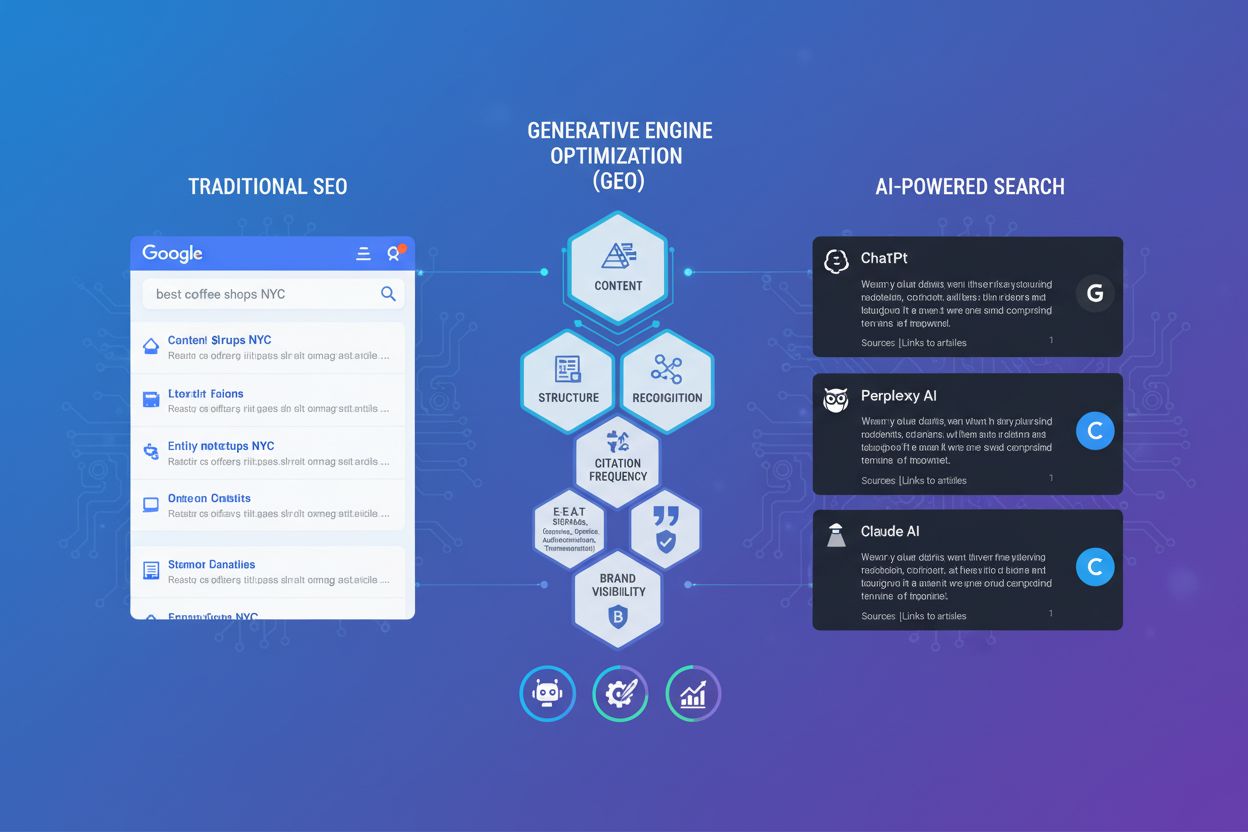
Generative Engine Optimization (GEO) is the practice of creating and optimizing content so that it appears in AI-generated answers on platforms like ChatGPT, Perplexity, Google AI Overviews, and Claude. Unlike traditional SEO, which focuses on ranking in search results, GEO emphasizes making your brand visible and cited within AI-generated responses. Training your team on GEO is critical because over 1 billion prompts are sent to ChatGPT daily, and 89% of B2B buyers now use generative AI as a key source of self-guided information throughout their purchasing journey. When your team understands GEO principles, they can create content that AI systems are more likely to reference, cite, and recommend to users. This shift represents a fundamental change in how discovery works online—and organizations that don’t adapt risk becoming invisible to their target audiences in AI search results.
The challenge is that GEO requires a different mindset than traditional SEO. Your team needs to understand how Retrieval-Augmented Generation (RAG) systems work, recognize that AI systems cite only 2-7 domains per response (compared to Google’s 10 blue links), and appreciate that brand mentions matter as much as website citations. Training ensures everyone from content creators to technical teams understands these distinctions and can execute a cohesive strategy.
Before diving into tactical execution, your team needs solid foundational knowledge about how AI search engines operate. Start by explaining the two distinct systems that power AI search: foundation models (like GPT-4 or Claude, which are pre-trained and fixed) and Retrieval-Augmented Generation (RAG) systems (like ChatGPT’s web search or Google AI Overviews, which pull live information). This distinction is crucial because it changes strategy—foundation models require long-term thinking about brand presence in training data, while RAG systems offer immediate optimization opportunities. Your team should understand that 95 out of 100 Google AI Mode queries end without a click, while 78-99 ChatGPT queries never send traffic to any website, yet traffic is still happening at scale (ChatGPT sends 12 million clicks per month to websites in Germany alone).
Introduce your team to the concept of E-E-A-T (Experience, Expertise, Authoritativeness, Trustworthiness), which remains critical for GEO success. Explain that AI systems evaluate content based on how trustworthy and authoritative the source appears, and that content with specific data points is 30-40% more likely to appear in LLM responses. Help them understand the difference between brand visibility (your company name appears in generated answers) and website citations (your content is used as a source). These are two separate metrics that require different strategies. Finally, teach them about query fanout—the fact that LLMs generate multiple related searches behind the scenes, not just searching for the exact prompt. This helps them understand why content optimization must be broader than keyword-focused.
Successful GEO training requires clear role definition and organizational alignment. Most organizations start by expanding SEO team responsibilities to include GEO, which makes sense since the skills overlap significantly. However, GEO is inherently cross-functional, requiring collaboration across multiple departments. Establish these core roles:
Each role needs specific training tailored to their responsibilities. Content strategists need deep knowledge of content structure and AI-friendly formatting. Technical leads need to understand schema markup, JavaScript rendering issues, and crawler accessibility. PR teams need to understand how co-citations and co-occurrences work—the fact that being mentioned alongside competitors in authoritative sources signals relevance to AI systems. Allocate $75,000-$150,000 annually for mid-market GEO programs (including tools, training, and resources), with enterprises potentially investing $250,000 or more.
| Organization Size | Training Approach | Timeline | Key Focus Areas | Tools Needed |
|---|---|---|---|---|
| Small Team (1-3 people) | Self-directed learning + external workshops | 4-6 weeks | Content structure, basic monitoring, manual testing | AmICited, ChatGPT, free schema tools |
| Mid-Market (5-10 people) | Internal workshops + role-specific training + external consultant | 8-12 weeks | Cross-functional alignment, content guidelines, competitive analysis | AmICited, Profound, Semrush AIO, internal documentation |
| Enterprise (10+ people) | Structured curriculum + certification program + ongoing workshops | 12-16 weeks | Governance, advanced analytics, multi-platform strategy, agent optimization | AmICited, Profound, Semrush Enterprise, custom dashboards |
| Agency | Client-specific training + standardized playbooks | 6-10 weeks | Scalable processes, client reporting, multi-client management | AmICited, client-specific tools, template library |
Begin with a comprehensive kickoff workshop that covers GEO fundamentals. Spend the first session explaining how AI search differs from traditional search, using real examples from ChatGPT, Perplexity, and Google AI Overviews. Show your team actual AI responses to queries relevant to your industry, and have them identify which sources are cited and why. This makes the concept tangible rather than theoretical.
In the second session, introduce your team to content structure principles. Teach them that AI systems process content in chunks, not full pages, and that one idea per paragraph is essential. Explain the importance of clear headings that sound like real questions, short sentences (15-20 words maximum), and direct, declarative statements rather than opinions. Show examples of poorly structured content versus AI-optimized content side-by-side. Introduce schema markup concepts, particularly FAQ schema, HowTo schema, and Product schema. While they don’t need to code it themselves, they need to understand what it does and why it matters.
Conduct a competitive audit exercise where your team manually tests 10-15 prompts relevant to your industry across ChatGPT, Perplexity, and Google AI Overviews. Have them document which competitors appear, what sources are cited, and what sentiment is expressed. This exercise reveals your competitive landscape in AI search and identifies immediate opportunities. Use tools like AmICited to automate this process at scale, showing your team how monitoring tools can track brand visibility, citation frequency, and sentiment across platforms.
This phase focuses on teaching your team how to create and optimize content for AI systems. Start with a content audit exercise where your team takes existing high-value pages and evaluates them through an AI lens. Create a simple audit checklist:
Have your team score 5-10 pages using this checklist, then rewrite one page together as a group exercise. This hands-on practice is far more effective than theoretical instruction. Show them how to restructure dense paragraphs into modular, answer-focused sections of 75-300 words each. Teach them to lead with answers—put key information high on the page in clear, structured blocks rather than burying it in marketing copy.
Introduce the concept of topic clusters and internal linking strategy. Explain how grouping related content around a core topic and linking consistently shows AI systems what your site is actually about. Have your team map out a topic cluster for one of your key service areas, identifying the pillar page and supporting sub-pages. This exercise helps them understand how content architecture influences AI visibility.
Conduct a prompt strategy workshop where your team develops 25-50 real questions your customers actually ask. These should come from customer support tickets, sales calls, Reddit discussions, and industry forums. Test each prompt multiple times across different AI platforms to see what searches the AI actually performs behind the scenes. This reveals optimization opportunities and helps your team understand user intent at a deeper level.
This phase bridges content strategy with technical execution. Work with your technical team to ensure AI crawlers can access your content. Most AI crawlers struggle with JavaScript, so prioritize server-side rendering for important pages. Have your technical lead audit your site’s JavaScript dependencies and identify pages that might be invisible to AI systems.
Implement schema markup across your site, starting with FAQ schema on your most important pages. Use free tools or plugins to add structured data without requiring custom development. Your team should understand that schema markup is a direct line to AI systems—it tells them exactly what your content means, not just what it says. Implement HTTPS everywhere, ensure mobile speed under 1.8 seconds, and verify that AI bot traffic isn’t being blocked by aggressive crawlers or DDoS prevention.
Set up analytics tracking to identify AI-driven traffic. Create custom segments in Google Analytics for traffic from ChatGPT, Claude, Perplexity, and other AI platforms. While Google doesn’t separate AI Overview clicks from regular organic traffic, you can track referral traffic from platforms that pass referrer data. Implement AmICited or similar monitoring tools to track your brand’s visibility across AI platforms. This gives your team concrete data on whether their optimization efforts are working.
Conduct a technical audit workshop where your team reviews your site’s crawlability, rendering, and schema implementation. Identify quick wins (pages that need minor fixes) versus longer-term projects. Create a prioritized roadmap for technical improvements.
By this point, your team has foundational knowledge and hands-on experience. Now focus on advanced strategy and ensuring all departments work together. Conduct a competitive benchmarking workshop where your team uses tools like AmICited to track how your brand performs against competitors across AI platforms. Analyze share of voice, citation frequency, and sentiment to identify gaps and opportunities.
Teach your team about co-citations and co-occurrences—the fact that being mentioned alongside competitors in authoritative sources signals relevance to AI systems. Develop a strategy for securing these mentions through digital PR, industry partnerships, and thought leadership. Have your PR team understand that media citations often matter more than traditional backlinks for AI rankings.
Introduce the concept of multi-platform presence. Explain that AI systems pull from Reddit, YouTube, LinkedIn, and other platforms, not just Google search results. Develop platform-specific strategies for each channel. For Reddit, emphasize genuine community participation rather than promotion. For YouTube, focus on product reviews, tool comparisons, and in-depth tutorials. For LinkedIn, emphasize thought leadership and professional discussions. For TikTok and Instagram Reels, focus on short-form videos answering common questions.
Conduct a cross-functional alignment workshop where content, technical, PR, and analytics teams discuss how their work contributes to GEO goals. Establish shared KPIs that everyone understands and works toward. Create a GEO governance structure with clear decision-making processes, approval workflows, and escalation paths.
Effective GEO training requires hands-on practice, not just lectures. Conduct regular auditing exercises where your team evaluates content through an AI lens. Here’s a structured approach:
Use AmICited to automate monitoring and provide your team with real-time data on how their optimization efforts are performing. This tool tracks brand visibility, citation frequency, and sentiment across ChatGPT, Perplexity, Google AI Overviews, and Claude—giving your team concrete feedback on whether their work is moving the needle.
Develop comprehensive internal GEO guidelines that your team can reference. These should cover:
Create content templates that make it easier for your team to create AI-optimized content. Include templates for FAQ sections, comparison articles, how-to guides, and data-driven content. Provide before and after examples showing how to transform traditional content into AI-optimized content.
GEO is not a one-time training initiative—it requires ongoing education as AI platforms evolve. Establish a monthly training cadence with 30-minute sessions covering new developments, competitive changes, and emerging best practices. Use AmICited to share monthly visibility reports with your team, highlighting wins, losses, and opportunities.
Conduct quarterly reviews where your team assesses GEO performance against KPIs. Review metrics like:
Use these reviews to identify what’s working, what needs adjustment, and where to focus next quarter. Celebrate wins—when a piece of content starts appearing in ChatGPT responses or your visibility score increases, share that success with your team.
Track whether your training is actually working by measuring behavioral changes and business outcomes. Monitor:
Use AmICited to track these metrics over time. The tool provides longitudinal data showing how your visibility changes as your team implements GEO strategies. This concrete feedback reinforces the value of training and motivates continued effort.
As you train your team on GEO, prepare them for the next evolution: agentic search. AI agents are autonomous systems that can ask follow-up questions, read and summarize content, make recommendations, and complete tasks. This represents a fundamental shift from traditional search where users click links to a future where agents research and make decisions on behalf of users.
Teach your team that in this future, visibility depends on being quotable, trustworthy, and everywhere agents look. Content must be structured as clear, factual answers that AI agents can easily find, understand, and quote in their recommendations. Emphasize the importance of semantic clarity, contextual richness, and AI-readability. Help your team understand that brand mentions matter as much as clicks—if an agent recommends your competitor based on AI research, you’ve lost the opportunity regardless of whether the user clicks through.
Introduce concepts like llms.txt files and Model Context Protocol (MCP) that allow you to control what AI agents can access and how they can use your content. While these are emerging standards, forward-thinking organizations are already implementing them to maintain control over their brand narrative in AI-driven discovery.
+++
Track how your brand appears across AI search engines in real-time. Use AmICited to measure training effectiveness and monitor your team's GEO optimization results across ChatGPT, Perplexity, Google AI Overviews, and Claude.
Learn Generative Engine Optimization (GEO) fundamentals. Discover how to get your brand cited in ChatGPT, Perplexity, and Google AI Overviews with proven strate...

Learn what Generative Engine Optimization (GEO) is and how to optimize your brand for visibility in AI search engines like ChatGPT, Perplexity, and Gemini. Disc...
Learn what Generative Engine Optimization (GEO) is, how it differs from SEO, and why it's critical for brand visibility in AI-powered search engines like ChatGP...