
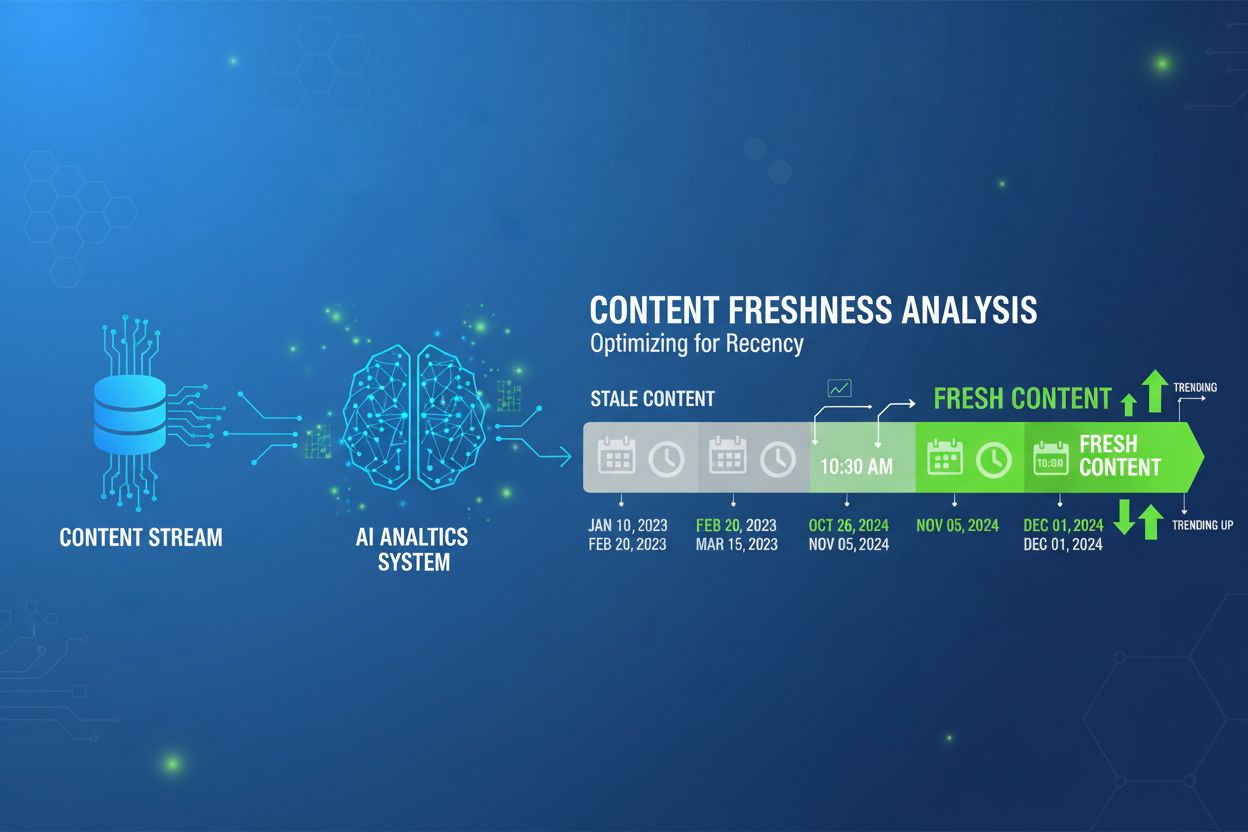
When to Update Content for AI: Freshness Signals
Learn when and how to update your content for AI visibility. Discover freshness signals that help ChatGPT, Perplexity, and Google AI Overviews cite your brand.
8 min read

Learn how to update content for AI freshness with technical signals, structural changes, and refresh strategies that keep your brand visible in ChatGPT, Perplexity, and other AI search engines.
Update content for AI freshness by implementing meaningful changes across multiple freshness signals including visible publication dates, updated content sections, structured data markup, and active re-promotion. AI systems prioritize recently modified pages with substantive updates over older content, requiring a systematic refresh cadence every 60-90 days for high-value content rather than one-time publication.
Content freshness has become a critical ranking signal in AI-powered search environments like ChatGPT, Perplexity, and Gemini. Unlike traditional search engines where evergreen content could maintain visibility for years, AI systems now prioritize recently updated pages with clear signals of active maintenance. The shelf life of evergreen content has compressed dramatically—what once remained relevant for 24-36 months now requires updates every 6-9 months to maintain visibility in AI-generated answers. This shift reflects how AI systems evaluate source reliability; when users expect current, accurate information, AI models lean heavily on pages that demonstrate recent, meaningful updates rather than older, static content.
The fundamental difference lies in how AI systems interpret freshness signals. Traditional search engines focused primarily on publication dates and crawl frequency, but AI language models evaluate freshness through a combination of technical indicators, structural changes, and external validation signals. A page updated two weeks ago with substantive new content will outrank a comprehensive guide from 2023, even if the older guide contains more total information. This creates a new content maintenance paradigm where publishers must treat their best-performing assets as living documents requiring regular updates rather than one-time investments.
AI systems detect content freshness through multiple overlapping signals that work together to establish whether a page represents current, reliable information. Understanding these signals helps you prioritize your update efforts effectively. Recency indicators form the foundation of freshness detection and include visible, crawlable modified dates that search engines can parse and display. When you update a page, ensure the modification date appears both in your HTML markup and in structured data using ISO 8601 format. New backlinks from recently published sources signal that your content remains relevant enough for current publishers to reference. Fresh social signals and brand mentions across social platforms indicate ongoing engagement with your content. Updated schema markup and metadata help AI systems understand that your page has been actively maintained.
Structural signals demonstrate that you have made substantive improvements beyond cosmetic changes. Adding new sections containing 500+ words of original content shows meaningful expansion. Updating screenshots and examples to reflect current interfaces and workflows proves you have tested the information recently. Expanding FAQ sections with answers to current questions shows you are addressing what users are actually asking today. Clean entity clarity with updated terminology ensures AI systems can confidently understand your content’s context and relevance. These structural changes are critical because AI systems can detect the difference between a simple date change and genuine content improvement.
External validation signals reinforce that your content deserves citation in AI answers. Press mentions from the last 6-12 months demonstrate industry recognition of your expertise. Inclusion in new research studies or expert roundups shows that authoritative sources consider your content worth referencing. Updated internal links connecting to your refreshed content and fresh outbound links to current authoritative sources create a web of relevance. When multiple signals align—recent publication date, substantive content updates, new backlinks, and fresh mentions—AI systems gain confidence that your page represents current, trustworthy information worth citing.
| Signal Type | Examples | Impact on AI Visibility |
|---|---|---|
| Recency Indicators | Modified dates, new backlinks, social mentions, updated schema | Signals active maintenance and current relevance |
| Structural Signals | New content sections, updated screenshots, expanded FAQs, fresh terminology | Demonstrates substantive improvements beyond date changes |
| External Validation | Press mentions, research inclusion, expert citations, fresh links | Confirms industry recognition and ongoing authority |
| Technical Signals | Crawlable dates, proper markup, fast page speed, clean URL structure | Enables AI systems to discover and parse updates quickly |
Creating a scalable refresh system requires two interconnected components: a cadence your team can actually maintain and the operational infrastructure that keeps updates moving consistently. Without both elements working together, refresh programs collapse under their own weight. When everything feels urgent and the backlog grows faster than you can process it, teams resort to rushed updates or abandon the program entirely. The solution is to tier your content by strategic value so updates follow a predictable, manageable rhythm.
Tier 1 content includes your highest-traffic, highest-conversion pieces on core topics that directly drive business results. These pages deserve refresh cycles every 60-90 days because they generate the most visibility and revenue impact. Tier 2 content encompasses supporting pages, category pages, and related resources that build topical authority but do not directly convert. These pieces benefit from refresh cycles every six months. Tier 3 content consists of foundational pieces on stable topics where information rarely changes—these warrant annual audits rather than frequent updates. This tiering approach prevents the common mistake of treating a foundational explainer with the same urgency as a high-converting asset, which creates impossible workload expectations.
Integrate your refresh cadence directly into your content operations so updates become a recurring production cycle rather than ad hoc work you only tackle after traffic crashes. Assign clear ownership for each piece, add refresh tasks to your project management system with specific dates, and tie updates to performance metrics. Treat refreshes like planned sprints—schedule them the same way you plan new content launches. Include re-promotion as part of the refresh process because updated content needs visibility boost to regain traction in AI search results. A 90-day workflow provides a practical framework: weeks 1-2 focus on auditing your Tier 1 content and identifying the top 10 pieces with the biggest business impact or steepest traffic decline. Weeks 3-6 involve refreshing and republishing those priority pieces with updated freshness signals and active promotion. Weeks 7-8 shift focus to auditing Tier 2 content for pieces due for their six-month refresh. Weeks 9-12 complete the cycle by refreshing priority Tier 2 pieces that influence topical authority or internal linking structure.
The most common mistake publishers make is updating only the publication date while leaving content unchanged. AI systems can detect this superficial approach and may actually penalize sites that artificially freshen dates without making real improvements. Substantive updates require multiple meaningful changes that demonstrate you have actively maintained and improved the content. Start by bringing in new data and updated statistics from the last 12 months. Replace outdated statistics with current figures, add recent case studies that reflect how your topic has evolved, and include new examples that show how things work in today’s environment. This is not about adding filler—it is about ensuring your content reflects current reality.
Update all screenshots and visual references to show current interfaces, dashboards, and workflows. When software updates its interface or a platform changes its features, outdated screenshots immediately signal that your content is stale. Expand sections that address emerging trends or recent developments in your field. If your topic has evolved significantly, add new sections that cover these developments comprehensively. Revise your FAQ section based on questions people are currently asking, not questions from when you originally published. Update terminology and language to reflect current industry standards and common usage. Adjust your introduction to explicitly acknowledge recent developments so AI systems recognize the content as current. For example, instead of “Here is how email marketing works,” update it to “Here is how email marketing works in 2025, including the latest authentication requirements and AI-powered personalization approaches.”
Update your meta descriptions to include current language and value propositions that reflect the refreshed content. Ensure your modified date is accurate and visible both on the page and in structured data markup. Re-promote the refreshed piece through social channels, newsletters, and internal links from newer content. Treat the refresh like a new publication event, not a maintenance task that happens invisibly. When you actively promote updated content, you generate fresh signals—new social mentions, fresh backlinks, and renewed engagement—that reinforce to AI systems that your page deserves current visibility.
Proper technical implementation ensures that your freshness updates are discoverable and recognized by AI systems. Visible, crawlable dates form the foundation—your publication date and modification date should appear in your HTML in a format that both humans and search engines can easily parse. Use the HTML time element with the datetime attribute for maximum clarity. In your structured data markup, implement Article schema with datePublished for the original publication date and dateModified for the most recent significant update. Format both dates in ISO 8601 format (YYYY-MM-DD) so systems can parse them consistently.
Your XML sitemap should include accurate lastmod values for each URL, but only update these when you make substantive changes. If you update lastmod every time you make trivial edits, search engines learn to ignore the signal. Use IndexNow (formerly Bing Webmaster Tools ping) to notify search engines immediately when you publish significant updates. This protocol allows you to push changed URLs to participating search engines for faster discovery and recrawling. For most modern CMS platforms, IndexNow integration is straightforward and can be enabled with minimal configuration.
Maintain fast page load speeds because slow pages reduce crawl frequency and delay the discovery of your updates. Optimize images, minimize CSS and JavaScript, and use content delivery networks to ensure your pages load quickly globally. Keep your URL structure clean and avoid unnecessary redirects that can slow down crawl efficiency. Monitor your Crawl Stats in Google Search Console to understand how frequently Googlebot visits your pages and whether your site health is supporting regular recrawls. If crawl frequency is declining, investigate whether page speed, server errors, or URL structure issues are limiting how often search engines can discover your updates.
Effective freshness strategies require ongoing monitoring to understand what is working and where to focus your efforts. Watch for declining traffic over six-month periods as an early warning sign that content is becoming stale. Monitor your keyword rankings for core terms to identify when competitors with fresher content are outranking you. Check whether your content is still appearing in AI-generated answers by running monthly spot checks in ChatGPT, Perplexity, and Gemini. Screenshot citations and track which brands appear in answers for your core topics. If your content disappears from AI answers while competitors’ content appears, that is a clear signal that freshness updates are needed.
Use content audit tools to identify older assets through last-modified data and spot pages losing relevance. Track which pieces are generating declining traffic and prioritize those for refresh cycles. Create a simple spreadsheet that logs each URL, its last refresh date, the next scheduled refresh date, its tier level, and any performance metrics. This tracking system helps you maintain consistency and prevents high-value content from falling through the cracks. Set up recurring calendar reminders for each tier’s refresh schedule so updates do not get deprioritized by urgent new projects.
Implement a checklist for every refresh to ensure you are hitting multiple freshness signals consistently. Update the introduction to acknowledge recent developments. Replace outdated statistics with current data from the last 12 months. Add 2-3 new examples reflecting current practices. Update all screenshots to show current interfaces. Expand or add FAQ sections based on current questions. Revise meta descriptions with current language. Update the modified date to today’s date. Re-promote through social, newsletters, and internal links. This systematic approach ensures that every refresh makes substantive improvements rather than superficial changes.
Many publishers undermine their freshness efforts by making preventable mistakes that actually harm their visibility. Inflating dates without real changes is perhaps the most damaging error. Search teams explicitly advise against artificial freshening, and systems may discount your dates if they do not match the actual content changes. If you update a date but make no meaningful content improvements, AI systems will detect the mismatch and may penalize your credibility. Misusing lastmod values creates similar problems—if you update lastmod every time you make trivial edits, crawlers learn to ignore the signal entirely. Reserve lastmod updates for substantive changes only.
Publishing conflicting dates confuses both search engines and users. If your on-page date says 2025 but your structured data says 2024, or if your sitemap lastmod does not match your visible date, systems may show the wrong date or suppress it entirely. Ensure all date signals align across your HTML, structured data, and sitemap. Neglecting page performance indirectly harms freshness because slow pages reduce crawl frequency and delay the discovery of your updates. A page that takes 5 seconds to load will be crawled less frequently than a page that loads in 1 second, meaning your updates take longer to be discovered.
Making only cosmetic updates wastes your effort because AI systems can distinguish between real improvements and superficial changes. Adding a single sentence or changing a few words does not constitute a meaningful update. Aim for at least 500 words of new or substantially revised content in each refresh. Failing to re-promote updated content means your freshness signals remain weak. If nobody links to, shares, or mentions your updated page, external validation signals stay flat. Treat refreshes like new publications and actively promote them through your owned channels.
Freshness is important, but it is not the only factor that determines whether AI systems cite your content. Authority and depth remain critical, especially for topics where information does not change rapidly. The goal is not to sacrifice comprehensive, authoritative content in pursuit of constant updates. Instead, balance your refresh strategy so that you maintain both current information and deep expertise. For time-sensitive topics like breaking news, security advisories, or rapidly changing prices, freshness should be your primary focus. For foundational topics like core concepts, historical analyses, or comprehensive tutorials, depth and authority carry more weight than recency.
Most successful content strategies require both types of content working together. Your foundational, authoritative pieces provide the depth and credibility that establish your expertise. Your regularly updated pieces demonstrate that you are actively engaged with current developments in your field. When AI systems evaluate your brand for citation, they look at your entire content portfolio. A brand that publishes original research quarterly, maintains updated guides on core topics, and demonstrates sustained expertise across related areas gains more citations than a brand that publishes frequently but without depth or consistency.
The key is to tier your content appropriately and allocate your refresh resources based on strategic value. Your highest-value, most-cited pieces deserve frequent updates to maintain visibility. Your foundational pieces deserve periodic audits to ensure accuracy but do not need constant refreshing. Your emerging topic pieces deserve initial depth and then regular updates as the topic evolves. This balanced approach prevents burnout while maintaining the freshness signals that keep your best content visible in AI-generated answers.
Track how your updated content appears in AI-generated answers across ChatGPT, Perplexity, and other AI search engines. Get real-time insights into which pages are being cited and when your freshness updates are working.
Learn when and how to update your content for AI visibility. Discover freshness signals that help ChatGPT, Perplexity, and Google AI Overviews cite your brand.

Learn optimal content update schedules for AI visibility. Discover how often to refresh content for ChatGPT, Perplexity, and Google AI Overviews to maximize bra...

Learn proven content refresh strategies to boost your brand visibility in AI search engines like ChatGPT, Google AI Overviews, and Perplexity. Discover how to u...