

What is Answer Engine Optimization (AEO)? Complete Guide for 2025
Learn what Answer Engine Optimization (AEO) is and how it helps your brand appear in AI-powered answers from ChatGPT, Perplexity, and Google AI Overviews. Disco...
13 min read

Learn how to write FAQ content optimized for AI search engines like ChatGPT, Perplexity, and Google AI Overviews. Master AEO strategies, schema markup, and content structure for maximum visibility.
Write FAQ content for AI search by using direct answers (40-60 words), natural conversational language, proper schema markup (FAQPage), clear H2/H3 heading hierarchy, and structured data that helps AI systems extract and cite your answers. Focus on real user questions, build authority signals, and optimize for featured snippets.
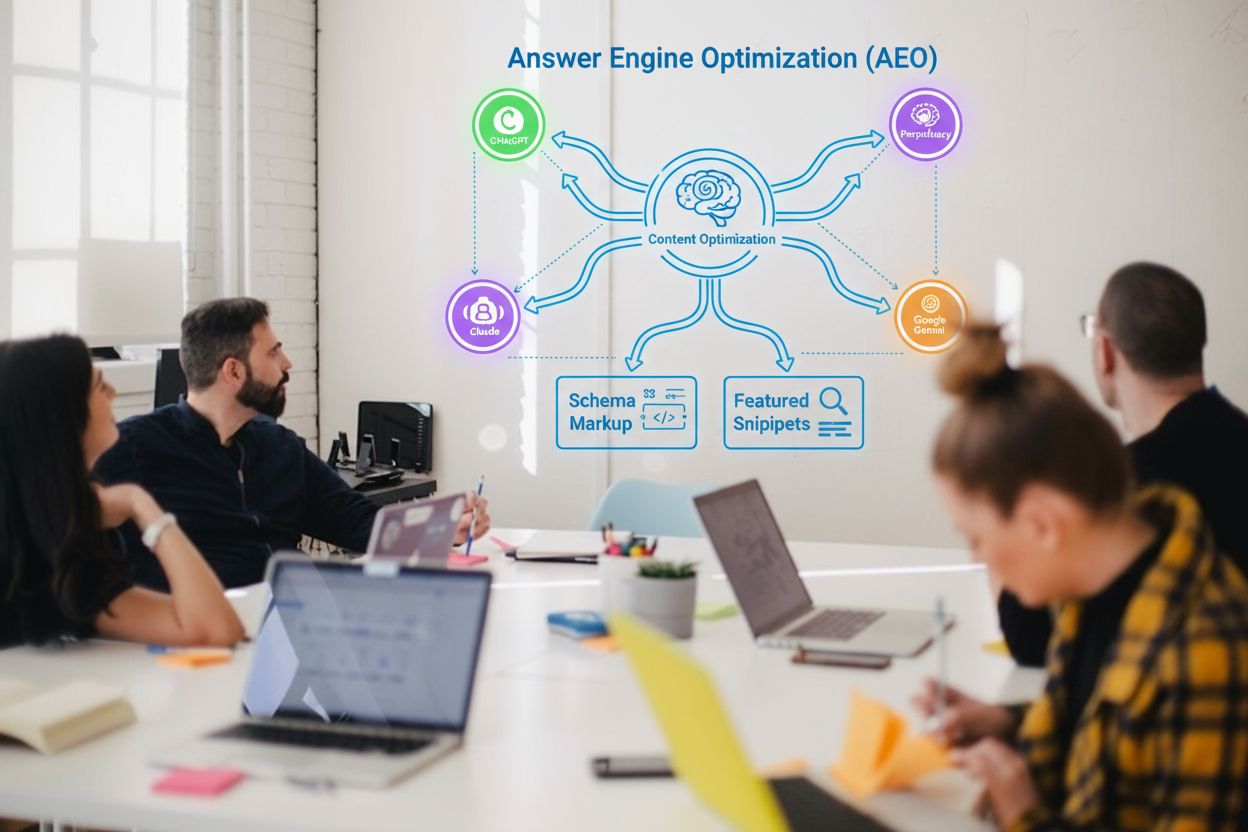
FAQ content optimization has fundamentally transformed in the era of artificial intelligence. Unlike traditional search engine optimization that focuses on ranking high in search results pages, Answer Engine Optimization (AEO) prioritizes getting your content cited and extracted by AI systems like ChatGPT, Perplexity, Google AI Overviews, and voice assistants. The shift is significant: while traditional SEO aims to drive clicks to your website, AEO focuses on zero-click visibility where your brand appears directly in AI-generated answers without users visiting your site. This distinction is crucial because nearly 60% of searches now end without a click, with users getting answers directly from AI summaries and featured snippets.
The approach to FAQ content differs substantially between traditional search engines and AI systems. Traditional SEO rewards content that ranks well on search results pages through keyword optimization, backlinks, and domain authority. Answer Engine Optimization, conversely, rewards content that AI systems can easily extract, understand, and confidently cite as authoritative. AI systems prioritize direct answers, semantic clarity, and structured data over keyword density and link profiles. When you write FAQ content for AI search, you’re essentially creating content that machines can parse, understand, and present as factual information to users asking questions through AI interfaces.
| Aspect | Traditional SEO | Answer Engine Optimization (AEO) |
|---|---|---|
| Primary Goal | Rank high in SERPs, drive website traffic | Get cited in AI responses, achieve zero-click visibility |
| Content Focus | Broad, long-form content targeting keyword groups | Precise Q&A format with direct answers (40-60 words) |
| Key Signals | Backlinks, keyword metrics, domain authority | Mentions, semantic markup, freshness, structured data |
| Success Metrics | Impressions, clicks, CTR, conversions, organic sessions | Citation rate, share of AI voice, AI impressions, brand mentions |
| Time Horizon | Medium to long term with sustained growth | Some faster wins (snippets), but requires continual adaptation |
The most critical element of FAQ content for AI search is the direct answer. AI systems don’t read your entire article linearly like humans do. Instead, they identify answer-like structures and extract them for presentation to users. Your first paragraph should contain a complete, standalone answer that fully addresses the question in 40-60 words. This answer must be self-contained, meaning someone could read only that paragraph and understand the complete response without needing additional context.
For example, if your FAQ question is “What is Answer Engine Optimization?”, your direct answer should be: “Answer Engine Optimization (AEO) is the strategic practice of structuring your content so AI-powered systems like ChatGPT and Google AI Overviews can easily extract, understand, and present it as authoritative answers. Unlike traditional SEO that focuses on ranking in search results, AEO prioritizes getting your content cited in AI-generated responses.” This answer is complete, factual, and ready for AI extraction. After this direct answer, you can expand with supporting details, examples, and context for readers wanting deeper understanding.
Schema markup is structured data you add to your HTML that explicitly tells search engines and AI systems what your content represents. For FAQ content, FAQPage schema is essential. This schema type marks question-and-answer pairs in a machine-readable format, making it significantly easier for AI systems to understand the relationship between questions and answers. When you implement FAQPage schema correctly, you’re essentially creating a roadmap for AI systems to navigate your content.
The implementation uses JSON-LD format embedded in your page’s HTML. Each question-answer pair should be marked with the Question and Answer schema types, with the question name and answer text clearly defined. This structured approach helps Google’s AI Overviews, voice assistants, and language models identify and extract your content with confidence. Beyond FAQPage schema, consider implementing Article schema for editorial content, HowTo schema for instructional content, and Speakable schema for content you want voice assistants to prioritize. Validation is crucial—use Google’s Rich Results Test to ensure your schema is correctly implemented and error-free.
AI systems favor clear, hierarchical content structure that uses proper semantic HTML. Your FAQ page should use a logical heading hierarchy starting with one H1 tag for the page title, followed by H2 tags for major sections, and H3 tags for subsections. Never skip heading levels (jumping from H2 to H4) as this confuses both AI systems and accessibility tools. Each question should be formatted as an H2 or H3 heading that mirrors the actual user question, not a paraphrased version.
Use bullet points and numbered lists strategically to break up information into digestible chunks. AI systems recognize these formatting patterns and can extract them more reliably than paragraph text. Tables are particularly valuable for comparisons and structured data—they provide clear visual organization that AI systems can parse accurately. Keep paragraphs short, ideally under four sentences, as this improves both human readability and AI comprehension. Use bold formatting to highlight key terms and concepts that AI systems should prioritize when extracting information.
Natural, conversational language is essential for FAQ content targeting AI search. AI systems are trained on how real people ask questions, so your FAQ questions should reflect actual user language, not corporate jargon or internal terminology. Instead of “What optimisation processes are used to enhance FAQ discoverability?”, write “How do I make my FAQs show up in Google or AI search results?” This conversational approach helps your content match the semantic patterns that AI systems recognize and prioritize.
Research real user questions through multiple sources: customer service interactions, sales conversations, Google’s “People Also Ask” boxes, Reddit discussions, and Quora threads. These sources reveal the exact language your audience uses when searching for answers. Incorporate these phrases naturally into your FAQ questions and answers. When your content uses the same terminology and phrasing as user queries, AI systems recognize the semantic match and are more likely to cite your content. This alignment between user intent and content language is a powerful signal for AI visibility.
AI systems, particularly large language models, prioritize content from authoritative sources. Your FAQ content must demonstrate expertise, credibility, and trustworthiness. Support every claim with reputable sources, data, and evidence. Include citations to industry research, government resources, academic studies, or recognized experts in your field. When your FAQ answers include verifiable facts backed by credible sources, AI systems recognize this as high-quality, trustworthy content worthy of citation.
Beyond citations, build authority through multi-channel presence. AI systems learn what to trust based on which sources appear frequently across authoritative contexts. Publish thought leadership on LinkedIn, create educational video content for YouTube, participate authentically in relevant Reddit communities, and pitch byline articles to industry publications. Each mention of your brand across different platforms reinforces your authority signals. Original research and data visualizations are particularly valuable—when you publish surveys, benchmark reports, or data-driven insights, these become link-worthy assets that get cited across the web, further strengthening your authority in the eyes of AI systems.
Featured snippets and “People Also Ask” boxes serve as training data for how AI systems select and present information. When your content appears in a featured snippet, you’ve essentially been pre-selected by Google as the authoritative answer, which significantly increases your chances of being cited by AI summaries and language models. To win featured snippets, format your answers to match the snippet type currently appearing in Google search results.
If the existing snippet is a numbered list, structure your answer as a numbered list. If it’s a paragraph, lead with a concise paragraph answer. If it’s a table, present your information in a comparison table. Mirror the question wording exactly in your H2 or H3 header—if the “People Also Ask” question is “How do you calculate ROI?”, your header should match that phrasing precisely. Place your answer high on the page, ideally within the first two scrolls, as Google prioritizes easily accessible, clearly structured content. Systematically harvest “People Also Ask” questions for your target topics every quarter by searching in an incognito browser and documenting every PAA question that appears.
Technical excellence ensures your FAQ content is crawlable, indexable, and accessible for both humans and AI systems. Use clear H2/H3 tags for question headings in proper hierarchy. Optimize page load speed—AI engines deprioritize slow or script-heavy pages. Ensure all critical content is server-side rendered; if answers load only via JavaScript, many crawlers won’t see them. Use proper semantic HTML tags (headings, lists, sections) to clarify content structure. Implement internal linking with descriptive anchor text to related content, helping AI systems map your content relationships and understand topic clusters.
Maintain strict heading hierarchy with one H1 and logical H2-H3 structure. Write clean, descriptive URLs that signal content purpose (e.g., /faq/how-to-write-faq-content-for-ai-search/ rather than /faq/post-47293). Test that essential content remains accessible with JavaScript disabled—if critical content disappears without JavaScript, crawlers and assistive technologies can’t access it either. Monitor your site’s Core Web Vitals to ensure fast loading times, good interactivity, and visual stability. These technical foundations are prerequisites for AEO success.
FAQ content requires ongoing maintenance because AI systems prioritize recency and accuracy. Assign ownership of every FAQ page to someone with subject-matter expertise responsible for keeping it accurate and current. Set a review schedule based on content type and topic volatility—high-velocity topics like industry news or tool comparisons need monthly or quarterly reviews, while evergreen content like foundational definitions might only need annual updates.
Monitor “People Also Ask” and AI-generated answers for new questions your audience is asking. When Google starts showing PAA questions you haven’t addressed, update your existing FAQ page to include them rather than creating new content. AI systems favor established, comprehensive pages over scattered content, so enhancing authoritative pages often delivers better results than publishing fresh posts. Track product and market changes that invalidate existing answers, and refresh pages with updated data, examples, and direct answers to maintain visibility. Use tools to identify citation drops and refresh pages accordingly. Treat your FAQ content as a living knowledge base that evolves with your business and audience questions.
Measuring AEO success differs from traditional SEO because AI citations don’t generate sessions in Google Analytics. Build a hybrid measurement framework combining proxy metrics with directional indicators. Track your share of featured snippets and “People Also Ask” appearances over time using tools like Google Search Console and specialized AEO tracking platforms. Monitor branded search volume—if your AI visibility increases, you should see more people searching your brand name directly after encountering it in AI answers.
Create a simple tracking system by assigning someone to periodically query major AI platforms (ChatGPT, Perplexity, Google AI Overviews, Bing Chat) with your target questions and document when your brand appears. Log the query, platform, date, and whether you were the primary source or mentioned alongside competitors. This qualitative data helps you understand which content formats and topics earn the most AI visibility. Survey new customers about how they first heard of you—increasingly, answers will reference discovering you through AI search. Correlate AEO milestones with pipeline velocity and deal size to demonstrate business impact even when the path isn’t linear.
Track how your content appears in ChatGPT, Perplexity, and Google AI Overviews with Amicited's AI monitoring platform. Get real-time insights into your brand visibility across AI answer generators.
Learn what Answer Engine Optimization (AEO) is and how it helps your brand appear in AI-powered answers from ChatGPT, Perplexity, and Google AI Overviews. Disco...
Answer Engine Optimization (AEO) is the practice of optimizing content for AI-powered platforms. Learn how to earn citations in ChatGPT, Perplexity, and Google ...
Learn how travel companies optimize for AI search engines like ChatGPT and Perplexity. Discover strategies for Answer Engine Optimization (AEO), content structu...