
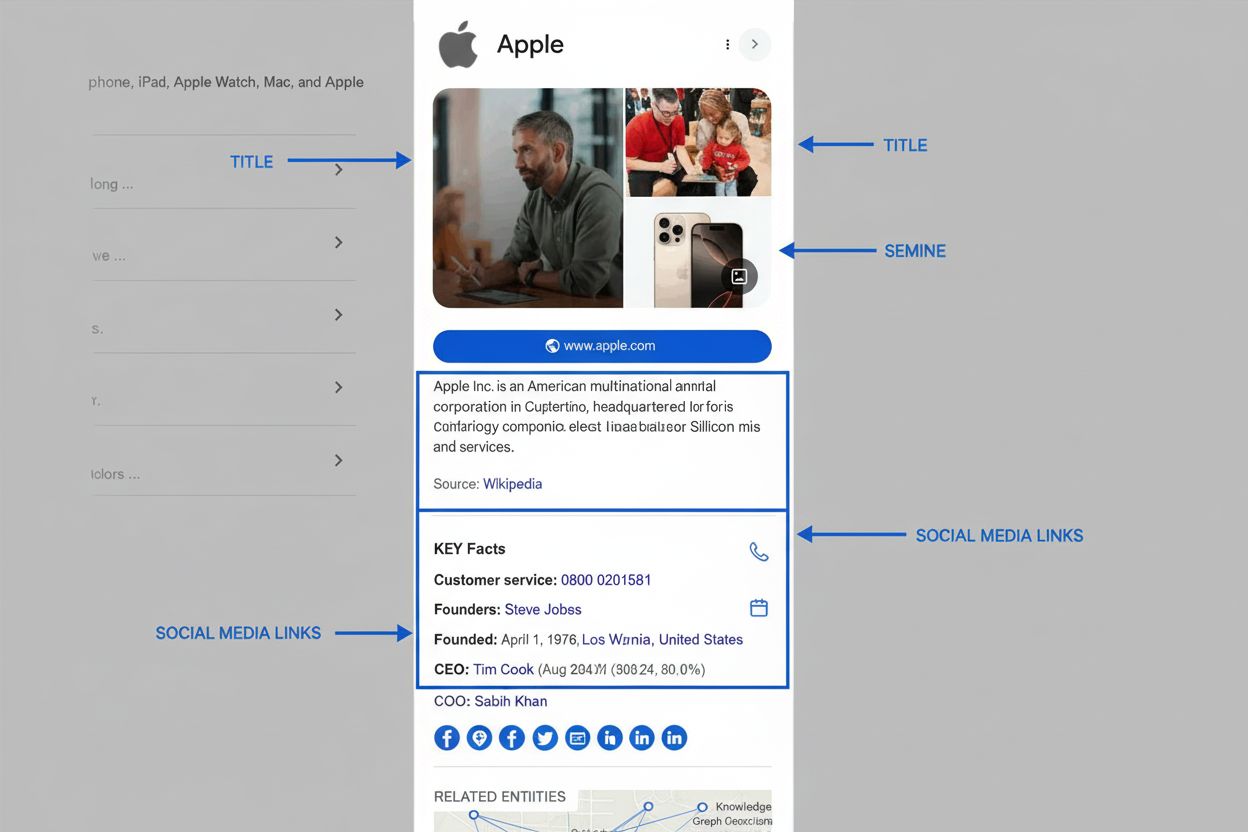
Knowledge Panel
Learn what a Knowledge Panel is, how it works, why it matters for SEO and AI monitoring, and how to claim or optimize one for your brand or entity.
12 min read

Learn how knowledge panels impact AI citations across ChatGPT, Perplexity, and Gemini. Discover why knowledge panel optimization is essential for AI search visibility and brand authority.
Knowledge panels serve as critical trust signals that directly influence how AI search engines like ChatGPT, Perplexity, and Gemini evaluate and cite your brand. When your entity has a well-optimized knowledge panel with accurate structured data, AI engines are significantly more likely to reference your company as an authoritative source in their generated responses, expanding your visibility beyond traditional search results.
Knowledge panels have evolved from simple information boxes into critical trust signals that directly influence how AI search engines evaluate and cite your brand. A knowledge panel is the information box that appears on the right side of desktop search results or at the top on mobile, displaying key facts about an entity such as a person, company, organization, or event. In the context of AI-powered search, these panels serve as a bridge between traditional search and emerging conversational AI platforms. When Google’s algorithm recognizes your entity as authoritative enough to warrant a knowledge panel, it simultaneously signals to AI systems like ChatGPT, Perplexity, and Gemini that your brand is a verified, trustworthy source worthy of citation in their generated responses.
The relationship between knowledge panels and AI citations represents a fundamental shift in how search visibility translates to brand authority. Unlike traditional SEO where ranking position determines visibility, knowledge panels create a separate, authoritative presence that isn’t dependent on your website’s organic ranking. This independence becomes increasingly valuable as AI search tools grow in prominence. According to recent research, conversational AI search tools are expected to dominate 70% of queries by 2025, making knowledge panel optimization essential for maintaining visibility across both traditional and AI-powered search experiences. The structured data that powers knowledge panels feeds directly into the knowledge graph, which AI engines reference when generating responses about financial services, products, companies, and industry topics.
Knowledge panels function as primary sources for AI trust assessment when these systems evaluate brand authority and credibility. The data contained within a knowledge panel—including company information, founding dates, executive details, social media profiles, and verified citations—creates a comprehensive entity profile that AI engines can trust. When AI systems like Gemini or ChatGPT generate responses about specific topics, they prioritize information from sources with established entity recognition and verified knowledge panel data. This means your knowledge panel optimization directly impacts your brand’s likelihood of being cited in AI-generated financial advice, product comparisons, industry analyses, and other conversational responses.
| Knowledge Panel Element | Impact on AI Citations | Importance Level |
|---|---|---|
| Organization Schema Markup | Enables AI systems to understand entity structure and relationships | Critical |
| NAP Consistency | Verifies business legitimacy across platforms | High |
| Wikipedia/Wikidata Presence | Provides authoritative third-party validation | High |
| Social Media Verification | Signals active, legitimate brand presence | Medium |
| Citation Network | Demonstrates widespread recognition and authority | High |
| Structured Data Completeness | Allows AI engines to extract accurate information | Critical |
The mechanism behind this connection involves named entity recognition (NER), a sophisticated AI process that Google uses to identify and rank documents. Google’s algorithm employs named entity recognition, user feedback loops, and AI to rank documents, creating a system that other AI search engines can tap into for credibility assessment. When your brand has a well-established knowledge panel with consistent, verified information across multiple platforms, AI engines recognize this as a strong signal that your entity is legitimate and authoritative. This recognition translates directly into higher probability of your brand being cited when users ask questions related to your industry, products, or services.
The AI search landscape has undergone dramatic transformation, with generative engine optimization (GEO) emerging as a critical complement to traditional SEO. GEO is the process of optimizing for AI search engines like ChatGPT, Perplexity, Gemini, CoPilot, and Claude to maximize a website’s reach and visibility in these platforms. The global AI market is projected to reach $826 billion by 2030, with GEO representing a fast-growing segment of search spend. For brands seeking visibility in this expanding market, knowledge panel optimization has become non-negotiable because it establishes the entity-level authority that AI systems require.
The growth trajectory of AI search traffic demonstrates the urgency of knowledge panel optimization. Traffic from generative AI sources increased by 1,200% compared to July 2024, with electronics and financial services showing the highest conversion rates from AI suggestions. This dramatic increase underscores the importance of establishing strong knowledge panel foundations that can support AI search visibility. When your brand appears in a knowledge panel, you’re not just gaining visibility in traditional Google search—you’re positioning yourself as a trusted source that AI engines will reference when generating responses to user queries. The synergy between knowledge panel optimization and AI search visibility represents a critical opportunity for brands to establish authoritative presence across multiple search channels simultaneously.
Organization schema markup serves as the structured data backbone that feeds both Google’s knowledge graph and AI search engines. For brands seeking to optimize their knowledge panels for AI citations, implementing comprehensive schema markup is essential. Schema markup transforms unstructured website content into structured data that search engines can easily parse, understand, and display. This structured approach enables AI systems to extract specific information with confidence, knowing that the data has been verified and properly formatted by the website owner.
The most effective schema implementation includes specific properties that establish authority and compliance credibility. Essential schema properties include your company name, URL, logo, comprehensive description of services, complete address information, contact points, social media profiles (sameAs property), and any relevant credentials or certifications. For financial services companies, implementing FinancialService schema type with additional properties like hasCredential (for financial licenses and regulatory approvals) significantly enhances knowledge panel completeness. Research demonstrates that comprehensive schema markup boosts rich-result impressions by 30% in just three months, making it a high-impact optimization for brands seeking immediate visibility improvements in both traditional and AI search results.
The sameAs property deserves particular attention because it creates connections between your entity and other verified online profiles. By linking your organization schema to verified Wikipedia pages, LinkedIn company profiles, social media accounts, and industry directories, you strengthen your entity’s profile in the knowledge graph. These connections signal to AI engines that your brand is recognized across multiple authoritative platforms, reinforcing credibility and increasing the likelihood of citation in AI-generated responses. Content that includes brand-owned data is 3× more likely to be cited in AI-generated answers, making comprehensive schema implementation essential for AI search visibility.
Name, Address, Phone (NAP) consistency across digital properties creates the citation foundation that Google uses to verify business legitimacy and build knowledge panel confidence. For brands seeking AI citations, this consistency becomes even more critical because AI systems evaluate citation networks when determining source credibility. When your NAP information appears consistently across Google My Business, industry directories, social media profiles, regulatory databases, and your website, you create a verifiable digital footprint that AI engines can trust.
Primary citation sources that influence knowledge panel authority and AI citations include Google My Business (essential for local presence), LinkedIn Company Page, Crunchbase (for funding and company data), Better Business Bureau, industry-specific directories, regulatory databases (SEC, FINRA where applicable), and news and PR distribution platforms. Cross-platform verification requires a systematic approach: audit existing citations using tools to identify inconsistencies, standardize format across all platforms (abbreviations, suite numbers, phone formats), monitor and maintain consistency as business information changes, and build new citations on high-authority platforms relevant to your industry. The verification process extends beyond basic NAP data to include business descriptions, service offerings, and executive information. AI search engines evaluate this consistency when determining source credibility, making comprehensive citation management a critical component of AI search optimization.
Wikipedia and Wikidata serve as authoritative sources that Google uses to populate knowledge panels with verified information, and AI engines reference these platforms when generating responses about entities. For brands seeking AI citations, having a well-maintained Wikipedia page with proper citations and a corresponding Wikidata entry significantly boosts knowledge panel reliability. These platforms act as trust signals that AI search engines also reference when generating responses about companies, making them essential components of a comprehensive knowledge panel optimization strategy.
Wikidata provides structured data that feeds directly into knowledge panels and AI search systems in machine-readable language. Creating and maintaining Wikidata entities involves establishing essential properties including instance of (Financial technology company), industry (Financial services, Software), headquarters location, founding information, founder names with Wikidata entities, inception date, official website, and stock exchange ticker if publicly traded. While Wikipedia serves more as a demonstration of entity notability rather than defining what an entity actually is, Wikidata is non-negotiable for knowledge panel optimization. The structured nature of Wikidata makes it particularly valuable for AI search engines seeking reliable, machine-readable information about entities and their relationships. Wikidata optimization requires ongoing maintenance as business information changes, but the investment pays dividends in knowledge panel completeness and AI citation likelihood.
Social media verification badges serve as trust signals that influence both knowledge panel display and AI search credibility assessment. For brands seeking AI citations, verification across key platforms becomes essential because these signals reinforce entity legitimacy. Priority platforms for verification include LinkedIn (business verification through LinkedIn Pages), Twitter/X (blue checkmark for brand recognition), Facebook (business verification for local presence), Instagram (professional account verification), and YouTube (channel verification for content authority). Each verification badge adds another layer of credibility that AI systems evaluate when determining whether to cite your brand.
Industry-specific verification and certification programs provide additional trust signals that AI engines evaluate. These include regulatory compliance documentation (SEC, FINRA, state licensing), industry association memberships, security certifications (SOC 2, ISO 27001, PCI DSS), and partnership verification with established organizations. These verification signals create a comprehensive trust profile that AI search engines can evaluate when determining source authority for industry-specific topics. Brands with high topical authority are 2.5× more likely to land in AI snippets, making verification a critical component of AI search strategy. The combination of social media verification, industry certifications, and regulatory compliance documentation creates a multi-layered trust profile that AI systems recognize as authoritative.
Beyond technical implementation, knowledge panel optimization extends to content strategy and authority building that directly influences AI citations. Executive profiles with individual knowledge panels strengthen your overall brand authority because AI systems recognize that your organization has recognized leaders in the industry. Company history and milestone documentation provide context that AI engines use when evaluating your brand’s significance and longevity. Product descriptions with clear value propositions help AI systems understand what your brand offers and when to cite you in relevant responses. Industry thought leadership through content marketing establishes topical authority that AI engines recognize when generating responses about your industry.
Media coverage and press release distribution create the external validation that AI systems require when determining whether to cite your brand. Speaking engagements at industry conferences, podcast appearances and media interviews, industry awards and recognition programs, partnership announcements with established brands, and regulatory approvals and compliance certifications all serve as authority signals that influence AI citation likelihood. Monthly content updates correlated with a 40% jump in visibility for AI search features, emphasizing the importance of maintaining fresh, authoritative content that supports knowledge panel optimization. The investment in building comprehensive authority signals pays dividends across multiple channels, creating a compound effect that strengthens brand authority and search visibility over time.
Tracking knowledge panel impact on AI search visibility requires specialized monitoring approaches that go beyond traditional SEO metrics. Key metrics to track include knowledge panel impressions and click-through rates, AI search citations across ChatGPT, Perplexity, and Gemini, brand mention frequency in AI-generated responses, competitive positioning in AI search results, and topic authority signals across relevant financial topics. Real-time updates improved click-through rates from AI features by 27%, highlighting the importance of maintaining current information across all knowledge panel sources.
Effective monitoring involves setting up systems to track how your brand appears in AI-generated answers across multiple platforms. This includes monitoring branded search queries to see if your knowledge panel appears, tracking mentions of your brand in AI responses to industry-related questions, analyzing the context in which your brand is cited (positive, neutral, or comparative), and comparing your citation frequency to competitors in your industry. Advanced monitoring also involves entity relationship mapping to understand how your brand connects to other entities that AI systems recognize. By understanding these relationships, you can optimize your knowledge panel to strengthen connections that AI engines value when generating responses about your industry or products.
A comprehensive 30-60-90 day roadmap for knowledge panel optimization includes foundation building in days 1-30 (complete organization schema implementation, audit and standardize NAP data across top 20 platforms, claim and optimize Google My Business listing, set up monitoring for knowledge panel changes, begin Wikipedia research and notability assessment), authority development in days 31-60 (create or update Wikidata entity, implement social media verification processes, build industry-specific citations and directory listings, launch content marketing campaign for topical authority, establish media outreach for coverage and mentions), and optimization and monitoring in days 61-90 (refine schema markup based on performance data, expand citation network to secondary platforms, monitor AI search citations and adjust strategy, implement advanced entity relationship mapping, establish ongoing maintenance and update processes).
Success requires comprehensive measurement across multiple channels. Primary KPIs include knowledge panel impression volume and growth, click-through rates from knowledge panel features, AI search citation frequency and context, brand mention volume in AI-generated responses, and organic search visibility improvements. Secondary metrics include social media verification completion rates, citation consistency scores across platforms, schema markup coverage and rich result performance, competitive positioning in knowledge panel features, and content authority signals and topical coverage. Pages with ongoing optimization average a 15% higher CTR from AI results, demonstrating the long-term value of comprehensive knowledge panel optimization. The investment in knowledge panel optimization pays dividends across multiple channels, creating a compound effect that strengthens brand authority and search visibility over time.
Track how your brand appears in AI-generated answers across ChatGPT, Perplexity, and other AI search engines. Get real-time insights into your AI citation performance and competitive positioning.
Learn what a Knowledge Panel is, how it works, why it matters for SEO and AI monitoring, and how to claim or optimize one for your brand or entity.

Learn how branded searches affect AI citations and why 86% of AI answers cite brand-controlled sources. Discover strategies to maximize your brand visibility in...
Learn proven strategies to improve your brand's citation position in ChatGPT, Perplexity, Gemini, and other AI answer engines. Discover technical, content, and ...