

How Publisher Deals Impact AI Citations and Content Visibility
Understand how publisher licensing agreements with AI platforms affect content citations, visibility in AI search results, and traffic implications for news org...
9 min read

Understand how AI partnerships with publishers influence citation patterns, brand visibility, and content sourcing across ChatGPT, Perplexity, and Google AI Overviews.
AI partnerships directly influence which sources get cited by shaping training data access, content credibility weighting, and retrieval priorities. Publishers with licensing agreements become trusted sources that AI models actively learn from and prioritize, while non-partnered domains face reduced visibility in AI-generated answers.
Partnerships between AI companies and publishers fundamentally reshape how citations are distributed across AI-generated answers. When OpenAI, Google, Perplexity, and other AI platforms establish licensing agreements with media organizations, they gain legal access to content archives, real-time data feeds, and exclusive information sources. These partnerships create a privileged relationship where certain publishers become embedded in the AI model’s training data, retrieval systems, and answer generation pipelines. The result is a dramatic shift in citation patterns that favors partnered publishers over non-partnered competitors, regardless of content quality or relevance.
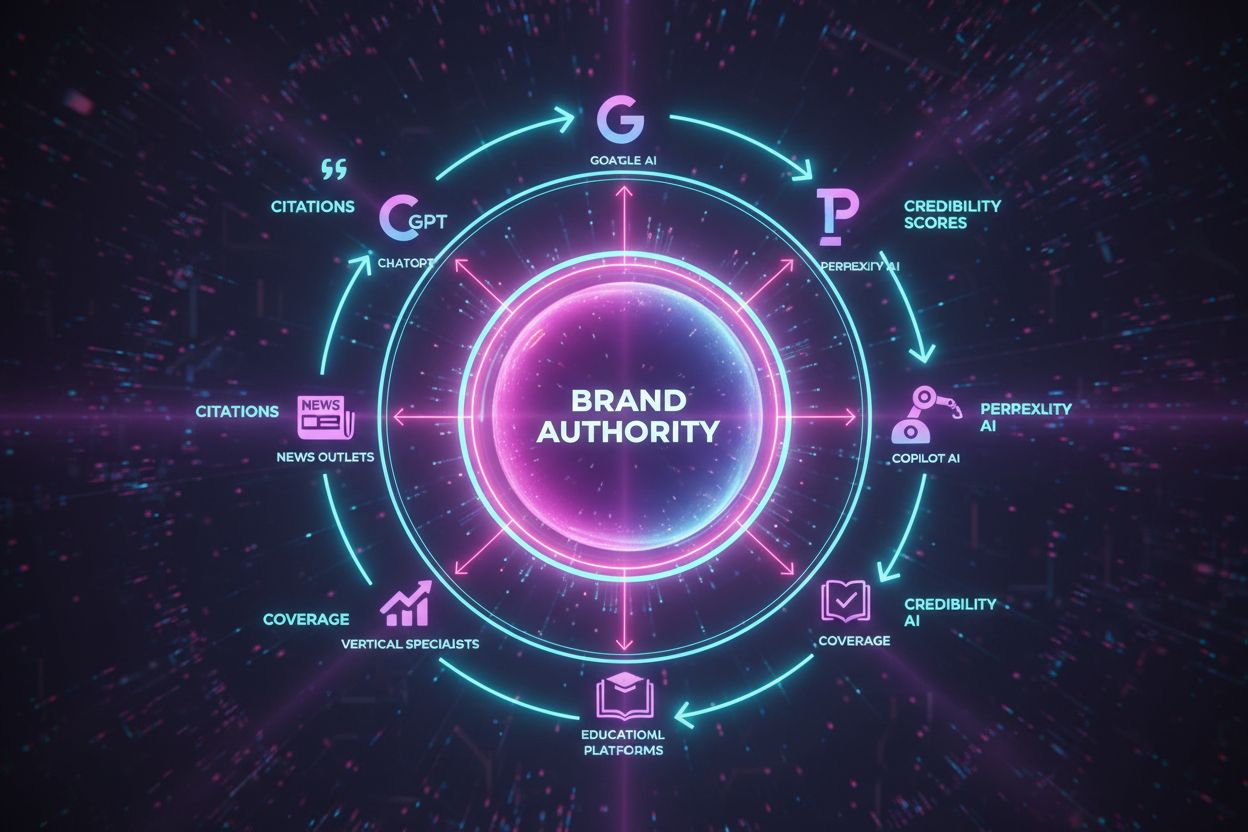
The mechanics of AI partnerships operate through three primary levers that shape a model’s internal knowledge graph and citation behavior. Coverage determines the legal scope and recency of content archives the AI can crawl and reuse. Context controls how frequently those sources appear across pretraining data, retrieval indexes, and evaluation sets. Credibility assigns confidence weights that determine how much the system trusts and prioritizes those sources when generating answers. When a publisher becomes a model partner, it stops being just another website the AI can read—it becomes a trusted landmark inside the system’s knowledge map that actively influences how the model understands topics, brands, and authority.
Partnered publishers receive systematic advantages in AI citation patterns that non-partnered domains cannot easily replicate. Research analyzing 680 million citations across ChatGPT, Google AI Overviews, and Perplexity reveals that only 14% of the top 50 most-mentioned sources appear across all three platforms. This fragmentation directly reflects the different partnership ecosystems each AI platform has built. ChatGPT’s partnerships with major news organizations and media conglomerates result in heavy citation of outlets like Reuters, Forbes, and Business Insider. Google AI Overviews, powered by Google’s own search index and partnerships, heavily favor Reddit, YouTube, and Google-owned properties. Perplexity’s real-time search approach creates different citation patterns that emphasize community platforms and niche vertical experts.
The advantage extends beyond simple citation frequency. Partnered sources receive higher credibility weights in answer generation, meaning their content is more likely to be selected, quoted, and cited when multiple sources contain similar information. When an AI model encounters conflicting information from a partnered publisher and a non-partnered competitor, the partnership relationship often tips the scales toward the licensed source. This creates a compounding effect where partnered publishers accumulate more citations over time, which increases their visibility in AI answers, which drives more traffic and authority, which makes them even more attractive partners for future AI licensing deals.
| AI Platform | Top Cited Source | Partnership Strategy | Citation Concentration |
|---|---|---|---|
| ChatGPT | Wikipedia (7.8%) | Licensed media partnerships | High (Wikipedia = 47.9% of top 10) |
| Google AI Overviews | Reddit (2.2%) | Search index + owned properties | Balanced (21% Reddit, 18.8% YouTube) |
| Perplexity | Reddit (6.6%) | Real-time web search + partnerships | High (Reddit = 46.7% of top 10) |
The data reveals that each AI platform’s partnership ecosystem creates distinctly different citation hierarchies. ChatGPT’s partnerships with established media organizations result in Wikipedia dominating nearly half of its top 10 citations, reflecting the platform’s preference for authoritative, encyclopedic sources. Google AI Overviews shows a more balanced distribution across multiple source types, including its own YouTube platform and community sites like Reddit and Quora. Perplexity’s real-time search approach combined with its partnerships creates heavy reliance on Reddit, which accounts for nearly 47% of citations among its top 10 sources. These differences mean that a brand’s citation visibility varies dramatically depending on which AI platform users query—a domain might be heavily cited in ChatGPT but nearly invisible in Perplexity, or vice versa.
AI partnerships determine not just which sources get cited, but which sources become foundational to how the model understands entire industries and topics. When OpenAI licensed content from major news organizations, those publishers’ language patterns, narrative frames, and topic associations became embedded in the model’s neural network. This means that when ChatGPT generates an answer about a topic, it’s drawing on training data that over-indexes on partnered publishers’ perspectives and terminology. The same applies to Google’s partnerships with publishers and Perplexity’s agreements with data providers—each partnership shapes the model’s internal representation of knowledge.
Syndication and republication amplify partnership advantages exponentially. When a major partnered publisher publishes a story, that content gets picked up by wire services, aggregated by news platforms, and republished across hundreds of local outlets. Each republication reinforces the original narrative and language patterns in the AI’s training data. One AP pickup becomes 200 local clones, and now that wording is everywhere in the model’s diet. This “statistical gravity” effect means that partnered publishers don’t just get cited more frequently—their framing of topics becomes the default language models use when answering questions. A brand mentioned in a partnered publisher’s story gets associated with that publisher’s credibility and reach, while a brand only mentioned in non-partnered sources remains invisible to the model’s understanding.
Brands and publishers without AI partnerships face systematic disadvantages in citation visibility that extend far beyond simple ranking factors. Research comparing 8,090 keywords across 25 verticals found that only 7.2% of domains appear in both Google AI Overviews and LLM results. Of the 22,410 unique domains identified, 70.7% appeared exclusively in Google AI Overviews, while 22.1% appeared exclusively in LLM foundation models. This massive fragmentation means that most domains are invisible to at least one major AI platform, and the determining factor is often partnership status rather than content quality.
Non-partnered domains face additional challenges beyond citation frequency. AI models trained on partnership-heavy datasets develop biases toward certain source types and publishers. The training corpora over-index on U.S. English, ad-supported news, and commercial publishers due to current partnerships. Non-U.S., non-English, academic, and NGO sources are systematically underweighted, leading to culturally narrow answers that exclude non-partnered voices. A brand that publishes excellent content in a non-English language or through an academic institution faces structural disadvantages because those sources weren’t part of the AI’s partnership ecosystem and therefore weren’t prioritized in training data collection.
Understanding partnership dynamics is essential for developing effective AI citation strategies. Brands cannot simply optimize content and expect citations to follow—they must also consider which publisher networks their content appears in and which AI platforms have partnerships with those networks. A brand that earns coverage in a major news outlet that has a licensing agreement with ChatGPT will see dramatically higher citation rates in ChatGPT answers compared to coverage in a non-partnered publication. This creates a new form of media hierarchy where partnership status matters as much as publication authority.
The most effective strategy involves targeting syndication paths within partnered publisher networks. When a brand secures coverage in a major partnered publisher, that story gets distributed through wire services and aggregated across hundreds of outlets. Each syndication reinforces the brand’s association with that publisher’s credibility and increases the likelihood of citation across multiple AI platforms. Brands should prioritize earning placements within the specific publisher networks that each AI platform has partnered with—TIME, FT Group, Guardian Media, and Axel Springer for general coverage; specialized vertical publishers for niche topics. This approach leverages the partnership ecosystem rather than fighting against it.
Brands that invest in credible, human-authored, legally clear coverage within partnered publisher networks will become the foundational voices that tomorrow’s AI models rely on. The future of AI citations belongs to publishers and brands that understand partnership dynamics and position themselves strategically within those ecosystems. This means moving beyond traditional SEO thinking about keywords and links to focus on building a digital footprint of authority that influences knowledge graphs, algorithms, and AI training data simultaneously.
The most successful brands in the AI era will be those that own their vertical completely and build the definitive source of knowledge for their industry. They’ll create step-by-step how-tos, definition blocks, comparison tables, and structured content that models love to cite. They’ll pitch experts to major media outlets to reinforce association and expertise. They’ll engineer syndication paths for every data study and insight. And critically, they’ll monitor their presence across AI platforms to understand which partnerships are driving their citations and where gaps exist. Brands that understand how partnerships shape AI citations will dominate AI-generated answers, while those that ignore partnership dynamics will find themselves increasingly invisible in the AI-powered search era.
Track how your domain appears across AI search engines and understand your citation patterns with AmICited's comprehensive monitoring platform.
Understand how publisher licensing agreements with AI platforms affect content citations, visibility in AI search results, and traffic implications for news org...
Learn what AI Platform Partnerships are and how formal relationships between brands and AI platforms enhance visibility in ChatGPT, Perplexity, Google AI Overvi...
Community discussion on how publisher licensing deals with AI companies like OpenAI affect citation patterns and content visibility. Perspectives from publisher...