
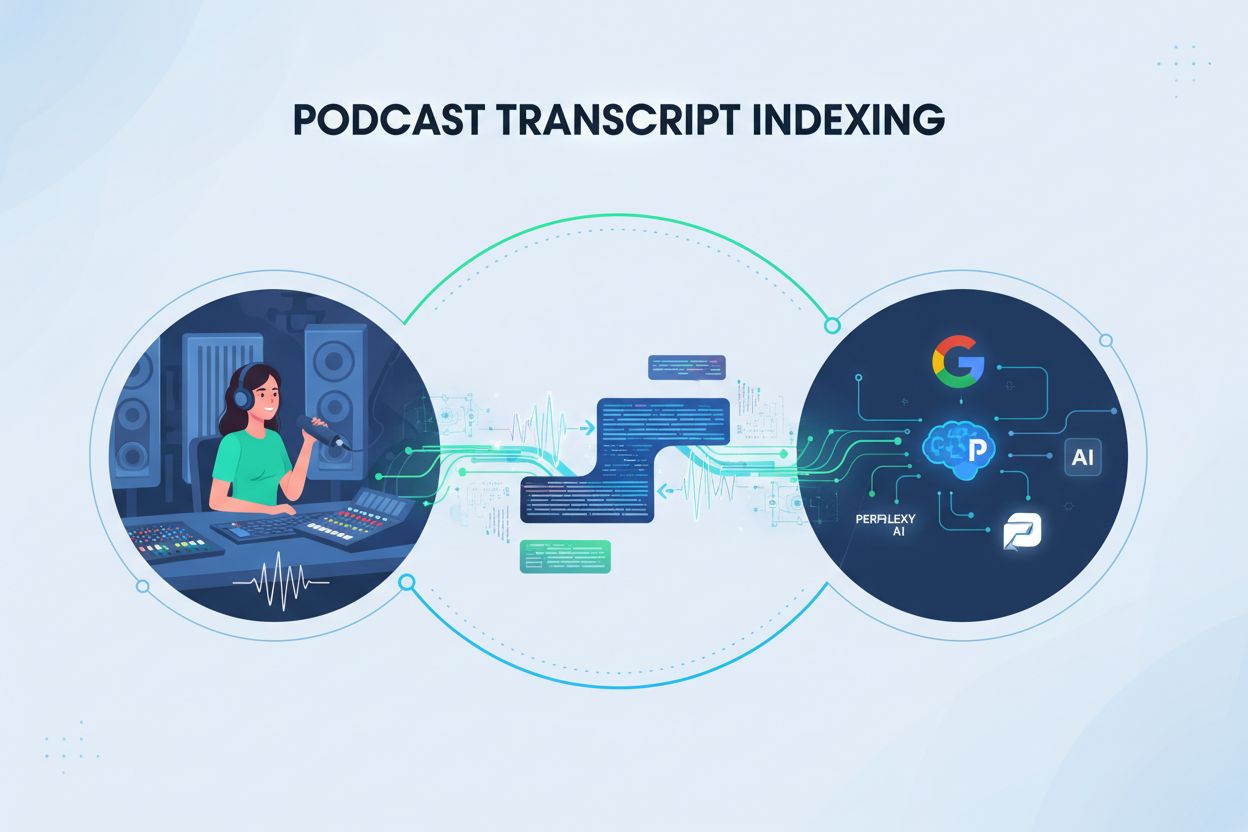
Podcast Transcript Indexing
Learn how podcast transcript indexing enables AI discovery and citation. Understand the process of converting audio to searchable text, its impact on SEO, acces...
11 min read

Learn how AI systems like ChatGPT and Perplexity discover, index, and cite podcast content. Understand the technical mechanisms behind podcast citations in AI-generated answers.
Podcasts get cited by AI systems through automatic transcription and indexing of podcast content. AI search engines like ChatGPT, Perplexity, and Gemini access podcast transcripts via RSS feeds, web crawling, and specialized podcast databases. When AI models are trained on diverse data sources, they learn to recognize and cite podcast episodes as authoritative sources for specific topics, similar to how they cite articles and websites.
Podcasts are discovered and indexed by AI systems through multiple interconnected mechanisms that work together to make audio content searchable and citable. Unlike traditional text-based content, podcasts require an additional processing step: automatic speech recognition (ASR) technology converts audio into searchable text transcripts. This transcription process is fundamental to how AI systems can access, understand, and ultimately cite podcast content in their responses. Major AI platforms invest heavily in podcast indexing infrastructure because podcasts represent a significant and growing source of authoritative information across virtually every industry and topic area.
The discovery process begins with RSS feed monitoring and web crawling, where AI systems continuously scan podcast directories and RSS feeds to identify new episodes. Platforms like Apple Podcasts, Spotify, and independent podcast hosting services publish RSS feeds that contain metadata about episodes including titles, descriptions, publication dates, and audio file URLs. AI search engines and training pipelines regularly crawl these feeds to identify new content. Additionally, web crawlers discover podcast content through podcast-specific search engines and aggregation platforms that have already indexed and transcribed episodes. This multi-layered discovery approach ensures that AI systems have access to both newly published content and historical episodes that may contain relevant information for user queries.
Automatic speech recognition technology is the critical bridge between audio content and AI citability. When a podcast episode is discovered, specialized ASR services like Amazon Transcribe, Google Cloud Speech-to-Text, or similar technologies automatically convert the audio into machine-readable text. These transcription services don’t simply produce raw text; they generate timestamped transcripts that preserve the exact moment when specific information was mentioned. This temporal precision is essential for citation purposes because it allows AI systems to not only identify that a podcast contains relevant information but also pinpoint the exact location within the episode where that information appears.
The transcription process involves several sophisticated steps that enhance the quality and searchability of podcast content. Custom vocabulary training helps transcription systems understand domain-specific terminology that might otherwise be misrecognized. For example, a technology podcast discussing “EC2” or “S3” services requires the transcription system to be trained on AWS-specific terminology to avoid misinterpreting these acronyms. Speaker identification and diarization separate different speakers within an episode, allowing AI systems to attribute statements to specific individuals. This is particularly important for citation accuracy because it enables AI to cite not just the podcast episode but potentially the specific speaker who made a particular claim or provided specific information.
| Transcription Feature | Impact on AI Citation | Example |
|---|---|---|
| Timestamped transcripts | Enables precise location of cited information | “At 23:45 in episode X, the speaker states…” |
| Speaker identification | Attributes statements to specific individuals | “According to guest expert John Smith in episode Y…” |
| Custom vocabulary | Improves accuracy for domain-specific terms | Correctly transcribes technical jargon and acronyms |
| Entity extraction | Identifies key topics, people, and organizations | Recognizes mentions of companies, products, and concepts |
| Sentiment analysis | Understands context and tone of statements | Distinguishes between endorsements and criticisms |
Once transcripts are generated, AI systems index podcast content using semantic search technology that goes far beyond simple keyword matching. Traditional search engines rely on exact word matches, but semantic search understands the meaning and context of information. This means an AI system can recognize that a podcast discussing “electric vehicle environmental impact” is relevant to a query about “EV sustainability” even though the exact words don’t match. Vector embeddings convert both podcast transcripts and user queries into mathematical representations that can be compared for semantic similarity, allowing AI systems to find relevant podcast content even when the language used differs significantly.
The indexing infrastructure used by major AI platforms employs dense retrieval systems and approximate nearest neighbor (ANN) search to efficiently search through millions of indexed podcast episodes. When a user asks a question, the AI system converts that question into a vector representation and searches the indexed podcast database for episodes with similar vector representations. This process happens in milliseconds, allowing AI systems to identify relevant podcast sources almost instantaneously. The sophistication of these indexing systems means that podcasts discussing a topic from multiple angles or using different terminology can all be discovered and ranked by relevance, ensuring that the most authoritative and relevant podcast sources are prioritized in AI responses.
AI language models are trained on diverse data sources including podcast transcripts, which means they learn to recognize podcasts as legitimate sources of information during their training phase. When models like ChatGPT or Gemini are trained on internet-scale data, they encounter podcast transcripts alongside articles, research papers, and other content. This exposure teaches the models to understand podcast content, recognize authoritative podcast sources, and cite them appropriately in responses. The training process creates associations between specific topics and the podcasts that discuss them, enabling the model to suggest relevant podcast sources when answering user questions.
The citation mechanism in AI systems works by matching user queries against indexed podcast content and retrieving the most relevant episodes based on semantic similarity and other ranking factors. When an AI system generates a response that includes a podcast citation, it’s typically because the podcast content was identified as highly relevant to the user’s query and met the system’s criteria for source quality and authority. Authority signals that influence podcast citation include factors such as podcast popularity, listener engagement metrics, the credentials of podcast hosts and guests, and the consistency of information across multiple episodes. AI systems are increasingly sophisticated at evaluating source credibility, meaning that well-produced podcasts with expert hosts and guests are more likely to be cited than amateur productions.
Several key factors determine whether a podcast will be cited by AI systems in response to user queries. Content quality and accuracy are paramount; AI systems are trained to prioritize sources that provide reliable, well-researched information. Podcasts that feature expert guests, cite their sources, and provide nuanced discussions of complex topics are more likely to be cited than those offering superficial coverage. Podcast metadata optimization also plays a crucial role, as AI systems rely on episode titles, descriptions, and show information to understand what each episode covers. Podcasts with clear, descriptive titles and comprehensive show descriptions are more easily indexed and matched to relevant queries.
Consistency and frequency of publication signal to AI systems that a podcast is an active, maintained source of information. Podcasts that publish regularly and maintain consistent quality are more likely to be included in AI training datasets and indexed in AI search systems. Additionally, cross-platform presence and mentions enhance a podcast’s visibility to AI systems. When a podcast is mentioned on websites, in articles, or across social media, these mentions create additional signals that help AI systems understand the podcast’s relevance and authority. Podcasts that are actively promoted and discussed across multiple platforms are more likely to be discovered and cited by AI systems compared to those with minimal online presence beyond their hosting platform.
Understanding how podcasts get cited by AI has important implications for podcast creators and brands seeking visibility in AI-generated answers. Optimizing podcast metadata is essential; creators should ensure that episode titles, descriptions, and show information clearly communicate the content and key topics covered. This metadata is what AI systems use to understand and index podcast content, so clarity and specificity directly impact discoverability. Publishing transcripts publicly on podcast websites or in show notes significantly enhances the likelihood of citation, as it makes content more accessible to AI crawlers and indexing systems. Many AI systems can discover and index transcripts more easily than they can process raw audio files.
Brands and podcast creators should also focus on building authority and credibility within their niche, as this directly influences whether AI systems will cite their content. This involves featuring expert guests, providing well-researched information, citing sources within episodes, and maintaining consistent publication schedules. Additionally, monitoring podcast citations in AI responses has become increasingly important for understanding brand visibility and reach. Tools that track when and how podcasts are cited by AI systems provide valuable insights into content performance and audience reach beyond traditional podcast analytics. As AI search engines become more prevalent, the ability to appear in AI-generated answers represents a significant opportunity for podcast creators to reach new audiences and establish authority in their fields.
Track when your podcast episodes appear in AI-generated answers across ChatGPT, Perplexity, and other AI search engines. Get real-time alerts for brand mentions and citations.
Learn how podcast transcript indexing enables AI discovery and citation. Understand the process of converting audio to searchable text, its impact on SEO, acces...

Master podcast SEO and AI visibility with proven audio content strategies. Learn how to optimize for listening intent, metadata, and AI-powered discovery platfo...
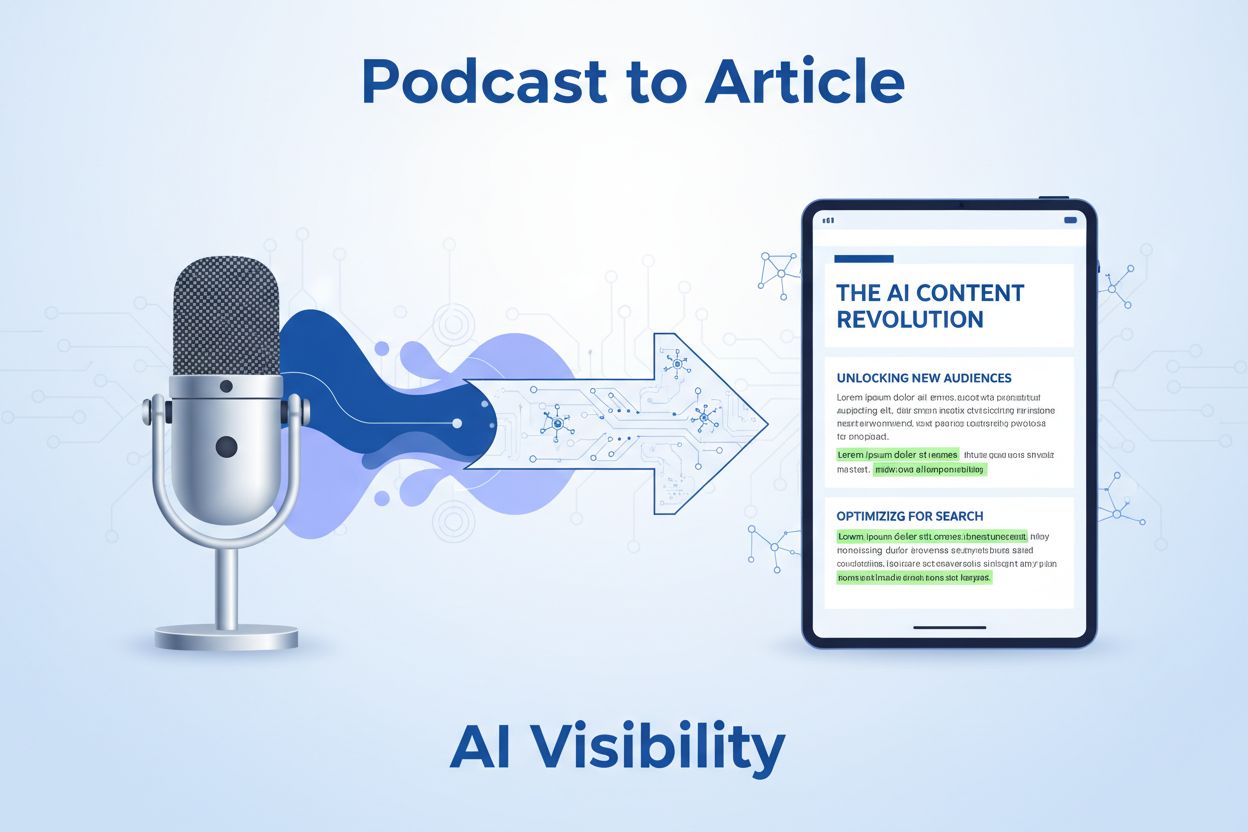
Learn how to convert podcasts to articles and boost AI visibility. Discover transcription strategies, optimization techniques, and tools to get your brand cited...