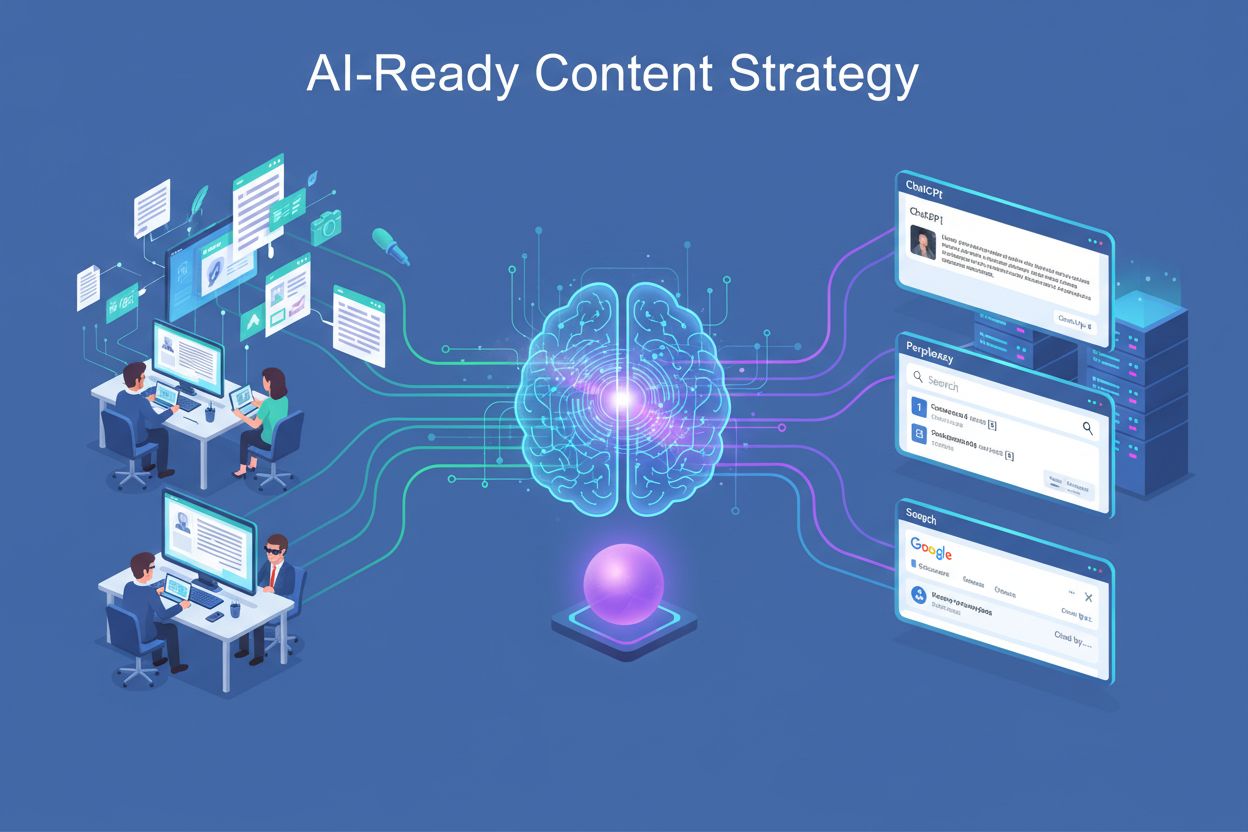
Understanding AI Citation Optimization
Publisher optimization for AI citations represents a fundamental shift in content strategy from traditional search engine ranking to becoming a trusted source within AI-generated answers. Unlike conventional SEO where visibility depends on ranking position in search results, AI citation optimization focuses on making content discoverable, extractable, and citable by large language models like ChatGPT, Perplexity, Google Gemini, and Claude. This new approach requires publishers to understand how different AI engines evaluate, retrieve, and synthesize information from web content. The goal is no longer just to rank on the first page of Google—it’s to become the source that AI systems pull from when answering user queries. This shift has created an entirely new discipline called Answer Engine Optimization (AEO) or Generative Engine Optimization (GEO), which demands different content structures, technical implementations, and measurement strategies than traditional SEO.
Why AI Citations Matter More Than Traditional Rankings
AI citations have become critically important because they represent direct recommendations to users at the moment they’re seeking answers. When an AI system cites your content, it’s not just displaying a blue link—it’s actively endorsing your information as authoritative and relevant. Research shows that AI referrals to top websites increased 357% year-over-year in June 2025, reaching 1.13 billion visits. This explosive growth demonstrates that users are increasingly turning to AI search engines as their primary discovery channel. Unlike traditional search results where users must click through multiple links, AI-generated answers synthesize information directly, meaning only a handful of sources get cited per response. If your brand isn’t among those cited sources, you’re essentially invisible in this emerging discovery channel. For publishers, this creates both an opportunity and an urgency—establishing authority early in the AI search era can drive long-term awareness and influence purchasing decisions directly at the top of the funnel.
Ready to Monitor Your AI Visibility?
Track how AI chatbots mention your brand across ChatGPT, Perplexity, and other platforms.
How Different AI Engines Evaluate and Cite Content
Each major AI platform has distinct preferences for which sources it cites, based on how it’s trained and how it retrieves information. Understanding these differences is essential for publishers developing a comprehensive AI citation strategy.
| AI Engine | Primary Citation Sources | Sourcing Behavior | Key Optimization Focus |
|---|
| ChatGPT (GPT-4o) | Wikipedia (47.9%), Reddit (11.3%), Forbes (6.8%), G2 (6.7%) | Prioritizes well-established, fact-based sources with institutional authority | Third-party validation, neutral publications, encyclopedic content |
| Google Gemini | Blogs (~39%), News (~26%), YouTube (~3%), Wikipedia (lower priority) | Blends blog content, professional reviews, and media; values both expert insights and peer validation | In-depth blog posts, YouTube content, authoritative media outlets |
| Perplexity AI | Blog/editorial (~38%), News (~23%), Expert review sites (~9%), Product blogs (~7%) | Acts like a research assistant; favors deep, factual content and reputable review platforms | Original research, data-backed comparisons, niche expert sites |
| Google AI Overviews | Blog articles (~46%), News (~20%), Reddit (>4%), LinkedIn (4th most-cited), Product blogs (~7%) | Sources from full spectrum of Google Search; values well-structured, deep content | Rich, evergreen content, listicles, step-by-step guides, community engagement |
This variation means publishers cannot use a one-size-fits-all approach. A strategy that works for ChatGPT citations may not be equally effective for Perplexity or Google Gemini. Publishers must tailor their content and distribution strategies to align with each platform’s unique preferences and sourcing algorithms.
Creating Answer-First Content Structure
The foundation of AI citation optimization is answer-first content—material that leads with direct answers rather than building narrative tension or context. AI systems are designed to extract concise, factual information quickly, and they reward content that delivers value immediately. Publishers should structure content so that the core answer appears within the first two sentences, allowing AI models to lift and cite the information without requiring additional context. This approach differs significantly from traditional content marketing, which often uses storytelling techniques to build engagement gradually.
Effective answer-first content follows a clear hierarchy: fact first, interpretation second, implication third. Publishers should lead with verifiable data points or observable trends, then explain what those facts mean for their audience, and finally discuss the broader implications. For example, instead of opening with “In today’s evolving digital landscape, AI visibility is becoming increasingly important,” a publisher should write “AI visibility measures how often your brand appears in AI-generated answers across platforms.” This direct approach makes content immediately useful to both human readers and AI systems. The structure should use clear headings phrased as questions people naturally ask, such as “What is AI visibility?” or “How do I measure AI citations?” rather than vague headings like “Learn More.” This question-based formatting helps AI systems instantly map content to user intent and extract relevant responses more readily.
Stay Updated on AI Visibility Trends
Get the latest insights on AI mentions, brand monitoring, and optimization strategies.
Implementing Structured Data and Schema Markup
Structured data acts as a bridge between human-readable content and machine-readable information, helping AI systems understand content context, relationships, and meaning. Publishers should implement schema markup using JSON-LD format to label content types and relationships explicitly. The most valuable schema types for AI citation optimization include FAQPage (for frequently asked questions), HowTo (for step-by-step guides), Article (for news and blog content), and QAPage (for question-and-answer content). These schema types signal to AI crawlers exactly what type of information they’re encountering and how it’s structured, making it easier for models to parse, evaluate, and cite the content.
Beyond traditional schema, publishers should also implement llms.txt files—an emerging standard that works similarly to robots.txt but specifically for AI crawlers. This file tells AI systems which pages they’re allowed to use and can increase the odds that a publisher’s most valuable pages get seen and cited. Publishers should prioritize adding structured data to core educational pages, data-rich content, and pages that answer common user questions. The implementation should be consistent across all relevant pages, with proper entity linking through the sameAs property to verified profiles on LinkedIn, Crunchbase, Wikipedia, or official brand pages. This consistency helps AI systems reliably trace connections between entities and understand topical authority.
Optimizing Content for AI Crawler Behavior
Understanding how AI crawlers interact with publisher websites is crucial for optimization. Major AI crawlers include GPTBot (OpenAI’s ChatGPT), PerplexityBot (Perplexity AI), ClaudeBot (Anthropic’s Claude), and various Googlebot crawlers for Google’s AI initiatives. These crawlers serve two critical functions: collecting training data for language models and retrieving real-time information for current answers. Publishers can track AI crawler activity through server log analysis or tools like SEO Bulk Admin, which automatically detects and reports on AI bot visits without requiring complex technical setup.
By analyzing which pages AI crawlers visit most frequently, publishers can identify content patterns that AI systems find valuable. Pages receiving high AI crawler attention typically share common characteristics: clear heading structures, concise paragraphs, bullet points or numbered lists, and direct answers to specific questions. Publishers should reverse-engineer these high-performing pages to understand their structure, format, topical depth, keyword usage, and internal linking patterns. This analysis reveals what makes content “citation-worthy” from an AI perspective. Publishers can then apply these successful attributes to underperforming content by breaking down dense paragraphs, adding more descriptive headings, implementing relevant schema markup, enhancing clarity and directness, expanding authority signals through citations and references, and improving internal linking to create stronger topical clusters.
Establishing Topical Authority and Entity Consistency
AI systems evaluate authority differently than traditional search engines. Rather than relying solely on backlinks and domain authority, AI models assess topical authority—the depth and consistency of expertise demonstrated across related content. Publishers should build out comprehensive content clusters around specific niches rather than chasing broad keywords. For example, a fintech publisher might dominate topics like “BNPL compliance,” “open banking integrations,” and “KYC requirements,” while a SaaS publisher might focus on “automated reimbursements,” “multi-country payroll,” and “ATO reporting for startups.”
Entity consistency is equally critical. Publishers must use the same full names for people, brands, products, and organizations across all content, metadata, and captions. If one article mentions “Google Workspace” and another refers to “G Suite,” AI systems may treat these as separate entities, weakening authority signals. Publishers should maintain consistent entity naming across blog posts, social media, internal links, and metadata. When featuring team members or partners, use identical full names and titles throughout. This consistency helps AI systems build a coherent understanding of the publisher’s expertise and relationships, making it more likely that content will be recognized, trusted, and cited.
Formatting Content for AI Extraction and Readability
AI systems don’t read content the way humans do—they parse it into smaller, structured pieces that can be evaluated for authority and relevance. Publishers should format content with this parsing process in mind. Paragraphs should be kept under 120 words, with clear topic sentences that can stand alone. Content should be broken up with bullet points for lists, numbered steps for guides, and tables for comparisons. These formatting elements serve dual purposes: they improve human readability and make it easier for AI systems to extract coherent summaries and correctly cite content.
Headings and subheadings should use natural language that mirrors how people ask questions. Instead of generic headings like “Overview” or “Details,” publishers should use specific, question-based headings like “What makes this dishwasher quieter than most models?” or “How do I integrate your API with Zapier?” This approach improves scannability for humans while helping AI systems understand content structure and intent. Publishers should avoid common mistakes that hurt AI visibility: long walls of text that blur ideas together, important answers hidden in tabs or expandable menus that AI systems may not render, reliance on PDFs for core information without HTML alternatives, and critical information presented only in images without accompanying text or alt text. Clear, consistent punctuation is also important—decorative symbols, excessive em dashes, and long strings of punctuation can confuse parsing algorithms.
Leveraging Original Data and Expert Insights
AI systems prioritize first-party data, proprietary research, and expert commentary over generic, recycled content. Publishers should identify unique data sources they already collect—user behavior metrics, product usage patterns, conversion funnels, fraud trends, or industry benchmarks—and transform this raw data into compelling reports and insights. These reports should include clear visualizations (charts, graphs, tables) and contextual analysis from in-house experts or trusted partners. Adding expert quotes from company leadership, subject matter experts, or industry specialists builds authority and signals credibility to AI systems.
Publishers should package original data for multiple distribution channels: downloadable PDF reports, blog summary posts, social media graphics, and embeddable charts or tables. This multiplied distribution increases the likelihood that AI tools and journalists will reference the work. Republishing insights on industry sites, newsletters, or even Wikipedia (where appropriate) builds additional authority signals that AI systems recognize. The key is ensuring that original data sources are clearly attributed and linked back to the publisher’s domain, creating a traceable chain of authority that AI systems can verify and cite.
Tracking and Measuring AI Citations
Traditional analytics tools like Google Analytics and Chartbeat don’t capture AI citations effectively because they focus on user visits rather than AI system interactions. Publishers need a new metrics stack that tracks how content appears in AI engines and ties those citations to business outcomes. Citation tracking tools like Atomic AGI, Writesonic, and Tollbit help publishers identify when and how their content appears in AI-generated answers across ChatGPT, Gemini, Perplexity, and other platforms.
Publishers should monitor three key signals: AI citation share (how often content is referenced), sentiment (whether mentions are positive, neutral, or critical), and authority context (which other sources appear alongside the publisher’s content). This data reveals optimization opportunities—if a competitor’s content is cited more frequently for similar topics, publishers can analyze what makes that content more citation-worthy and adjust their strategy accordingly. Publishers should also track grounding events, which occur when an AI engine uses a publisher’s content to verify or ground an answer. These events indicate that AI systems trust the content enough to use it as a factual foundation, which is a strong signal of authority. By iterating based on actual inclusion data, publishers can continuously refine their content strategy to improve AI visibility and citation frequency.
Building a Comprehensive AI Citation Strategy
A successful AI citation strategy requires coordination across multiple teams and functions. Content teams need to understand answer-first principles and implement question-based structures. Technical teams must ensure proper schema implementation, site crawlability, and fast page speed. SEO teams should maintain traditional SEO fundamentals while adding AI-specific optimizations. Product teams can identify unique data and insights that differentiate the publisher’s content. Analytics teams need to implement new tracking mechanisms for AI citations and grounding events.
Publishers should start by establishing a baseline understanding of their current AI visibility. Which pages are being crawled most frequently by AI bots? Which content is already being cited in AI-generated answers? What topics are competitors dominating? This baseline assessment reveals priorities and opportunities. Publishers should then focus on high-impact pages—those that already rank well in traditional search or address high-intent queries—and optimize them for AI citation using the strategies outlined above. As these optimizations take effect and citation data accumulates, publishers can expand the strategy to additional content and refine their approach based on what’s actually working. The key is treating AI citation optimization as an ongoing, data-driven process rather than a one-time implementation.