

How Academic Citations Impact AI Visibility and Search Rankings
Learn how academic citations affect your visibility in AI-generated answers. Discover why citations matter more than traffic for AI search engines and how to op...
8 min read

Learn how related terms, synonyms, and semantic variations affect your content’s visibility in AI citations. Discover strategies to optimize for multiple query variations and increase citation opportunities across AI search engines.
Related terms and synonyms significantly impact AI citations by expanding content discoverability. AI systems use semantic understanding to recognize synonyms, contextual variations, and related concepts, making content citable across multiple query variations. This means your content can be cited for questions using different terminology than what appears on your page, increasing citation opportunities and visibility in AI-generated answers.
Related terms and synonyms play a crucial role in how AI systems discover, evaluate, and cite your content. Unlike traditional search engines that relied on exact keyword matching, modern AI citation systems use semantic understanding to recognize that different words can express the same concept. When you optimize your content for related terms and semantic variations, you dramatically increase the likelihood that AI systems will cite your content across multiple query variations, even when users search using different terminology than what appears on your page.
The fundamental shift from keyword-based to semantic-based citation systems means that your content’s visibility in AI answers depends less on exact phrase matching and more on how comprehensively you address a topic using natural language variations. AI systems like ChatGPT, Perplexity, Google Gemini, and Claude all employ natural language processing (NLP) technologies that understand synonyms, contextual relationships, and conceptual connections between terms. This semantic understanding allows these systems to recognize that “remote work management,” “distributed team leadership,” and “managing virtual employees” all address the same underlying concept, making your content potentially citable for any of these variations.
AI citation systems employ several sophisticated techniques to understand and match related terms. Neural matching, an AI system developed by Google, exemplifies this approach by connecting words to concepts rather than relying on exact string matching. This technology helps AI systems understand that “cardiac issues,” “heart problems,” and “cardiovascular disease” all relate to the same medical concept, allowing your content to be cited across these different terminology variations.
The process begins with natural language processing (NLP), which breaks down your content into its semantic components. NLP analyzes sentence structure, word relationships, and contextual meaning to extract the core concepts your content addresses. When an AI system processes a user query, it performs the same semantic analysis, creating a conceptual representation of what the user is asking. The system then matches these conceptual representations, rather than matching surface-level keywords.
Word embeddings represent another critical technology enabling related term recognition. These embeddings convert words and phrases into numerical vectors in a multi-dimensional space where semantically similar terms cluster together. In this semantic space, synonyms and related terms occupy nearby positions, allowing AI systems to recognize their relationships mathematically. For example, “sustainable energy,” “renewable power,” and “clean electricity” would all occupy nearby positions in the embedding space, enabling AI systems to understand their conceptual similarity even if they don’t share common words.
| AI Citation Mechanism | How It Recognizes Related Terms | Impact on Your Content |
|---|---|---|
| Neural Matching | Connects words to underlying concepts rather than exact phrases | Content cited for multiple query variations |
| Word Embeddings | Maps semantically similar terms to nearby positions in vector space | Increased discoverability across terminology variations |
| Entity Recognition | Identifies named entities and their relationships in knowledge graphs | Content linked to related topics and concepts |
| Contextual Analysis | Understands meaning based on surrounding words and context | Content cited in appropriate semantic contexts |
| Retrieval-Augmented Generation (RAG) | Retrieves relevant content based on semantic similarity, not keyword matching | Content surfaces for conceptually related queries |
Semantic search fundamentally changed how AI systems discover and cite content. Traditional search engines used lexical search, which required exact keyword matches between user queries and webpage content. This approach meant that if your page used “vehicle emissions” but a user searched for “car pollution,” your content wouldn’t appear in results because the exact words didn’t match. Semantic search eliminates this limitation by understanding that these terms address the same concept.
AI citation systems leverage semantic search principles to identify the most relevant sources for synthesizing answers. When a user asks an AI system a question, the system doesn’t simply search for pages containing those exact words. Instead, it performs a semantic search that identifies content addressing the underlying concept, regardless of the specific terminology used. This means your content about “remote team management” can be cited when users ask about “managing distributed workforces,” “virtual team leadership,” or “asynchronous team coordination,” even if your page doesn’t contain these exact phrases.
The Retrieval-Augmented Generation (RAG) architecture used by most modern AI citation systems exemplifies this semantic approach. RAG systems first perform a semantic retrieval step, pulling back documents that address the user’s query conceptually, then synthesize answers from these retrieved sources. The retrieval step relies entirely on semantic similarity rather than keyword matching, meaning your content’s visibility depends on how comprehensively you address a topic’s core concepts using natural language variations.
Optimizing your content for related terms and semantic variations directly expands the number of queries for which your content can be cited. When you naturally incorporate synonyms, alternative phrasings, and conceptually related terms throughout your content, you create multiple semantic pathways through which AI systems can discover and cite your work. This approach differs fundamentally from traditional keyword optimization, which focused on targeting specific phrases for ranking purposes.
Consider a comprehensive guide about “artificial intelligence in healthcare.” By naturally incorporating related terms like “machine learning in medical practice,” “AI-powered diagnostics,” “intelligent healthcare systems,” “clinical decision support,” and “automated medical analysis,” you create a rich semantic landscape that AI systems can navigate. When users ask questions using any of these variations—or even combinations like “how does machine learning improve patient outcomes?"—your content becomes a potential citation source because it addresses the underlying concepts comprehensively.
Content chunking amplifies this effect by breaking your content into semantically coherent sections. When you organize content with clear headings and subheadings that address specific aspects of your topic using varied terminology, AI systems can extract individual sections as answers to specific queries. A section titled “Machine Learning Applications in Diagnostic Imaging” can be cited for queries about “AI in radiology,” “automated medical imaging analysis,” or “intelligent diagnostic tools,” even though these exact phrases might not appear in that section. The semantic coherence of the section allows AI systems to recognize its relevance across multiple query variations.
Citation networks in AI systems are built on semantic relationships between content pieces. When your content comprehensively addresses a topic using multiple related terms, it becomes more likely to be cited alongside other authoritative sources addressing the same concept. AI systems recognize that content addressing “sustainable business practices,” “corporate environmental responsibility,” and “green business strategies” all contribute to understanding the broader concept of sustainability in business, creating a citation network where all pieces reinforce each other’s authority.
This semantic interconnection means that optimizing for related terms doesn’t just increase your individual citation opportunities—it strengthens your overall topical authority. When AI systems recognize that your content addresses a topic from multiple angles using varied terminology, they perceive your domain as a comprehensive authority on that subject. This perception increases the likelihood that your content will be cited not just for direct matches to user queries, but as a supporting source for related concepts and variations.
Knowledge graph optimization plays a supporting role in this process. Search engines and AI systems maintain knowledge graphs that map relationships between entities and concepts. When your content uses related terms and semantic variations, it helps AI systems understand how your content connects to the broader knowledge graph. Content that clearly addresses multiple related concepts becomes more valuable to AI systems because it helps them understand the conceptual landscape and provide more comprehensive answers to users.
Effective optimization for related terms requires a strategic approach that goes beyond simple synonym insertion. Natural language variation should be your primary focus—using related terms as they naturally appear in human language rather than forcing keyword variations. When discussing “artificial intelligence,” naturally incorporate variations like “machine learning,” “intelligent systems,” “AI technology,” and “automated decision-making” as they fit contextually within your content. This natural approach ensures that AI systems recognize these variations as genuine semantic expressions rather than keyword stuffing.
Topic clustering provides a structured framework for identifying and organizing related terms. By mapping out the semantic landscape of your topic, you can identify the various angles, subtopics, and related concepts that users might search for. A comprehensive guide on “content marketing strategy” might naturally address “content creation planning,” “audience engagement through content,” “editorial calendars,” “content distribution,” and “measuring content performance.” Each of these related concepts deserves dedicated sections that use natural terminology variations, creating multiple semantic entry points for AI systems to discover and cite your content.
Structured data markup helps AI systems understand the semantic relationships within your content. Using schema.org markup to identify key concepts, entities, and their relationships provides explicit signals about your content’s semantic structure. When you mark up your content to indicate that it addresses multiple related concepts, you help AI systems understand the full scope of your content’s relevance. This structured approach complements natural language optimization by providing machine-readable signals about your content’s semantic richness.
Query variation directly affects how frequently your content gets cited across different AI platforms. Users phrase questions in countless ways, and each variation represents a potential citation opportunity. Content optimized for only a single keyword phrase or terminology set will be cited only when users happen to use that exact phrasing. Content that comprehensively addresses a topic using multiple related terms becomes citable across the full spectrum of query variations users employ.
Research into AI search behavior shows that users employ significantly more varied terminology when interacting with AI systems compared to traditional search engines. This increased variation stems from the conversational nature of AI interactions—users ask questions more naturally, using their own vocabulary rather than trying to match search engine keywords. This shift means that content optimized for related terms and semantic variations captures a much larger share of citation opportunities. A page optimized only for “remote work” might be cited for 30% of queries about distributed work arrangements, while a page comprehensively addressing “remote work,” “distributed teams,” “virtual offices,” “asynchronous collaboration,” and “work-from-home management” could be cited for 80% or more of related queries.
The long-tail effect in AI citations amplifies this advantage. While traditional search focused on high-volume keywords, AI citation systems distribute citations across numerous query variations. Your content’s ability to be cited for these long-tail variations—many of which individually receive low search volume but collectively represent significant traffic—depends entirely on how comprehensively you address your topic using related terms. A single comprehensive page addressing a topic through multiple semantic angles can generate citations from hundreds of query variations, each contributing to your overall visibility in AI answers.
Tracking how your content performs across related terms requires monitoring tools that understand semantic relationships. Citation tracking platforms should reveal not just which queries cite your content, but how those queries relate semantically to your target topic. This semantic view of citation performance helps you understand whether your related term optimization is working effectively. If your content is being cited primarily for one specific query variation while related variations cite competitors, it indicates that your related term optimization needs strengthening.
Citation diversity serves as a key performance indicator for related term optimization. Content that achieves citations across multiple semantically related query variations demonstrates strong semantic optimization. If your content about “sustainable business practices” is cited for “corporate sustainability,” “environmental responsibility,” “green business,” and “sustainable operations,” you’ve successfully optimized for related terms. If citations cluster around only one or two variations, it suggests opportunities to strengthen your coverage of related concepts.
Analyzing citation context reveals how AI systems understand your content’s semantic relationships. When AI systems cite your content, they often include brief context about why that source is relevant. Examining this context across different citations shows whether AI systems recognize your content’s relevance to various related concepts. If your content is consistently cited in contexts addressing only one aspect of your topic, it indicates that your related term optimization could be expanded to address additional semantic angles.
Semantic keyword research goes beyond traditional keyword tools by identifying conceptual clusters rather than individual keywords. Tools that map semantic relationships help you understand which related terms, synonyms, and conceptually adjacent topics should be addressed in your content. This research reveals not just what terms people search for, but how those terms relate conceptually, allowing you to create content that addresses multiple related concepts comprehensively.
Latent semantic indexing (LSI) concepts, evolved through modern NLP techniques, help identify the underlying semantic themes within your content and your topic area. By understanding the semantic themes that characterize your topic, you can ensure your content addresses these themes comprehensively using natural language variations. Content that addresses all major semantic themes of its topic becomes more discoverable and citable across related query variations.
Entity-based optimization focuses on identifying and comprehensively addressing the key entities, concepts, and relationships within your topic. Rather than optimizing for keywords, you optimize for entities and their relationships. A comprehensive guide on “digital marketing” would address entities like “social media marketing,” “email marketing,” “content marketing,” “SEO,” and “paid advertising,” along with their relationships and interactions. This entity-focused approach naturally incorporates related terms while creating a semantically rich content structure that AI systems can easily understand and cite.
Related terms and semantic variations fundamentally shape how AI systems discover, evaluate, and cite your content. By understanding how AI systems recognize synonyms, related concepts, and semantic relationships, you can optimize your content to capture citations across the full spectrum of query variations users employ. The shift from keyword-based to semantic-based citation systems means that comprehensive, naturally-written content addressing topics through multiple semantic angles generates significantly more citations than content optimized for single keywords. Implementing related term optimization strategies—from natural language variation to topic clustering to structured data markup—directly increases your visibility in AI-generated answers and strengthens your overall topical authority across AI citation systems.
Track how your content appears in AI-generated answers across ChatGPT, Perplexity, Google AI Overviews, and other AI platforms. Understand which related terms and variations are driving citations to your domain.
Learn how academic citations affect your visibility in AI-generated answers. Discover why citations matter more than traffic for AI search engines and how to op...
Community discussion on how semantic and related terms influence AI citation patterns. SEO specialists and content strategists share insights on entity optimiza...
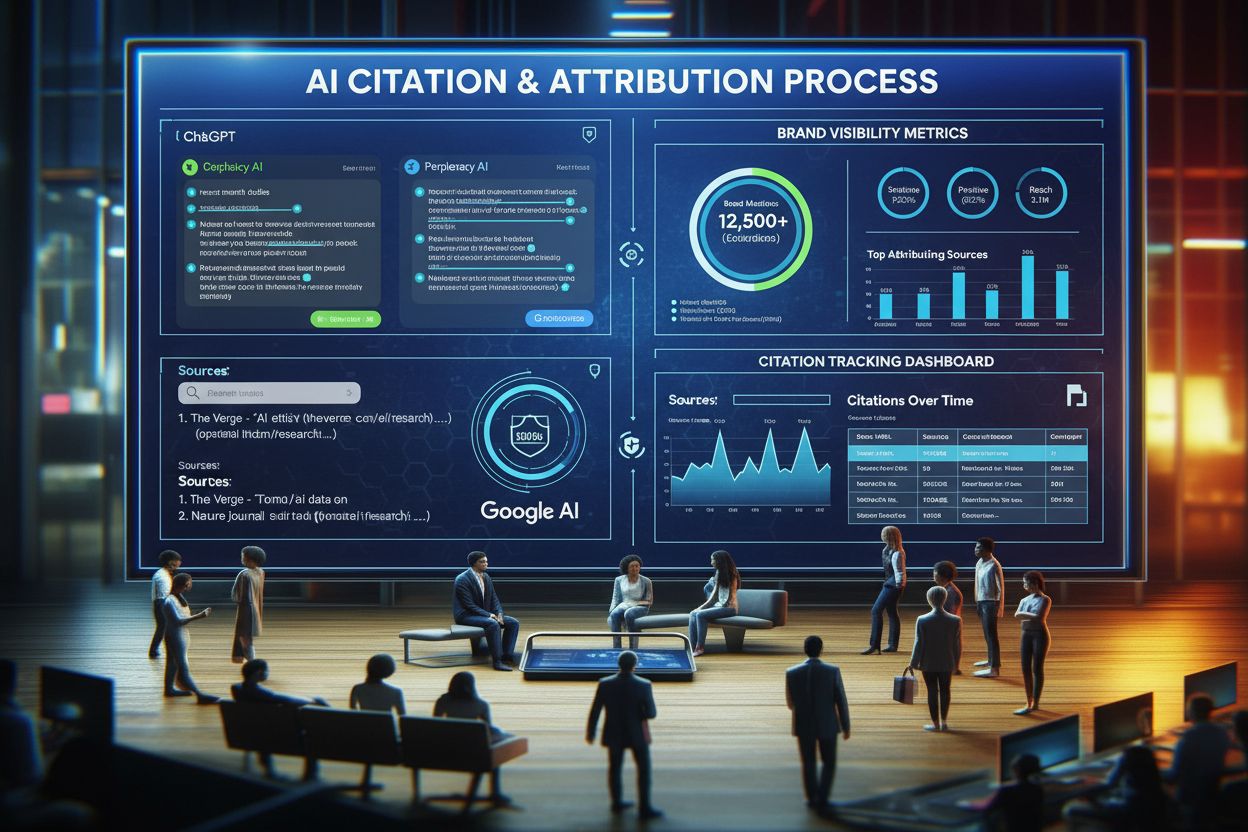
Learn what AI citations are, how they work across ChatGPT, Perplexity, and Google AI, and why they matter for your brand's visibility in generative search engin...