
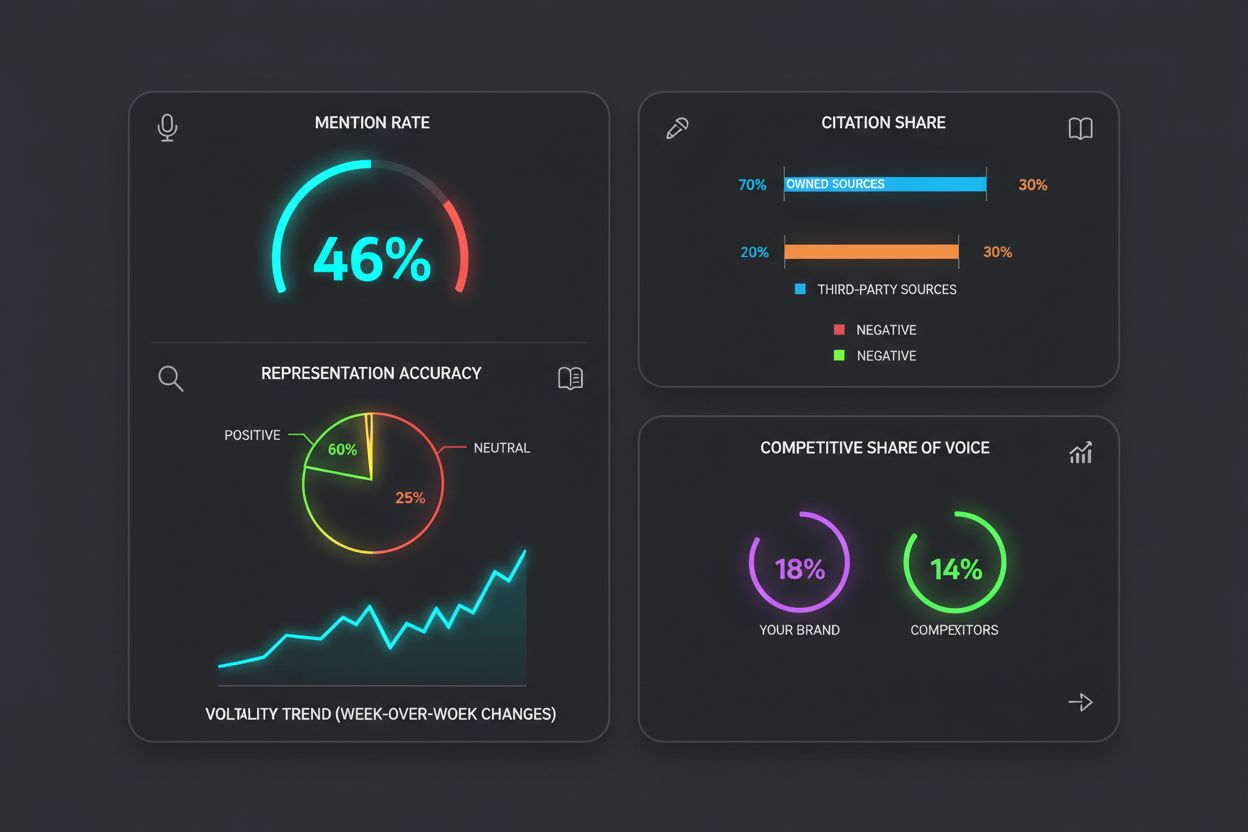
AI Visibility Quick Reference: One-Page Guide
Quick reference guide to AI visibility monitoring. Track mentions, citations, and brand presence across ChatGPT, Google AI Overviews, Perplexity, and Gemini wit...
10 min read

Learn how SaaS companies achieve visibility in ChatGPT, Perplexity, and Google AI Overviews. Discover GEO strategies, content optimization, and monitoring tactics.
SaaS companies achieve AI visibility by creating structured, citation-ready content that AI models can easily extract and recommend, building authority through third-party mentions, and optimizing for AI search platforms like ChatGPT, Perplexity, and Google AI Overviews. Success requires combining clear product positioning, strategic content architecture, and monitoring tools to track brand mentions across AI systems.
AI visibility refers to how often and how prominently a SaaS product appears in answers generated by artificial intelligence systems like ChatGPT, Perplexity, Google AI Overviews, and Claude. Unlike traditional search engine optimization where companies compete for rankings on a results page, AI visibility is about being cited, recommended, and trusted by AI models when they generate answers to user queries. This shift represents a fundamental change in how SaaS companies are discovered—instead of users clicking through search results, they’re asking AI assistants for recommendations and accepting those suggestions as authoritative. For SaaS companies, achieving AI visibility means ensuring their product is part of the AI’s “trusted dataset” and appears in the shortlist when potential customers ask for solutions. This matters because 41% of Gen Z consumers already rely on AI-driven assistants for shopping and task management decisions, and that percentage is climbing rapidly across all demographics.
The importance of AI visibility cannot be overstated in today’s market. When an AI model generates an answer about project management tools, CRM software, or any SaaS category, it typically mentions only 2-5 solutions. If your product isn’t in that narrow list, you’re effectively invisible to that buyer at the exact moment they’re making a decision. Research shows that 60% of Google searches in 2024 never left the search results page at all, with users finding answers in AI summaries instead of clicking through to websites. By May 2025, approximately 50% of search results pages included an AI-generated summary, up from just 25% in mid-2024. This compression of discovery means that traditional marketing funnels—where prospects might encounter your brand through multiple touchpoints—are being replaced by single-moment decisions mediated by AI. The stakes are higher, the window is narrower, and the competition for that AI recommendation is fiercer than ever.
The transformation from traditional search to AI-driven discovery represents one of the most significant changes in digital marketing since the rise of Google itself. For decades, SaaS companies optimized for search rankings, understanding that page one visibility meant traffic and leads. Today, that model is being disrupted. When users ask an AI assistant a question, they don’t see a ranked list of results—they see a synthesized answer that may mention only a handful of vendors. Research from a comprehensive UX study tracking 70 users found that most people only skim the top of the AI answer, with the median user scrolling through just 30% of the AI overview content. Roughly 70% of users never made it past the top third of an AI answer, meaning anything not immediately visible might as well be invisible. This creates a winner-takes-most dynamic where being mentioned in the first few lines of an AI response is exponentially more valuable than appearing lower in the answer.
The click-through rate data is equally sobering. On desktop searches with an AI overview, the click-through rate to websites dropped from approximately 28% to just 11%—fewer than one in ten users clicked a traditional link. Mobile saw a similar decline, with CTR falling from 38% to 21% when AI results were shown. Users are satisfied by the AI’s digest or choose other rich results like maps, videos, or “People Also Ask” suggestions instead of clicking organic links. This shift has profound implications: even a #1 organic ranking won’t help if the user never scrolls that far because an AI snippet stole the spotlight. The “click economy” is transforming into a “visibility economy” where being seen in the AI answer itself matters more than driving clicks. For SaaS companies, this means the entire funnel architecture must be reconsidered. You’re no longer just trying to get prospects to your website—you’re trying to get the AI to recommend you before the prospect even knows they need to visit your site.
Understanding how AI models make recommendations is critical to achieving visibility. When someone asks an AI a complex question like “What’s the best project management tool for a 10-person remote team with a $100/month budget?”, four distinct processes happen under the hood. First, the model dissects every nuance in the question, inferring the user’s role, team size, tech stack, budget constraints, intent, use case, and any limitations. Second, the model generates dozens of micro-queries through a process called query fan-out, creating intent-specific searches like “project management tools under $100 for remote teams” or “best alternatives to Asana for small businesses.” This is why optimizing for a single keyword is ineffective—you must write for hundreds of intent variations that will never appear in a keyword tool.
Third, modern AI assistants like Perplexity, ChatGPT Search, and Google AI Overview use RAG (Retrieval-Augmented Generation), meaning they don’t rely solely on internal knowledge but actively pull live fragments from the web to support their answers. They strongly prefer information that is short, factual, and verifiable: a concise quote, one-sentence statistic, clear definition, or FAQ-style answer. These fragments are easy to extract and safe for AI to repeat, often becoming the building blocks of the final answer. This is why quotes, stats, and extractable facts work so well in an AI-first content strategy—they match exactly what RAG systems look for and trust. Fourth, the model filters based on clarity and reliability, not traditional ranking signals. Before generating a recommendation, the model evaluates whether a source is safe to use by checking for extractability (HTML, bullets, headings, tables), consistency (are the same facts repeated elsewhere?), neutrality (no promotional language), third-party confirmation (Reddit, G2, press releases), reliability (no conflicting prices or claims), and recency (is the information up to date?).
| AI Decision Factor | What It Means | How SaaS Companies Win |
|---|---|---|
| Extractability | Content must be easy for AI to parse and quote | Use structured formats: tables, bullets, FAQs, short paragraphs |
| Consistency | Same facts repeated across multiple sources | Ensure messaging is uniform across your site, reviews, and third-party mentions |
| Neutrality | No overly promotional language | Write objectively; include honest trade-offs and competitor mentions |
| Third-Party Confirmation | External validation matters more than self-promotion | Secure mentions on G2, Capterra, Reddit, YouTube, and industry publications |
| Reliability | No conflicting information or outdated claims | Keep pricing, features, and compliance info current; use datestamps |
| Recency | Fresh information is prioritized | Publish regular updates; add version notes; maintain active documentation |
| Authority Signals | Trust indicators like certifications and expert endorsements | Display security badges, compliance certifications, customer logos, and expert quotes |
The foundation of AI visibility is creating content that AI models can understand, trust, and confidently cite. This begins with building an ecosystem of structured content that serves as reference material for AI systems. Create “Best-of” pages like “Best project management software,” “Best tools for remote teams,” and “Best alternatives to [competitor]” pages. These pages help AI models understand categories, recognize criteria, and logically compare solutions. Unlike traditional SEO where these pages were designed to capture traffic, in an AI-first world they become explanatory assets that teach AI how solutions differ. AI models respond especially well to pages structured with clear criteria, neutral descriptions, comparison tables, and scenarios where each tool fits or doesn’t fit.
Next, develop use-case pages that describe specific situations rather than just features. SaaS rarely sells “a product”—it sells use cases. Examples include “onboarding automation for B2B SaaS,” “outbound workflows for agencies,” “lead scoring for small teams,” or “reporting for PLG companies.” AI actively tries to match user prompts to recognizable scenarios like these. If your website doesn’t explicitly describe these contexts, AI cannot map your solution to real-world problems and won’t recommend you. Create one page per use case, describing the problem, audience, workflow, limits, and outcomes. Write as if you’re helping AI make the correct recommendation. These pages often appear verbatim in AI-generated responses because they deliver the contextual clarity that LLMs crave.
Comparison pages are another critical asset, but they must be structured differently than traditional marketing comparisons. In an AI-first world, comparison pages become explanatory assets rather than persuasive ones. Their job is no longer to convince people but to teach AI how solutions differ. AI does not trust exaggeration or vague marketing claims—it wants clear differences, trade-offs, target audience distinctions, explicit use-case fit, and real strengths and real weaknesses. A comparison should answer: Where are you stronger? Where is the competitor stronger? Which type of team is better suited to which tool? When is your product not the best choice? That last question is essential—it signals objectivity, which AI values deeply. Interestingly, many comparison pages don’t rank well in Google, yet they are cited in AI answers precisely because they’re semantically rich and neutral.
To maximize your chances of being cited by AI, you must create compact, verifiable fragments that AI models can confidently lift and reuse. Research shows that these fragments can increase visibility in generative AI answers by up to 40%, simply because they’re easier for models to extract and reuse. For SaaS companies, this means your content must include “hooks” that AI can confidently quote: a clean statistic, a concise insight, a referenced fact, or one or two lines of proprietary data. These micro-facts improve both authority and quotability. Keep these fragments short—most LLMs only quote one or two sentences at a time. The more compact and verifiable the fact, the more likely AI is to cite it.
Structured data and schema markup are essential for helping AI interpret your content accurately. Schemas such as SoftwareApplication, FAQPage, Organization, Product, and Review don’t just help with classic SEO—they help AI models interpret your content rather than merely read it. Structured data is to AI what subtitles are to video: it makes everything more understandable, reliable, and easier to process. If your category is competitive or ambiguous, structured data often becomes the difference between AI “kind of guessing” what your product does versus AI confidently placing you in the correct shortlist. Think of schema as the metadata layer that ensures models actually understand the meaning behind your content.
FAQ sections work exceptionally well in AI search. Not just because of structured data but because AI models can easily extract and reuse question-answer fragments. Every query to an LLM triggers dozens of microquestions: “Does this work with HubSpot?”, “What’s the pricing structure?”, “What alternatives fit small teams?” A good FAQ directly answers these micro-intents. FAQs are powerful for AI because they are short, factual, neutral, and semantically rich—exactly the type of information AI is confident quoting. Add FAQs to your product pages, use-case pages, comparison guides, alternatives pages, and even blog posts. Use real questions prospects actually ask, and keep answers crisp. FAQs aren’t just helpful for users; they’re one of the most efficient ways to help AI describe your product accurately and completely.
While internal content signals matter, external signals are what give AI the confidence to actually recommend you. AI models use external validation to check whether your story is accurate—not because you say so, but because the internet confirms it. Press releases are a forgotten weapon in the AI era, but AI models love them. Why? Because press releases are factual, consistent, widely distributed across authoritative domains, written in clear structured language, and unambiguous about products, features, pricing, and integrations. A good press release helps AI with entity resolution: building a coherent, unified understanding of what your product is and how it fits into a category. This is especially useful if your messaging is inconsistent across the web, outdated information still circulates, your product has recently evolved, or your competitors dominate directory listings. The goal of press releases today isn’t media attention—it’s AI trust-building.
Third-party mentions and reviews form the external validation layer that AI models use to determine whether your product deserves a place on a shortlist. Platforms like G2, Capterra, and TrustRadius are not marketing to AI—they’re structured, verifiable input. Since AI cannot test products itself, reviews become essential signals for authenticity, sentiment, risk assessment, reliability, user context, and variation in feedback. Reddit is especially influential. When users discuss products in relevant threads, AI often treats these comments as human-grounded truth. Participating genuinely (not promotionally) in these discussions strengthens your credibility. G2 and Capterra add another layer: they are centralized sources with standardized review formats that AI can easily extract and reuse. Good reviews give AI not just information, but confidence.
YouTube videos and transcripts are underutilized assets for AI visibility. AI models read YouTube transcripts as if they were long-form blog posts, making video far more valuable than most SaaS teams realize. Videos contain exactly what AI struggles to extract from traditional written content: concrete steps, real screens, real workflows, natural language, specific terminology, and contextual details. This makes transcripts semantically rich sources that AI loves quoting and referencing. The formats that work best are workflow walkthroughs (“How to set up an outreach campaign in 5 minutes”), use-case demonstrations (“How small teams improve pipeline discipline”), integration explanations (“How to connect our product to HubSpot”), and neutral comparisons (“When to choose X, when to choose Y”). Because almost no SaaS companies do this, the upside is enormous—a simple 3-5 minute walkthrough can outperform a 3,000-word blog post in AI visibility because the transcript contains so many “understandable” details.
Measuring AI visibility requires different metrics than traditional SEO. You don’t look at positions but at presence: how often does your product appear in AI answers within your category? That’s your practical share of voice—not as a competitive scoreboard, but as an indicator that AI recognizes your product and finds it relevant. Equally important is the nature of the mention. Are you only mentioned as “another option,” or does AI provide context about your strengths, typical use cases, or price level? That difference says more about the quality of your information than about your visibility. Because AI traffic often comes indirectly—first via a recommendation, later via branded search or direct navigation—attribution is less about click behavior and more about recognition.
You can see AI visibility impact in three places: an increase in brand searches (brand lift), higher-quality inbound leads, and answers in onboarding such as “I came across you in ChatGPT.” The key is simple: Don’t measure whether AI ranks you “at the top” because that concept doesn’t exist. Measure whether AI understands you, can explain you, and is willing to mention you. Start with manual check-ins: Ask ChatGPT and Perplexity the questions your prospects ask. Note which tools appear, in what order, and with what reasoning. This is often more revealing than any dashboard. There are emerging tools like AI Share-of-Voice trackers and LLM citation monitors that help identify trends over time—who AI mentions, how often, and based on which sources. But they do not replace manual research. They just speed it up.
| Visibility Metric | How to Measure | Why It Matters |
|---|---|---|
| Citation Share | Track how often your brand appears in AI answers for key queries | Shows whether AI recognizes your product as relevant; goal is consistent presence |
| Recommendation Share | Measure what % of mentions position you as the “best choice” | Reflects whether you’re winning AI’s tie-breakers; maps directly to buyer influence |
| Misrepresentation Rate | Log instances where AI gets facts wrong about your product | Every hallucination or inaccuracy is a risk to pipeline; track reduction over time |
| Brand Search Volume | Monitor branded search queries in Google Search Console | AI awareness often leads to branded searches before direct visits |
| Direct Traffic Lift | Track direct navigation to your site | Users who discover you via AI often return directly later |
| Lead Quality | Assess MQL/SQL conversion rates from AI-attributed sources | AI-driven leads often have higher intent and conversion rates |
| Pipeline Attribution | Connect AI mentions to demos, trials, and closed deals | Proves that AI visibility isn’t vanity—it’s a growth channel |
Different AI platforms have different characteristics that affect how they surface and recommend products. Google AI Overviews are integrated into Google Search and appear on approximately 50% of queries as of mid-2025. They favor content that’s already ranking well in traditional Google search, so classic SEO fundamentals still matter. Google’s AI prefers clean structure, FAQs, tables, and extractable explanations. Optimize for featured snippets, use schema markup extensively, and ensure your content answers questions directly and concisely. Perplexity AI crawls the web directly and provides real-time answers with source citations. It prefers deeper, more complete, more factually detailed content. Perplexity users often ask more specific, research-oriented questions, so your content should be thorough and well-supported with data and citations.
ChatGPT relies heavily on Bing’s index and prefers clean structure, FAQs, tables, and extractable explanations. It’s less about depth and more about clarity and ease of extraction. Claude (Anthropic) is known for coherent and comprehensive answers that emphasize safety and ethical considerations. It tends to cite sources more explicitly and values content that demonstrates nuance and acknowledges trade-offs. The practical difference: ChatGPT prefers easy-to-extract clarity while Perplexity prefers thorough, well-supported depth. Good AI-first content satisfies both. This means creating content that is simultaneously concise enough for ChatGPT to quote easily and detailed enough for Perplexity to cite as authoritative.
The ultimate measure of AI visibility success is whether it drives business results. Track brand lift using a Looker Studio Dashboard based on Google Search Console (GSC) data—in GSC, you can see exactly how many clicks your brand receives in Google’s search results. Add an open text field on all your lead forms: “How did you find us?” You’ll start seeing “ChatGPT,” “Perplexity,” or “Google AI Overview” far sooner than you expect. Monitor the quality of leads coming from AI-attributed sources—are they more qualified? Do they convert faster? Do they have higher lifetime value? These questions matter because they determine whether AI visibility is a vanity metric or a genuine growth lever.
For SaaS companies using AI automation tools like FlowHunt, you can automate the process of monitoring your AI visibility across multiple platforms and queries. FlowHunt allows you to set up workflows that automatically track your brand mentions, monitor competitor positioning, and alert you when your visibility changes. This kind of automation is essential because manually checking ChatGPT, Perplexity, Google AI, and Claude for dozens of queries would be prohibitively time-consuming. Similarly, AmICited offers specialized monitoring for tracking your brand and domain appearances across AI answer engines, providing real-time insights into where and how AI systems are mentioning your product. These tools transform AI visibility from a manual research exercise into an ongoing, data-driven practice that informs your content and positioning strategy.
The trajectory is clear: AI-driven discovery will become the primary way SaaS products are found and evaluated. As AI agents become more autonomous and capable, they’ll move from simply answering questions to actually making purchasing decisions on behalf of users. A 2024 McKinsey study found that 41% of Gen Z consumers already rely on AI-driven assistants for shopping and task management, and that percentage is expected to climb rapidly. In business settings, AI adoption is following suit, with companies integrating AI into workflows to automate complex decisions or narrow options. It’s not hard to imagine a near-future in which a CTO asks an AI agent to “find the best data analytics SaaS that meets our security standards and budget, then initiate a trial,” and the AI does exactly that.
This evolution means that SaaS companies must prepare now for a world where AI visibility is as important as—or more important than—traditional search rankings. The companies that move quickly and strategically can gain significant competitive advantages. Those that ignore this shift risk invisibility at the exact moment when buyers are making decisions. The good news is that the window to adapt is open now. Start with an audit of your current content and search presence from an AI perspective. Ask yourself: If I were an AI trained on the internet, would I confidently recommend my product? If the honest answer is “probably not,” then you have clear work to do. Implement structured data, refine your messaging, get active in communities, seek authoritative mentions, and monitor your visibility across AI platforms. Every piece you add to the puzzle increases the odds that when an AI is connecting the dots, your dot isn’t left out.
Track where your SaaS brand appears in ChatGPT, Perplexity, Google AI Overviews, and Claude. Get real-time insights into your AI search presence and optimize your visibility strategy.
Quick reference guide to AI visibility monitoring. Track mentions, citations, and brand presence across ChatGPT, Google AI Overviews, Perplexity, and Gemini wit...

Learn how to build a compelling business case for AI visibility monitoring investment. Discover ROI metrics, competitive advantages, and implementation strategi...

Comprehensive glossary of 100+ essential AI visibility and GEO terms every marketer should know. Learn about citation tracking, brand monitoring, and AI search ...