
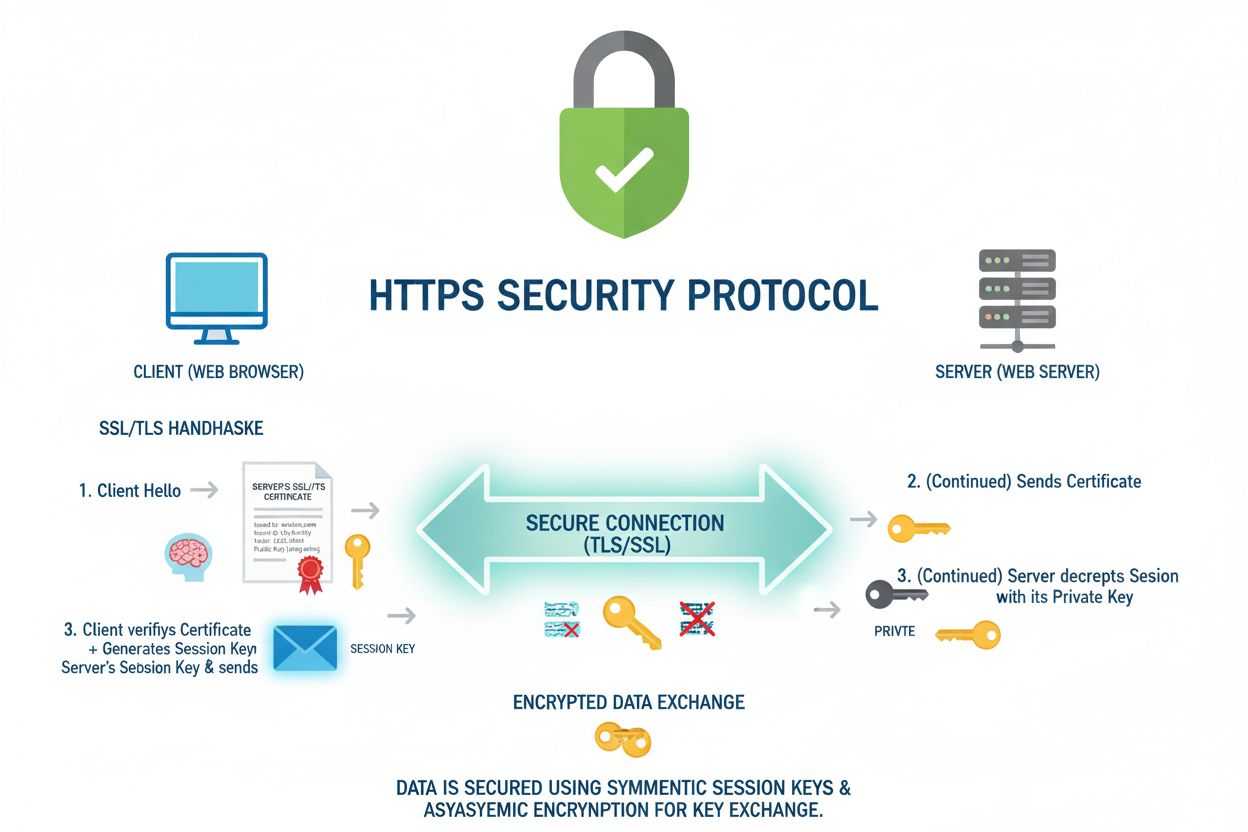
HTTPS
HTTPS is the secure protocol for web communication using SSL/TLS encryption. Learn how it protects data, differs from HTTP, and why it's essential for website s...
10 min read

Learn how HTTPS impacts AI search trust and visibility. Discover why SSL certificates matter for ChatGPT, Perplexity, and AI answer generators. Essential guide for brand monitoring in AI search.
HTTPS is a critical trust signal for AI search engines and answer generators. It encrypts data transmission, validates content authenticity, and helps AI systems determine whether to cite your website in AI-generated answers. Without HTTPS, your content may be excluded from AI search results, Perplexity summaries, ChatGPT citations, and other AI answer generators, directly impacting your brand visibility in the AI-powered search landscape.
HTTPS (HyperText Transfer Protocol Secure) is the encrypted version of HTTP, utilizing SSL/TLS protocols to secure data transmission between a user’s browser and your web server. The padlock icon visible in browser address bars signals that a connection is secure. However, HTTPS has evolved far beyond basic security—it has become a fundamental trust signal that AI search engines and answer generators use to determine whether your content is credible enough to cite in their responses.
In the traditional search landscape, HTTPS was primarily a ranking factor introduced by Google in 2014. Today, in the era of AI-powered search engines like Perplexity, ChatGPT, Microsoft Copilot, and Google’s Search Generative Experience (SGE), HTTPS serves a more critical function. AI systems don’t just evaluate your content; they assess whether your entire domain infrastructure is trustworthy enough to include in their synthesized answers. Without HTTPS implementation, your website may be silently excluded from AI consideration, regardless of content quality.
AI search engines operate fundamentally differently from traditional search engines. Rather than simply ranking pages, they synthesize information from multiple sources to generate direct answers to user queries. This process requires AI systems to make rapid trust assessments about which sources are reliable enough to cite. HTTPS serves as a primary validation mechanism in this decision-making process.
When an AI crawler encounters your website, it immediately checks for HTTPS implementation. This verification happens before the system even evaluates your content. AI systems use HTTPS status as a data integrity signal—confirming that information was delivered without interception or tampering. For AI answer generators, this is non-negotiable, especially when handling sensitive topics like healthcare, finance, or legal advice. A site without HTTPS is flagged as potentially risky, and the AI system may exclude it from consideration entirely.
Additionally, HTTPS enables proper SSL certificate validation, which AI systems use to verify domain ownership and authenticity. This prevents malicious actors from impersonating legitimate brands. When your SSL certificate is valid and current, AI systems recognize your domain as a legitimate, maintained entity. Expired or misconfigured certificates send the opposite signal—that your site is neglected or potentially compromised.
| Trust Signal | Impact on AI Visibility | Description |
|---|---|---|
| Valid HTTPS with current SSL | High inclusion probability | AI systems prioritize citing your content in answers |
| HTTPS with expired certificate | Reduced visibility | AI may exclude or deprioritize your domain |
| Mixed HTTPS/HTTP content | Moderate risk | Inconsistent security signals confuse AI crawlers |
| HTTP only (no HTTPS) | Likely exclusion | AI systems typically skip non-secure sites entirely |
| HSTS headers implemented | Enhanced trust | Signals commitment to security; AI systems reward this |
| Self-signed certificates | Low trust | AI systems may treat as suspicious or unverified |
This hierarchy demonstrates that HTTPS isn’t a binary on/off switch for AI visibility—it exists on a spectrum. A properly maintained HTTPS implementation with current certificates, HSTS headers, and consistent security practices signals to AI systems that your brand is professional, trustworthy, and worth citing.
Perplexity, ChatGPT, Google SGE, and Microsoft Copilot all employ similar trust-filtering mechanisms when deciding which sources to cite. These AI systems crawl the web continuously, but they don’t treat all sources equally. HTTPS status is one of the first filters applied. Here’s how this works in practice:
When a user asks Perplexity a question about your industry, the AI system searches for relevant content. It identifies dozens of potential sources, but before synthesizing an answer, it filters out sites that fail basic trust checks. Non-HTTPS sites are typically excluded at this stage. Even if your content is more comprehensive or accurate than a competitor’s, if your site lacks HTTPS, you won’t be cited.
For ChatGPT and similar LLM-based systems, the trust evaluation is slightly different but equally important. These systems were trained on web data, and their training data prioritized secure, reputable sources. When generating answers in real-time, they reference their training data and may access current web information. Sites without HTTPS are underrepresented in their training data and are less likely to be referenced in responses.
Google’s SGE (Search Generative Experience) integrates HTTPS validation directly into its ranking algorithm. SGE generates AI summaries at the top of search results, and it preferentially cites HTTPS sites. If your site lacks HTTPS, you’re competing at a disadvantage even if your content is superior.
Consider a practical scenario: a regional healthcare provider offers specialized services but hasn’t migrated to HTTPS. When patients ask Perplexity or ChatGPT for recommendations in their area, the AI system may cite competitors instead—not because their content is better, but because their HTTPS implementation signals trustworthiness. The healthcare provider’s content is effectively invisible to AI systems, despite being locally relevant and authoritative.
This pattern repeats across industries. E-commerce sites, SaaS companies, local service providers, and content publishers all report reduced AI visibility when HTTPS is missing or misconfigured. The impact is particularly severe for YMYL (Your Money or Your Life) topics—healthcare, finance, legal advice—where AI systems apply stricter trust filters.
Conversely, brands that maintain robust HTTPS implementations report higher citation rates in AI-generated answers. They appear more frequently in Perplexity summaries, are referenced more often in ChatGPT responses, and rank better in Google SGE results. This visibility translates directly to brand awareness, traffic, and credibility in the AI-powered search landscape.
Beyond simply having HTTPS enabled, several technical factors enhance your trust signal to AI systems:
SSL Certificate Quality and Maintenance is foundational. Extended Validation (EV) certificates signal the highest level of trust, though Organization Validated (OV) certificates are generally sufficient. Critically, your certificate must remain current—expired certificates are immediate red flags to AI systems. Implement automated renewal processes using services like Let’s Encrypt or your hosting provider’s certificate management tools.
HSTS (HTTP Strict Transport Security) headers represent an advanced trust signal. By implementing HSTS, you instruct browsers and AI crawlers to always access your site over HTTPS, never falling back to HTTP. This prevents SSL stripping attacks and demonstrates a commitment to security. AI systems recognize HSTS as a sign of technical sophistication and security awareness.
Consistent HTTPS across all pages and subdomains is essential. Mixed content—where some pages are HTTPS and others are HTTP—confuses AI crawlers and suggests incomplete implementation. Ensure all pages, including subdomains, redirect to HTTPS. Use 301 redirects to guide traffic from HTTP to HTTPS versions.
Certificate chain validation must be correct. Your SSL certificate should include the complete chain from your certificate to the root certificate authority. Broken chains cause validation failures that AI systems interpret as security issues.
Google’s E-E-A-T framework (Experience, Expertise, Authoritativeness, Trustworthiness) has become central to AI search optimization. HTTPS directly supports the Trustworthiness pillar. When AI systems evaluate whether your content demonstrates trustworthiness, they check multiple signals: HTTPS status, certificate validity, site speed, content accuracy, and author credentials. HTTPS is the foundation—without it, the other signals are weakened.
For Answer Engine Optimization (AEO), the emerging discipline of optimizing for AI search engines, HTTPS is non-negotiable. AEO strategies focus on making your content discoverable and citable by AI systems. This requires:
HTTPS enables the first requirement. Without it, your AEO efforts are undermined before they begin.
Proactive monitoring is essential for maintaining AI search visibility. Certificate expiration is a common failure point—even large brands occasionally let certificates lapse, causing sudden visibility drops in AI search results. Implement automated monitoring using tools like SSL Labs, Pingdom, or StatusCake to receive alerts before expiration.
Regularly audit your HTTPS implementation using Google Search Console’s HTTPS report and third-party tools like Screaming Frog. Check for:
Update your internal links to use HTTPS URLs. Audit your content management system to ensure all internal links point to HTTPS versions. This prevents unnecessary redirects and ensures AI crawlers encounter consistent security signals.
Monitor AI visibility specifically by tracking whether your brand appears in AI-generated answers. Tools designed for AI search monitoring can alert you when your domain is cited in Perplexity, ChatGPT, or other AI systems. If visibility drops, HTTPS issues are often the culprit.
Expired SSL certificates are the most common mistake. Even brief expirations can cause AI systems to flag your site as untrustworthy. Set up automated renewal at least 30 days before expiration.
Incomplete HTTPS migration leaves some pages on HTTP. This creates mixed signals that confuse AI crawlers. Ensure every page, including archives and legacy content, redirects to HTTPS.
Self-signed certificates instead of certificates from recognized Certificate Authorities reduce trust signals. AI systems may treat self-signed certificates as suspicious.
Broken certificate chains occur when your server doesn’t include intermediate certificates. This causes validation failures that AI systems interpret as security problems.
Inconsistent HTTPS across subdomains suggests incomplete implementation. Ensure all subdomains use HTTPS with valid certificates.
As AI search engines mature, HTTPS will likely become an even stricter requirement. Currently, it’s a strong trust signal; in the future, it may become a hard requirement for inclusion in AI-generated answers. Brands that implement robust HTTPS infrastructure now will maintain visibility as AI search standards evolve.
Additionally, emerging technologies like certificate transparency logs and domain validation improvements will provide AI systems with even more granular trust information. Staying ahead of these developments requires maintaining best practices today.
By implementing these steps, you ensure that HTTPS works as a powerful trust signal, maximizing your visibility in AI search engines and answer generators. In the AI-powered search landscape, HTTPS is no longer just a security requirement—it’s a competitive advantage.
Track how your domain appears in AI-generated answers across ChatGPT, Perplexity, Google SGE, and other AI search engines. Get real-time alerts when your brand is mentioned and ensure your HTTPS implementation is optimized for AI visibility.
HTTPS is the secure protocol for web communication using SSL/TLS encryption. Learn how it protects data, differs from HTTP, and why it's essential for website s...

Community discussion on HTTPS importance for AI search visibility. Webmasters share experiences with HTTP vs HTTPS sites and their impact on ChatGPT and Perplex...
Discover how trust signals differ between AI search engines and traditional SEO. Learn which credibility factors matter most for AI systems like ChatGPT and Per...