
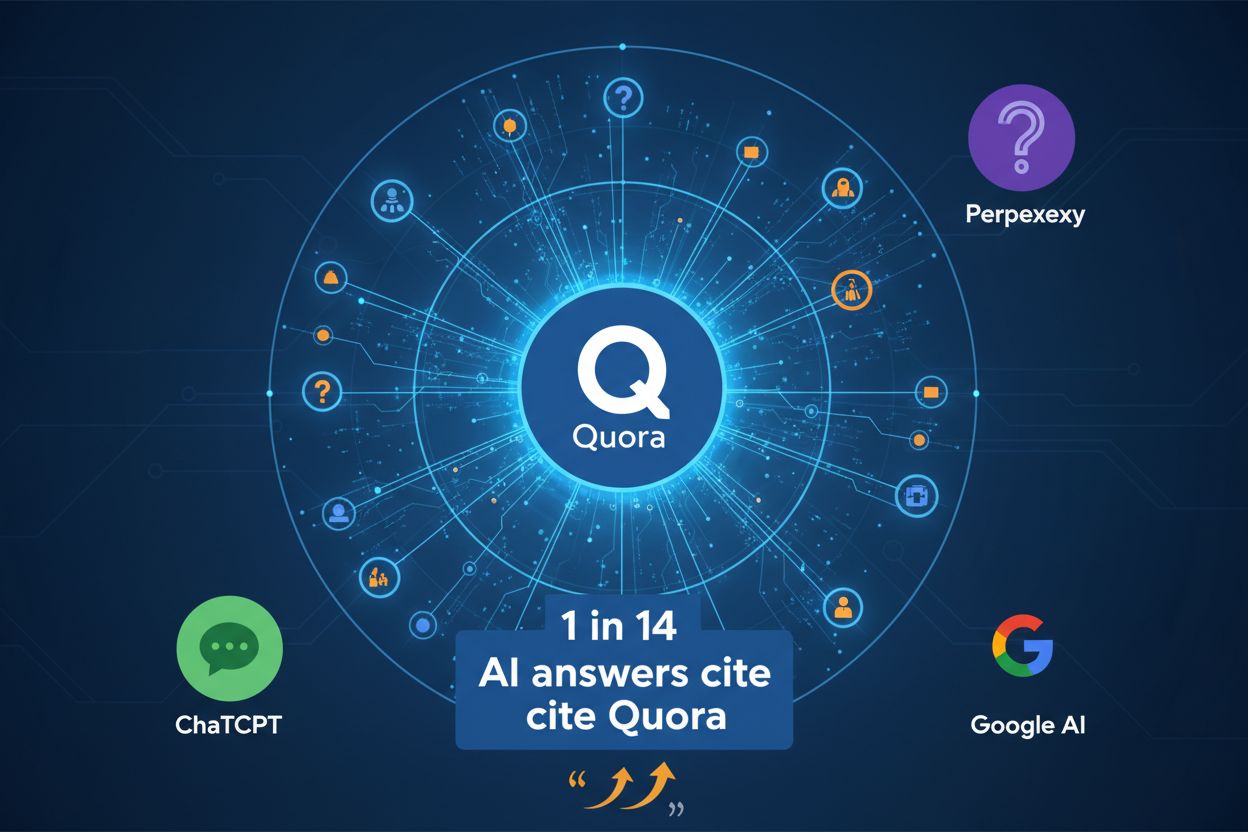
Quora for AI Visibility: Answering Questions That Get Cited
Learn how to leverage Quora for AI visibility and get your brand cited by ChatGPT, Perplexity, and Google AI. Strategic guide to LLM SEO and Quora marketing.
10 min read

Learn how Quora impacts AI citations in ChatGPT, Perplexity, and Google AI Mode. Discover why Quora is one of the top sources cited by AI systems and how to optimize your content for AI visibility.
Quora is the 4th most cited source in Google AI Mode, appearing in 7.25% of AI-generated answers. AI systems cite Quora content based on topic alignment, engagement signals, and quality markers rather than exact keyword matches. Brands can increase their visibility in AI citations by publishing detailed, well-structured answers that demonstrate expertise and encourage discussion.
Quora has become one of the most important sources for AI-generated answers, ranking as the fourth most cited domain in Google AI Mode. Research analyzing 278,279 AI-generated responses found that approximately 7.25% of answers included Quora citations, translating to over 20,000 unique Quora URLs being referenced. This makes Quora comparable in importance to LinkedIn and significantly more influential than many traditional websites. The platform’s prominence in AI citations means that brands and individuals who maintain an active presence on Quora can substantially increase their visibility in AI-generated answers across multiple platforms including ChatGPT, Perplexity, and Google’s AI Mode. Understanding how Quora influences AI citations is essential for anyone looking to build brand authority in the age of AI-powered search and answer engines.
AI systems don’t cite Quora content based on exact keyword matches or simple relevance scoring. Instead, they prioritize topic alignment and contextual relevance over literal phrase matching. Research shows that the similarity between user queries and the Quora question titles that get cited is remarkably low, averaging just 0.1 on a similarity scale. This means AI systems are sophisticated enough to understand that a question about “best productivity tools for remote teams” might cite a Quora thread about “how to stay organized while working from home,” even though the wording differs significantly. The AI systems analyze the underlying intent and topic rather than surface-level keywords, making it crucial for Quora contributors to focus on comprehensive topic coverage rather than keyword optimization. This approach ensures that AI citations reflect genuine topical expertise and understanding rather than gaming search algorithms through keyword stuffing.
Engagement metrics serve as powerful signals that help AI systems identify high-quality Quora content worth citing. Threads that receive citations in AI Mode average approximately 37 replies per thread, 15 upvotes, and at least 535 words in the answer length. These engagement signals indicate that the content has been validated by the Quora community and represents genuine expertise rather than promotional material. Active discussions with multiple perspectives and ongoing comments demonstrate that the topic remains relevant and that the community finds value in the conversation. AI systems interpret these engagement patterns as quality indicators, making them more likely to include cited content in their responses. Additionally, threads with sustained activity over time signal to AI systems that the information remains current and trustworthy. This means that simply publishing an answer on Quora isn’t enough—brands need to actively participate in discussions, respond to comments, and encourage ongoing engagement to maximize their chances of being cited by AI systems.
AI systems closely follow Quora’s own internal algorithm when selecting content to cite, creating a direct correlation between Quora’s quality markers and AI visibility. Approximately 89.7% of answers cited by Google AI Mode were also marked as “Most Relevant” by Quora’s algorithm, indicating that AI systems trust Quora’s own quality assessment mechanisms. This alignment means that following Quora’s best practices directly improves your chances of being cited by AI systems. Quora’s algorithm prioritizes answers that directly address the question in the opening sentences, demonstrate credible expertise, provide genuine value, and use clear formatting. When you optimize for Quora’s algorithm, you’re simultaneously optimizing for AI citation visibility. This creates a virtuous cycle where high-quality content that performs well on Quora is more likely to be discovered and cited by AI systems, further amplifying your reach and authority.
An important aspect of how Quora affects AI citations is understanding that AI systems don’t copy content directly—they synthesize and rewrite it. Analysis of AI Mode responses shows that the average overlap between an AI-generated answer and the closest Quora source is just 0.435, meaning less than 50% similarity. This indicates that AI systems blend ideas from multiple Quora responses and restructure them into new text that maintains the core concepts while presenting them in fresh language. For example, when multiple Quora answers discuss how Vaseline affects wrinkles, AI Mode might extract the common themes (hydration, occlusive barrier properties, limitations in reducing existing wrinkles) and rewrite them into a cohesive answer that cites Quora as a source without directly quoting any single response. This rewriting approach means that Quora contributors should focus on clarity, specificity, and logical structure rather than trying to create perfectly polished prose. The more clearly you explain your reasoning and ground your points in concrete examples, the better your ideas survive the AI rewriting process and remain recognizable as coming from your Quora answer.
| Citation Factor | Impact on AI Visibility | Key Metric |
|---|---|---|
| Topic Alignment | Very High | 0.1 similarity score (intent-based, not keyword-based) |
| Engagement Signals | High | 37 average replies per cited thread |
| Quality Markers | Very High | 89.7% of cited answers marked “Most Relevant” |
| Answer Length | High | 535+ words minimum |
| Upvotes | Moderate | 15 average upvotes per cited answer |
| Community Comments | High | Active discussion signals relevance |
| Content Overlap | Low | 0.435 similarity (AI rewrites content) |
To maximize your visibility in AI citations through Quora, you should implement several key strategies that align with both Quora’s algorithm and AI system preferences. Answer questions directly and immediately by providing your main answer in the first 1-3 sentences, then expand with supporting details, examples, and reasoning. This structure helps both Quora’s algorithm and AI systems quickly identify and extract your key insights. Demonstrate real credibility by explaining your background, qualifications, and why you’re uniquely positioned to answer the question—this builds trust with both human readers and AI systems that evaluate source authority. Provide genuine value by following the 80/20 rule: make 80% of your response genuinely helpful and only 20% promotional, ensuring your answer serves the reader’s needs rather than pushing a product or service. Format for scannability using short paragraphs, bullet points, bold text for key concepts, and clear white space to make your answer easy to read and extract. Ground your points in specifics by including data, examples, case studies, or concrete details that survive AI paraphrasing better than vague claims. Engage with your audience by ending answers with questions that invite discussion, responding to comments, and linking to related Quora threads to keep conversations active. Finally, use AI as a tool, not a replacement—you can use AI to help reformat existing content or speed up the writing process, but your answers must reflect genuine expertise and human perspective to engage readers and gain traction.
Understanding how Quora affects your specific brand’s AI citations requires active monitoring and tracking of when your content appears in AI-generated responses. Tools like AI visibility platforms allow you to see which of your Quora threads are being cited by Google AI Mode, how frequently they appear, and against which user queries they’re surfaced. By tracking your citation sources over time, you can identify which topics, answer styles, and engagement strategies drive the most AI visibility. This data-driven approach enables you to refine your Quora strategy, double down on high-performing topics, and identify content gaps where you could establish authority. Regular monitoring also helps you understand how your Quora presence compares to competitors and reveals opportunities to differentiate your expertise. Additionally, tracking citations helps you measure the ROI of your Quora efforts, demonstrating how your platform participation translates into AI visibility and brand awareness. The insights gained from citation tracking should inform your content calendar, helping you prioritize questions and topics that have the highest potential for AI citation and visibility.
Track when your brand, domain, or URLs appear in AI-generated answers across ChatGPT, Perplexity, and other AI platforms. Get real-time insights into how AI systems cite your content.
Learn how to leverage Quora for AI visibility and get your brand cited by ChatGPT, Perplexity, and Google AI. Strategic guide to LLM SEO and Quora marketing.

Discover which websites and pages get cited most frequently by AI systems like ChatGPT, Perplexity, and Google AI Overviews. Learn citation patterns, domain pre...
Learn how community discussions on Reddit and other platforms influence AI citations, shape brand visibility in ChatGPT, Perplexity, and Google AI, and why moni...