

What is Semantic Search for AI? How It Works and Why It Matters
Learn how semantic search uses AI to understand user intent and context. Discover how it differs from keyword search and why it's essential for modern AI system...
12 min read

Learn how semantic understanding impacts AI citation accuracy, source attribution, and trustworthiness in AI-generated content. Discover the role of context analysis in citation verification.
Semantic understanding enables AI systems to comprehend the true meaning and context of information, allowing them to generate more accurate citations that faithfully represent source material rather than simply matching keywords. This deep contextual awareness helps AI systems verify whether claims are fully supported, partially supported, or unsupported by their sources, reducing hallucinations and improving citation trustworthiness.
Semantic understanding refers to an AI system’s ability to comprehend the true meaning, context, and nuance of information beyond simple keyword matching. Rather than treating text as isolated words or phrases, semantically-aware AI systems analyze the relationships between concepts, the intent behind statements, and the broader context in which information appears. This capability is fundamentally different from traditional keyword-based search methods, which often fail to capture the actual meaning of content. When AI systems possess strong semantic understanding, they can recognize that two statements with different wording might convey the same meaning, or conversely, that similar-sounding phrases might have entirely different implications depending on their context. This distinction becomes critically important when generating citations, as accurate citations must reflect not just the presence of information in a source, but whether that source actually supports the specific claim being made.
The development of semantic understanding in AI has been driven by advances in embedding technologies and transformer-based language models. These systems convert text into high-dimensional vector representations that capture semantic relationships, allowing AI to understand that “coffee consumption reduces cardiovascular risk” and “filtered coffee lowers heart disease probability” are related but not identical claims. The semantic distance between these vectors helps AI systems recognize subtle differences in meaning, scope, and applicability. Without this semantic layer, AI systems would struggle to distinguish between claims that are fully supported by a source, partially supported with missing context, or entirely unsupported. This semantic capability directly influences citation quality because accurate citations require understanding whether a source truly substantiates a claim, not merely whether the source contains related keywords.
Context analysis represents one of the most critical applications of semantic understanding in citation generation. When AI systems analyze citations, they must evaluate not just whether information appears in a source document, but whether the source’s context supports the specific claim being cited. A statement might be technically present in a source but presented with important caveats, limitations, or qualifications that fundamentally change its meaning. For example, a research paper might state that “coffee consumption reduces heart disease risk in filtered coffee drinkers aged 40-65,” but an AI system without strong semantic understanding might cite this as simply “coffee reduces heart disease risk” without acknowledging the specific population, preparation method, or age range limitations. This represents a semantic citation error—the citation is technically referencing the source, but it misrepresents what the source actually claims.
Advanced semantic understanding enables AI systems to perform full-text source analysis, examining not just isolated sentences but the complete context surrounding a claim. This includes understanding the methodology of studies, the scope of findings, the limitations acknowledged by authors, and the nuances of conclusions. When AI systems implement semantic verification frameworks, they classify citations into categories such as “Supported” (full alignment with proper context), “Partially Supported” (core claim supported but missing nuances), “Unsupported” (contradicting or absent from source), and “Uncertain” (ambiguous or insufficient information). This nuanced classification system reflects the reality that citation accuracy exists on a spectrum rather than as a binary true/false determination. The semantic understanding required to make these distinctions involves analyzing the relationship between the cited claim and the source material at a deep conceptual level, not merely performing keyword searches.
Hallucinations in AI-generated content—where AI systems generate plausible-sounding but false citations or misattributed information—represent one of the most significant challenges in trustworthy AI systems. Semantic understanding directly addresses this problem by enabling AI systems to verify that generated citations actually correspond to real sources and that the cited information genuinely appears in those sources. Without semantic verification, AI systems might generate citations that sound authoritative but reference non-existent papers, misquote sources, or attribute claims to sources that don’t actually support them. The integration of semantic understanding into citation validation systems creates a verification layer that catches these errors before they reach users.
The mechanism by which semantic understanding reduces hallucinations involves several interconnected processes. First, semantic retrieval uses embedding-based search to find passages in source documents that are semantically similar to the claim being verified, rather than relying on simple keyword matching. This ensures that the AI system is comparing the claim against genuinely relevant source material. Second, semantic analysis examines whether the retrieved passages actually support the claim at a conceptual level, accounting for context, methodology, and limitations. Third, evidence-based reasoning provides transparent explanations for why a citation is classified as supported or unsupported, allowing human reviewers to verify the AI system’s decision-making process. When these semantic processes are combined, they create a robust defense against hallucinations because the AI system must demonstrate that a citation is not just plausible but actually grounded in source material.
| Citation Verification Component | Role in Semantic Understanding | Impact on Citation Quality |
|---|---|---|
| Semantic Retrieval | Finds contextually relevant source passages using embeddings | Ensures comparison against truly relevant material, not just keyword matches |
| Semantic Analysis | Evaluates conceptual alignment between claim and source | Detects misrepresentations and context omissions |
| Evidence-Based Reasoning | Provides transparent explanations for classifications | Enables human verification and builds trust |
| Full-Text Processing | Analyzes complete source documents with context | Captures limitations, caveats, and methodological details |
| Classification Framework | Categorizes citations as Supported/Partially Supported/Unsupported/Uncertain | Reflects nuanced reality of citation accuracy |
When AI systems like ChatGPT, Perplexity, and other AI answer generators provide responses, they increasingly include citations to support their claims. The quality of these citations depends heavily on the semantic understanding capabilities embedded in the system. Source attribution—the process of correctly identifying and linking claims to their original sources—requires semantic understanding because the AI system must recognize that a claim it has generated is semantically equivalent to or derived from a specific source, even if the wording differs significantly. This is particularly challenging because AI systems often paraphrase or synthesize information from multiple sources, and they must still maintain accurate attribution to the original sources that support each component of their response.
Semantic understanding enables AI systems to perform claim-source alignment, which involves mapping specific claims in the generated response back to the passages in source documents that support those claims. This process requires understanding not just that a source contains related information, but that the source specifically substantiates the particular claim being made. For instance, if an AI system generates a response about the health effects of coffee, it must semantically understand which sources support claims about cardiovascular effects, which support claims about cognitive effects, and which sources might actually contradict certain claims. Without this semantic layer, AI systems might attribute claims to sources that merely mention related topics without actually supporting the specific claim. This semantic precision in source attribution is what distinguishes trustworthy AI-generated content from content that merely appears to be well-sourced but actually contains misattributed or unsupported claims.
Modern citation verification systems leverage semantic understanding to implement sophisticated validation frameworks that go far beyond simple fact-checking. These frameworks recognize that semantic citation errors—where citations technically reference a source but misrepresent its content—are often more problematic than obvious factual errors because they appear credible while being misleading. A semantic citation error might involve oversimplifying findings, ignoring important limitations, applying findings beyond their scope, or presenting correlations as causation. Detecting these errors requires semantic understanding because the AI system must comprehend not just what the source says, but what it means in context and how it should be appropriately applied.
Advanced semantic verification frameworks implement multi-layered analysis that combines several semantic techniques. The first layer involves semantic retrieval to identify relevant source passages. The second layer performs semantic reranking to prioritize the most relevant passages. The third layer conducts deep semantic analysis using language models to evaluate the relationship between the claim and the source material. The fourth layer generates evidence-based reasoning that explains the verification decision. This multi-layered approach reflects the complexity of semantic understanding—it’s not a single capability but rather an integrated system of semantic processes working together. The result is a citation verification system that can classify citations with nuance, provide transparent reasoning for its classifications, and support human reviewers in making final determinations about citation accuracy. Organizations implementing these frameworks report significant improvements in citation accuracy and reductions in the time required for manual citation verification.
For organizations concerned about how their brand, domain, or URLs appear in AI-generated answers, semantic understanding plays a crucial role in citation monitoring. When your content appears in AI answers, the quality of the citation depends on whether the AI system semantically understood your content and accurately represented it. Semantic citation monitoring involves tracking not just whether your content is cited, but whether it’s cited accurately and in appropriate context. An AI system might cite your domain but misrepresent your findings, apply your research beyond its intended scope, or present your conclusions in a misleading way. Semantic understanding enables monitoring systems to detect these semantic citation errors, not just obvious factual mistakes.
Effective brand protection in the age of AI requires understanding that semantic accuracy matters more than mere presence. Your domain might appear in AI answers across ChatGPT, Perplexity, and other platforms, but if the citations are semantically inaccurate—misrepresenting your content or applying it inappropriately—this can damage your credibility and mislead users. Semantic monitoring systems can identify when your content is cited but the citation doesn’t accurately reflect what your content actually says. This capability allows organizations to take corrective action, whether by reaching out to AI platforms, updating their own content for clarity, or implementing strategies to improve how their content is understood and cited by AI systems. The semantic layer of citation monitoring transforms it from a simple presence-tracking exercise into a comprehensive accuracy verification system.
The practical implementation of semantic understanding in citation systems has demonstrated measurable improvements in citation quality across multiple domains. Research institutions, academic publishers, and content platforms are increasingly deploying semantic citation verification tools that leverage the semantic understanding capabilities of modern AI systems. These tools have shown that fine-tuned language models can achieve citation verification accuracy comparable to large commercial systems while requiring significantly lower computational resources. This democratization of semantic citation verification means that organizations of all sizes can implement robust citation quality assurance processes.
The practical benefits of semantic understanding in citations extend beyond accuracy metrics. Organizations report that semantic citation verification reduces the time required for manual citation review from hours to seconds, enabling systematic review of citations at scale. The transparent reasoning provided by semantic verification systems helps human reviewers understand why citations are classified as supported or unsupported, enabling them to make informed decisions about remedial actions. For AI-generated content, semantic verification provides a quality assurance layer that builds user trust by demonstrating that citations have been rigorously verified. For academic content, semantic verification streamlines peer review processes and helps maintain research integrity. For content creators and organizations monitoring their brand appearance in AI answers, semantic verification enables proactive management of how their content is represented and cited across AI platforms.
Track how your domain, brand, and URLs appear in AI-generated answers across ChatGPT, Perplexity, and other AI search engines. Ensure accurate citations and proper attribution.
Learn how semantic search uses AI to understand user intent and context. Discover how it differs from keyword search and why it's essential for modern AI system...
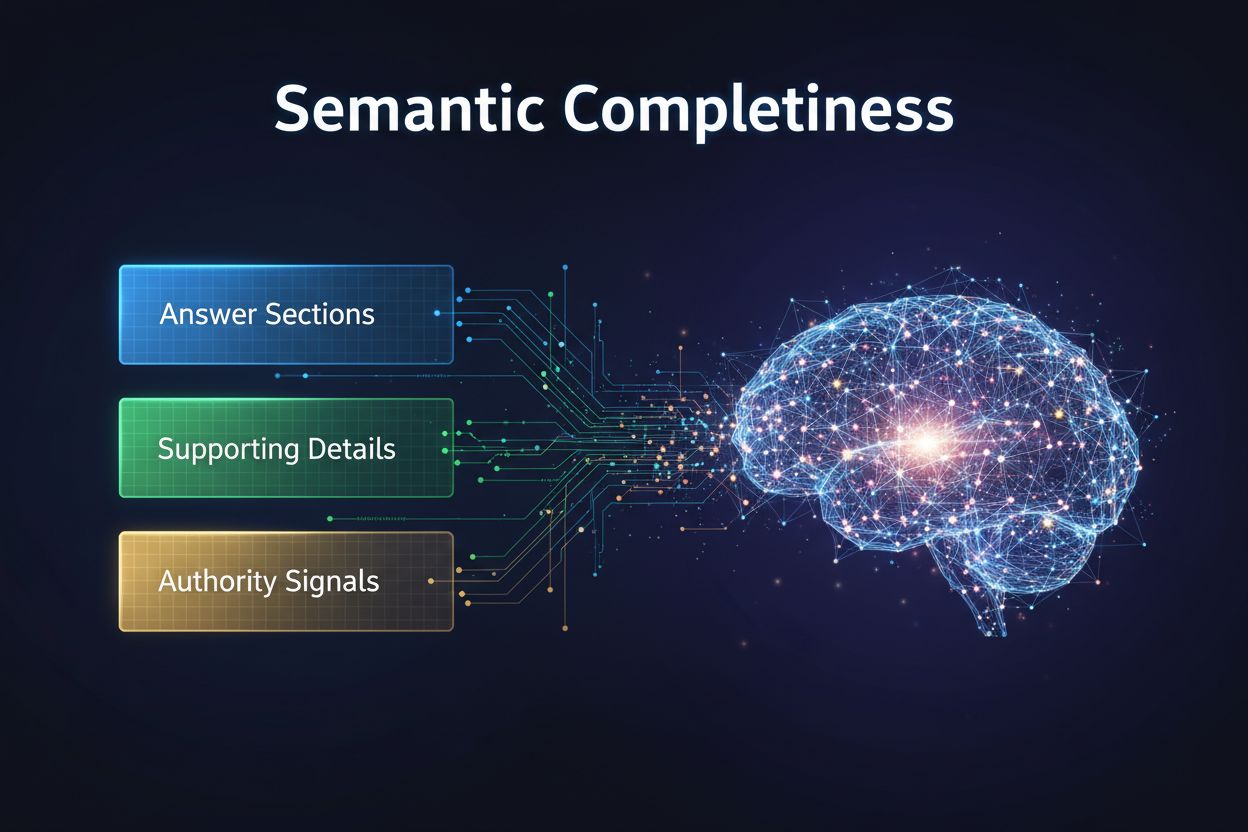
Learn how semantic completeness creates self-contained answers that AI systems cite. Discover the 3 pillars of semantic completeness and implement GEO strategie...
Semantic search interprets query meaning and context using NLP and machine learning. Learn how it differs from keyword search, powers AI systems, and improves s...