
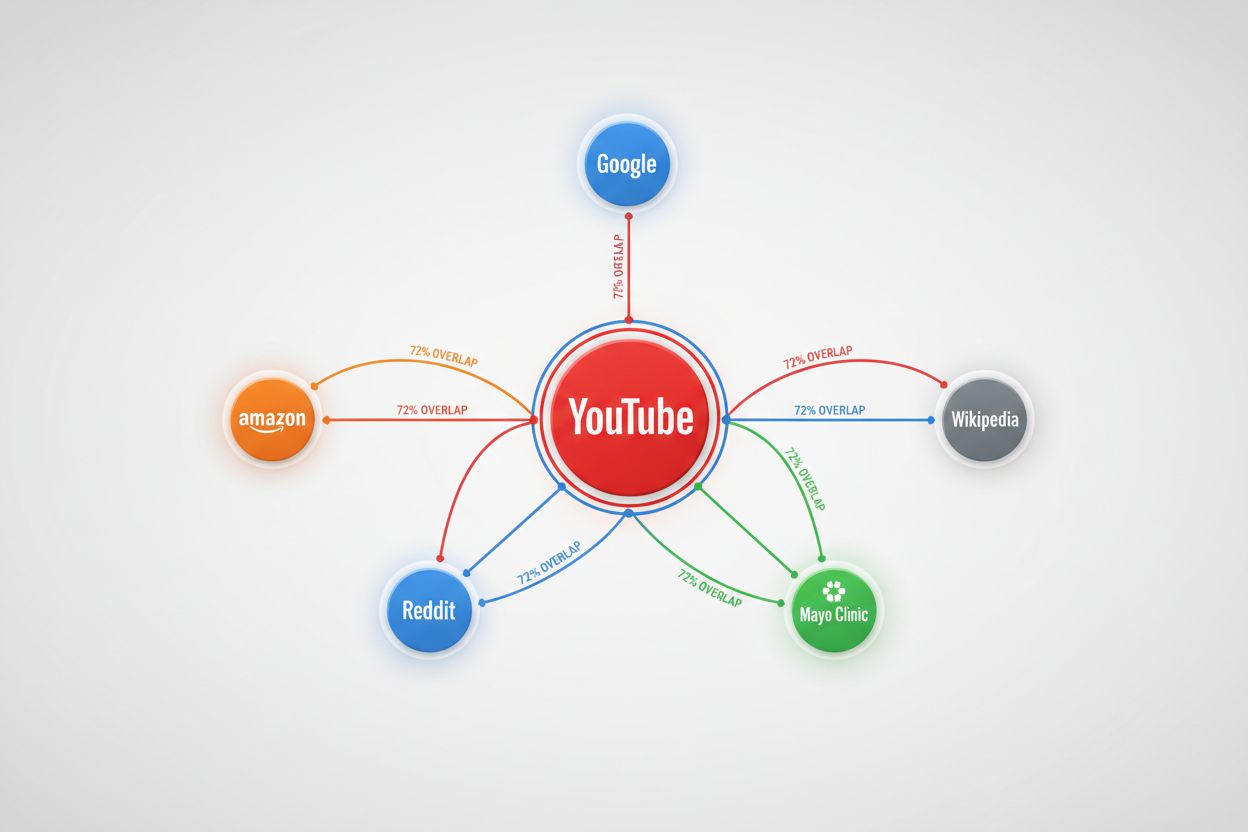
Why YouTube is the Most Cited Source in AI Overviews
YouTube dominates Google AI Overviews with 29.5% citation share, cited 200x more than other video platforms. Learn why and how to leverage this for your brand.
8 min read

Learn how YouTube content influences AI citations across ChatGPT, Perplexity, and Google AI. Discover why YouTube dominates with 200x more citations than competitors and how to optimize your videos for AI discovery.
YouTube content dominates AI citations with a 200x advantage over other video platforms. AI systems like ChatGPT and Perplexity cite YouTube videos 20% of the time on average, making it the most cited video source. Fresh, comprehensive content with optimized metadata and accurate transcripts receives the most citations from AI search engines.
YouTube content has become the most cited video platform across all major AI search engines, with a commanding 200x citation advantage over its nearest competitor. According to recent analysis of AI citation patterns, YouTube accounts for approximately 20% of all video citations across platforms like ChatGPT, Perplexity, and Google AI Overviews. This extraordinary dominance reflects a fundamental shift in how AI systems discover and validate information through video content. The platform’s position is so strong that competing video services like TikTok, Vimeo, Twitch, and Dailymotion barely register in AI citations, each accounting for less than 0.1% of video references. This concentration of citations demonstrates that YouTube has become the de facto standard for video-based information in AI-generated answers.
The significance of YouTube’s dominance extends beyond mere statistics. Even AI platforms with no corporate incentive to favor Google properties, such as Perplexity and ChatGPT, overwhelmingly choose YouTube as their video source. This platform-agnostic preference indicates that YouTube’s content quality, comprehensiveness, and accessibility make it the most reliable source for AI systems seeking video-based information. The consistency of this preference across independent platforms suggests that YouTube’s advantage is not due to algorithmic bias but rather reflects genuine superiority in meeting AI systems’ information needs.
Different AI platforms show varying levels of YouTube citation, but all demonstrate significant reliance on the platform. Google AI Overviews cite YouTube in 29.5% of responses, making it the single most cited domain overall, ahead of established authorities like Mayo Clinic at 12.5%. This positions YouTube as a top-tier information source comparable to medical and financial authorities. Google AI Mode shows a slightly lower citation rate of 16.6%, while Perplexity cites YouTube in 9.7% of responses, ranking it as the fifth most cited domain on that platform. ChatGPT currently cites YouTube in only 0.2% of responses, but this figure is growing rapidly with 100% week-over-week growth, indicating an emerging trend toward greater video integration in ChatGPT’s answers.
| AI Platform | YouTube Citation Share | Ranking | Average Position | Trend |
|---|---|---|---|---|
| Google AI Overviews | 29.5% | #1 Domain | 6.3 | -32.8% weekly |
| Google AI Mode | 16.6% | #1 Domain | 9.7 | -3.2% weekly |
| Perplexity | 9.7% | #5 Domain | 9.7 | +4.8% weekly |
| ChatGPT | 0.2% | Growing | 5.2 | +100% weekly |
The variation in citation rates across platforms reflects different architectural approaches to information retrieval and validation. Google’s AI products, having direct access to YouTube’s infrastructure, naturally integrate video citations more frequently. Perplexity’s independent approach still prioritizes YouTube heavily, suggesting that the platform’s content quality transcends corporate relationships. ChatGPT’s lower but rapidly growing citation rate indicates that video integration is becoming increasingly important as AI systems evolve to provide more comprehensive answers.
AI systems cite YouTube content strategically based on query type and information need. The platform shows particularly strong citation rates for tutorials, product demonstrations, pricing information, and financial content. Queries about “how-to” topics, software tutorials, medical procedures, and product reviews consistently trigger YouTube citations. Conversely, YouTube content is rarely cited for abstract concepts, career advice, strategic planning questions, or pure informational queries that don’t benefit from visual demonstration. This selective citation pattern reveals that AI systems understand the unique value of video content for specific information types and deploy it strategically rather than indiscriminately.
The most frequently cited YouTube content falls into several distinct categories. Educational and instructional videos dominate, particularly those explaining software features, financial tools, and medical procedures. Product demonstration videos receive high citation rates, especially when they show pricing, features, or comparative analysis. Technical tutorials and setup guides are consistently cited when users ask about implementation or configuration. Conversely, opinion-based content, entertainment videos, and abstract discussions rarely receive citations, indicating that AI systems prioritize factual, demonstrable information from video sources.
Video length and recency are the two most statistically significant factors determining whether AI systems cite YouTube content. Analysis of ChatGPT’s citation patterns reveals that newer videos receive approximately 2% more citations for every year of freshness advantage. This preference for recent content reflects AI systems’ need for current, accurate information that hasn’t become outdated. Simultaneously, longer, more comprehensive videos receive approximately 2% more citations for every 10-minute increase in duration. This creates a clear optimization strategy: awareness-stage content should be fresh and concise (8-12 minutes), while consideration-stage content should be comprehensive and evergreen (20-30 minutes).
The relationship between video characteristics and citation frequency demonstrates that AI systems evaluate content utility differently than human viewers. While YouTube’s recommendation algorithm prioritizes watch time and engagement metrics, AI systems prioritize information density and currency. A 25-minute deep-dive video on a technical topic may receive more citations than a viral 3-minute clip, despite the latter’s superior view count. This distinction is crucial for content creators optimizing for AI visibility: the metrics that matter for human audiences differ fundamentally from those that matter for AI discovery. Subscriber counts, while descriptively helpful, show no statistically significant correlation with citation frequency after controlling for content quality and freshness.
AI systems read video transcripts rather than “watching” videos, making metadata optimization and transcript accuracy critical for AI citations. ChatGPT and other language models extract information from the text content of transcripts, not from visual elements. This means that video titles, descriptions, tags, and especially accurate transcripts directly influence whether AI systems discover and cite your content. Videos with literal, keyword-rich titles like “Product A vs. Product B Comparison” receive more citations than clever but vague titles. Similarly, videos that include explicit comparison terms (“vs,” “benchmark,” “comparison”) or technical terminology (“API,” “integration,” “SQL”) in their metadata are more likely to be cited for relevant queries.
Transcript quality and accuracy represent a significant but often overlooked factor in AI citation success. Hand-corrected transcripts with proper spelling, punctuation, and technical terminology provide AI systems with dense, reliable text to extract information from. Auto-generated transcripts, while better than no transcript, often contain errors that reduce citation likelihood. The semantic similarity between a video’s metadata and a user’s query strongly predicts citation probability. Videos with titles and descriptions that directly mirror user search intent receive substantially more citations than those with tangential or creative titles. For maximum AI visibility, use literal, descriptive titles that answer specific questions rather than relying on curiosity-driven or branded titles.
YouTube’s massive archive serves as a critical training dataset for AI language models, with OpenAI and Google explicitly using YouTube transcripts to train their text-based AI systems. The platform contains an estimated 14.8 billion videos, making it an extraordinarily rich source of diverse, multilingual text content. AI companies extract transcripts from these videos to create training datasets that teach language models how to understand and generate human language. This training relationship means that YouTube content doesn’t just influence AI citations—it fundamentally shapes how AI systems understand and respond to queries. The breadth of YouTube’s content, from professional tutorials to personal videos, provides AI models with exposure to diverse communication styles, technical terminology, and real-world language use.
The implications of YouTube’s role in AI training extend beyond citation patterns. Content creators who publish on YouTube are essentially contributing to the training data that powers AI systems. This creates a feedback loop where popular, high-quality YouTube content influences how AI systems are trained, which in turn affects what content those systems cite. However, this relationship also raises important considerations about content representation in AI training data. Research has identified that YouTube’s archive includes significant amounts of personal, family, and educational content never intended for broad distribution. When AI companies use YouTube transcripts for training, they’re incorporating this diverse, sometimes private content into their models, which has implications for privacy and data governance.
Third-party creators and influencers account for approximately 73% of YouTube citations in AI-generated answers, while brand-owned channels capture only 19%. This striking disparity reveals important insights about how AI systems evaluate content credibility and usefulness. For awareness-stage queries where users are first learning about a topic, brand-owned channels receive zero citations, with AI systems exclusively citing influencer content. This preference suggests that AI systems perceive third-party creators as more neutral and educational, while brand channels are viewed as promotional. The dominance of influencer content indicates that AI systems have learned to associate independent creators with objective, educational content and brand channels with marketing-oriented material.
The influencer advantage in AI citations reflects broader patterns in how AI systems evaluate source credibility. Independent creators typically produce content focused on explaining concepts clearly and comprehensively, without the pressure to promote specific products or services. This educational orientation aligns well with AI systems’ need for factual, demonstrable information. Additionally, influencers often have stronger incentives to produce high-quality, well-researched content that builds audience trust, which translates into the kind of comprehensive, accurate information that AI systems prefer. For brands seeking to increase their YouTube citations in AI answers, this finding suggests that partnering with respected influencers for awareness-stage content may be more effective than relying solely on brand-owned channels.
Successful YouTube optimization for AI citations requires a fundamentally different approach than optimizing for YouTube’s native algorithm. Rather than focusing on clickbait titles, sensational thumbnails, and watch-time metrics, AI-optimized content prioritizes clarity, comprehensiveness, and metadata accuracy. The optimization strategy should be stage-aware, with different content approaches for awareness, interest, and consideration stages of the buyer journey. For awareness-stage content, create fresh, concise videos (8-12 minutes) with literal titles that answer specific questions. These videos should be refreshed every 6-12 months to maintain their recency signal. For consideration-stage content, invest in longer, evergreen deep dives (20-30 minutes) that comprehensively address complex topics like comparisons, benchmarks, and integrations.
Metadata optimization requires using literal, descriptive language that mirrors user search intent. Instead of creative or branded titles, use direct titles like “How to [Task] with [Your Product]” or “[Your Product] vs. [Competitor]: [Benchmark] Comparison.” Include specific technical terms, integration partner names, and competitor names in video tags and descriptions. Always upload accurate, hand-corrected transcripts rather than relying on auto-generated versions. Use chapter markers to break long videos into logical sections that can answer specific sub-questions. This structured approach to metadata helps AI systems understand your content’s scope and relevance, increasing the likelihood of citations. Additionally, consider adopting an influencer-first strategy for awareness-stage content, reserving your brand channel for the in-depth, bottom-of-funnel content where your authority is strongest.
YouTube’s dominance in AI citations is likely to increase as AI systems become more sophisticated in processing and integrating video content. Current trends show rapid growth in video citations across platforms, with ChatGPT’s YouTube citations growing 100% week-over-week and Perplexity showing consistent 4.8% weekly growth. This acceleration suggests that AI systems are increasingly recognizing the value of video content for providing comprehensive, demonstrable answers. As AI systems develop better capabilities for understanding video content—potentially moving beyond transcript analysis to actual visual understanding—the strategic importance of YouTube optimization will only grow. Brands that establish strong YouTube presence and optimize their content for AI discovery now will have significant advantages as these systems mature.
The evolution of AI citation patterns also reflects broader changes in how people seek information. As AI search engines become primary discovery mechanisms for many users, the importance of appearing in AI-generated answers rivals or exceeds traditional search engine optimization. YouTube’s position as the dominant video platform in AI citations means that video content strategy is becoming as important as written content strategy for brand visibility. Organizations that treat YouTube optimization as a core component of their AI search strategy, rather than an afterthought, will capture disproportionate visibility in AI-generated answers. The data clearly demonstrates that YouTube content affects AI citations profoundly, making it essential for any brand seeking to maintain visibility in the age of AI-powered search and answer generation.
Track how your YouTube content appears in AI-generated answers across ChatGPT, Perplexity, and Google AI. Get real-time insights into your brand's visibility in AI search results.
YouTube dominates Google AI Overviews with 29.5% citation share, cited 200x more than other video platforms. Learn why and how to leverage this for your brand.

Discover how tutorial content performs in AI citations. Learn why YouTube tutorials dominate AI search with 200x advantage over competitors and how to optimize ...
Discover which subreddits AI models cite most and learn data-driven strategies to target high-citation communities for maximum AI visibility.