

Content Update Frequency for AI Visibility: Complete Guide for 2025
Learn optimal content update schedules for AI visibility. Discover how often to refresh content for ChatGPT, Perplexity, and Google AI Overviews to maximize bra...
10 min read

Learn why content freshness is crucial for AI search visibility. Discover how ChatGPT, Perplexity, and other AI engines prioritize fresh content and how to optimize your brand’s appearance in AI answers.
Content freshness is critical for AI search visibility. AI search engines like ChatGPT, Perplexity, and Google AI Overview use explicit freshness metrics as primary ranking factors, with newer publication dates influencing ranking decisions up to 25% of the time. Regular content updates are essential to maintain visibility and authority in AI-generated answers.
Content freshness has become a fundamental ranking factor in AI-powered search engines, fundamentally different from traditional search algorithms. Unlike older Google models where well-established content could maintain visibility for years, modern AI search engines like ChatGPT, Perplexity, and Google AI Overview use explicit freshness metrics and scoring profiles such as “time_decay_rate” and “use_freshness_scoring_profile” that strongly prioritize recent content. This shift represents a critical change in how brands must approach their content strategy to maintain visibility in AI-generated answers. The impact is measurable and significant: newer publication dates alone can push AI ranking decisions to favor new content up to 25% of the time, even when competing against previously preferred older passages with established authority.
The fundamental difference lies in how AI systems generate answers. Traditional search engines rank entire pages, while AI search engines select specific content chunks that best answer user queries. This means your content must not only be relevant but also current and frequently updated to be selected for inclusion in AI-generated responses. The time decay approach used by models like GPT-4o, GPT-4, and LLaMA-3 gradually deprioritizes older content, creating a continuous pressure to maintain fresh, updated information across your knowledge base.
AI-powered search experiences promise users quick, confident, and accurate summaries. When those summaries cite outdated information, user trust collapses immediately. To reduce this risk and maintain credibility, AI systems lean heavily on sources that display clear publication dates, consistent update patterns, and strong signals of recent change. As AI summaries reach hundreds of millions of users monthly, the competitive cost of being out of date grows exponentially for every publisher competing for visibility in AI-generated answers.
The distinction between AI search and traditional search is crucial to understand. Traditional search engines could afford to show older, authoritative content because users could evaluate multiple results and choose the most current source themselves. AI search engines, however, synthesize information into a single answer that users trust implicitly. This fundamental difference means AI systems must be far more conservative about content recency. When a user asks about current interest rates, stock prices, or recent events, an AI system citing outdated information would provide objectively wrong answers. Therefore, freshness gates your eligibility to be cited in AI-driven panels on time-sensitive queries, and even on evergreen topics, recent updates signal that your information remains accurate and trustworthy.
| Detection Method | How It Works | Impact on Visibility |
|---|---|---|
| Publication Dates | AI systems scan visible publication dates and structured data (datePublished in Article schema) | Clear, accurate dates increase citation probability |
| Update Dates | Modified dates and dateModified fields signal ongoing maintenance | Recent updates boost freshness scores significantly |
| Crawl Frequency | Continuous indexing systems detect how often content changes | Frequently updated pages get higher freshness ratings |
| Content Velocity | Publishing frequency and update cadence across your domain | Consistent updates establish authority and relevance |
| Chunk Retrieval | How often specific content segments appear in AI answers | Fresh chunks are selected more frequently for responses |
| Semantic Density | Depth and comprehensiveness of updated information | Meaningful updates outrank superficial date changes |
| Structured Data | Schema.org markup with proper date formatting | Enables accurate date interpretation by AI systems |
AI search engines employ multiple sophisticated mechanisms to identify and reward fresh content. Continuous indexing systems like Google’s Caffeine enable faster detection of new and updated content, making fresher material discoverable much sooner after publication. Crawl demand and budget allocation determine how frequently search engines revisit your pages—faster, stable servers and clean URL structures help secure more frequent recrawls. Sitemaps with lastmod tags signal to search engines when pages have been meaningfully updated, helping them schedule recrawls efficiently. Additionally, real-time notification protocols like Bing’s IndexNow allow you to push changed URLs to participating engines for quicker discovery, often enabling indexing within minutes rather than days.
On-page signals matter equally. Visible publication and update dates placed prominently near headlines help both users and AI systems understand content recency. Structured data markup using Article schema with datePublished and dateModified in ISO 8601 format ensures search engines can accurately parse and interpret your dates. For news-focused content, proper date placement between headline and article text, combined with avoiding artificial freshening, maintains credibility with AI systems that can detect manipulation attempts.
A common misconception is that freshness alone guarantees AI search success. This is fundamentally incorrect. Freshness without depth can actually harm your credibility. AI search engines evaluate both the recency of content and its semantic density—the amount of useful facts, insights, and comprehensive coverage in each content segment. Superficial updates that only change dates or make minor cosmetic edits can reduce perceived trust and authority, potentially causing AI systems to deprioritize your content.
The optimal strategy combines regular updates with deep, comprehensive coverage that expands knowledge rather than simply updating timestamps. Consider these scenarios:
The relationship between freshness and authority creates a compound effect. When you combine recent publication dates with deep, well-researched content that demonstrates clear understanding of the topic, AI systems recognize this as the gold standard. Your content becomes more likely to be selected for inclusion in AI-generated answers, and when selected, it carries more weight in shaping the AI’s response.
Traditional SEO tools fall short when measuring content freshness specifically for AI search. Most platforms track recency at a basic level but do not monitor AI-specific freshness factors such as semantic density changes, structured data freshness, or citation frequency across different AI models. Modern AI search optimization requires tools that can track performance across ChatGPT, Google AI Overview, Perplexity, and similar platforms, measuring metrics like:
Chunk retrieval frequency deserves special attention because it directly reflects AI search performance. AI systems do not evaluate entire pages as single units; they select individual chunks of content that best answer specific user queries. Fresh, well-updated content scores higher on chunk retrieval because AI models favor recent, comprehensive information when forming responses. High chunk retrieval frequency indicates that your content is not only indexed but actively selected for inclusion in AI answers, making this metric a crucial signal of true AI search authority.
Understanding what not to do is equally important as knowing best practices. Several common mistakes can actively harm your AI search visibility:
Successful content freshness requires a structured approach aligned with your topic categories. Map your content by freshness need: decide which pages must be updated within minutes (breaking news), hours (price changes), days (product updates), or weeks (evergreen guides). For each category, establish an appropriate update cadence that balances freshness signals with content quality.
Technical implementation is equally critical. Add visible publication and updated dates near headlines using clear, human-readable formats. Implement Article schema with datePublished and dateModified in ISO 8601 format to ensure AI systems can accurately parse your dates. Keep sitemaps clean and accurate, populating lastmod only when substantive changes occur—this prevents crawlers from wasting resources on pages that have not meaningfully changed. For news-focused content, follow Google News date placement guidance and use a News sitemap if eligible.
Improve crawl efficiency by optimizing page speed, reducing duplicate URLs, and monitoring Crawl Stats in Search Console. Accelerate discovery by enabling IndexNow for Bing and partner search engines, allowing you to notify them immediately when content updates occur. Build an editorial update cadence for evergreen pages, scheduling quarterly or semiannual reviews to maintain accuracy. Track date impressions by monitoring performance on time-sensitive queries and adjusting update frequency where ranking decays fastest. Most importantly, never fake recency—always log and publish change notes to show real, substantive updates.
As AI search continues to evolve and capture larger portions of search traffic, content freshness will only become more critical. The competitive landscape is shifting rapidly: brands that maintain programmatically fresh content libraries with consistent updates will increasingly dominate AI citations and recommendations. Manual content creation and traditional agency workflows struggle to match the publishing velocity that AI systems reward, creating a widening gap between brands that adapt and those that do not.
The integration of semantic density with freshness represents the new frontier. AI systems are becoming increasingly sophisticated at distinguishing between meaningful updates and superficial date changes. Your content must not only be recent but also demonstrate continuous improvement in depth, accuracy, and comprehensiveness. This means your freshness strategy should focus on adding real value with each update—expanding coverage, incorporating new research, updating examples, and refining explanations rather than simply changing dates.
Track how your content appears in AI answers across ChatGPT, Perplexity, and other AI search engines. Get real-time insights into your content freshness performance and optimize your visibility.
Learn optimal content update schedules for AI visibility. Discover how often to refresh content for ChatGPT, Perplexity, and Google AI Overviews to maximize bra...
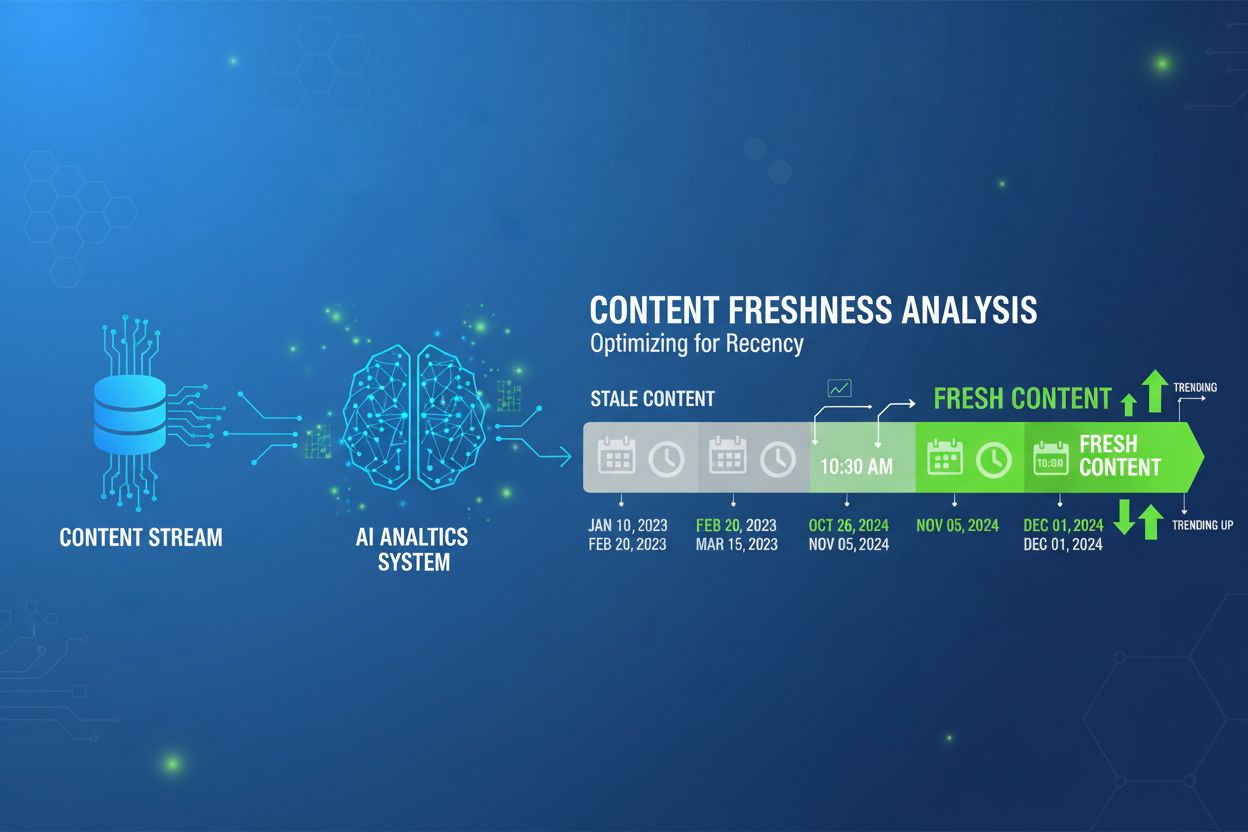
Learn when and how to update your content for AI visibility. Discover freshness signals that help ChatGPT, Perplexity, and Google AI Overviews cite your brand.
Learn how to update content for AI freshness with technical signals, structural changes, and refresh strategies that keep your brand visible in ChatGPT, Perplex...