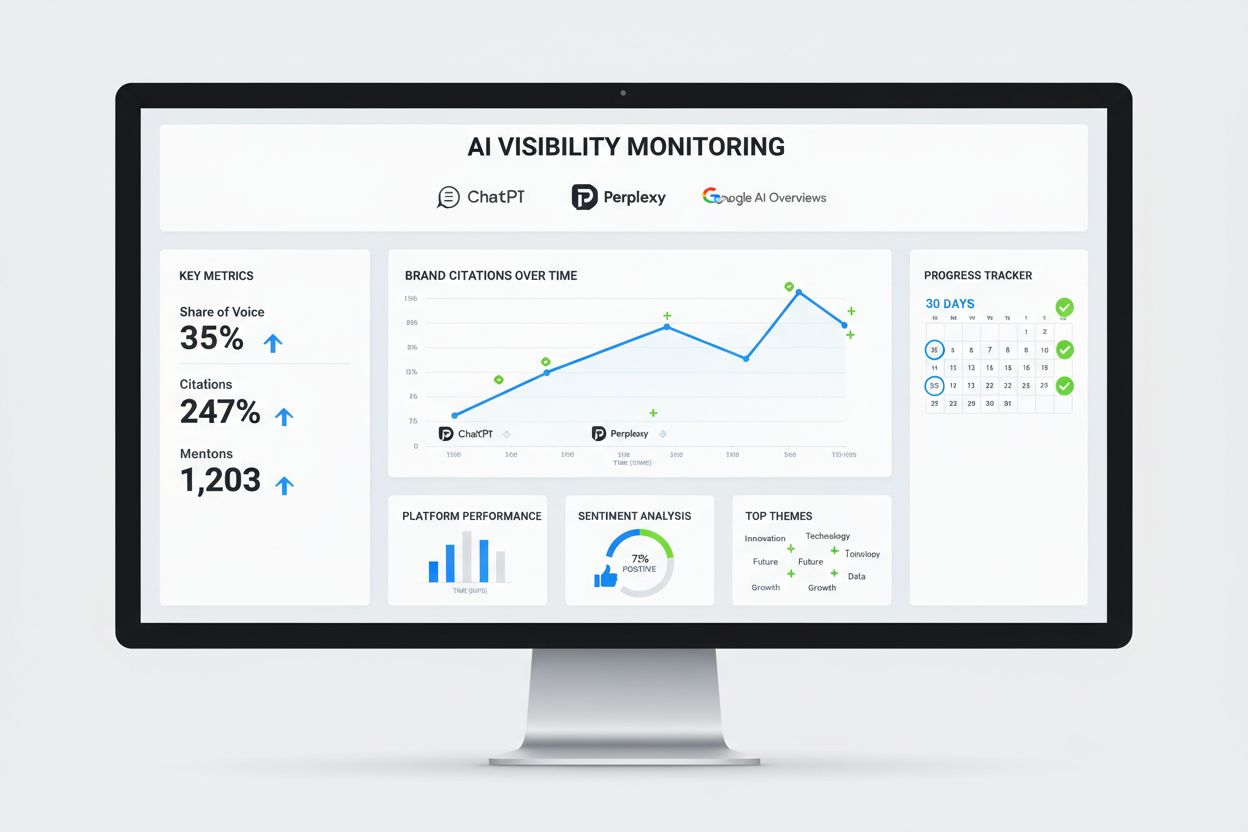
Understanding AI Content Discovery Timelines
The question of how long content takes to appear in AI search results has become critical for businesses competing in the evolving search landscape. Unlike traditional Google search, where ranking timelines can stretch months or years, AI answer generators operate on different indexing and citation cycles. Understanding these timelines helps you set realistic expectations and measure the effectiveness of your AI visibility strategy.
The answer depends on several factors including which AI platform you’re targeting, your content quality, technical optimization, and competitive landscape. Most businesses see early signs of progress within 2 weeks, measurable citations by 4-6 weeks, and consistent visibility across multiple AI models by 2-3 months. However, some platforms like ChatGPT can incorporate fresh information much faster through Retrieval-Augmented Generation (RAG) technology.
How Different AI Platforms Index Content
AI search engines don’t work like traditional search engines. They use advanced technologies including machine learning and natural language processing (NLP) to analyze content deeply, understand its semantic meaning, and determine relevance to user queries. This fundamental difference affects how quickly your content appears in AI answers.
ChatGPT uses Bing’s search index for its RAG capabilities, which means it can access newly indexed content relatively quickly. When a user asks ChatGPT a question that requires current information, the system searches the web in real-time and incorporates fresh data into its response. Research shows that ChatGPT can pick up new information within hours to a couple of days when content is properly indexed by Bing and submitted via IndexNow. This is significantly faster than traditional SEO ranking timelines.
Google Gemini integrates Google’s broader search ecosystem and retrains frequently, typically showing early mentions in Google AI Overviews within 3-4 weeks. Perplexity pulls real-time internet data and backs results with citations, making it responsive to fresh content, though slightly slower than ChatGPT. Claude by Anthropic emphasizes accuracy and context-rich understanding, prioritizing content that aligns with reliable information distribution.
Ready to Monitor Your AI Visibility?
Track how AI chatbots mention your brand across ChatGPT, Perplexity, and other platforms.
The Two-Week Foundation Phase
During the first two weeks of an AI SEO optimization project, you won’t see dramatic visibility jumps, but you’ll establish the technical foundation that determines future results. This phase focuses on making your website machine-readable and ensuring AI crawlers can access and understand your content.
Key improvements during this period include enhanced crawlability through proper robots.txt configuration, updated XML sitemaps, and fixed technical issues like broken links and slow server response times. You should also implement structured data markup such as FAQPage, HowTo, and LocalBusiness schema. These technical signals tell AI systems what your content means, not just what it says.
Additionally, this phase involves improving site speed, ensuring JavaScript rendering works properly (since ~97% of websites use JavaScript), and creating clear internal linking structures. Tools like Google Search Console will show validation of your structured data, confirming that AI systems can parse your pages correctly. While these changes won’t immediately put you in ChatGPT answers, they set the stage for all future visibility.
Weeks 3-4: Early AI Visibility Emerges
Between weeks 3-4, businesses often start appearing inside Google AI Overviews and Google AI Mode answers. This is because Google retrains and updates its AI summaries frequently, and fresh, well-structured content is picked up relatively quickly. According to recent studies, AI Overviews now appear in 13.14% of search queries, with many of these being high-intent purchase or comparison questions that directly impact business outcomes.
During this phase, your content may begin showing up in “People Also Ask” boxes, featured snippets, and small AI-generated summaries. You’ll also see confirmation in your analytics that AI crawlers are actively visiting your site. These early signals prove your technical foundation is working and that AI systems recognize your content as relevant to certain queries.
The speed of appearance depends heavily on your content quality, topical relevance, and how well you’ve optimized for natural language processing. Content that directly answers common questions in a clear, structured format appears faster than generic or poorly formatted content. This is why question-based headings, bullet points, and concise paragraphs significantly accelerate visibility.
Stay Updated on AI Visibility Trends
Get the latest insights on AI mentions, brand monitoring, and optimization strategies.
Weeks 5-6: Citations in ChatGPT and Gemini
Citations in ChatGPT and Gemini generally take a bit longer, around 5-6 weeks, compared to Google’s AI systems. These models update their knowledge based on both continuous crawling and periodic retraining schedules, which vary by platform. OpenAI’s GPTBot crawls continuously, but citations in ChatGPT answers depend on how confident the model is in your authority and expertise.
The confidence signals that matter most include backlinks from authoritative sources, mentions across the web, structured data quality, and content freshness. If your content is well-researched, properly formatted with schema markup, and backed by credible sources, ChatGPT is more likely to cite you when answering relevant questions.
Google Gemini integrates its broader search ecosystem, meaning it benefits from Google’s existing authority signals like PageRank and domain authority. However, Gemini also evaluates E-E-A-T signals (Expertise, Experience, Authoritativeness, Trustworthiness) to determine whether to cite your content. This means that even established domains need to demonstrate clear expertise in their topic area to earn consistent citations.
The 2-3 Month Milestone: Consistent Visibility
The “final milestone” of AI SEO is achieving consistent visibility across multiple AI models whenever a query touches your unique selling propositions (USPs). Reaching this stage typically takes 2-3 months, but the timeline varies significantly based on several factors.
Industry competition plays a major role—fast-moving sectors like technology may take longer than niche local services because more competitors are investing in AI visibility. Competitor activity also matters; if your competitors are already optimized for AI search, you’ll need stronger authority signals to compete. Model retraining cycles can also affect timing; major AI models periodically refresh their training data, which can boost or delay visibility depending on your content’s relevance at that moment.
During this phase, your topical authority compounds. The more your site is referenced or verified by AI systems, the easier it becomes for them to cite you again. Visibility stabilizes, and brand recognition begins to outpace simple keyword rankings. This is where the real competitive advantage emerges—when AI systems automatically think of your brand when answering questions in your category.
| Platform | 2 Weeks | 4 Weeks | 6 Weeks | 2-3 Months |
|---|
| Google AI Overviews | Improved crawlability and baseline signals detected | Early mentions in summaries | Broader coverage in purchase/comparison queries | Consistent presence across USP-related queries |
| Google AI Mode | Technical health improvements visible | Early feature in AI-generated results | Stronger ranking for niche queries | Broad authority coverage |
| ChatGPT | Crawl signals picked up by GPTBot | Some testing queries may surface your content | First citations in user-facing answers | Consistent citations for USP-related prompts |
| Gemini | Content crawl and structured signals registered | Internal confidence building begins | Early appearances in certain categories | Consistent presence across AI recommendations |
| Perplexity | Technical indexing signals detected | Limited early visibility | Growing coverage with citations | Strong citation presence for relevant queries |
Factors That Accelerate or Delay AI Visibility
Site authority significantly impacts how quickly AI systems trust your content. Older, established domains typically earn trust faster than brand new websites because they have existing backlink profiles and domain history. However, new sites can still achieve visibility quickly if they publish exceptionally high-quality, well-structured content.
Schema accuracy is non-negotiable. Incorrect or incomplete markup ensures AI systems misinterpret your content, delaying visibility. Proper implementation of FAQPage schema, Article schema, and Organization schema tells AI systems exactly what your content means. Publishing consistency also matters—fresh, structured content signals ongoing relevance. AI systems favor websites that regularly update their content with current information.
Topic competition directly affects speed. Niche or local terms move faster than national, competitive keywords because fewer websites are optimized for them. For example, a local service business in a specific city will see AI visibility much faster than a national e-commerce brand competing in a saturated market. User engagement metrics like time on page, bounce rate, and click-through rate also influence how AI systems evaluate your content’s quality.
How RAG Technology Accelerates ChatGPT Visibility
Retrieval-Augmented Generation (RAG) is a game-changer for understanding ChatGPT’s speed. When a user asks ChatGPT a question that requires current information, the system doesn’t rely solely on its training data. Instead, it searches the web in real-time, retrieves relevant pages, and incorporates that information into its response.
This means ChatGPT can cite your content within hours or days if your page is indexed by Bing and properly formatted. Research from industry experts shows that when content is submitted via IndexNow (which notifies Bing immediately of new or updated content), ChatGPT can pick it up remarkably fast. However, this speed applies primarily to RAG-based queries—questions where ChatGPT actively searches the web for current information.
For non-RAG queries (where ChatGPT relies on its training data), visibility depends on when your content was included in the model’s training data and how confident the model is in your authority. This is why consistent publishing, strong backlinks, and topical authority matter for long-term visibility beyond just RAG-based answers.
Common Mistakes That Delay AI Visibility
Expecting instant results is the most common mistake. AI SEO builds momentum gradually, similar to traditional SEO. While some platforms like ChatGPT can incorporate information quickly through RAG, earning consistent citations across all AI models requires time and authority-building.
Over-focusing on brand-specific queries limits your visibility potential. Broader purchase intent queries and comparison questions deliver more visibility and traffic than branded searches. For example, instead of optimizing only for “Your Brand Name,” optimize for “Best solutions for [problem]” or “How to [achieve goal].”
Ignoring technical health is fatal. If crawlers can’t access your site, render your JavaScript, or understand your content structure, visibility won’t follow regardless of content quality. Broken links, slow server response times, and blocked resources all prevent AI crawlers from properly indexing your content.
Stopping too early prevents you from reaching the compounding phase. Visibility accelerates in the second and third months as AI systems build confidence in your authority. Many businesses give up after 4-6 weeks when they haven’t seen dramatic results, missing the window where visibility truly compounds.
Measuring AI Visibility Progress
Traditional SEO metrics like rankings and click-through rates don’t fully capture AI visibility. You need new measurement approaches. Structured data impressions in Google Search Console show how often your schema markup appears in search results. Featured snippets and “People Also Ask” listings are early indicators that your content structure works well for AI systems.
Voice search responses can be tested by asking questions on mobile devices or smart speakers to see if your content appears. AI citations can be monitored by periodically testing relevant queries on ChatGPT, Gemini, and Perplexity to track when your brand starts appearing. Engagement metrics like time on page, zero-click conversions, and direct voice queries indicate whether AI systems are actually sending qualified traffic.
Tools like Ahrefs Brand Radar, ChatGPT test prompts, and custom monitoring solutions help track these metrics over time. The key is measuring progress from multiple angles because visibility today doesn’t always mean immediate clicks, but it builds brand recognition and authority that compounds over time.
Real-World Example: Accelerated AI Visibility
A babysitting platform in Portugal came to optimization completely invisible in AI search. They weren’t being mentioned when users asked ChatGPT questions like “What’s the best babysitting service in Lisbon?” After implementing comprehensive AI SEO optimization—including technical foundations, authority-driven content, and clear USP highlighting—they achieved their first conversion directly from an AI recommendation within 40 days. ChatGPT began citing them in relevant queries, moving them from invisible to chosen.
This timeline shows that while full visibility across all AI models may take months, tangible results can come much sooner with proper optimization. The key was combining technical excellence with content that clearly demonstrated their unique value proposition.
Strategic Recommendations for Faster AI Visibility
Prioritize technical foundations first. Ensure your site is fully crawlable, has proper schema markup, and loads quickly. This is the prerequisite for everything else. Create question-based content that directly answers what users ask AI systems. Use conversational language and clear formatting that mirrors how people naturally speak.
Build topical authority by clustering related content into topic hubs. This helps AI systems understand that you’re an expert in your category, not just a single-page resource. Maintain publishing consistency—regular updates signal ongoing relevance to AI systems. Optimize for multiple AI platforms simultaneously, as each has slightly different preferences and crawling schedules.
Monitor your progress across multiple metrics and platforms. Don’t rely on a single indicator. Track structured data impressions, featured snippets, voice search visibility, and direct AI citations to get a complete picture of your AI visibility growth.