

AI Search Trends to Monitor in 2025 - Key Insights for Your Brand
Discover critical AI search trends including ChatGPT dominance, Perplexity growth, Google AI Mode expansion, and zero-click optimization. Learn how to monitor y...
10 min read

Discover current AI search traffic statistics, growth rates, and platform breakdown. Learn how ChatGPT, Perplexity, and other AI platforms are reshaping web traffic patterns in 2025.
AI search currently drives 0.15% of global internet traffic, but it's growing 7x faster than traditional search. ChatGPT leads with 78% of AI traffic, while Perplexity, Gemini, and other platforms are rapidly gaining market share. Importantly, AI-referred visitors are 68% more engaged than organic search visitors, making this channel increasingly valuable for brands.
AI search traffic represents one of the most significant shifts in digital discovery since the rise of mobile search. While the absolute numbers may seem small compared to traditional search engines, the trajectory and engagement metrics tell a compelling story about where web traffic is heading. Understanding these dynamics is critical for any brand that wants to maintain visibility as user behavior evolves. The landscape has transformed dramatically from theoretical discussions about AI’s impact to measurable, real-world traffic patterns that are reshaping how users find information and make purchasing decisions.
AI platforms currently account for 0.15% of global internet traffic, a figure that may seem modest until you consider the context. This represents a seven-fold increase from just 0.02% in 2024, demonstrating explosive growth in a relatively short timeframe. To put this in perspective, organic search still dominates at 48.5% of global traffic, meaning traditional search engines send approximately 300 times more traffic than all AI platforms combined. However, this comparison becomes less relevant when examining growth trajectories and engagement metrics, which paint a dramatically different picture about the future of search.
The growth acceleration is particularly striking when examining specific platforms. ChatGPT’s traffic share doubled between January and April 2025, jumping from 0.0793% to 0.1587% of total internet traffic. In some industries, the penetration is far more significant. Legal websites now receive 0.86% of their traffic from AI platforms, up from just 0.37% a year earlier. Finance and SaaS sectors show similar trajectories, with some domains exceeding 1% of total traffic from AI sources. These aren’t marginal improvements—they represent fundamental shifts in how users discover content within specific verticals.
| Platform | Global Market Share | Average Session Duration | Key Strength |
|---|---|---|---|
| ChatGPT | 77.97% | 9 minutes 43 seconds | Dominant reach and consistent engagement |
| Perplexity | 15.10% | 9 minutes 13 seconds | Strong U.S. presence (19.73% of AI traffic) |
| Gemini | 6.40% | 6-7 minutes | Growing integration with Google ecosystem |
| DeepSeek | 0.37% | 12-13 minutes | Highly engaged niche audience |
| Claude | 0.17% | 19 minutes average (1 hour+ in EU) | Super-users with exceptional engagement |
ChatGPT remains the undisputed leader in AI-driven traffic, commanding nearly 78% of all AI referrals globally. This dominance reflects both its first-mover advantage and its seamless integration into user workflows. With 800 million weekly active users and 5.7 billion monthly visits, ChatGPT has become the fourth most visited website globally. The platform processes 2 billion queries daily, making it a legitimate search alternative that’s capturing serious market share from traditional engines like Google and Bing. What’s particularly significant is that ChatGPT’s top citation sources include Wikipedia (7.8%), Reddit (1.8%), and Forbes (1.1%), indicating that the platform draws from diverse, authoritative sources rather than relying on a narrow set of websites.
Perplexity has carved out a loyal following, particularly in the United States where it captures nearly 20% of AI traffic—significantly higher than its 15.10% global share. The platform’s emphasis on source transparency and real-time citations resonates with users who want to verify AI-generated answers. Perplexity’s user base skews toward high-income professionals, with 30% in senior leadership roles and 65% in white-collar professions, making it particularly valuable for B2B and professional services companies. The platform’s growth rate of 25% in just four months of 2025 suggests it’s building momentum beyond its initial early-adopter audience.
Google’s Gemini underperforms relative to Google’s dominance in traditional search, accounting for just 6.40% of AI traffic. This gap exists partly because most users still default to classic Google search rather than seeking out Gemini specifically. However, Gemini visitors spend 6-7 minutes per session, substantially longer than the 4+ minutes typical for Google’s organic search results. This engagement differential suggests that when Gemini does send visitors, they’re highly qualified and engaged. If Google accelerates Gemini integration into mainstream search results, this traffic source could grow exponentially.
Emerging platforms like DeepSeek and Claude demonstrate the importance of monitoring the entire AI landscape. DeepSeek, despite holding just 0.37% of AI traffic, shows exceptional engagement with visitors spending 12-13 minutes per session. Claude’s numbers are even more striking—while it represents only 0.17% of AI traffic globally, Claude users in the EU spend an average of nearly one hour on referred websites. These outliers suggest that niche AI platforms are attracting highly specialized audiences with specific needs, creating opportunities for brands in technical, academic, and research-heavy sectors.
AI search adoption varies significantly by geography, with the United States leading adoption at 0.13% of traffic share, followed closely by the European Union at 0.12%, and the United Kingdom at 0.07%. However, growth rates tell a more interesting story. ChatGPT’s traffic share more than doubled in the U.S. and tripled in the UK within just four months of 2025, indicating that adoption is accelerating rapidly across all major markets. The U.S. market shows the most platform diversity, with Perplexity capturing 19.73% of AI traffic compared to its 15.10% global average, and Claude showing particularly strong presence at 0.58%, more than three times its global average.
The European Union demonstrates the strongest engagement metrics, with AI users spending nearly 10.3 minutes on average compared to 5.8 minutes for organic traffic—a 78% engagement premium. This suggests that European users may be more intentional in their AI search behavior or that European websites are better optimized for AI-driven discovery. The United Kingdom, while showing lower absolute AI traffic, demonstrates the fastest growth trajectory, with ChatGPT’s share jumping from 0.0326% in January to 0.1005% in April 2025.
One of the most compelling findings about AI search traffic is its superior engagement compared to traditional organic search. Across all analyzed data, visitors arriving from AI platforms spend 67.7% more time on websites than those from organic search—an average of 9 minutes 19 seconds compared to 5 minutes 33 seconds for Google and other search engines. This engagement differential persists even when examining median session durations, which reduce the impact of outliers: 2 minutes 24 seconds for AI versus 1 minute 53 seconds for organic search.
This engagement advantage reflects a fundamental difference in how AI platforms deliver traffic. AI search acts as an “intent filter,” bringing users who have already engaged in a conversational exchange with the model to refine their query and context before clicking through to your website. Users aren’t arriving cold—they’ve already had their question partially answered and have been directed to your site because the AI model determined your content would provide additional value. This pre-qualification effect means that while AI traffic volumes are currently lower, the visitors you receive are often further along in their decision journey and more likely to convert.
The engagement advantage varies by region and platform. In the EU, AI users spend 78% longer on sites than organic visitors, while in the U.S., the advantage is more modest at 28.7%. Claude users demonstrate the most extreme engagement, with average sessions lasting nearly 19 minutes globally and over one hour in the EU, though these averages are skewed by a small group of “super-users” who spend exceptional amounts of time on referred websites. These super-users represent highly valuable audience segments—individuals deeply engaged with specific topics who are willing to invest significant time exploring relevant content.
AI search traffic is not distributed evenly across industries, with certain sectors showing dramatically higher penetration rates. Legal websites lead with 0.86% of traffic from AI platforms, reflecting users’ tendency to ask AI systems contextual, trust-heavy questions about legal matters. Finance follows at 0.24%, with users seeking complex financial guidance and investment advice. Health websites receive 0.15% of traffic from AI sources, as users ask AI systems about medical conditions, medications, and health concerns. Together, legal, finance, health, SMB, and insurance account for 55% of all AI-sourced sessions, indicating that AI search is particularly valuable for industries where expertise, trust, and contextual understanding matter most.
This concentration in high-trust industries reflects how users actually employ AI platforms. Rather than using them like traditional search engines to look up facts, users are asking contextual, consultative questions that require nuanced understanding: “What should I ask a lawyer before signing this contract?” or “How do I structure payroll as a small business owner?” These are the exact types of queries where AI excels and where users are most likely to click through to authoritative sources for deeper information.
The growth rate of AI search traffic suggests we’re at an inflection point in digital discovery. The 527% increase in AI-referred sessions between January and May 2025 (from 17,076 to 107,100 sessions across analyzed properties) indicates that adoption is accelerating beyond early adopters into mainstream user behavior. Some SaaS companies are already seeing over 1% of all sessions coming from AI platforms, with one notable example showing ChatGPT accounting for 86.1% of AI referral traffic and delivering 12,832 site visits monthly, resulting in a 127% increase in orders and $66,400 in revenue directly attributed to AI-driven sessions.
AI search visitors are predicted to surpass traditional search visitors by 2028, according to recent projections. This timeline may seem distant, but it underscores the urgency of developing AI search optimization strategies now. Early movers who establish visibility in AI-generated answers will build compounding advantages as the channel matures. The competitive landscape is currently less crowded than traditional search, meaning there’s an opportunity to secure prominent positioning before competition intensifies.
Understanding AI search traffic is essential for brands using monitoring platforms like Amicited. Your brand’s visibility in AI-generated answers depends on factors fundamentally different from traditional SEO rankings. Branded web mentions show the strongest correlation (0.664) with appearances in Google AI Overviews, significantly stronger than backlinks (0.218). 40% of sources cited in AI Overviews rank lower than the top 10 positions in traditional search results, meaning you can gain AI visibility without dominating traditional search rankings. Schema markup increases citation likelihood by 30%, and AI platforms prefer content that’s 25.7% fresher than what traditional search engines favor. These insights suggest that AI search optimization requires distinct strategies focused on clarity, freshness, and structured data rather than traditional link-building and keyword optimization.
Track how often your brand appears in ChatGPT, Perplexity, and other AI platforms. Get real-time visibility into your AI search performance and stay ahead of competitors.
Discover critical AI search trends including ChatGPT dominance, Perplexity growth, Google AI Mode expansion, and zero-click optimization. Learn how to monitor y...
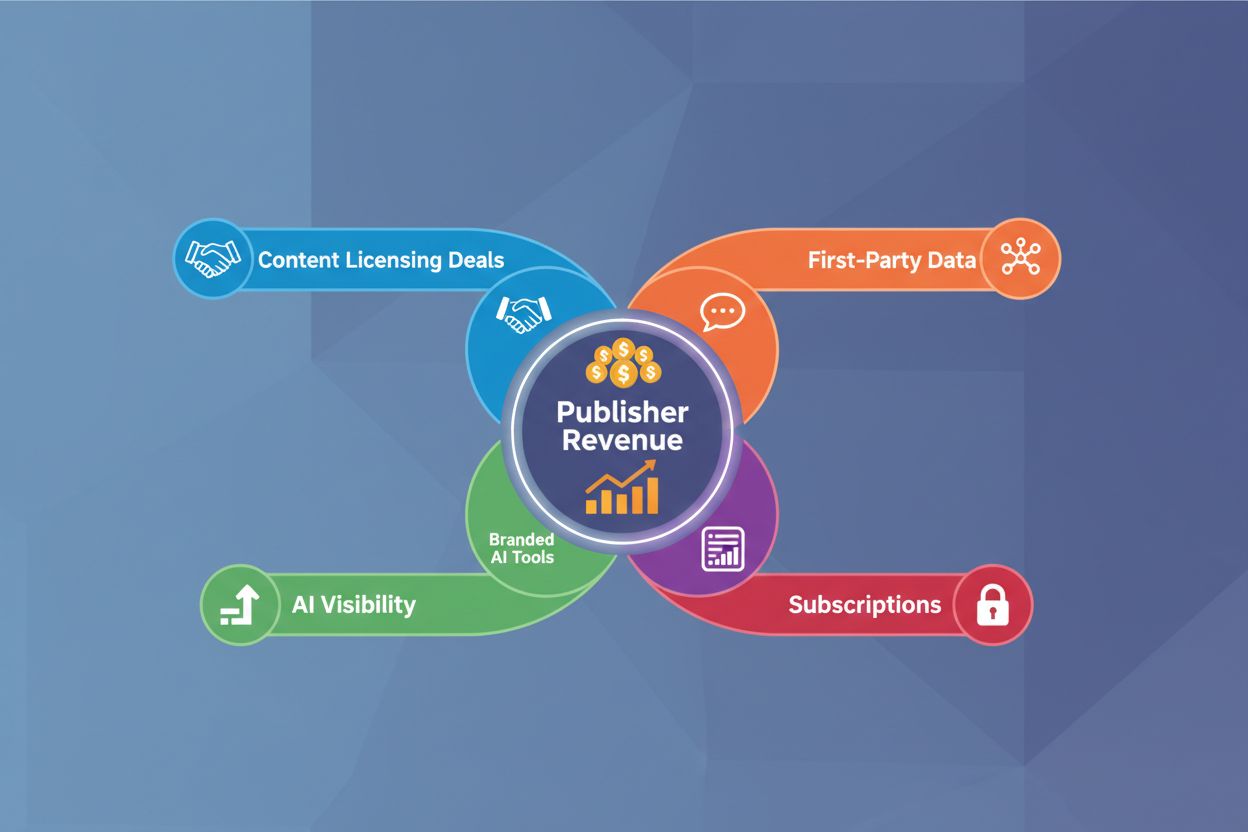
Discover proven revenue strategies for monetizing AI traffic. Learn licensing deals, GEO optimization, and diversified income streams for publishers in the AI e...
Comprehensive guide to the 25 best AI visibility tools in 2026. Compare features, pricing, and capabilities of Profound, Am I Cited, Peec AI, Otterly, Semrush A...