
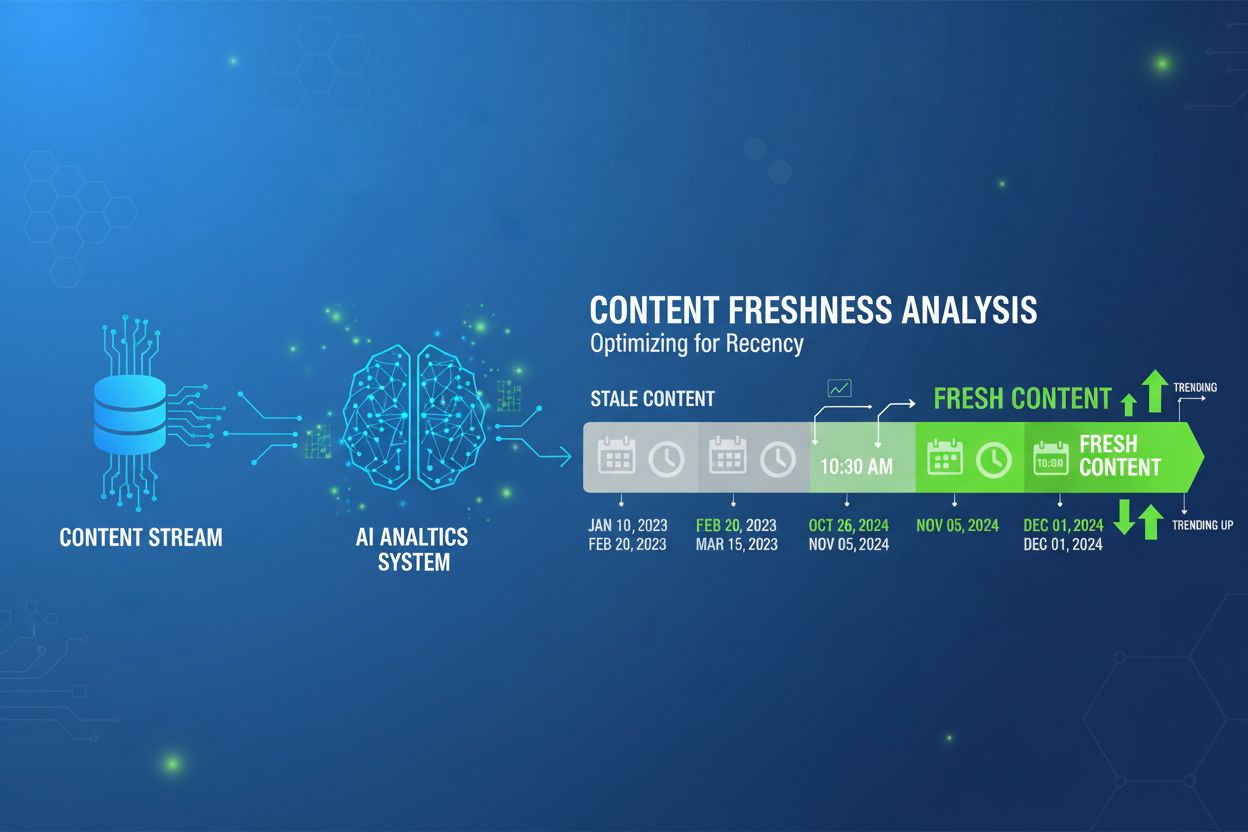
When to Update Content for AI: Freshness Signals
Learn when and how to update your content for AI visibility. Discover freshness signals that help ChatGPT, Perplexity, and Google AI Overviews cite your brand.
8 min read

Learn optimal content update schedules for AI visibility. Discover how often to refresh content for ChatGPT, Perplexity, and Google AI Overviews to maximize brand citations and AI search rankings.
Update core content every 90 days, time-sensitive content weekly to monthly, and evergreen content every 3-6 months. AI engines prefer fresh content that is 25% younger than traditional search results, with sites updating 9+ times monthly seeing 20%+ organic traffic increases.
AI search engines fundamentally prioritize fresh content differently than traditional search engines. Research analyzing 17 million AI assistant citations reveals that ChatGPT cites content that is 393 days newer than Google’s average results, while Gemini references sources 314 days fresher, and Perplexity favors content 266 days newer than traditional organic search results. This represents a 25.7% freshness advantage for AI-powered platforms, making content recency a critical ranking factor for visibility in AI answers, Perplexity responses, and ChatGPT citations.
The implications are significant for brands monitoring their appearance in AI search results. Unlike Google, which can rank older, authoritative content indefinitely, AI engines systematically surface newer, freshly updated content over static pages, regardless of historical domain authority. This shift means that your content update strategy directly impacts whether your brand appears in AI-generated answers that users see when they ask questions on ChatGPT, Perplexity, or Google’s AI Overviews.
Different content types require different update schedules based on how quickly information becomes outdated and how AI engines evaluate relevance. Understanding these distinctions helps you allocate resources efficiently while maintaining visibility across AI platforms.
| Content Type | Update Frequency | Rationale | AI Impact |
|---|---|---|---|
| Breaking News & Events | Daily to Hours | Information changes rapidly; users expect current details | Critical - AI prioritizes latest developments |
| Product Reviews & Comparisons | Weekly to Monthly | New products launch, features change, pricing updates | High - AI cites recent reviews for purchase decisions |
| Statistical Reports & Data | Monthly | New data releases, trends shift, benchmarks change | High - AI values current statistics and research |
| How-To Guides & Tutorials | Quarterly (3 months) | Best practices evolve, tools update, processes improve | Medium-High - AI extracts step-by-step instructions |
| Evergreen Content & Definitions | Semi-Annually (6 months) | Foundational knowledge remains stable but needs verification | Medium - AI uses for context and definitions |
| Industry Trends & Analysis | Quarterly | Market conditions change, new insights emerge | High - AI synthesizes trend analysis in responses |
Breaking news and time-sensitive content demand the most frequent updates because AI engines use the Query Deserves Freshness (QDF) model to determine which content should be prioritized. When users ask about recent events, product launches, or current developments, AI systems immediately recognize the query’s time-sensitivity and prioritize the newest available sources. Failing to update this content means competitors with fresher information will dominate AI citations.
Product-led content requires regular updates as your offerings evolve. When you release new features, update pricing, or deprecate old functionality, your tutorials, comparison articles, and product pages must reflect these changes. AI engines crawl product pages frequently—sometimes more than 100 times more often than Google—so outdated product information can damage your credibility with answer engines within days of publication.
Evergreen content like foundational guides and definitions can survive longer without updates, but they still need regular audits. Even though the core information remains stable, you should refresh examples, add new case studies, update statistics, and verify that links still work. Research shows that sites updating at least 9+ times monthly see 20%+ organic traffic uplift and dramatically higher chances of appearing in AI-assisted queries.
Content freshness directly correlates with AI citation rates and organic traffic growth. Data from the Stratabeat 2025 B2B SaaS SEO Performance Report demonstrates clear performance differences based on update frequency:
These metrics reveal that consistent, frequent content updates are not optional for AI visibility—they are essential for competing in AI-driven search. Brands that publish or refresh 9+ pieces of content monthly attract 90% more referring domains and surge ahead in keyword coverage. This happens because AI engines recognize active, engaged publishers as more trustworthy sources, and they reward this behavior with increased citations.
The relationship between update frequency and AI visibility extends beyond simple rankings. AI engines use freshness signals to determine source credibility. When an AI system sees that you regularly update your content, it interprets this as a sign that you’re actively maintaining accurate, current information. Conversely, pages that haven’t been touched in months signal to AI that the information may be outdated or abandoned, making them less likely to be cited in responses.
AI systems detect freshness through three distinct signals: byline dates, syntactic dates, and semantic analysis. Understanding how these signals work helps you optimize your content update strategy for maximum AI visibility.
Byline dates are explicit “last updated” timestamps that you manually set in your content management system. This is the most direct freshness signal, but it only works when you make substantive changes. Critical best practice: only update your published or last modified dates when you make meaningful revisions. Cosmetic changes without real edits can harm both credibility and visibility because AI systems can detect when dates don’t match the actual content changes. If you update a date but only change a few words, AI engines will recognize the mismatch and penalize your credibility.
Syntactic dates appear in URLs, titles, and metadata—for example, “2025 SEO Trends” or “Best Email Tools for 2025.” These dates signal topicality without requiring manual updates, but they become problematic when the year changes. A page titled “2024 Best Practices” automatically becomes less relevant on January 1st, even if the content is still accurate. AI systems recognize these date patterns and adjust relevance accordingly.
Semantic analysis uses natural language processing to detect real-world topicality. AI engines analyze the actual content to determine if it discusses current events, recent data, or up-to-date information. This is why adding fresh statistics, recent case studies, and current examples matters so much—AI can recognize when you’ve genuinely updated the substance of your content, not just the date.
Your specific update frequency should depend on your industry, content type, and competitive landscape. Here’s how to determine the right schedule for your brand:
For SaaS and technology companies, update product-related content monthly because features change frequently and AI systems crawl product pages more often than other content types. Update comparison articles and pricing pages immediately when changes occur, as these directly influence purchase decisions and AI citations in product research queries.
For news and media publishers, maintain daily or hourly updates for breaking stories, as AI engines prioritize the most recent coverage. Establish a system where your editorial team updates timestamps and adds new information as stories develop, ensuring your content remains the freshest source available.
For B2B service providers, audit core service pages and case studies quarterly, but update them immediately when you win significant new clients or develop new service offerings. Update thought leadership content and industry analysis monthly to maintain authority in your niche.
For ecommerce brands, refresh product descriptions and reviews monthly to reflect new inventory, customer feedback, and competitive changes. Update seasonal content at least 4-6 weeks before each season to ensure AI systems have time to crawl and index the changes before peak search periods.
For agencies and consultants, publish new insights and case studies at least twice monthly to demonstrate active expertise. Update methodology pages and service descriptions quarterly as your processes evolve.
Creating a content refresh calendar is essential for maintaining consistent AI visibility. Rather than updating randomly, segment your content inventory by freshness need and assign specific review dates. This systematic approach ensures nothing falls through the cracks while preventing wasted effort on content that doesn’t need updates.
Start by categorizing your content using the Query Deserves Freshness model: breaking queries (update hours to days), recent queries (update weekly to monthly), ongoing queries (review quarterly), and evergreen content (review bi-annually). Assign each piece to a category, then set calendar reminders for review dates. When you review content, ask: Is the information still accurate? Have new developments occurred? Are there new statistics or examples? Can I improve the structure for AI extraction?
Batch your updates thematically to maximize efficiency. Rather than updating one random page per week, dedicate specific weeks to updating all product pages, then all blog posts, then all case studies. This batching approach allows you to develop consistent messaging and leverage templates, reducing the time required per update.
Deploy AI tools for automated updates where appropriate. Use AI writing assistants to help rewrite introductions, update statistics, and add emerging keywords. However, always review AI-generated content for accuracy before publishing—AI can hallucinate or misinterpret data, and publishing inaccurate information damages your credibility with both users and AI systems.
Monitor performance after updates using Google Search Console and AI visibility tracking tools. Track changes in average position, impressions, clicks, and CTR for updated pages. Monitor brand mentions in citation tracking tools to see if your updates increase AI citations. This data helps you understand which update strategies work best for your content and audience.
The biggest mistake brands make is updating dates without updating content. AI systems have become sophisticated enough to detect when you’ve changed a publication date without making substantive changes to the article. This practice, sometimes called “date manipulation,” can actually harm your credibility with AI engines rather than help it.
When you update a page, ensure the changes are meaningful and reflect genuine improvements. Add new statistics from recent research, include new case studies or examples, update outdated information, improve the structure for better readability, or expand sections that need more depth. These substantive changes justify updating your publication date and signal to AI that you’re actively maintaining accurate information.
Sync your CMS and schema markup with your actual updates. If you update the Article.modifiedTime in your schema markup but don’t actually change the content, AI systems will detect the inconsistency. Ensure that your content management system automatically updates schema timestamps when you modify content, or manually update schema when you make changes.
Document your update rationale in your CMS or editorial calendar. Note what changed, why it changed, and what new information was added. This documentation helps your team understand the update’s significance and ensures future updates build on previous improvements rather than repeating the same changes.
Track the right metrics to demonstrate the value of your content update efforts. Don’t just monitor traditional rankings—measure AI-specific metrics that show real business impact.
Monitor citation frequency using tools that track when your content appears in AI responses. Set up weekly or monthly reports showing how many times your brand was cited in ChatGPT, Perplexity, Google AI Overviews, and other AI platforms. Compare citation trends before and after updates to quantify the impact of your refresh strategy.
Track Share of Voice across AI platforms. This metric shows what percentage of citations in your industry go to your brand versus competitors. If you’re updating content but your Share of Voice isn’t increasing, it may indicate that competitors are updating more frequently or that your content isn’t optimized for AI extraction.
Measure conversion impact from AI-driven traffic. Set up separate analytics segments for traffic from AI platforms and track how these visitors convert compared to traditional search traffic. Research shows that AI-driven traffic converts 3-6 times more often than Google organic traffic, making this a critical ROI metric.
Monitor crawl frequency using real-time monitoring platforms. If AI bots stop visiting your pages after an update, it may indicate technical issues or content quality problems. Healthy pages should see consistent crawl activity from ChatGPT, Perplexity, and other AI systems.
Track how often your content appears in AI answers and get alerts when competitors outrank you. Start monitoring your brand's presence across ChatGPT, Perplexity, and Google AI Overviews today.
Learn when and how to update your content for AI visibility. Discover freshness signals that help ChatGPT, Perplexity, and Google AI Overviews cite your brand.

Learn why content freshness is crucial for AI search visibility. Discover how ChatGPT, Perplexity, and other AI engines prioritize fresh content and how to opti...
Learn how to update content for AI freshness with technical signals, structural changes, and refresh strategies that keep your brand visible in ChatGPT, Perplex...