
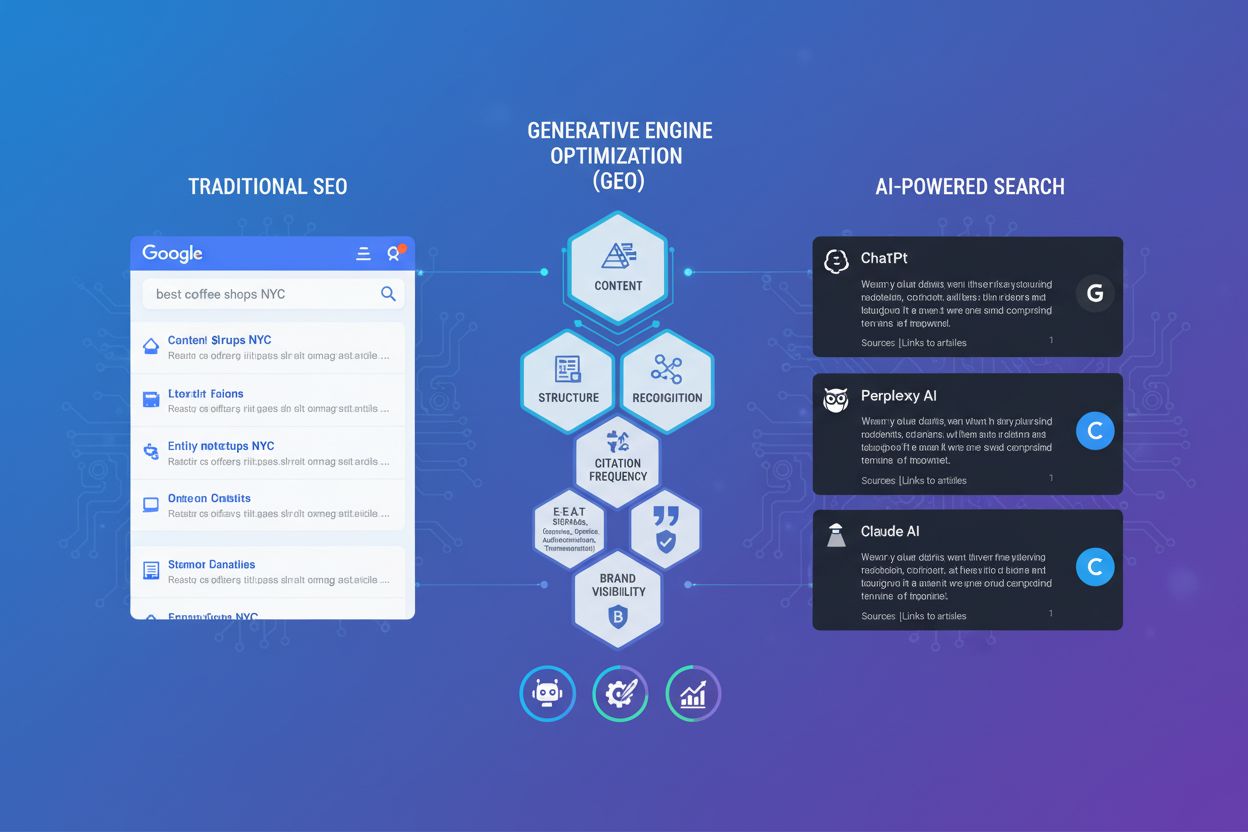
Generative Engine Optimization (GEO)
Learn what Generative Engine Optimization (GEO) is, how it differs from SEO, and why it's critical for brand visibility in AI-powered search engines like ChatGP...
11 min read

Discover whether hiring a Generative Engine Optimization agency is right for your business. Compare costs, expertise, and ROI of agency vs in-house GEO strategies.
Hiring a GEO agency is recommended for most businesses because agencies provide specialized expertise in knowledge capture, AI visibility tracking, and omnichannel optimization that in-house teams struggle to deliver. Agencies offer cost-effective solutions with proven tools and methodologies, while in-house approaches require significant investment in hiring, training, and technology infrastructure.
Generative Engine Optimization (GEO) represents a fundamental shift in how brands achieve visibility in the digital landscape. Unlike traditional SEO, which optimizes for search engine rankings and blue-link results, GEO focuses on ensuring your brand’s knowledge is captured, understood, and cited by Large Language Models (LLMs) like ChatGPT, Google Gemini, Perplexity, and Claude. The distinction is critical: SEO gets you found, while GEO ensures you’re cited as an authoritative source within AI-generated answers. This emerging discipline requires specialized knowledge, proprietary tools, and continuous monitoring across multiple AI platforms—capabilities that most in-house teams lack.
The complexity of GEO extends far beyond traditional marketing. It demands understanding of knowledge graphs, entity mapping, retrieval-augmented generation (RAG) systems, and how different AI models interpret and reuse content. Most businesses attempting to manage GEO internally discover they lack the technical infrastructure, data integration capabilities, and real-time monitoring systems necessary to compete effectively in AI search environments. The learning curve is steep, and the cost of mistakes—being invisible in AI answers—is substantial.
| Aspect | GEO Agency | In-House Team |
|---|---|---|
| Expertise Depth | Specialized teams across multiple disciplines (SEO, PR, copywriting, ORM) | Single or small team wearing multiple hats |
| Technology & Tools | Proprietary platforms, automation systems, AI tracking software | Limited tools, often manual processes |
| Cost Structure | Fixed retainer ($2,500-$12,000/month) with predictable ROI | Salary, benefits, training, equipment, and ongoing hiring costs |
| Scalability | Easily adjusts services as business grows | Requires hiring and onboarding new staff |
| Measurement & Reporting | Advanced AI Visibility Rate (AIGVR), citation frequency, passage-level tracking | Basic metrics, often incomplete data |
| Industry Knowledge | Experience across multiple industries and AI platforms | Limited to your specific industry |
| Speed to Results | Faster implementation with established processes | Slower due to learning curve and resource constraints |
Building an effective in-house GEO team presents significant challenges that many businesses underestimate. First, hiring qualified talent is extremely difficult because GEO expertise is rare—most marketing professionals come from traditional SEO backgrounds and lack understanding of LLM architectures, knowledge graphs, and AI-specific optimization techniques. The talent pool for genuine GEO specialists is minimal, making recruitment expensive and time-consuming. Second, the technology investment required is substantial. Agencies invest in proprietary tools that track AI crawler activity, monitor citations across multiple platforms, and measure passage-level inclusion in AI-generated answers. These tools cost thousands monthly and require technical expertise to implement and maintain.
Third, operational depth cannot be replicated with a small team. True GEO success requires integration of Digital PR for authority signals, copywriting for high-information-gain content, and Online Reputation Management (ORM) for user-generated content integrity. A single in-house specialist cannot excel across all these disciplines simultaneously. Fourth, the continuous learning requirement is demanding. AI models, platforms, and best practices evolve rapidly. Agencies dedicate resources to staying current with patent filings, algorithm updates, and emerging optimization techniques. In-house teams often fall behind, implementing outdated strategies that fail to drive AI visibility.
When evaluating the financial case for GEO, the numbers strongly favor agencies for most businesses. Hiring a qualified in-house GEO specialist typically costs $80,000-$150,000 annually in salary alone, plus benefits, equipment, and training. Hiring a full GEO team (specialist, copywriter, PR coordinator) easily exceeds $300,000+ annually. Additionally, you must invest in software tools, which can cost $2,000-$5,000 monthly for proper AI tracking and analytics platforms. The total first-year investment for a capable in-house team often reaches $400,000-$500,000 or more.
In contrast, a GEO agency retainer ranges from $2,500-$12,000 monthly ($30,000-$144,000 annually), depending on service level and business size. This investment includes access to specialized expertise, proprietary technology, proven methodologies, and measurable results. Agencies achieve economies of scale by serving multiple clients, allowing them to invest in expensive tools and maintain specialized teams that individual businesses cannot afford independently. For most companies, the agency model delivers better ROI, faster results, and lower financial risk. You pay only for services rendered, with no long-term employment commitments or infrastructure costs.
Knowledge Capture Engineering is the foundation of effective GEO. Agencies understand how to structure content so it’s machine-interpretable and retrievable by RAG systems. They map entity relationships, optimize fact density, and ensure content aligns with LLM embedding spaces. This requires technical knowledge of how different AI models process information—knowledge that takes years to develop and is rarely found in traditional marketing teams. Agencies study patents like US11769017B1 (Google’s Gemini integration) and WO2024064249A1 (OpenAI’s retrieval-augmented citation systems) to understand how LLMs reason and make citation decisions.
Omnichannel Integration is another critical capability. GEO agencies coordinate Digital PR to build external authority signals, copywriting to create high-information-gain content, and ORM to manage user-generated content that influences AI perception. They understand that LLMs triangulate credibility across multiple signals: what your website says, what authoritative sources say about you, and what users say in reviews and forums. Coordinating these three dimensions requires expertise and infrastructure that in-house teams typically lack. When these signals align, AI systems trust your brand more and include it more frequently in generated answers.
Advanced Measurement and Reporting distinguishes professional GEO agencies from DIY approaches. Agencies track AI Visibility Rate (AIGVR), citation frequency, passage-level inclusion, and AI-attributed conversions. They monitor how often your content appears in ChatGPT, Perplexity, and Google’s AI Overviews. They measure not just traffic but actual citations and answer inclusion. This level of measurement requires proprietary tools and technical expertise that most in-house teams cannot replicate. Agencies can show exactly which prompts trigger your brand mentions, which competitors are cited instead, and what content changes drive citation improvements.
While agencies are recommended for most businesses, certain scenarios favor in-house approaches. Enterprise organizations with substantial budgets and existing marketing teams may benefit from building internal GEO capabilities, particularly if they have dedicated resources for technology investment and continuous learning. Highly specialized industries with unique knowledge requirements might justify in-house expertise to maintain proprietary insights and competitive advantages. Organizations with existing strong SEO teams may be able to extend their capabilities into GEO with additional training and tool investment, though this requires significant commitment and ongoing education.
However, even in these scenarios, many enterprises partner with agencies for specialized GEO work while maintaining in-house SEO teams. This hybrid approach leverages agency expertise for complex AI optimization while keeping core SEO functions internal. The key consideration is whether your organization can realistically invest in the technology, talent, and continuous learning required to compete effectively in AI search environments. Most organizations discover that the hybrid model—combining agency GEO expertise with in-house SEO execution—delivers the best balance of cost, expertise, and control.
Gartner predicts that search engine volume will drop by 25% by 2026 due to AI chatbots. This timeline creates urgency for businesses to establish AI visibility now, before competitors dominate AI-generated answers. Agencies can implement GEO strategies immediately using proven methodologies and existing infrastructure. In-house teams face months of hiring, onboarding, and learning before they can execute effectively. During this delay, competitors who engaged agencies early establish themselves as the “default” recommendations in AI training data—a position that becomes increasingly difficult to displace.
The concept of “citation flattening” further emphasizes this urgency. Research shows that while Google concentrates clicks at top positions, ChatGPT distributes citations more evenly across the top-10 results. This means ranking #10 in traditional search now carries more weight in AI answers than it did in traditional search. Businesses that fail to optimize for GEO risk becoming invisible in AI-generated responses, even if they maintain decent traditional search rankings. The window for establishing early-mover advantage in AI search is closing rapidly.
Professional GEO agencies provide measurable results that demonstrate clear ROI. Chicco, a notable case study, achieved a +4,600% year-over-year increase in conversation-to-click rate inside AI search environments and a +9,600% increase in AI-driven ecommerce purchases. These aren’t projections—they’re documented results from proper GEO implementation. Agencies track specific metrics including AI Visibility Rate (AIGVR), which measures the percentage of prompts where your brand appears in AI answers; Citation Frequency, showing how often your content is reused or referenced; and Conversation-to-Click Rate, measuring click-throughs from AI-generated environments.
When evaluating agencies, demand transparency about measurement methodologies. Reputable agencies use proprietary tools to track your presence across multiple AI platforms, monitor citation patterns, and connect AI-driven traffic to business outcomes like leads and revenue. They provide regular reporting showing trends, competitive positioning, and specific optimization recommendations. If an agency cannot demonstrate these metrics or explain how they measure GEO success, they likely lack genuine GEO expertise. Ask for case studies showing before-and-after citation rates, AI visibility improvements, and business impact from GEO optimization.
Choose an agency if: You need results quickly, lack in-house GEO expertise, want access to specialized tools and methodologies, prefer predictable costs, or operate in competitive industries where AI visibility is critical. Most businesses fall into this category. Consider in-house if: You have substantial budget for hiring and technology, operate in a highly specialized niche requiring proprietary knowledge, already have strong marketing infrastructure, and can commit to multi-year capability building. Even then, consider hybrid approaches combining agency expertise with in-house execution.
Evaluate specific agencies based on: Their ability to demonstrate GEO results (not just SEO), their understanding of LLM architectures and knowledge graphs, their use of proprietary tracking tools, their integration of PR and copywriting with technical optimization, their experience across multiple AI platforms, and their transparency about measurement and ROI. Ask for case studies specific to GEO (not traditional SEO), references from clients in your industry, and detailed explanations of their methodology. Request examples of how they’ve helped competitors become invisible or visible in AI answers.
The decision ultimately depends on your business size, budget, competitive landscape, and timeline. However, for most organizations, the combination of specialized expertise, proven tools, faster implementation, and measurable ROI makes GEO agencies the more practical choice than attempting to build these capabilities in-house. The cost of waiting or failing to establish AI visibility is far greater than the investment in professional GEO services.
Track how your brand appears in ChatGPT, Perplexity, and other AI search engines. Get real-time insights into your AI citations and visibility across generative platforms.
Learn what Generative Engine Optimization (GEO) is, how it differs from SEO, and why it's critical for brand visibility in AI-powered search engines like ChatGP...
Learn Generative Engine Optimization (GEO) fundamentals. Discover how to get your brand cited in ChatGPT, Perplexity, and Google AI Overviews with proven strate...

Discover why Generative Engine Optimization (GEO) is essential for businesses in 2025. Learn how AI-powered search is reshaping brand visibility, consumer behav...