

What is the opportunity cost of ignoring AI search? | AmICited
Discover the real business costs of ignoring AI search monitoring. Learn how brands lose visibility, market share, and customer discovery when they don't track ...
10 min read

Discover critical AI search trends including ChatGPT dominance, Perplexity growth, Google AI Mode expansion, and zero-click optimization. Learn how to monitor your brand visibility across AI search engines.
Monitor ChatGPT and Perplexity dominance in AI search traffic, the rise of Google AI Mode, declining click-through rates below position 2, increasing brand citations in AI responses, and the shift toward zero-click optimization where visibility matters more than traffic.
The search ecosystem is undergoing a fundamental transformation that extends far beyond traditional search engines. AI-powered search platforms are reshaping how users discover information, and brands that fail to adapt will find themselves invisible to an entire generation of searchers. The shift from traditional search to AI-generated answers represents one of the most significant changes in digital discovery since the rise of Google itself. Understanding these trends is no longer optional—it’s essential for maintaining brand visibility and relevance in an increasingly AI-driven world.
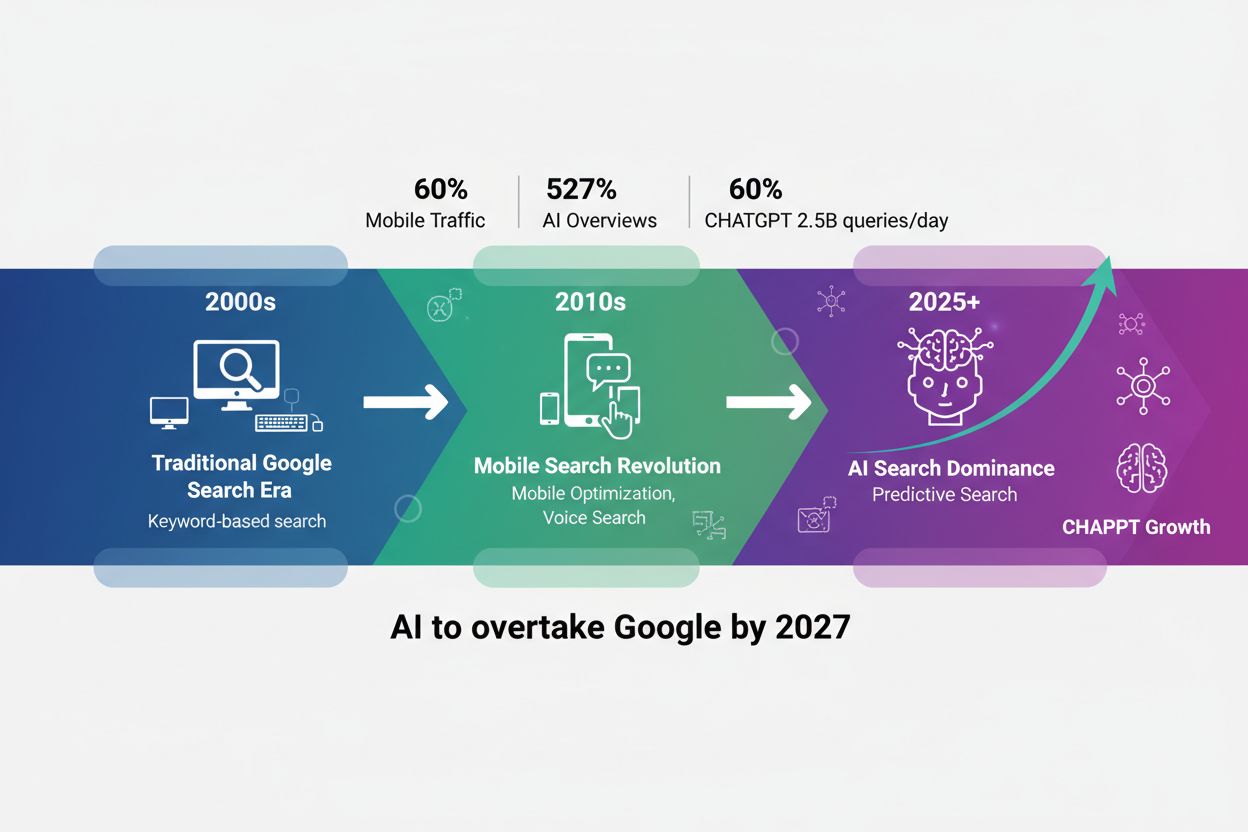
The data reveals a clear pattern: AI search traffic is growing exponentially, with some industries experiencing growth rates exceeding 49% month-over-month. While AI search currently represents less than 0.5% of total organic traffic across most domains, the trajectory is unmistakable. For every single click driven by an AI search result, approximately 20 background searches occur without generating direct traffic. This fundamental shift means that visibility in AI responses has become as important as traditional search rankings, if not more so.
ChatGPT and Perplexity have emerged as the clear leaders in driving traffic from AI search platforms, while Gemini and Microsoft Copilot remain relatively minor traffic sources at this stage. ChatGPT alone accounts for approximately 3.5% of all searches globally, positioning it as the #45 ranked website worldwide. This may seem modest compared to traditional search, but the growth trajectory is remarkable—ChatGPT processes over 30 million searches daily and continues to expand its user base rapidly.
Perplexity has become equally significant, handling 780 million queries monthly with a growth rate of 20% month-over-month. The platform’s emphasis on transparency and citation-first design has made it particularly attractive to researchers and professionals seeking detailed, sourced answers. What makes these platforms particularly important for brand monitoring is their different approaches to content sourcing and citation. ChatGPT increasingly leverages traditional search results, with approximately 28% of ChatGPT responses now including at least one cited source. When citations are used, ChatGPT references an average of 6-7 distinct URLs per response, indicating a growing emphasis on multi-source attribution.
| AI Search Platform | Monthly Queries | Growth Rate | Citation Frequency | Primary User Type |
|---|---|---|---|---|
| ChatGPT | 30M+ daily | Rapid expansion | 28% of responses | General users & professionals |
| Perplexity | 780M monthly | 20% month-over-month | Citation-first design | Researchers & professionals |
| Google AI Mode | 25% keyword coverage | Early rollout phase | Integrated with search | Traditional search users |
| Gemini | Growing | Moderate | Emerging | Google ecosystem users |
| Microsoft Copilot | Growing | Moderate | Emerging | Microsoft ecosystem users |
Google’s entry into AI-powered search through AI Mode and AI Overviews represents a seismic shift in how the search giant approaches information delivery. AI Overviews currently appear in approximately 29% of U.S. search results, while Google’s newer AI Mode feature has already achieved presence across 25% of keywords in the dataset. What’s particularly noteworthy is that there’s minimal overlap between keywords triggering AI Overviews and those activating AI Mode—only 9% of keywords trigger both features. This suggests Google is testing different AI approaches for different query types and user intents.
The implications for brand visibility are significant. AI Overviews pull from sources that already rank well in traditional search, but they don’t always cite the #1 ranked page. If a lower-ranking page has superior content structure optimized for AI comprehension, it can be cited instead. This creates an opportunity for brands to gain AI visibility even without dominating traditional search rankings. However, Google has made a surprising change to AI Overviews: the average text length has declined by 70%, dropping from approximately 5,300 characters in July to just 1,600 characters in August. This reduction suggests Google may be optimizing for user engagement, protecting ad revenue, or managing feature overlap with other SERP elements.
One of the most dramatic trends emerging from AI search adoption is the collapse of click-through rates for positions below the top two organic results. While CTR for positions 1 and 2 remains relatively stable—position 1 at 12.40% and position 2 at 4.59%—the decline for lower positions is severe. Position 3 has dropped from 4.88% to 2.47%, while position 4 has plummeted from 2.79% to 1.05%. This represents a fundamental shift in user behavior driven by AI Overviews pushing traditional organic results further down the page.
The practical implication is clear: earning clicks below the top two positions is becoming increasingly difficult in AI-first search results pages. This doesn’t mean traditional SEO is dead, but it does mean the stakes for ranking in the top two positions have never been higher. Brands that previously relied on position 3-5 rankings to drive meaningful traffic now face a significant challenge. The solution isn’t to abandon traditional SEO but to complement it with AI search optimization strategies that ensure your brand gets cited in AI-generated answers, regardless of your traditional search ranking.
The adoption of AI search is not uniform across industries. Education leads dramatically with 46.17% of AI-driven traffic, followed by Health at 14.42% and B2B at 12.14%. This concentration reveals important insights about where AI search is having the most immediate impact. Educational institutions and health-related content are particularly well-suited to AI search because users frequently seek comprehensive, authoritative answers to complex questions—exactly what AI search engines excel at providing.
For brands operating in these high-impact industries, AI search optimization is no longer a future consideration—it’s a present necessity. A B2B SaaS site tracked in the research showed AI search accounting for approximately 4.5% of overall organic traffic, with a 127% increase over three months. A healthcare site saw AI-driven traffic contributing 1% of overall organic traffic, with ChatGPT dominating as the primary traffic source. These numbers, while still small as a percentage of total traffic, demonstrate the rapid acceleration of AI search adoption in specific verticals. Brands in education, health, and B2B sectors should prioritize AI search monitoring and optimization immediately.
The rise of zero-click searches—where users get their answers directly from AI without clicking through to a website—represents a fundamental shift in how success should be measured. Current data shows 65% of searches now end without a click, with projections suggesting this could reach 70% by the end of 2025. This trend is particularly pronounced in AI search, where comprehensive answers are delivered directly in the interface.
This doesn’t mean traffic is disappearing; rather, it means visibility and brand mentions have become the primary KPIs for AI search success. When a user asks ChatGPT for the best project management tool and your competitor gets mentioned while you don’t, that’s not a missed click—it’s a missed customer who never even knew you existed. The solution involves redefining success metrics to include AI visibility scores, share of voice in AI responses, citation frequency, and sentiment analysis of how AI platforms discuss your brand. Brands that adapt to this zero-click reality by focusing on authority building, content structure optimization, and multi-platform presence will maintain relevance even as direct website traffic from search continues to decline.
AI models prioritize sources that demonstrate clear expertise, experience, authoritativeness, and trustworthiness (E-E-A-T). This means traditional SEO signals like backlinks and keyword rankings are less important than demonstrating genuine expertise and credibility. AI systems evaluate authority through multiple signals: named authors with real credentials, original research and data, consistent cross-platform presence, and third-party validation through media mentions and awards.
The key insight is that AI models are trained to detect patterns of authority. If your content looks, reads, and is referenced like an expert source, it gets weighted higher in generative responses. This requires a different approach than traditional SEO. Instead of optimizing for keywords, you’re optimizing for comprehension and credibility. Named bylines with credentials, original research, consistent messaging across platforms, and third-party validation all signal to AI systems that your content deserves to be cited. Brands that invest in building genuine authority—through original research, expert positioning, and cross-platform presence—will naturally gain more visibility in AI-generated answers.
AI systems don’t read content the way humans do. They parse and analyze structured information, which means content architecture matters more than ever. The most effective approach involves answer-first architecture, where key insights appear in the first 50-100 words before expanding into detail. Structured formatting using clear headings, bullet points, numbered lists, and tables helps AI models extract and reference your content more effectively.
Schema markup implementation has become essential rather than optional. FAQPage schema for Q&A content, HowTo schema for guides, and Organization schema for brand information all signal to AI systems how to interpret and cite your content. Question-focused content that explicitly answers the questions your audience asks performs better in AI search than generic, keyword-optimized content. Tools like AnswerThePublic and Google’s “People Also Ask” feature reveal the specific questions users are asking, allowing you to create content that directly addresses these queries in a format AI systems can easily extract and reference.
AI models don’t just pull from your website—they scan your entire digital ecosystem. ChatGPT, Perplexity, and Claude reference content from your website, LinkedIn articles, industry publications where you’re quoted, Reddit discussions, YouTube videos, and podcast transcripts. Brands dominating AI search aren’t just creating great website content; they’re building an ecosystem of authority that AI can cross-reference.
When ChatGPT sees your name mentioned in five different credible places all saying consistent things, you become an anchor in its knowledge graph. This multi-platform approach means your AI search strategy should extend beyond your website to include LinkedIn thought leadership, guest articles in industry publications, podcast appearances, YouTube content, and active participation in relevant online communities. Each mention reinforces your authority and increases the likelihood that AI systems will cite you when answering questions in your domain.
Traditional SEO metrics—rankings, organic traffic, bounce rate—remain relevant but incomplete for measuring AI search success. New KPIs have become essential: AI visibility score (how often your brand appears in AI-generated responses), share of voice in AI (what percentage of AI answers in your category mention you versus competitors), citation quality (whether you’re mentioned in passing or positioned as the authoritative source), and sentiment analysis (how AI platforms discuss your brand).
Emerging tools like Writesonic’s GEO tracker, AthenaHQ, and platforms from Semrush are beginning to offer AI-specific visibility analytics. These tools are becoming as essential as Google Search Console was a decade ago. Tracking these metrics reveals whether your AI search optimization efforts are working and where adjustments are needed. The goal isn’t just to appear in AI responses but to be positioned as the authoritative source that AI systems reference first when answering questions in your domain.
The window to gain a competitive advantage in AI search optimization is narrowing. Brands that move first will shape how AI understands their entire industry and become the reference point against which competitors are measured. This requires a comprehensive approach: building genuine authority through original research and expert positioning, optimizing content structure for AI comprehension, implementing schema markup, establishing multi-platform presence, and continuously monitoring AI visibility metrics.
The businesses that will thrive in the AI search era aren’t fighting the shift to zero-click optimization—they’re embracing it by redefining success around visibility, citations, and brand authority rather than clicks alone. By understanding and acting on these AI search trends now, you position your brand to remain visible and relevant as search continues to evolve.
Track how your brand appears in ChatGPT, Perplexity, Google AI Overviews, and other AI answer generators. Get real-time visibility insights and stay ahead of AI search trends.
Discover the real business costs of ignoring AI search monitoring. Learn how brands lose visibility, market share, and customer discovery when they don't track ...
Discover how AI search is reshaping SEO. Learn the key differences between AI platforms like ChatGPT and traditional Google search, and how to optimize your con...

Compare paid AI advertising and organic optimization strategies. Learn costs, ROI, and best practices for visibility across ChatGPT, Perplexity, and Google AI O...