
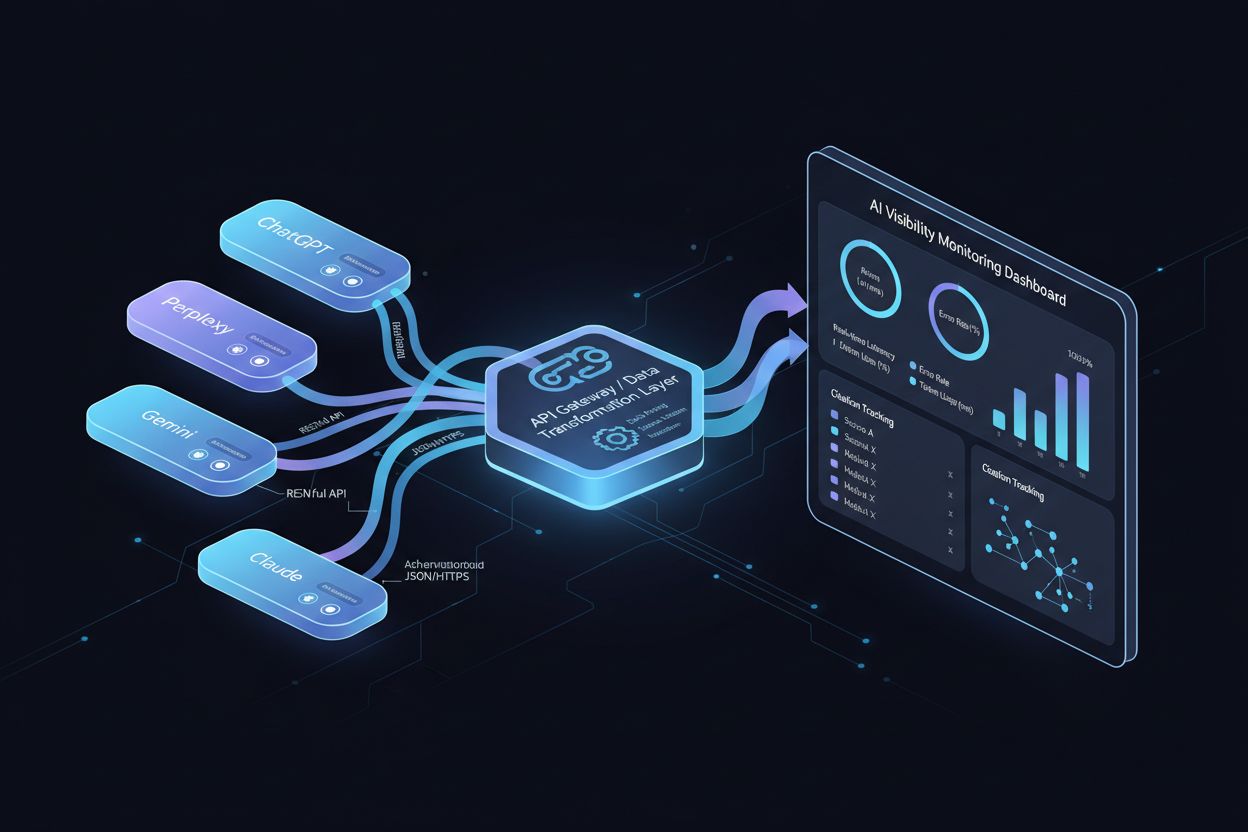
AI Visibility APIs: Connecting Monitoring to Workflows
Learn how AI visibility APIs enable real-time monitoring of brand mentions across ChatGPT, Perplexity, and Gemini. Discover API integration strategies, workflow...
16 min read

Discover the best APIs for tracking your brand in AI search engines like ChatGPT, Perplexity, and Gemini. Learn about API-based monitoring vs UI scraping, official LLM APIs, and specialized AI visibility platforms.
AI search tracking APIs include official LLM APIs (OpenAI, Anthropic, Google), specialized monitoring platforms (Firecrawl, Exa, Tavily), and brand visibility tools (LLMrefs, Sight AI, Profound). These APIs enable real-time monitoring of brand mentions in AI-generated answers across ChatGPT, Perplexity, Gemini, and Claude.
AI search tracking APIs have emerged as essential infrastructure for brands navigating the rapidly evolving landscape of generative search. Unlike traditional search engine optimization that focused on Google rankings, AI search monitoring requires a fundamentally different approach because AI-powered platforms like ChatGPT, Perplexity, Gemini, and Claude generate conversational answers rather than displaying ranked links. These platforms integrate web search capabilities through APIs, allowing developers and marketers to programmatically monitor how brands appear in AI-generated responses. The distinction between different API types—official LLM APIs, specialized search APIs, and dedicated brand monitoring platforms—determines the accuracy, compliance, and actionability of your tracking data.
The API landscape for AI search tracking divides into two primary categories: official APIs provided by AI platform creators and specialized third-party monitoring solutions. OpenAI’s API, Google’s Gemini API, Anthropic’s Claude API, and Perplexity’s API represent the official channels for accessing AI models programmatically. These official APIs provide structured access to model outputs with web search integration, allowing you to submit queries and receive responses with citation metadata. However, official APIs have significant limitations for brand monitoring—they return simplified, developer-facing versions of responses without the full user interface context, shopping results, plugins, or formatting that real users experience. This means API-based monitoring captures only partial information about how your brand actually appears to end users.
Specialized monitoring platforms like Firecrawl, Exa, and Tavily address these limitations by combining official API access with advanced data processing. These platforms use web search tool integration to capture real-time citations and source references, then structure the data specifically for brand monitoring and competitive analysis. The key advantage is that specialized platforms provide aggregated tracking across multiple AI engines simultaneously, eliminating the need to manage separate integrations with each LLM provider. They also offer pre-built analytics dashboards, sentiment analysis, and competitive benchmarking features that raw API responses don’t provide.
The choice between API-based monitoring and UI scraping represents a critical decision for AI search visibility tracking. API-based approaches leverage official APIs with web search capabilities to track brand mentions in AI responses. This method offers several decisive advantages: full compliance with platform terms of service, scalability across thousands of queries, structured data with rich metadata, and reproducible results that can be audited and verified. API responses include explicit documentation of when web searches were triggered through tool_calls metadata, allowing you to distinguish between hallucinated answers and grounded responses backed by actual sources. This transparency is invaluable for understanding citation accuracy and source reliability.
UI scraping, by contrast, simulates human users logging into AI platforms and capturing rendered interface output. While scraping theoretically captures the complete user experience including shopping results and plugins, it introduces severe operational challenges. Scrapers are extremely fragile—minor UI updates break functionality silently, geographic blocking prevents access in certain regions, and sophisticated anti-bot defenses trigger rate limits or account suspension. Most critically, UI scraping violates platform terms of service, exposing organizations to legal risks under the Computer Fraud and Abuse Act and other regulatory frameworks. The maintenance overhead is substantial, requiring constant updates to handle evolving login flows, multi-factor authentication, and CAPTCHA systems. For enterprise organizations, the compliance risks and operational fragility make API-based monitoring the only sustainable approach for long-term AI search tracking.
| Comparison Factor | API-Based Monitoring | UI Scraping |
|---|---|---|
| Compliance | Fully compliant with terms of service | Violates platform ToS, legal risk |
| Stability | Version-controlled, guaranteed backward compatibility | Breaks with UI updates, high maintenance |
| Scalability | Elastic scaling across thousands of queries | Limited by infrastructure and anti-bot measures |
| Data Quality | Structured metadata with tool_calls documentation | Raw HTML requiring complex parsing |
| Coverage | Consistent across all users and configurations | Single narrow user configuration only |
| Real-Time Capability | Instant API responses enable real-time alerts | Delayed by scraping cycles and processing |
| Legal Risk | Zero exposure to CFAA or platform penalties | High risk of account suspension or legal action |
Firecrawl represents a modern approach to AI search tracking by combining search discovery with optional content extraction in a single integrated workflow. The platform supports multiple search categories including web results, news, GitHub repositories, research papers (arXiv, Nature, IEEE, PubMed), and PDF documents. Advanced filtering capabilities include time-based searches (past hour, day, week, month, or custom date ranges), location-based targeting by country, and HD image searches with dimension filtering. Firecrawl’s distinctive feature is the ability to optionally enable content scraping through a simple parameter, transforming search results into clean, LLM-ready markdown without requiring separate infrastructure or API chaining. This integrated approach eliminates the common workflow bottleneck where developers must chain together separate search and scraping services, losing context and efficiency.
Exa specializes in neural semantic search trained on link prediction to understand how researchers actually connect ideas across the internet. The platform excels at finding research-grade content by grasping semantic relationships beyond simple keyword matching. When searching for “breakthrough AI research,” Exa’s neural networks surface top papers by understanding research significance rather than just term frequency. Response times remain under one second even for complex semantic queries, and real-time indexing adds fresh content within hours. However, Exa’s smaller search index means less comprehensive coverage than broader platforms, and neural search effectiveness varies unpredictably across different domains and query types.
Tavily takes a citation-first approach to search, prioritizing source authority and credibility for trustworthy brand monitoring. The platform surfaces high-quality, citable sources that can immediately ground LLM responses, functioning as a research librarian of search APIs. Tavily provides structured JSON output with citation metadata, enabling workflows that require source provenance and explainable AI. The platform offers 1,000 free searches monthly, then charges $0.008 per request on a pay-as-you-go basis. While Tavily’s per-request pricing is transparent, teams may find the lack of bundled plans less predictable for budgeting than competitors with monthly tiers.
SerpAPI operates as an enterprise-grade wrapper service providing unified access to over 40 different search engines and platforms through a single integration. Rather than building separate connections to Google, Bing, Yahoo, DuckDuckGo, Baidu, Yandex, Amazon, Yelp, and dozens of other services, developers access all through SerpAPI’s standardized JSON interface. However, SerpAPI returns only search result metadata including titles, snippets, and links rather than full page content. Organizations needing content for LLM processing must build additional infrastructure to fetch URLs, convert HTML to text, and handle content extraction separately. SerpAPI targets enterprise customers with premium pricing starting at $75 monthly for 5,000 searches, scaling to $275 for 30,000 searches, making it 10-50x more expensive than focused search API alternatives.
ScrapingDog specializes in reliable Google search coverage by operating as an intermediary between applications and Google’s search results. The platform focuses entirely on extracting Google’s SERP data and delivering it in clean, structured JSON format, handling the full spectrum of SERP features including organic results, People Also Ask sections, featured snippets, local results, and shopping data. ScrapingDog’s infrastructure focus means it lacks semantic search capabilities or LLM-optimized outputs—you receive only what Google returns without additional processing. Competitive pricing ranges from $0.29 to $1.00 per 1,000 searches with a generous free tier, making it cost-effective for applications requiring comprehensive Google search coverage.
Serper positions itself as an affordable middle ground between budget and premium SERP API options, offering straightforward Google search results through a clean REST API. The platform emphasizes partnerships and framework integrations over direct developer outreach, with extensive LangChain support making it accessible through popular AI frameworks. Serper’s volume-friendly pricing scales from $1.00 to $0.30 per 1,000 searches for large users, though the platform offers no free tier for testing compared to generous trial offers from competitors.
Brave Search API runs on an independent search index that doesn’t rely on Google’s infrastructure or tracking systems. The company built their own web crawler and search algorithms to provide search results without surveillance-based business models. Brave Search doesn’t collect data during API usage, making it valuable for healthcare applications, financial research, government projects, or scenarios where query confidentiality is important. However, Brave has a smaller search index than Google, meaning less comprehensive results for niche topics or very recent content. Pricing is competitive at $3 per 1,000 queries with a generous 2,000 queries monthly free tier.
LLMrefs pioneered the category of AI answer engine monitoring by focusing specifically on tracking brand visibility within ChatGPT, Google AI Overviews, Perplexity, Claude, and Gemini. The platform adopts a keyword-first methodology rather than fragile prompt-tracking, automatically generating diverse, realistic conversational prompts to simulate real-world user queries. LLMrefs aggregates responses across multiple LLMs, providing statistically significant share-of-voice and citation metrics that are actionable and reliable. The platform’s Aggregated Rank metric provides a weighted score of brand visibility across all major answer engines, giving organizations a single, powerful KPI to track over time. Source-level analysis reveals exactly which articles, forum discussions, and studies are influencing AI responses, allowing teams to identify content gaps and prioritize outreach to cited domains.
Sight AI combines real-time tracking across ChatGPT, Perplexity, Claude, and Google AI Overviews with integrated content creation tools. The platform identifies gaps where competitors earn citations instead of your brand, then helps publish articles optimized for both traditional search and AI retrieval. The content quality is notably higher than generic AI writing tools because it’s built specifically for earning citations in LLM responses. Sight AI tracks citation sentiment analysis to understand whether mentions are positive, neutral, or negative, and provides historical tracking to measure visibility improvements over time.
Profound serves enterprise-level organizations requiring AI visibility tracking at scale with advanced governance and multi-stakeholder reporting. The platform handles organizational complexity through multi-brand architecture supporting dozens of products or business units with separate dashboards and isolated data environments. Role-based access controls ensure teams see only relevant data while maintaining centralized oversight and audit trails. API integration connects AI visibility data to Tableau, Power BI, or custom analytics platforms for unified reporting across marketing channels. Custom sentiment analysis supports brand-specific taxonomy beyond simple positive/negative scoring.
Peec AI focuses on comparative analytics, showing not just where your brand appears but how your AI visibility stacks up against competitors across visibility, position, and sentiment metrics. The platform tracks your brand alongside up to 10 competitors simultaneously, revealing share of voice in AI-generated responses and showing exactly where you’re winning or losing citation battles. Position tracking indicates whether you were cited first, third, or fifth in the response—a critical distinction because users trust and remember the first brand mentioned far more than those buried later.
Compliance and legal risk should be your primary consideration when evaluating AI search tracking solutions. Official APIs and reputable third-party platforms maintain full compliance with platform terms of service, while UI scraping approaches expose organizations to legal liability and account suspension risks. Scalability and repeatability matter significantly—API-based solutions allow you to execute thousands of prompts across multiple models, geographic locations, and timeframes, while scraping approaches struggle with infrastructure limitations and anti-bot defenses.
Data quality and structure directly impact your ability to extract actionable insights. Platforms providing structured metadata with tool_calls documentation allow you to distinguish hallucinated answers from grounded responses backed by actual sources. Real-time monitoring capabilities enable immediate alerts when your brand appears in AI responses or when competitive positioning changes. Cross-platform coverage becomes increasingly important as users distribute queries across ChatGPT, Perplexity, Gemini, Claude, and emerging AI platforms—unified monitoring eliminates the need to manage separate integrations.
Integration capabilities determine whether AI visibility data connects to your existing business intelligence systems. Platforms offering API access, CSV exports, and webhook support enable seamless integration into existing workflows, while those limited to web dashboards create data silos. Sentiment analysis and source-level insights reveal not just that your brand was mentioned, but in what context and by which sources, enabling strategic content and outreach decisions.
Track how your brand appears in ChatGPT, Perplexity, Gemini, and other AI search engines. Get real-time insights into your AI visibility and competitive positioning.
Learn how AI visibility APIs enable real-time monitoring of brand mentions across ChatGPT, Perplexity, and Gemini. Discover API integration strategies, workflow...

Learn how to automate monitoring of your brand mentions and website citations across ChatGPT, Perplexity, Google AI Overviews, and other AI search engines with ...
Learn how to protect and control your brand reputation in AI-generated answers from ChatGPT, Perplexity, and Gemini. Discover strategies for brand visibility an...