

How to Identify Search Intent for AI Optimization
Learn how to identify and optimize for search intent in AI search engines. Discover methods to classify user queries, analyze AI SERPs, and structure content fo...
11 min read

Explore AI search intent categories and how generative engines like ChatGPT, Perplexity, and Google AI interpret user goals. Learn the 4 core types and advanced intent recognition.
AI search intent categories classify the underlying purpose behind user queries in generative engines like ChatGPT, Perplexity, and Google AI Overviews. The four primary categories are informational (seeking knowledge), navigational (finding specific sites), transactional (ready to purchase), and commercial investigation (comparing options). However, AI systems recognize millions of micro-intents through query fan-out, expanding single searches into dozens of sub-queries to better understand true user goals.
AI search intent categories represent the fundamental purposes behind user queries in generative engines—systems like ChatGPT, Perplexity, Google AI Overviews, and Claude that synthesize answers directly rather than ranking individual web pages. Unlike traditional search engines that match keywords to pages, AI systems interpret the deeper goal behind what users type, then retrieve and synthesize content that fulfills that specific purpose. Understanding these categories is critical because generative engines don’t just read queries—they predict what users actually want to accomplish, even when the words alone don’t make it obvious. This shift fundamentally changes how content gets selected for AI-generated answers, making intent alignment more important than keyword matching. When your content matches the precise intent behind a query, AI systems are far more likely to retrieve, cite, and feature it in their synthesized responses, directly impacting your brand’s visibility in the generative search landscape.
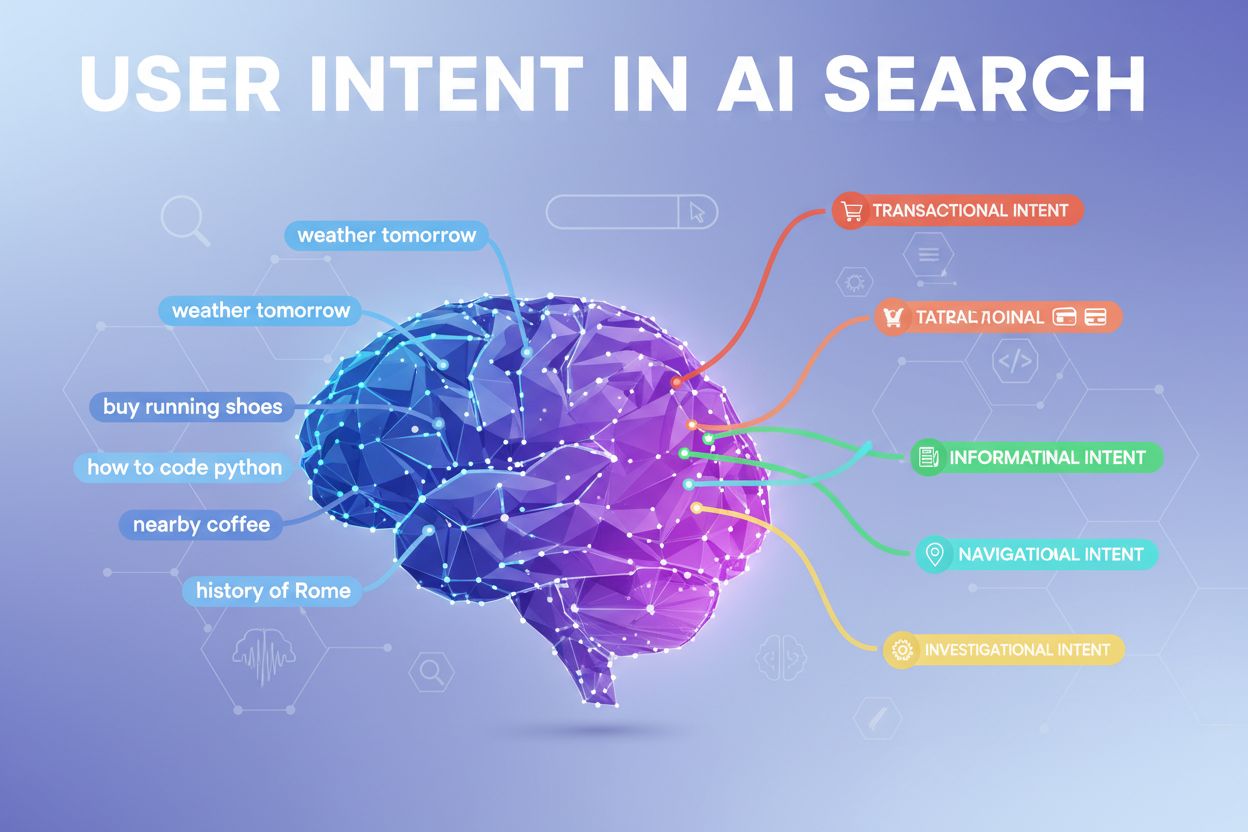
The traditional framework for understanding search intent divides queries into four primary categories, each representing a distinct user goal. These categories have evolved from traditional SEO but now serve as the foundation for how generative engines classify and respond to user queries. While these four buckets provide a useful starting point, it’s important to recognize that AI systems expand far beyond these simple categories through sophisticated intent recognition mechanisms. Each category carries specific characteristics that influence how AI systems retrieve and synthesize content.
| Intent Category | User Goal | Query Examples | Content Type AI Prefers | Citation Likelihood |
|---|---|---|---|---|
| Informational | Seeking knowledge, answers, or explanations | “How to bake sourdough bread,” “What is machine learning,” “Why do plants need sunlight” | Guides, tutorials, definitions, how-to articles | High if comprehensive and well-structured |
| Navigational | Finding a specific website or brand | “Facebook login,” “OpenAI blog,” “Slack download,” “Amazon Prime Video” | Official pages, branded content, direct links | Medium (AI often provides direct answers) |
| Transactional | Ready to purchase or complete an action | “Buy iPhone 15 Pro,” “Book flights to Tokyo,” “Order pizza near me” | Product pages, pricing pages, checkout flows | Medium (AI may provide options rather than direct links) |
| Commercial Investigation | Comparing options before purchase decision | “Best project management tools 2025,” “Notion vs Trello,” “Top running shoes for marathons” | Comparison articles, reviews, feature breakdowns, case studies | Very High (AI synthesizes these for decision-making) |
Generative engines don’t stop at these four categories. When a user enters a query, systems like Google AI Mode, ChatGPT, and Perplexity employ sophisticated mechanisms to understand intent at a much deeper level. The process begins with query fan-out, where a single search query is broken down into dozens or even hundreds of micro-queries, each exploring different angles of potential user intent. For example, a simple query like “best project management tools” might expand into sub-queries such as “Which is best for remote teams?”, “What integrates with Slack?”, “Which one is cheapest?”, and “What’s easiest for beginners?” This expansion allows AI systems to understand the complete scope of what users might actually need, rather than just the surface-level keywords they typed.
Passage-level analysis represents another critical shift in how AI interprets intent. Rather than evaluating entire pages, generative engines analyze individual passages and sections to determine which specific content best matches each micro-intent. This means your comprehensive 5,000-word guide might only have a single paragraph selected if that paragraph perfectly answers a specific sub-query. AI systems prioritize clarity and specificity over page length, making every section of your content potentially retrievable for different intent variations. Additionally, custom corpus filtering narrows the universe of available content based on the specific intent signals detected. Instead of searching the entire web, AI systems create a highly filtered group of results that are relevant to the detected sub-queries, matched to the user’s personal context, and optimized for their current session behavior. This means your content isn’t competing against the entire internet—it’s competing within a much smaller, intent-specific slice.
Informational intent occurs when users seek knowledge, answers, or explanations about a topic without any immediate purchase or action goal. In traditional search, these queries typically start with words like “how,” “what,” “why,” or “where.” In AI-powered systems, informational intent is far more nuanced. A user asking “how to improve productivity” might actually need different information depending on whether they’re a student, a remote worker, an entrepreneur, or a manager—each representing a distinct sub-intent within the broader informational category. Generative engines recognize these distinctions through contextual signals like previous search history, device type, location, and even the specific phrasing used.
For informational queries, AI systems prioritize content that is comprehensive, well-structured, and answer-first. Research shows that 71.5% of U.S. consumers now use AI-powered search engines for information discovery, and these systems reward content that directly addresses the core question in the opening sentences, then provides supporting detail. Content that buries the answer in lengthy introductions or requires users to read multiple sections to find the core information is less likely to be selected. Structured data and clear formatting significantly increase the likelihood of being cited—bullet points, numbered lists, definitions, and comparison tables are all highly retrievable by AI systems. Additionally, original research, statistics, and verifiable claims boost credibility signals that generative engines use to evaluate informational content. When your informational content includes specific numbers, dates, named examples, and sources, AI systems are more confident in surfacing it as authoritative.
Navigational intent represents queries where users are looking for a specific website, brand, or destination. Traditionally, these queries include brand names or domain-specific terms like “Facebook login” or “OpenAI blog.” However, in the AI search landscape, navigational intent has become more complex. Users might ask “How do I access my Gmail account?” or “Where can I find the Slack help center?"—queries that blend navigational purpose with informational framing. Generative engines must recognize that the user’s true goal is reaching a specific destination, even if the query is phrased as a question.
For navigational queries, AI systems often provide direct answers rather than links, which can actually reduce click-through traffic to branded destinations. Research indicates that 60% of users exhibit zero-click behavior when AI provides a complete answer, meaning they never visit the actual website. This presents both a challenge and an opportunity: while you may lose direct traffic, being cited in the AI’s answer establishes your brand as the authoritative destination. Brand signals become critical for navigational intent—consistent branding across the web, official social media presence, and clear entity recognition help AI systems identify and prioritize your brand when users search for you. Additionally, structured data markup that clearly identifies your organization, location, and official channels increases the likelihood of being recognized as the authoritative source for navigational queries.
Transactional intent identifies queries where users are ready to take action—typically making a purchase, booking a service, or completing a transaction. These queries often include action words like “buy,” “order,” “book,” “download,” or “sign up.” In the AI search environment, transactional intent is particularly valuable because users at this stage are highly motivated and close to conversion. Generative engines recognize transactional intent through specific keyword signals and user context, including previous browsing behavior, location data, and device type.
For transactional queries, AI systems prioritize content that removes friction from the decision-making process. This includes clear pricing information, product specifications, availability status, and direct pathways to purchase. Comparison content that helps users choose between options is highly valued—AI systems recognize that transactional users often need to compare a few final options before committing. Research shows that 73% of commercial intent queries in ChatGPT involve users making business or purchase decisions, indicating the high value of this intent category. Content that addresses common objections, provides social proof through testimonials, and clearly communicates value propositions is more likely to be selected. Additionally, freshness matters significantly for transactional content—outdated pricing, availability information, or product details reduce AI confidence in surfacing your content. Keeping transactional content current and accurate is essential for maintaining visibility in this high-intent category.
Commercial investigation (also called commercial intent) represents the research phase where users are actively comparing options before making a purchase decision. These queries typically include comparative language like “best,” “top,” “vs,” “comparison,” or “review.” This category is particularly important in AI search because generative engines are specifically designed to synthesize comparisons and help users evaluate options. When a user asks “Notion vs Trello for startups,” they’re not just seeking information—they’re seeking a curated, synthesized comparison that helps them make a decision.
AI systems excel at commercial investigation queries because they can pull information from multiple sources, organize it into clear comparison frameworks, and present trade-offs in an accessible format. Research indicates that commercial investigation content has the highest citation likelihood in AI-generated answers, with systems actively seeking out comparison articles, feature breakdowns, and use-case guides. For this intent category, content structure is paramount—AI systems prefer content organized with clear headers, side-by-side comparisons, pros and cons lists, and explicit verdicts about which option is “best for” specific use cases. Including sections like “Best for freelancers,” “Best for enterprise teams,” or “Best budget option” directly aligns with how AI systems break down commercial investigation queries into micro-intents. Additionally, original research and unique data significantly boost visibility—if you’ve conducted a study comparing tools or gathered exclusive user feedback, AI systems are more likely to cite your content as a primary source rather than aggregating information from multiple competitors.
One of the most significant differences between traditional search and AI-powered search is the concept of query fan-out—the process where a single user query is expanded into dozens or hundreds of related sub-queries. This mechanism allows generative engines to understand the complete scope of what a user might need, even if they didn’t explicitly ask for it. For example, a user searching for “best productivity tools” might trigger sub-queries including “best for remote teams,” “best free options,” “best for Mac,” “best for collaboration,” “best for time tracking,” and many others.
Query fan-out is critical for content visibility because it means your content might be retrieved for intent variations you never explicitly targeted. If you’ve written a comprehensive guide about productivity tools that includes sections on remote team features, free options, Mac compatibility, and collaboration capabilities, your content has multiple opportunities to be selected across different sub-intents. This is why modular content design is so important in the AI search era—each section of your content should be able to stand alone and answer a specific micro-intent. Research from iPullRank demonstrates that single queries generate 485,000+ citations through sub-intent expansion, showing the massive multiplier effect of query fan-out. To optimize for this mechanism, structure your content with clear headers that address specific sub-intents, use descriptive subheadings that match how users might phrase related questions, and ensure each section provides complete, standalone answers to its specific micro-intent.
Generative engines employ multiple sophisticated mechanisms to recognize and interpret user intent beyond simple keyword matching. Contextual relevance analysis examines the full meaning of a query, connecting it with related topics, implied needs, and even past search patterns to predict the best-fit answer. When a user searches for “best laptop for video editing,” the system recognizes that this implies needs for processing power, RAM, storage, display quality, and portability—even though the user didn’t explicitly mention these factors. User embeddings create vector-based profiles that capture each user’s evolving intent based on their search history, browsing behavior, device type, location, and interaction patterns. This allows AI systems to personalize responses based on who is searching, not just what they’re searching for.
Sentiment and emotion detection represents another critical intent recognition mechanism. The same words can carry different meanings depending on tone and emotional context. A frustrated user searching “I can’t fix this bug” signals urgent, problem-solving intent, while a curious user searching “how do bugs work” signals exploratory, learning intent. Generative engines detect these emotional signals through linguistic patterns and adjust their response style accordingly—providing more direct, step-by-step guidance for frustrated users and more exploratory, educational content for curious users. Entity recognition and relationship mapping help AI systems understand not just what users are asking about, but how different concepts relate to each other. When a user asks about “best CRM for small businesses,” the system recognizes relationships between CRM platforms, business size categories, industry verticals, and use cases, allowing it to synthesize more relevant comparisons. For content creators, this means clearly defining entities, establishing semantic relationships, and using consistent terminology significantly improves the likelihood of being recognized and cited for relevant intent variations.
Different generative engines recognize and prioritize intent differently, based on their underlying architecture, training data, and design philosophy. ChatGPT, powered by OpenAI’s GPT models, tends to recognize intent through conversational context and multi-turn dialogue. Users can refine their intent across multiple messages, and ChatGPT maintains context throughout the conversation. This means content that supports iterative exploration and follow-up questions is particularly valuable for ChatGPT visibility. Perplexity AI emphasizes real-time web search integration with intent recognition, meaning it prioritizes fresh, current content that directly answers specific questions. Perplexity’s intent recognition is particularly strong for research-oriented and comparison-focused queries, making it ideal for commercial investigation content.
Google AI Overviews and Google AI Mode integrate intent recognition with Google’s existing search infrastructure, meaning they recognize intent through traditional SEO signals plus new AI-specific factors. Google’s systems are particularly strong at recognizing navigational and transactional intent because they have decades of search behavior data. However, Google’s AI systems also prioritize content that appears in traditional search results, meaning strong SEO fundamentals remain important. Claude, developed by Anthropic, emphasizes nuanced understanding of complex intent and tends to recognize intent through careful analysis of query phrasing and context. Claude is particularly strong at recognizing when users have implicit constraints or unstated requirements. For multi-platform visibility, content should be structured to work across all these systems—clear, modular sections that can be retrieved independently, explicit entity definitions, and comprehensive coverage of likely sub-intents.
Structuring content to align with AI intent recognition requires a fundamentally different approach than traditional SEO. Rather than optimizing an entire page for a single keyword, you must structure content as a collection of intent-aligned sections, each capable of standing alone and answering a specific micro-intent. This modular approach means using clear, descriptive headers that match how users might phrase related questions, organizing information with bullet points and numbered lists for easy parsing, and including comparison tables, definitions, and FAQs that directly address likely sub-intents.
Answer-first formatting is critical—generative engines prioritize content that leads with the key takeaway rather than burying it in lengthy introductions. Start each section with a clear, concise answer to the specific question it addresses, then provide supporting detail and context. Structured data markup using schema.org vocabulary helps AI systems understand and categorize your content more effectively, increasing the likelihood of retrieval for relevant intents. Include schema markup for articles, FAQs, products, reviews, and other content types to signal intent-relevant information. Citation-ready formatting with specific numbers, dates, named examples, and verifiable claims makes your content more likely to be quoted or cited directly in AI-generated answers. When AI systems can easily extract a specific fact or statistic from your content, they’re more likely to use it. Additionally, visual content including infographics, comparison charts, and diagrams can be particularly valuable for commercial investigation intent, as AI systems increasingly incorporate visual elements in their synthesized answers.
Effective intent analysis requires looking beyond surface-level keywords to understand the deeper motivations driving searches. Topic variations reveal multiple user motivations—when you see searches like “best project management tools,” “project management tools for remote teams,” “free project management tools,” and “project management tools with calendar,” each variation signals a distinct sub-intent. By analyzing these variations, you can identify the full spectrum of intent your target audience exhibits. Keyword signals expose underlying problem requirements—words like “affordable,” “easy,” “beginner-friendly,” “enterprise,” or “integration” all signal specific constraints or requirements that shape intent. Momentum detection identifies rising user interest in specific intent variations, allowing you to create content proactively before demand peaks. Tools that track search volume trends can reveal which intent variations are growing fastest.
Content gap analysis identifies overlooked intent variations that competitors aren’t addressing. If you notice that many searches include “best for remote teams” but few content pieces explicitly address this use case, that’s a content gap opportunity. Query context analysis reveals the complete scope of intent behind a query—understanding not just what users are asking, but what they’re trying to accomplish, what constraints they face, and what information they need to make a decision. User behavior data validates intent assumptions—tracking metrics like scroll depth, time on page, and click patterns reveals whether your content is actually satisfying the intent you think it addresses. If users are bouncing quickly from a page you thought addressed a specific intent, that’s a signal that your intent analysis was incorrect. Competitor analysis reveals successful intent matching—studying which content consistently appears in AI-generated answers for specific intents shows what structure, tone, and focus AI systems reward.
Intent recognition in generative engines continues to evolve rapidly, with systems becoming increasingly sophisticated at understanding nuanced, context-dependent user goals. Early AI systems relied primarily on keyword matching and basic semantic understanding, but modern generative engines employ multi-layered intent recognition that considers user history, device context, location, emotional signals, and implicit constraints. Personalization is becoming increasingly important—the same query from different users may trigger different intent interpretations based on their profile, history, and context. This means content that serves multiple intent variations has a significant advantage over content optimized for a single interpretation.
Multi-turn conversation support is reshaping how intent evolves during search sessions. Rather than single, isolated queries, users increasingly engage in iterative dialogue with AI systems, refining their intent across multiple turns. Research shows that 49.4% of ChatGPT conversations are single-turn, while 50.6% are multi-turn, indicating that many users refine their intent through follow-up questions. This means content that supports iterative exploration and addresses likely follow-up questions is increasingly valuable. Implicit intent recognition represents another frontier—AI systems are becoming better at understanding what users mean even when they don’t explicitly state it. A user asking “best laptop under $1000” implicitly signals needs for performance, portability, and value, even though they didn’t mention these factors. As AI systems become better at recognizing implicit intent, content that addresses these unstated needs will have a competitive advantage.
Cross-platform intent consistency is emerging as important—users increasingly move between ChatGPT, Perplexity, Google AI, and other systems, expecting consistent intent recognition across platforms. This means content optimized for one platform’s intent recognition mechanisms should ideally work across all platforms. Real-time intent adaptation based on current events, trends, and seasonal patterns is becoming more sophisticated, with AI systems adjusting intent interpretation based on temporal context. Content that acknowledges current context and addresses time-sensitive variations of intent will be increasingly valuable. Additionally, intent-based personalization is moving beyond individual users to audience segments—AI systems are learning to recognize intent patterns common to specific demographic groups, industries, or use cases, allowing for more targeted content synthesis.
Tracking how your content aligns with AI search intent categories is essential for maintaining and improving visibility in generative engines. AmICited provides tools to monitor where your brand appears in AI-generated answers across ChatGPT, Perplexity, Google AI Overviews, and Claude, helping you understand which intent categories your content is being retrieved for and where gaps exist. By tracking citations across different intent variations, you can identify which of your content pieces are successfully matching user intent and which need optimization. Citation frequency by intent type reveals whether your content is being selected for the right intent categories—if your commercial investigation content is being cited for informational queries instead, that’s a signal to adjust your content structure or focus.
Intent-based performance metrics help you understand which intent variations drive the most valuable traffic and citations. Not all intent categories are equally valuable—commercial investigation intent typically drives higher-value traffic than informational intent, so understanding your citation distribution across intent types helps prioritize optimization efforts. Competitor intent analysis shows which intent categories competitors are dominating and where opportunities exist for your brand to gain visibility. If competitors are consistently cited for commercial investigation queries but rarely for informational queries, that’s an opportunity to build informational content that establishes authority and drives awareness. Seasonal and trending intent variations require ongoing monitoring—intent patterns shift based on current events, seasons, and emerging trends, so content that was optimized for one intent variation may need adjustment as user behavior evolves. Regular monitoring helps you stay ahead of these shifts and maintain visibility as intent patterns change.
+++
AI search intent categories represent the fundamental purposes behind user queries in generative engines—systems like ChatGPT, Perplexity, Google AI Overviews, and Claude that synthesize answers directly rather than ranking individual web pages. Unlike traditional search engines that match keywords to pages, AI systems interpret the deeper goal behind what users type, then retrieve and synthesize content that fulfills that specific purpose. Understanding these categories is critical because generative engines don’t just read queries—they predict what users actually want to accomplish, even when the words alone don’t make it obvious. This shift fundamentally changes how content gets selected for AI-generated answers, making intent alignment more important than keyword matching. When your content matches the precise intent behind a query, AI systems are far more likely to retrieve, cite, and feature it in their synthesized responses, directly impacting your brand’s visibility in the generative search landscape.
The traditional framework for understanding search intent divides queries into four primary categories, each representing a distinct user goal. These categories have evolved from traditional SEO but now serve as the foundation for how generative engines classify and respond to user queries. While these four buckets provide a useful starting point, it’s important to recognize that AI systems expand far beyond these simple categories through sophisticated intent recognition mechanisms. Each category carries specific characteristics that influence how AI systems retrieve and synthesize content.
| Intent Category | User Goal | Query Examples | Content Type AI Prefers | Citation Likelihood |
|---|---|---|---|---|
| Informational | Seeking knowledge, answers, or explanations | “How to bake sourdough bread,” “What is machine learning,” “Why do plants need sunlight” | Guides, tutorials, definitions, how-to articles | High if comprehensive and well-structured |
| Navigational | Finding a specific website or brand | “Facebook login,” “OpenAI blog,” “Slack download,” “Amazon Prime Video” | Official pages, branded content, direct links | Medium (AI often provides direct answers) |
| Transactional | Ready to purchase or complete an action | “Buy iPhone 15 Pro,” “Book flights to Tokyo,” “Order pizza near me” | Product pages, pricing pages, checkout flows | Medium (AI may provide options rather than direct links) |
| Commercial Investigation | Comparing options before purchase decision | “Best project management tools 2025,” “Notion vs Trello,” “Top running shoes for marathons” | Comparison articles, reviews, feature breakdowns, case studies | Very High (AI synthesizes these for decision-making) |
Generative engines don’t stop at these four categories. When a user enters a query, systems like Google AI Mode, ChatGPT, and Perplexity employ sophisticated mechanisms to understand intent at a much deeper level. The process begins with query fan-out, where a single search query is broken down into dozens or even hundreds of micro-queries, each exploring different angles of potential user intent. For example, a simple query like “best project management tools” might expand into sub-queries such as “Which is best for remote teams?”, “What integrates with Slack?”, “Which one is cheapest?”, and “What’s easiest for beginners?” This expansion allows AI systems to understand the complete scope of what users might actually need, rather than just the surface-level keywords they typed.
Passage-level analysis represents another critical shift in how AI interprets intent. Rather than evaluating entire pages, generative engines analyze individual passages and sections to determine which specific content best matches each micro-intent. This means your comprehensive 5,000-word guide might only have a single paragraph selected if that paragraph perfectly answers a specific sub-query. AI systems prioritize clarity and specificity over page length, making every section of your content potentially retrievable for different intent variations. Additionally, custom corpus filtering narrows the universe of available content based on the specific intent signals detected. Instead of searching the entire web, AI systems create a highly filtered group of results that are relevant to the detected sub-queries, matched to the user’s personal context, and optimized for their current session behavior. This means your content isn’t competing against the entire internet—it’s competing within a much smaller, intent-specific slice.
Informational intent occurs when users seek knowledge, answers, or explanations about a topic without any immediate purchase or action goal. In traditional search, these queries typically start with words like “how,” “what,” “why,” or “where.” In AI-powered systems, informational intent is far more nuanced. A user asking “how to improve productivity” might actually need different information depending on whether they’re a student, a remote worker, an entrepreneur, or a manager—each representing a distinct sub-intent within the broader informational category. Generative engines recognize these distinctions through contextual signals like previous search history, device type, location, and even the specific phrasing used.
For informational queries, AI systems prioritize content that is comprehensive, well-structured, and answer-first. Research shows that 71.5% of U.S. consumers now use AI-powered search engines for information discovery, and these systems reward content that directly addresses the core question in the opening sentences, then provides supporting detail. Content that buries the answer in lengthy introductions or requires users to read multiple sections to find the core information is less likely to be selected. Structured data and clear formatting significantly increase the likelihood of being cited—bullet points, numbered lists, definitions, and comparison tables are all highly retrievable by AI systems. Additionally, original research, statistics, and verifiable claims boost credibility signals that generative engines use to evaluate informational content. When your informational content includes specific numbers, dates, named examples, and sources, AI systems are more confident in surfacing it as authoritative.
Navigational intent represents queries where users are looking for a specific website, brand, or destination. Traditionally, these queries include brand names or domain-specific terms like “Facebook login” or “OpenAI blog.” However, in the AI search landscape, navigational intent has become more complex. Users might ask “How do I access my Gmail account?” or “Where can I find the Slack help center?"—queries that blend navigational purpose with informational framing. Generative engines must recognize that the user’s true goal is reaching a specific destination, even if the query is phrased as a question.
For navigational queries, AI systems often provide direct answers rather than links, which can actually reduce click-through traffic to branded destinations. Research indicates that 60% of users exhibit zero-click behavior when AI provides a complete answer, meaning they never visit the actual website. This presents both a challenge and an opportunity: while you may lose direct traffic, being cited in the AI’s answer establishes your brand as the authoritative destination. Brand signals become critical for navigational intent—consistent branding across the web, official social media presence, and clear entity recognition help AI systems identify and prioritize your brand when users search for you. Additionally, structured data markup that clearly identifies your organization, location, and official channels increases the likelihood of being recognized as the authoritative source for navigational queries.
Transactional intent identifies queries where users are ready to take action—typically making a purchase, booking a service, or completing a transaction. These queries often include action words like “buy,” “order,” “book,” “download,” or “sign up.” In the AI search environment, transactional intent is particularly valuable because users at this stage are highly motivated and close to conversion. Generative engines recognize transactional intent through specific keyword signals and user context, including previous browsing behavior, location data, and device type.
For transactional queries, AI systems prioritize content that removes friction from the decision-making process. This includes clear pricing information, product specifications, availability status, and direct pathways to purchase. Comparison content that helps users choose between options is highly valued—AI systems recognize that transactional users often need to compare a few final options before committing. Research shows that 73% of commercial intent queries in ChatGPT involve users making business or purchase decisions, indicating the high value of this intent category. Content that addresses common objections, provides social proof through testimonials, and clearly communicates value propositions is more likely to be selected. Additionally, freshness matters significantly for transactional content—outdated pricing, availability information, or product details reduce AI confidence in surfacing your content. Keeping transactional content current and accurate is essential for maintaining visibility in this high-intent category.
Commercial investigation (also called commercial intent) represents the research phase where users are actively comparing options before making a purchase decision. These queries typically include comparative language like “best,” “top,” “vs,” “comparison,” or “review.” This category is particularly important in AI search because generative engines are specifically designed to synthesize comparisons and help users evaluate options. When a user asks “Notion vs Trello for startups,” they’re not just seeking information—they’re seeking a curated, synthesized comparison that helps them make a decision.
AI systems excel at commercial investigation queries because they can pull information from multiple sources, organize it into clear comparison frameworks, and present trade-offs in an accessible format. Research indicates that commercial investigation content has the highest citation likelihood in AI-generated answers, with systems actively seeking out comparison articles, feature breakdowns, and use-case guides. For this intent category, content structure is paramount—AI systems prefer content organized with clear headers, side-by-side comparisons, pros and cons lists, and explicit verdicts about which option is “best for” specific use cases. Including sections like “Best for freelancers,” “Best for enterprise teams,” or “Best budget option” directly aligns with how AI systems break down commercial investigation queries into micro-intents. Additionally, original research and unique data significantly boost visibility—if you’ve conducted a study comparing tools or gathered exclusive user feedback, AI systems are more likely to cite your content as a primary source rather than aggregating information from multiple competitors.
One of the most significant differences between traditional search and AI-powered search is the concept of query fan-out—the process where a single user query is expanded into dozens or hundreds of related sub-queries. This mechanism allows generative engines to understand the complete scope of what a user might need, even if they didn’t explicitly ask for it. For example, a user searching for “best productivity tools” might trigger sub-queries including “best for remote teams,” “best free options,” “best for Mac,” “best for collaboration,” “best for time tracking,” and many others.
Query fan-out is critical for content visibility because it means your content might be retrieved for intent variations you never explicitly targeted. If you’ve written a comprehensive guide about productivity tools that includes sections on remote team features, free options, Mac compatibility, and collaboration capabilities, your content has multiple opportunities to be selected across different sub-intents. This is why modular content design is so important in the AI search era—each section of your content should be able to stand alone and answer a specific micro-intent. Research from iPullRank demonstrates that single queries generate 485,000+ citations through sub-intent expansion, showing the massive multiplier effect of query fan-out. To optimize for this mechanism, structure your content with clear headers that address specific sub-intents, use descriptive subheadings that match how users might phrase related questions, and ensure each section provides complete, standalone answers to its specific micro-intent.
Generative engines employ multiple sophisticated mechanisms to recognize and interpret user intent beyond simple keyword matching. Contextual relevance analysis examines the full meaning of a query, connecting it with related topics, implied needs, and even past search patterns to predict the best-fit answer. When a user searches for “best laptop for video editing,” the system recognizes that this implies needs for processing power, RAM, storage, display quality, and portability—even though the user didn’t explicitly mention these factors. User embeddings create vector-based profiles that capture each user’s evolving intent based on their search history, browsing behavior, device type, location, and interaction patterns. This allows AI systems to personalize responses based on who is searching, not just what they’re searching for.
Sentiment and emotion detection represents another critical intent recognition mechanism. The same words can carry different meanings depending on tone and emotional context. A frustrated user searching “I can’t fix this bug” signals urgent, problem-solving intent, while a curious user searching “how do bugs work” signals exploratory, learning intent. Generative engines detect these emotional signals through linguistic patterns and adjust their response style accordingly—providing more direct, step-by-step guidance for frustrated users and more exploratory, educational content for curious users. Entity recognition and relationship mapping help AI systems understand not just what users are asking about, but how different concepts relate to each other. When a user asks about “best CRM for small businesses,” the system recognizes relationships between CRM platforms, business size categories, industry verticals, and use cases, allowing it to synthesize more relevant comparisons. For content creators, this means clearly defining entities, establishing semantic relationships, and using consistent terminology significantly improves the likelihood of being recognized and cited for relevant intent variations.
Different generative engines recognize and prioritize intent differently, based on their underlying architecture, training data, and design philosophy. ChatGPT, powered by OpenAI’s GPT models, tends to recognize intent through conversational context and multi-turn dialogue. Users can refine their intent across multiple messages, and ChatGPT maintains context throughout the conversation. This means content that supports iterative exploration and follow-up questions is particularly valuable for ChatGPT visibility. Perplexity AI emphasizes real-time web search integration with intent recognition, meaning it prioritizes fresh, current content that directly answers specific questions. Perplexity’s intent recognition is particularly strong for research-oriented and comparison-focused queries, making it ideal for commercial investigation content.
Google AI Overviews and Google AI Mode integrate intent recognition with Google’s existing search infrastructure, meaning they recognize intent through traditional SEO signals plus new AI-specific factors. Google’s systems are particularly strong at recognizing navigational and transactional intent because they have decades of search behavior data. However, Google’s AI systems also prioritize content that appears in traditional search results, meaning strong SEO fundamentals remain important. Claude, developed by Anthropic, emphasizes nuanced understanding of complex intent and tends to recognize intent through careful analysis of query phrasing and context. Claude is particularly strong at recognizing when users have implicit constraints or unstated requirements. For multi-platform visibility, content should be structured to work across all these systems—clear, modular sections that can be retrieved independently, explicit entity definitions, and comprehensive coverage of likely sub-intents.
Structuring content to align with AI intent recognition requires a fundamentally different approach than traditional SEO. Rather than optimizing an entire page for a single keyword, you must structure content as a collection of intent-aligned sections, each capable of standing alone and answering a specific micro-intent. This modular approach means using clear, descriptive headers that match how users might phrase related questions, organizing information with bullet points and numbered lists for easy parsing, and including comparison tables, definitions, and FAQs that directly address likely sub-intents.
Answer-first formatting is critical—generative engines prioritize content that leads with the key takeaway rather than burying it in lengthy introductions. Start each section with a clear, concise answer to the specific question it addresses, then provide supporting detail and context. Structured data markup using schema.org vocabulary helps AI systems understand and categorize your content more effectively, increasing the likelihood of retrieval for relevant intents. Include schema markup for articles, FAQs, products, reviews, and other content types to signal intent-relevant information. Citation-ready formatting with specific numbers, dates, named examples, and verifiable claims makes your content more likely to be quoted or cited directly in AI-generated answers. When AI systems can easily extract a specific fact or statistic from your content, they’re more likely to use it. Additionally, visual content including infographics, comparison charts, and diagrams can be particularly valuable for commercial investigation intent, as AI systems increasingly incorporate visual elements in their synthesized answers.
Effective intent analysis requires looking beyond surface-level keywords to understand the deeper motivations driving searches. Topic variations reveal multiple user motivations—when you see searches like “best project management tools,” “project management tools for remote teams,” “free project management tools,” and “project management tools with calendar,” each variation signals a distinct sub-intent. By analyzing these variations, you can identify the full spectrum of intent your target audience exhibits. Keyword signals expose underlying problem requirements—words like “affordable,” “easy,” “beginner-friendly,” “enterprise,” or “integration” all signal specific constraints or requirements that shape intent. Momentum detection identifies rising user interest in specific intent variations, allowing you to create content proactively before demand peaks. Tools that track search volume trends can reveal which intent variations are growing fastest.
Content gap analysis identifies overlooked intent variations that competitors aren’t addressing. If you notice that many searches include “best for remote teams” but few content pieces explicitly address this use case, that’s a content gap opportunity. Query context analysis reveals the complete scope of intent behind a query—understanding not just what users are asking, but what they’re trying to accomplish, what constraints they face, and what information they need to make a decision. User behavior data validates intent assumptions—tracking metrics like scroll depth, time on page, and click patterns reveals whether your content is actually satisfying the intent you think it addresses. If users are bouncing quickly from a page you thought addressed a specific intent, that’s a signal that your intent analysis was incorrect. Competitor analysis reveals successful intent matching—studying which content consistently appears in AI-generated answers for specific intents shows what structure, tone, and focus AI systems reward.
Intent recognition in generative engines continues to evolve rapidly, with systems becoming increasingly sophisticated at understanding nuanced, context-dependent user goals. Early AI systems relied primarily on keyword matching and basic semantic understanding, but modern generative engines employ multi-layered intent recognition that considers user history, device context, location, emotional signals, and implicit constraints. Personalization is becoming increasingly important—the same query from different users may trigger different intent interpretations based on their profile, history, and context. This means content that serves multiple intent variations has a significant advantage over content optimized for a single interpretation.
Multi-turn conversation support is reshaping how intent evolves during search sessions. Rather than single, isolated queries, users increasingly engage in iterative dialogue with AI systems, refining their intent across multiple turns. Research shows that 49.4% of ChatGPT conversations are single-turn, while 50.6% are multi-turn, indicating that many users refine their intent through follow-up questions. This means content that supports iterative exploration and addresses likely follow-up questions is increasingly valuable. Implicit intent recognition represents another frontier—AI systems are becoming better at understanding what users mean even when they don’t explicitly state it. A user asking “best laptop under $1000” implicitly signals needs for performance, portability, and value, even though they didn’t mention these factors. As AI systems become better at recognizing implicit intent, content that addresses these unstated needs will have a competitive advantage.
Cross-platform intent consistency is emerging as important—users increasingly move between ChatGPT, Perplexity, Google AI, and other systems, expecting consistent intent recognition across platforms. This means content optimized for one platform’s intent recognition mechanisms should ideally work across all platforms. Real-time intent adaptation based on current events, trends, and seasonal patterns is becoming more sophisticated, with AI systems adjusting intent interpretation based on temporal context. Content that acknowledges current context and addresses time-sensitive variations of intent will be increasingly valuable. Additionally, intent-based personalization is moving beyond individual users to audience segments—AI systems are learning to recognize intent patterns common to specific demographic groups, industries, or use cases, allowing for more targeted content synthesis.
Tracking how your content aligns with AI search intent categories is essential for maintaining and improving visibility in generative engines. AmICited provides tools to monitor where your brand appears in AI-generated answers across ChatGPT, Perplexity, Google AI Overviews, and Claude, helping you understand which intent categories your content is being retrieved for and where gaps exist. By tracking citations across different intent variations, you can identify which of your content pieces are successfully matching user intent and which need optimization. Citation frequency by intent type reveals whether your content is being selected for the right intent categories—if your commercial investigation content is being cited for informational queries instead, that’s a signal to adjust your content structure or focus.
Intent-based performance metrics help you understand which intent variations drive the most valuable traffic and citations. Not all intent categories are equally valuable—commercial investigation intent typically drives higher-value traffic than informational intent, so understanding your citation distribution across intent types helps prioritize optimization efforts. Competitor intent analysis shows which intent categories competitors are dominating and where opportunities exist for your brand to gain visibility. If competitors are consistently cited for commercial investigation queries but rarely for informational queries, that’s an opportunity to build informational content that establishes authority and drives awareness. Seasonal and trending intent variations require ongoing monitoring—intent patterns shift based on current events, seasons, and emerging trends, so content that was optimized for one intent variation may need adjustment as user behavior evolves. Regular monitoring helps you stay ahead of these shifts and maintain visibility as intent patterns change.
Track how your content aligns with AI search intent categories across ChatGPT, Perplexity, Google AI Overviews, and Claude. Ensure your brand appears in AI-generated answers for the right user intents.
Learn how to identify and optimize for search intent in AI search engines. Discover methods to classify user queries, analyze AI SERPs, and structure content fo...

Learn how to align your content with AI query intent to increase citations across ChatGPT, Perplexity, and Google AI. Master content-prompt matching strategies ...
Learn how large language models interpret user intent beyond keywords. Discover query expansion, semantic understanding, and how AI systems determine which cont...