
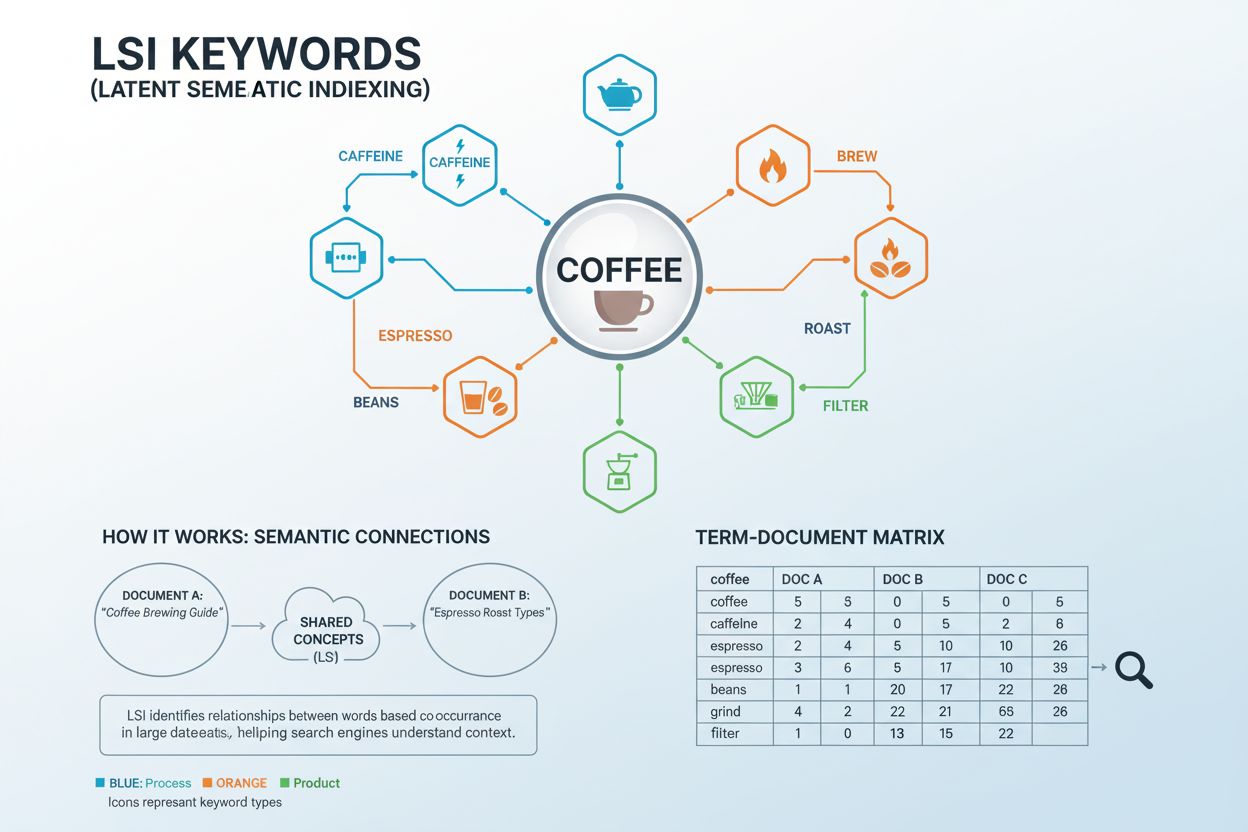
LSI Keywords
Learn what LSI Keywords are, how they differ from semantic keywords, and why they matter for AI search visibility and content optimization on AmICited.
10 min read

Learn what LSI keywords are and how they help your brand appear in AI search results. Discover how semantic indexing improves visibility in ChatGPT, Perplexity, and other AI answer generators.
LSI keywords are semantically related terms and concepts that help AI search engines understand the broader context and topic of your content. Unlike traditional keyword matching, LSI keywords enable AI systems like ChatGPT, Perplexity, and other AI answer generators to comprehend content meaning, extract relevant information, and cite your content more accurately in AI-generated responses.
LSI keywords (Latent Semantic Indexing keywords) are search terms and concepts that are semantically related to your primary target keyword. These are not synonyms, but rather terms that are conceptually connected and frequently appear together in content discussing the same topic. For AI search engines and answer generators, LSI keywords are critical because they provide contextual understanding that goes far beyond simple keyword matching. When AI systems like ChatGPT, Perplexity, Claude, or Gemini analyze your content, they use LSI keywords to determine the overall topic, extract relevant information, and decide whether to cite your content in their generated answers.
The technology behind LSI uses Singular Value Decomposition (SVD), a mathematical technique that analyzes relationships between words and concepts within documents. This approach helps AI systems understand which terms are frequently used together and what hidden concepts connect them. For example, if your content discusses “cold brew coffee,” the AI system recognizes related terms like “filter,” “temperature,” “grind,” “cold water,” and “ice” as part of the same semantic cluster. This semantic understanding is essential for AI visibility because it determines whether your content gets selected as a source for AI-generated answers. The mathematical decomposition breaks down complex relationships into simpler, more understandable patterns that AI systems can use to evaluate content relevance and authority.
Traditional keyword optimization focused on keyword density and exact phrase matching. Search engines would look for specific keywords repeated throughout your content to determine relevance. However, modern AI search engines evaluate content differently. They analyze the semantic relationships between all terms on your page, not just the primary keyword. This shift is particularly important for AI answer generators, which need to understand your content’s full context to determine if it’s authoritative and relevant enough to cite.
| Aspect | Traditional Keywords | LSI Keywords |
|---|---|---|
| Focus | Exact keyword repetition | Semantic relationships and context |
| Matching | Literal phrase matching | Conceptual understanding |
| AI Evaluation | Limited context understanding | Deep contextual analysis |
| Citation Likelihood | Based on keyword presence | Based on topical authority and depth |
| Content Quality Signal | Keyword density | Comprehensive topic coverage |
| Relevance Determination | Surface-level matching | Semantic relevance and concept clustering |
The distinction matters significantly for AI search visibility. When AI systems like Perplexity or ChatGPT generate answers, they don’t simply search for pages containing specific keywords. Instead, they analyze whether your content demonstrates comprehensive understanding of the topic through the use of related concepts, terminology, and contextual information. This means that pages with strong LSI keyword integration are more likely to be selected as sources for AI-generated answers, directly impacting your brand’s visibility in AI search results. The AI’s evaluation process considers the entire semantic landscape of your content, not just isolated keyword occurrences.
AI search engines operate fundamentally differently from traditional search engines. When a user asks a question in ChatGPT, Perplexity, or similar platforms, the AI system must identify the most relevant and authoritative sources to synthesize an answer. LSI keywords help AI systems make these decisions by providing semantic signals about your content’s depth and relevance. If your content uses a rich vocabulary of related terms and concepts, the AI recognizes it as authoritative and comprehensive, making it more likely to be cited.
The importance of LSI keywords for AI visibility cannot be overstated. AI systems evaluate content based on topical relevance rather than isolated words. When your content includes semantically related terms, it signals to the AI that you have deep expertise in the subject matter. For example, if you’re writing about “brand monitoring,” including related terms like “brand visibility,” “online reputation,” “mention tracking,” “AI search monitoring,” “citation tracking,” and “brand presence” tells the AI system that your content is comprehensive and authoritative. This semantic richness makes your content more attractive as a source for AI-generated answers. The AI recognizes these patterns as indicators of genuine expertise rather than keyword stuffing.
Additionally, LSI keywords improve content extraction. AI systems need to pull relevant passages from your content to include in their answers. When your content uses varied terminology and semantic relationships, the AI can more easily identify the most relevant sections. This increases the likelihood that your content will not only be cited but cited in a way that accurately represents your expertise and drives meaningful traffic back to your site. The extraction process becomes more precise when semantic relationships are clear and well-established throughout your content.
Discovering LSI keywords requires understanding what terms and concepts naturally relate to your primary topic. Several practical methods can help you identify these semantic relationships. Google Autocomplete is one of the fastest ways to find related terms. When you type your primary keyword into Google’s search bar, the suggestions that appear are terms that users frequently search for in connection with your keyword. These suggestions represent semantic relationships that Google’s algorithm has identified as relevant. The bold terms in these suggestions are particularly valuable because they indicate high search volume and strong semantic connections.
Related Searches at the bottom of Google search results provide another valuable source. These terms represent queries that users make when searching for topics related to your primary keyword. By analyzing these related searches, you can identify the semantic clusters that Google associates with your topic. Google Images tags also reveal related terminology—when you search for a keyword in Google Images, the platform displays related terms above the image results, giving you insight into how Google categorizes semantic relationships. This visual search approach often reveals LSI keywords that text-based searches might miss.
The Google Keyword Planner offers additional insights by showing keyword ideas related to your target term. While some results will be synonyms or variations, digging deeper reveals semantically related phrases that represent different aspects of your topic. You can also analyze competitor content to identify which LSI keywords they’re using. By examining pages that rank well for your target keyword, you can see which related terms and concepts they incorporate, giving you a roadmap for your own content optimization. This competitive analysis helps you understand which semantic relationships are most important for your industry or niche.
Once you’ve identified relevant LSI keywords, the next step is strategic integration into your content. The good news is that placement flexibility exists—LSI keywords don’t need to appear in specific locations to be effective. You can naturally incorporate them throughout your content, including in title tags, H2 and H3 subheadings, image alt text, and within the body content itself. The key is ensuring they appear naturally and contextually relevant to the surrounding text. Forced or unnatural keyword placement can actually harm your content’s credibility with both AI systems and human readers.
For AI search optimization, semantic clustering is particularly important. Group related LSI keywords together in sections that discuss specific aspects of your topic. For example, if you’re writing about “AI search monitoring,” you might have a section dedicated to “tracking brand mentions in AI answers” where you naturally use related terms like “citation tracking,” “AI visibility,” “mention detection,” and “answer monitoring.” This clustering helps AI systems understand that you’re comprehensively covering a specific subtopic. The proximity of related terms signals to AI systems that you’re exploring a coherent concept rather than randomly including keywords.
Content structure matters significantly for AI systems. Using clear headings, subheadings, and organized sections helps AI systems parse your content and understand its semantic organization. When you use LSI keywords in headings and subheadings, you’re providing explicit signals about the topics you’re covering. Additionally, FAQ sections are particularly valuable for AI search optimization because they directly address questions that users might ask AI systems. By including LSI keywords in your FAQ answers, you increase the likelihood that your content will be selected when AI systems generate answers to related questions. Well-structured FAQ sections act as semantic anchors that help AI systems understand your content’s scope and relevance.
The relationship between LSI keywords and AI search visibility is direct and measurable. When your content demonstrates topical authority through semantic richness, AI systems recognize it as a valuable source. This recognition translates into citations in AI-generated answers, which drives traffic and increases your brand’s visibility in AI search results. For platforms like AmICited that monitor brand appearance in AI answers, understanding LSI keyword optimization is essential for tracking and improving your AI visibility. The more semantically rich your content, the more likely it is to be selected as a source for AI-generated answers.
AI systems evaluate content quality through multiple signals, and semantic depth is a primary indicator. Content that uses varied terminology, explores multiple aspects of a topic, and demonstrates comprehensive understanding is more likely to be cited. This means that investing in LSI keyword optimization isn’t just about improving search rankings—it’s about establishing your content as an authoritative source that AI systems trust and cite. For brands competing for visibility in AI search results, this distinction is crucial. The semantic signals you provide through LSI keywords directly influence whether AI systems view your content as authoritative enough to cite.
The practical impact is significant. When your brand appears in AI-generated answers, you gain credibility and visibility that traditional search results alone cannot provide. AI answer generators reach millions of users daily, and being cited in these answers represents a major opportunity for brand visibility. By optimizing your content with LSI keywords, you’re directly improving your chances of being selected as a source for AI-generated answers, which translates into increased brand awareness and traffic. This visibility in AI search results has become increasingly important as more users rely on AI assistants for information rather than traditional search engines.
Track how your brand, domain, and URLs appear in AI-generated answers across ChatGPT, Perplexity, and other AI search engines. Get real-time insights into your AI visibility.
Learn what LSI Keywords are, how they differ from semantic keywords, and why they matter for AI search visibility and content optimization on AmICited.

Learn how to optimize keywords for AI search engines. Discover strategies to get your brand cited in ChatGPT, Perplexity, and Google AI answers with actionable ...
Community discussion on whether LSI keywords matter for AI search visibility. Real insights on semantic optimization and how AI systems understand topical relev...