
YMYL (Your Money Your Life)
YMYL content requires high E-E-A-T standards. Learn what qualifies as Your Money Your Life content, why it matters for SEO and AI visibility, and how to optimiz...
12 min read

Learn what YMYL topics are in AI search, how they impact your brand visibility in ChatGPT, Perplexity, and Google AI Overviews, and why monitoring them matters for your domain.
YMYL (Your Money or Your Life) topics are content categories that significantly impact a person's health, finances, safety, or well-being. In AI search engines like ChatGPT, Perplexity, and Google's AI Overviews, these topics receive heightened scrutiny to ensure accuracy and prevent harmful misinformation.
YMYL stands for “Your Money or Your Life,” a term originally introduced by Google in 2013 to describe content categories that have the potential to significantly impact a person’s financial stability, health, safety, or overall well-being. In the context of AI search engines and AI answer generators like ChatGPT, Perplexity, and Google’s AI Overviews, YMYL topics have become increasingly important for brand monitoring and content visibility. These topics receive heightened scrutiny from both AI systems and human reviewers because the consequences of inaccurate or misleading information can be severe and far-reaching.
The significance of YMYL topics extends beyond traditional search results. When AI systems generate answers to YMYL queries, they must balance providing helpful information with ensuring accuracy and preventing potential harm. This creates a unique challenge for brands and organizations whose domains appear in these AI-generated responses. Understanding what constitutes YMYL content is essential for anyone monitoring their brand’s appearance in AI search results, as these topics often determine how strictly AI systems evaluate source credibility and information accuracy.
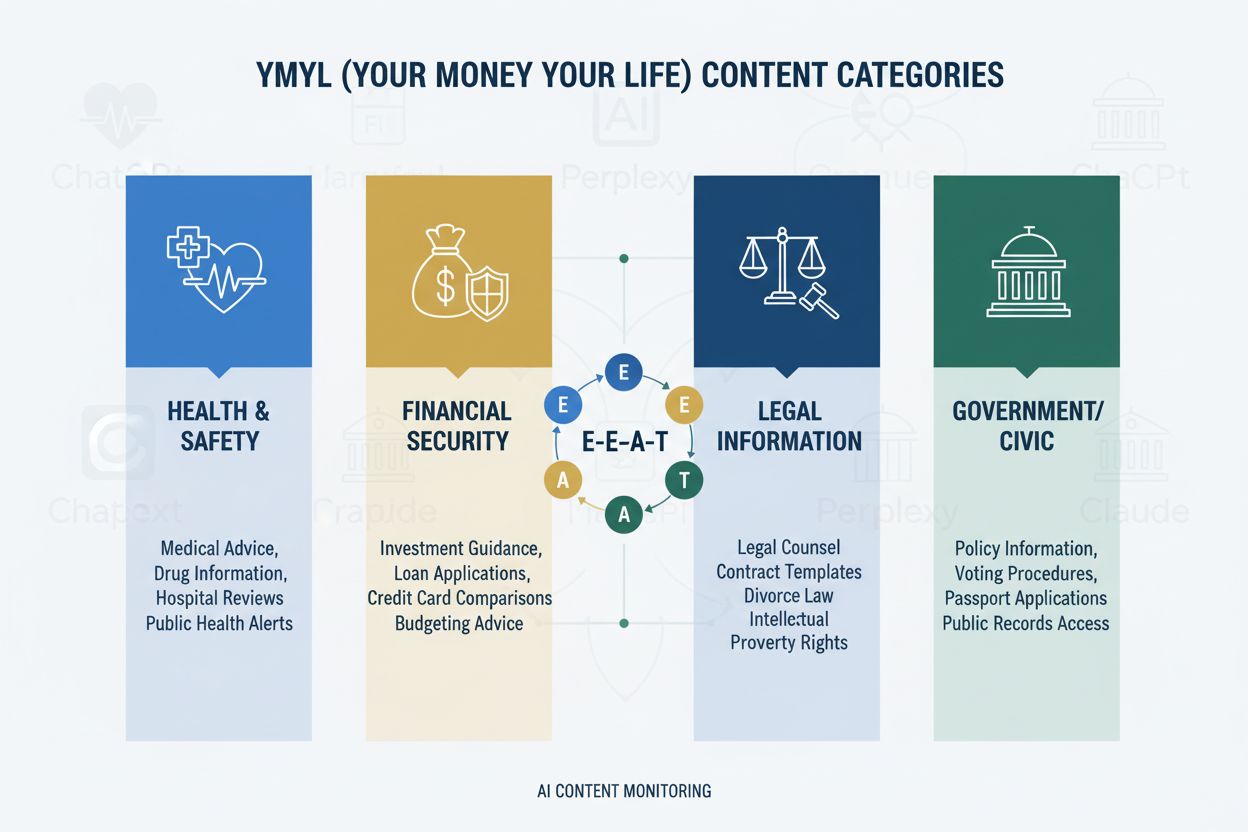
YMYL topics span across four primary categories that directly affect people’s lives and livelihoods. Health and medical information represents one of the most critical YMYL areas, encompassing everything from treatment recommendations and medication guidance to mental health support and disease prevention. When AI systems generate answers about health conditions, symptoms, or treatments, they must prioritize accuracy because incorrect information could lead to serious health consequences. Financial services and advice constitute another major YMYL category, including content about investments, loans, credit management, insurance, and retirement planning. A single piece of misinformation about financial decisions can have lasting impacts on someone’s economic stability.
Legal information and services form the third major YMYL category, covering topics related to criminal defense, family law, housing disputes, wills and estates, and medical directives. The complexity and jurisdiction-specific nature of legal information makes it particularly challenging for AI systems to provide accurate answers without proper context and expertise. Finally, government and civic information including voting procedures, public policy, social services, and legislation represents the fourth core YMYL category. This category also encompasses news and current events that could affect public safety, infrastructure, or major societal issues. Each of these categories requires AI systems to implement additional safeguards to ensure the information provided is reliable, current, and aligned with expert consensus.
Research from September 2024 reveals that 50.33% of YMYL keywords trigger AI Overviews in Google Search, with significant variation across different YMYL categories. The legal niche shows the highest AI Overview trigger rate at 77.67%, followed by health topics at 65.33%, finance at 41.67%, and politics at just 16.67%. This variation reflects Google’s cautious approach to different YMYL categories, with political topics receiving the most restrictive treatment due to the potential for bias and misinformation. For health-related queries, Google includes disclaimers in 83% of AI Overviews, explicitly stating that the information is for educational purposes only and that users should consult healthcare professionals for medical advice.
The sources featured in AI Overviews for YMYL topics demonstrate a clear preference for authoritative and established institutions. For health topics, Mayo Clinic leads with 107 links, followed by WebMD with 91 links and Healthline with 77 links. In the finance category, Investopedia dominates with 68 links, while NerdWallet and Bankrate follow with 57 and 56 links respectively. For legal topics, NYCourts.gov leads significantly with 114 links, reflecting Google’s preference for official government sources. This sourcing pattern shows that AI systems prioritize well-established, expert-reviewed sources when generating answers to YMYL queries, which is crucial for maintaining credibility and accuracy.
| YMYL Category | AI Overview Trigger Rate | Top Source | Link Count | Disclaimer Frequency |
|---|---|---|---|---|
| Legal | 77.67% | NYCourts.gov | 114 | 19.74% |
| Health | 65.33% | Mayo Clinic | 107 | 83% |
| Finance | 41.67% | Investopedia | 68 | 63.2% |
| Politics | 16.67% | Wikipedia | 36 | Varies |
For brands and organizations operating in YMYL spaces, appearing in AI-generated answers presents both opportunities and challenges. When your domain is featured in an AI Overview for a YMYL query, it signals that your content is considered authoritative and trustworthy by the AI system. However, this visibility comes with increased responsibility to ensure accuracy and alignment with expert consensus. Research shows that on average, 6.67 links from AI Overviews match sources in the top 20 organic search results, indicating that AI systems draw from a mix of highly-ranked and alternative sources when generating answers.
The overlap between AI Overview sources and traditional search rankings varies significantly by YMYL category. For health topics, the average overlap is 7.13 links, while legal topics show 6.49 links of overlap. Finance topics demonstrate the lowest overlap at 5.96 links, suggesting that AI systems may source from less conventional sources when answering financial questions. This variation is important for brand monitoring because it means your domain might appear in AI answers even if it doesn’t rank in the top 20 organic results for that query. Conversely, high organic rankings don’t guarantee inclusion in AI Overviews, particularly for YMYL topics where accuracy and source credibility are paramount.
Understanding which keyword patterns trigger AI Overviews for YMYL topics can help brands optimize their content strategy and monitoring efforts. “How” questions dominate YMYL query patterns, with 25% of health-related AI Overviews triggered by queries beginning with “how,” such as “how to manage diabetes” or “how long does recovery take.” These practical, instructional queries are particularly common in health and finance YMYL spaces. “What is” questions represent another significant pattern, appearing in 34% of political YMYL queries and 18.4% of finance queries. These definitional queries seek to establish understanding of concepts, making them ideal opportunities for authoritative sources to appear in AI answers.
Personalized queries containing pronouns like “you” and “I” also trigger substantial numbers of YMYL AI Overviews. In health topics, 15.82% of AI Overviews are triggered by queries containing “you,” while 13.27% include “I.” These personal queries often seek advice or guidance specific to individual circumstances, making them particularly sensitive from an accuracy perspective. Finance queries show similar patterns, with 11.2% containing “you” and 15.2% containing “I.” Understanding these keyword patterns is crucial for brands monitoring their appearance in AI search, as it helps identify which types of queries are most likely to generate AI answers and therefore represent the highest-value monitoring opportunities.
E-E-A-T (Experience, Expertise, Authoritativeness, and Trustworthiness) has become the framework that AI systems use to evaluate content quality for YMYL topics. Google’s search quality raters apply stricter E-E-A-T standards to YMYL content, and AI systems are trained on this feedback to identify high-quality sources. For YMYL topics, trustworthiness is the most critical E-E-A-T component, as it directly impacts whether users can safely rely on the information provided. Expertise becomes particularly important for certain YMYL topics like medical treatments or legal advice, where only qualified professionals should be providing guidance. Experience can also demonstrate credibility, particularly for personal finance or health topics where first-hand knowledge adds value.
Brands can strengthen their E-E-A-T signals for YMYL topics by implementing several key strategies. Clear author bylines with biographical information demonstrating expertise in the topic area signal authoritativeness to AI systems. Comprehensive “About Us” pages that explain your organization’s mission, credentials, and track record in the YMYL space build trust. Proper sourcing to authoritative first-party sources, rather than secondary sources, demonstrates that your content is well-researched and reliable. Including disclaimers where appropriate, particularly for health and financial content, shows transparency and responsibility. Finally, maintaining current, accurate information and updating content regularly signals that your organization takes YMYL topics seriously and stays informed about the latest developments and expert consensus.
Effective brand monitoring in AI search requires tracking your domain’s appearance across multiple AI platforms, not just Google’s AI Overviews. ChatGPT, Perplexity, Claude, and other AI answer generators each have different training data, algorithms, and quality standards. Research comparing SearchGPT with Google’s approach to election-related YMYL queries revealed significant differences in how different AI systems handle sensitive topics. While Google restricts AI Overviews for election-related queries, SearchGPT provides detailed answers with polling data and source citations. This variation means your brand might appear prominently in one AI system while being absent from another, even for the same YMYL query.
Monitoring YMYL topics is particularly important because these queries often have high commercial and informational value. Users searching for YMYL information are typically making important decisions that could significantly impact their lives, making them highly engaged and valuable audience segments. When your domain appears in AI answers for YMYL queries, it positions your brand as a trusted authority and can drive qualified traffic. However, the stakes are also higher—any inaccuracies or misleading information in your content could damage your reputation and credibility. Establishing a systematic monitoring process that tracks your domain’s appearance in AI answers for YMYL queries across multiple platforms helps you understand your brand’s visibility, identify opportunities for improvement, and quickly address any issues that might arise.
AI systems face significant challenges when generating answers to YMYL queries, and these challenges create risks for both users and brands. One major challenge is the potential for AI hallucinations—instances where AI systems generate plausible-sounding but factually incorrect information. For YMYL topics, hallucinations can be particularly dangerous because users may rely on the information for important decisions. Research has identified cases where AI Overviews for finance topics recommended weight loss pills without adequately addressing the lack of scientific evidence, or suggested snake venom facials based on outdated and commercially-biased sources. These examples demonstrate how AI systems can inadvertently spread misinformation even when attempting to provide helpful answers.
Geographic inconsistencies represent another significant challenge in YMYL AI answers. Legal information, in particular, varies dramatically by jurisdiction, yet AI systems sometimes struggle to provide location-specific answers. Research documented instances where a query about consumer refund rights triggered AI Overviews with information about South Africa, then the UK, and eventually no AI Overview at all—all within a week. This inconsistency creates confusion and could lead users to rely on information that doesn’t apply to their location. Additionally, AI systems sometimes rely on outdated sources or sources with conflicts of interest when generating YMYL answers. For example, finance-related AI Overviews have featured YouTube videos from affiliate marketing schemes where creators profit more from selling courses than from actual trading success, potentially misleading users into adopting risky financial strategies.
Organizations creating content in YMYL spaces should implement comprehensive quality assurance processes to ensure their content meets the high standards expected by AI systems. This begins with rigorous fact-checking and sourcing, ensuring every claim is backed by authoritative, first-party sources. For health content, this means citing peer-reviewed medical research and official health organizations. For financial content, it means referencing established financial institutions and regulatory bodies. For legal content, it means consulting official government sources and legal databases. Beyond sourcing, organizations should clearly disclose the expertise and credentials of content creators through author bylines and biographical information that explains why they are qualified to write about the topic.
Transparency about content creation processes and any limitations is essential for YMYL topics. This includes disclosing when content is updated, explaining the methodology used for research or testing, and acknowledging areas of uncertainty or controversy. For AI-generated or AI-assisted content, explicit disclosure of how automation was used and why it was beneficial helps readers understand the content’s creation process. Organizations should also implement regular content audits to identify and correct any outdated information, particularly important for YMYL topics where expert consensus and best practices evolve over time. Finally, maintaining clear contact information and accessible customer service channels demonstrates trustworthiness and provides users with a way to report errors or ask clarifying questions, further strengthening your brand’s credibility in YMYL spaces.
Track how your domain appears in AI-generated answers across ChatGPT, Perplexity, Google AI Overviews, and other AI search engines. Ensure your brand maintains visibility and accuracy in high-stakes YMYL topics.
YMYL content requires high E-E-A-T standards. Learn what qualifies as Your Money Your Life content, why it matters for SEO and AI visibility, and how to optimiz...

Learn how AI platforms like ChatGPT, Perplexity, and Google AI Overviews evaluate financial content. Understand YMYL requirements, E-E-A-T standards, and compli...

Learn how to optimize Your Money or Your Life (YMYL) content for AI search engines like ChatGPT, Perplexity, and Google's AI Overviews. Master E-E-A-T signals, ...