
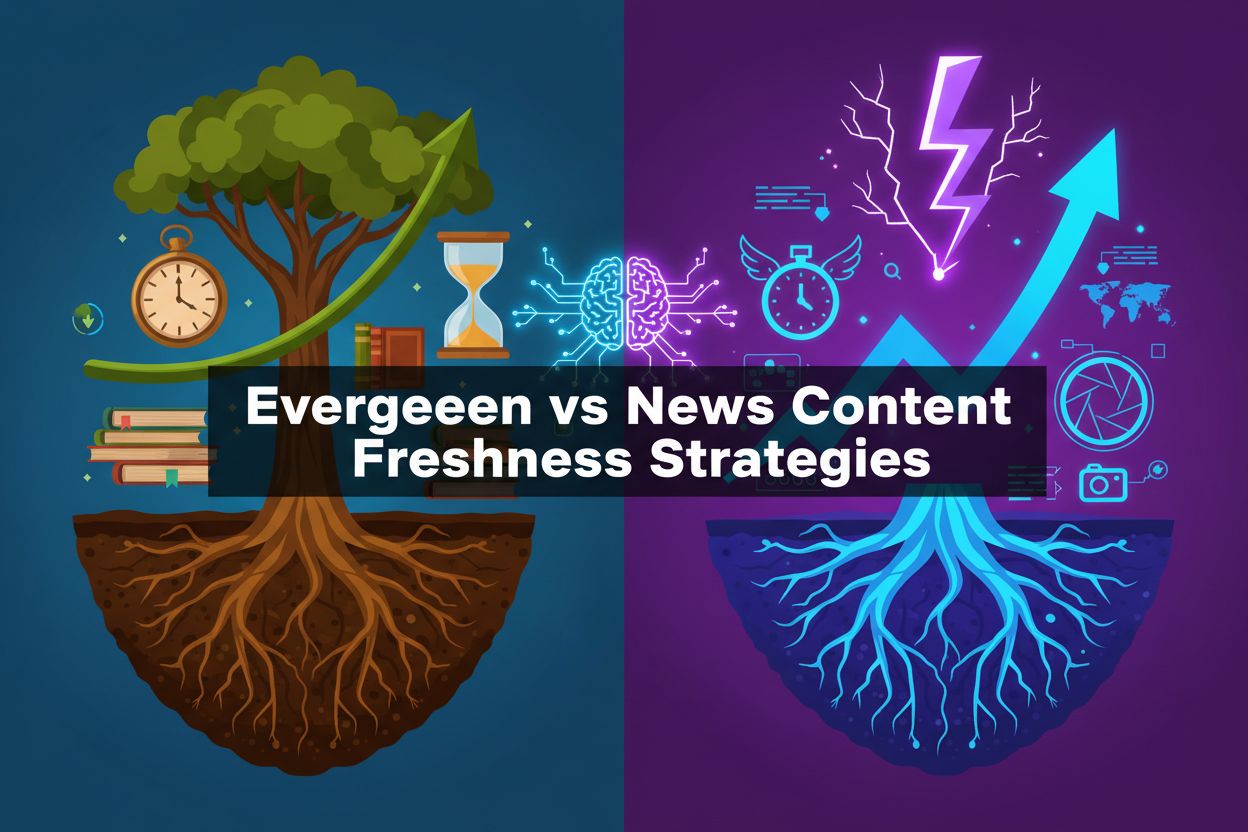
Evergreen vs News Content: Different Freshness Strategies for AI
Learn how to balance evergreen and news content for maximum AI visibility. Discover freshness strategies that work with ChatGPT, Gemini, and Perplexity.
10 min read

Understand how AI models prioritize content freshness. Learn citation patterns from ChatGPT, Perplexity, and Google AI Overviews, industry variations, and strategies to optimize for AI visibility.
The AI content freshness factor is the strong preference AI models show for recently published or updated content, with nearly 65% of AI bot hits targeting content from the past year and 79% from the last two years, varying significantly by industry.
The AI content freshness factor represents a fundamental shift in how artificial intelligence systems evaluate and prioritize content for citations and visibility. Unlike traditional search engines that balance freshness with authority and relevance, AI models demonstrate a pronounced bias toward recently published or updated content. This preference is not uniform across all industries or platforms, but rather varies significantly based on the type of information being sought, the specific AI model being used, and the industry vertical in question. Understanding this factor is critical for any content strategy aimed at achieving visibility in AI-powered search results and conversational AI platforms.
AI systems evaluate content freshness through multiple mechanisms that go beyond simple publish dates. When AI bots crawl your website, they track both the original publication date and the last update timestamp, using this temporal data to assess whether content remains current and relevant. The freshness signal operates differently across parametric knowledge (information learned during model training) and retrieved knowledge (real-time information pulled during query processing). For parametric knowledge, freshness is locked at the model’s training cutoff date, while retrieved knowledge systems like RAG (Retrieval Augmented Generation) can access and prioritize recently updated content in real-time.
The measurement of content recency involves analyzing AI log file hits—the frequency with which AI crawlers visit your pages—and correlating this activity with the content’s last updated year. Research analyzing over 5,000 URLs across multiple AI platforms revealed that nearly 65% of AI bot hits target content published within the past year, while 79% of total hits target content from the last two years. This demonstrates a clear and measurable preference for recent content that extends across all major AI platforms, though the intensity of this preference varies considerably by industry and content type.
Different AI models exhibit distinct patterns in how they prioritize content freshness, reflecting their underlying architectures and training methodologies. ChatGPT shows a more balanced approach to freshness, with approximately 31% of its citations from 2025, around 29% from 2024, and about 11% from 2023, totaling 71% of citations from 2023-2025. The remaining 29% of ChatGPT citations come from older content, including Wikipedia articles and established reference materials, suggesting that while recency matters, authority and longevity also play important roles in citation selection.
Perplexity demonstrates a much stronger recency bias than ChatGPT, reflecting its real-time search architecture. About 50% of Perplexity’s citations are from 2025 alone, approximately 20% from 2024, and around 10% from 2023, with roughly 80% of all citations from 2023-2025. This aggressive preference for recent content makes sense given Perplexity’s design as a real-time search engine that indexes over 200 billion URLs and prioritizes current information. Google AI Overviews shows the strongest favoring of recent content, with roughly 44% of citations from 2025, around 30% from 2024, approximately 11% from 2023, and about 85% of all citations from 2023-2025. This alignment with Google’s historical preference for fresh content reflects the search giant’s influence on AI Overview behavior.
| AI Model | 2025 Citations | 2024 Citations | 2023 Citations | 2023-2025 Total |
|---|---|---|---|---|
| ChatGPT | 31% | 29% | 11% | 71% |
| Perplexity | 50% | 20% | 10% | 80% |
| Google AI Overviews | 44% | 30% | 11% | 85% |
The importance of content freshness varies dramatically across different industries, reflecting the nature of information in each sector. Financial Services exhibits the most extreme recency bias, with thousands of AI bot hits concentrated on 2024-2025 content and almost no activity on pre-2020 material. This pattern makes sense because topics such as payroll regulations, tax laws, and HR compliance requirements change frequently, and outdated information rapidly loses relevance and accuracy. Both users and AI systems prioritize current financial information, making regularly refreshed content crucial in finance. A financial services company publishing content about 2024 tax changes will see significantly more AI bot traffic than similar content from 2020, even if the older content was originally authoritative.
The Travel Industry shows strong recency preferences but with a slightly broader window than financial services, with 92% of hits focusing on content from the last three years, peaking with 2023 content. Travel content often has a longer shelf life because much of it is evergreen—guides on “best places to travel in July” or “when to book holiday flights” remain relevant beyond their initial publication dates. However, AI systems still prefer recent updates because travel information changes (new hotels open, prices fluctuate, travel restrictions evolve), and users want the most current recommendations. A travel guide updated in 2024 will receive more AI bot attention than the same guide from 2019, even if the core information remains similar.
The Energy Industry presents a fascinating counterpoint, demonstrating that recency matters less when content is fundamentally evergreen and educational. AI crawlers gravitated toward informational content that won’t become outdated next month, such as “what is environmental sustainability?” and “green vs. renewable energy.” This tells us that topics in the energy space have a longer shelf life due to their educational nature. A well-written explanation of renewable energy concepts from 2015 might still receive substantial AI bot traffic because the fundamental concepts haven’t changed. However, this doesn’t mean energy companies should ignore freshness—updating that older content could potentially catapult it to even higher performance levels.
A particularly instructive case study emerged from analyzing the decking industry, which demonstrates that quality instructional content can maintain relevance for 10-15 years or longer. While experiencing large amounts of log hits to recent content, the decking industry showed that AI crawlers still interact with instructional content from as far back as 2004. This pattern applies to any industry where information doesn’t fundamentally change year over year—where what was true 10 years ago remains true today, and where instructional or “how-to” content tends to perform well. The lesson here is nuanced: while AI systems do interact with older content, this doesn’t mean you should treat it as “good enough.” Rather, updating that older content could potentially increase AI bot hits and visibility significantly.
The overall distribution of AI bot activity across content ages reveals a clear hierarchy of freshness preference. 89% of hits occur on content updated within the last three years (2023-2025), while 94% of hits occur on content published within the last five years (2021-2025). Only 6% of hits target content older than six years, demonstrating that while older content isn’t completely ignored, it represents a tiny fraction of AI bot activity. This distribution is consistent across all three major AI platforms, though the intensity varies. The implication is clear: if your content hasn’t been updated in more than three years, it’s likely receiving minimal AI bot attention and may not be cited by AI systems even if it ranks well in traditional search results.
Understanding the AI content freshness factor requires rethinking traditional content strategy in several fundamental ways. First, content updates should be prioritized based on industry dynamics rather than applying a one-size-fits-all approach. Financial services companies need aggressive update schedules (quarterly or more frequently), travel companies should update content seasonally or when information changes, and energy companies can maintain longer update cycles for evergreen content while still benefiting from periodic refreshes. Second, the publish date and update timestamp matter more than ever, and simply updating the “last modified” date can improve AI visibility—though this should only be done when the content has actually been meaningfully updated.
Third, content freshness interacts with other AI visibility factors like brand authority, content comprehensiveness, and citation patterns. A 2020 article from a highly authoritative source might still receive some AI citations, but a 2024 article from a less-known source will likely receive more. This suggests that the optimal strategy combines freshness with authority-building activities. Fourth, different AI platforms require different freshness strategies. If your primary goal is Perplexity visibility, aggressive freshness optimization is essential. If you’re targeting ChatGPT, you can rely more on authority and comprehensiveness while still maintaining reasonable freshness.
Measuring content freshness impact requires tracking two key metrics: publish date distribution and AI log file hits. Start by extracting the publication and last-updated dates from your content, then group them by year. Next, analyze your server logs to identify traffic from AI crawlers (GPTBot, OAI-SearchBot, PerplexityBot, etc.) and correlate this activity with content age. You should see a clear pattern where recent content receives more bot hits. If your older content is receiving substantial AI bot traffic, it may be a high-value target for updates. Tools like Seer Interactive’s log file analysis or Profound’s citation tracking can automate this process.
Optimization strategies should be tailored to your industry and content type. For time-sensitive content (financial, news, travel), implement a regular update schedule—quarterly for financial content, seasonally for travel, and as-needed for news. For evergreen content (educational, how-to, reference), prioritize updates when information changes or when you can add new insights, but don’t feel pressured to update annually if the core information remains accurate. Always update the “last modified” date when you make meaningful changes, and consider adding a visible “Updated for 2025” note in your content to signal freshness to both users and AI systems. Finally, monitor your AI visibility metrics monthly because citation patterns show 40-60% normal volatility, meaning you need ongoing optimization rather than one-time updates.
Content freshness doesn’t operate in isolation—it interacts with other critical factors that influence AI citations. Brand search volume shows the strongest correlation with AI visibility (0.334 correlation coefficient), meaning that building brand authority is more important than any single content optimization tactic. Content comprehensiveness matters significantly, with longer, more detailed articles receiving more citations than thin content. Citation patterns within your content—including statistics, quotations, and references to authoritative sources—increase AI visibility by 22-37%, and this benefit applies regardless of content age. Structured data and schema markup help AI systems understand and extract information from your content more effectively, making freshness optimization more impactful when combined with proper technical implementation.
The research also reveals that backlinks show weak or neutral correlation with AI citations, contradicting traditional SEO wisdom. This means that freshness optimization and content quality matter more than link-building for AI visibility. Additionally, multi-platform presence significantly increases citation likelihood—sites mentioned on 4+ platforms are 2.8x more likely to appear in ChatGPT responses. This suggests that freshness optimization should be part of a broader strategy that includes building presence on Wikipedia, Reddit, LinkedIn, YouTube, and industry-specific platforms where AI systems source information.
Developing an effective freshness strategy requires understanding your industry’s specific dynamics. Financial Services companies should implement quarterly or more frequent updates for regulatory content, tax information, and compliance guidance. Use timestamps prominently and consider adding “Updated for 2025” notes to signal freshness. Prioritize content about recent regulatory changes, new tax laws, and current market conditions. Travel companies should update seasonal content before each season, refresh destination guides annually, and add current pricing and availability information. Maintain a balance between evergreen content (which can have longer update cycles) and timely content (which needs frequent updates). Energy companies can maintain longer update cycles for educational and evergreen content, but should prioritize updates for content about new technologies, policy changes, and sustainability developments.
For industries with slower information change cycles (like decking, construction, or manufacturing), focus on updating content when new products, techniques, or standards emerge, rather than forcing artificial update schedules. However, even in these industries, periodic refreshes (every 2-3 years) can improve AI visibility. The key principle is matching your update frequency to your industry’s information change rate, rather than applying arbitrary update schedules across all content.
The AI content freshness factor represents a fundamental shift in how content achieves visibility in AI-powered search and conversational AI systems. With nearly 65% of AI bot hits targeting content from the past year and 79% from the last two years, freshness has become a primary ranking signal for AI systems. However, this preference varies significantly by industry, with financial services showing extreme recency bias, travel showing moderate preferences, and energy showing longer content lifespans. Understanding your industry’s specific freshness requirements and implementing targeted update strategies is essential for maximizing AI visibility. Combined with other factors like brand authority, content comprehensiveness, and multi-platform presence, content freshness optimization can significantly improve your visibility across ChatGPT, Perplexity, Google AI Overviews, and other AI-powered platforms.
Track how your content performs across AI models and optimize for maximum visibility with real-time monitoring.
Learn how to balance evergreen and news content for maximum AI visibility. Discover freshness strategies that work with ChatGPT, Gemini, and Perplexity.
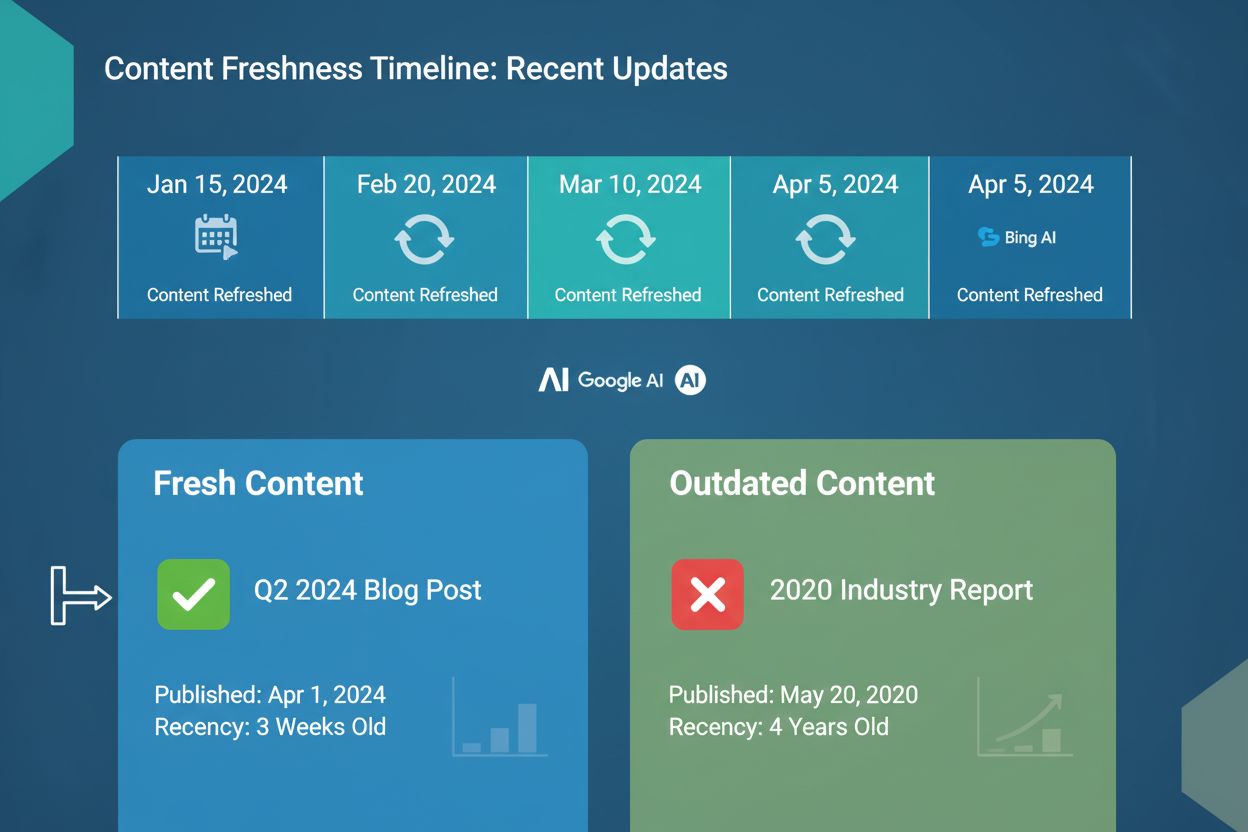
Learn what content freshness means, why it matters for SEO and AI search engines like ChatGPT and Perplexity, and how to keep your content updated for better vi...
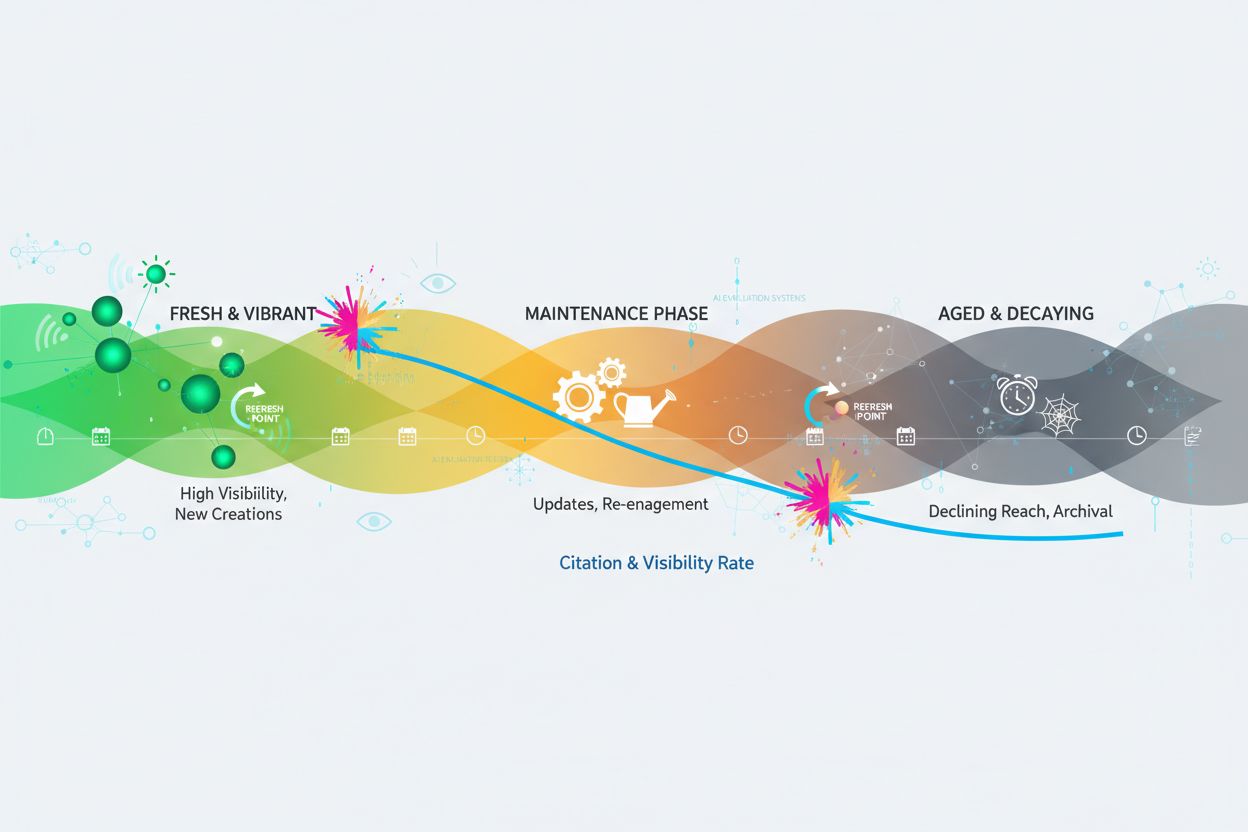
Learn how content freshness signals work in AI systems. Understand timestamps, modification dates, and technical indicators that influence AI citations and visi...