
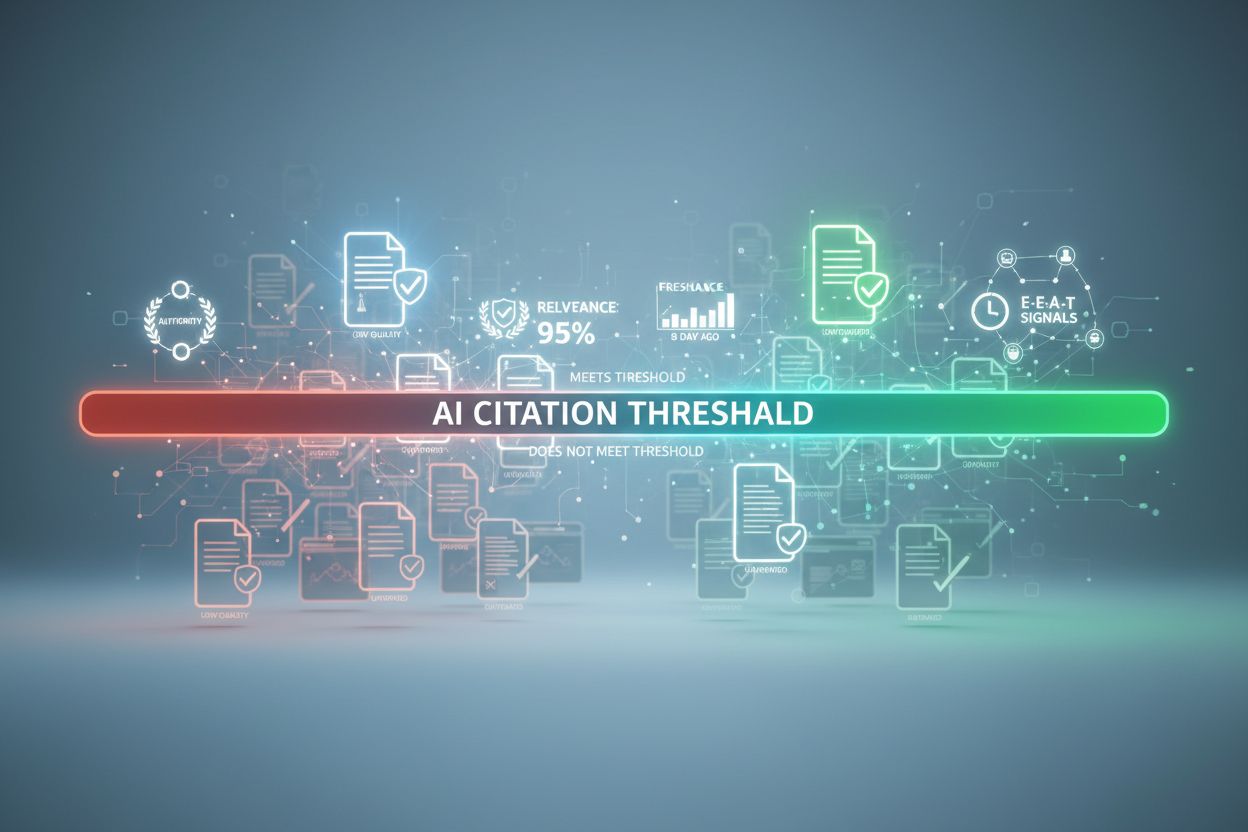
AI Citation Threshold
Learn what AI citation thresholds are, how they work across ChatGPT, Perplexity, and Google AI Overviews, and strategies to meet them for better AI visibility.
12 min read

Learn what AI content quality thresholds are, how they’re measured, and why they matter for monitoring AI-generated content across ChatGPT, Perplexity, and other AI answer generators.
An AI content quality threshold is a measurable benchmark that determines whether AI-generated content meets minimum standards for accuracy, relevance, coherence, and ethical safety. It combines quantitative metrics and qualitative evaluation criteria to ensure content is suitable for publication or use in specific contexts.
An AI content quality threshold is a predefined benchmark or standard that determines whether AI-generated content meets minimum acceptable criteria for publication, distribution, or use in specific applications. These thresholds serve as critical control mechanisms in the era of generative AI, where organizations must balance the speed and efficiency of automated content generation with the need to maintain brand integrity, accuracy, and user trust. The threshold acts as a quality gate, ensuring that only content meeting established standards reaches your audience, whether through AI answer engines like ChatGPT, Perplexity, or other AI-powered platforms.
Quality thresholds are not arbitrary numbers but rather scientifically-grounded benchmarks developed through evaluation frameworks that assess multiple dimensions of content performance. They represent the intersection of technical metrics, human judgment, and business objectives, creating a comprehensive system for quality assurance in AI-driven content ecosystems.
Accuracy is the foundation of any quality threshold system. This dimension measures whether the information presented in AI-generated content is factually correct and verifiable against reliable sources. In high-stakes domains like healthcare, finance, and journalism, accuracy thresholds are particularly stringent, often requiring 95-99% correctness rates. The challenge with AI systems is that they can produce hallucinations—plausible-sounding but entirely fabricated information—making accuracy assessment critical.
Accuracy evaluation typically involves comparing AI outputs against ground truth data, expert verification, or established knowledge bases. For instance, when monitoring how your brand appears in AI answers, accuracy thresholds ensure that any citations or references to your content are factually correct and properly attributed. Organizations implementing quality thresholds often set minimum accuracy scores of 85-90% for general content and 95%+ for specialized domains.
Relevance measures how well AI-generated content addresses the user’s actual intent and query. A response might be grammatically perfect and factually accurate but still fail if it doesn’t directly answer what the user is asking. Quality thresholds for relevance typically evaluate whether the content structure, tone, and information hierarchy align with the underlying search intent.
Modern AI content scoring systems analyze relevance through multiple lenses: topical coverage (does it address all aspects of the question?), audience alignment (is it pitched at the right level?), and journey stage alignment (does it match whether the user is researching, comparing, or deciding?). Relevance thresholds often range from 70-85%, recognizing that some tangential information may be acceptable depending on context.
Coherence refers to the structural quality and logical flow of content. AI systems must generate text that flows naturally, with clear sentence construction, consistent tone, and logical progression of ideas. Readability metrics assess how easily a human can understand the content, typically measured through readability scores like Flesch-Kincaid or Gunning Fog Index.
Quality thresholds for coherence often specify minimum readability scores appropriate to the target audience. For general audiences, a Flesch Reading Ease score of 60-70 is typical, while technical audiences might accept lower scores (40-50) if the content is appropriately specialized. Coherence thresholds also evaluate paragraph structure, transition quality, and the presence of clear headings and formatting.
Originality ensures that AI-generated content is not simply copying or paraphrasing existing material without attribution. This dimension is particularly important for maintaining brand voice and avoiding copyright issues. Quality thresholds typically require originality scores of 85-95%, meaning that 85-95% of the content should be unique or substantially rewritten.
Plagiarism detection tools measure the percentage of content that matches existing sources. However, thresholds must account for legitimate reuse of common phrases, industry terminology, and factual information that cannot be expressed differently. The key is distinguishing between acceptable paraphrasing and problematic copying.
Brand voice consistency measures whether AI-generated content maintains your organization’s unique tone, style, and messaging guidelines. This dimension is crucial for maintaining brand recognition and trust across all touchpoints, including AI-generated answers that appear in search engines and answer platforms.
Quality thresholds for brand voice are often qualitative but can be operationalized through specific criteria: vocabulary choices, sentence structure patterns, emotional tone, and adherence to brand messaging principles. Organizations typically set thresholds requiring 80-90% alignment with established brand voice guidelines, allowing for some flexibility while maintaining core identity.
Ethical safety encompasses multiple concerns: absence of harmful stereotypes, offensive language, biased assumptions, and content that could be misused or cause harm. This dimension has become increasingly important as organizations recognize their responsibility to prevent AI systems from amplifying societal biases or generating harmful content.
Quality thresholds for ethical safety are often binary or near-binary (95-100% required) because even small amounts of bias or harmful content can damage brand reputation and violate ethical principles. Evaluation methods include automated bias detection tools, human review by diverse evaluators, and testing across different demographic contexts.
Modern quality threshold systems employ multiple automated metrics to evaluate AI content at scale. These include:
| Metric Type | What It Measures | Threshold Range | Use Case |
|---|---|---|---|
| BLEU/ROUGE Scores | N-gram overlap with reference text | 0.3-0.7 | Machine translation, summarization |
| BERTScore | Semantic similarity using embeddings | 0.7-0.9 | General content quality |
| Perplexity | Language model prediction confidence | Lower is better | Fluency assessment |
| Readability Scores | Text comprehension difficulty | 60-70 (general) | Accessibility evaluation |
| Plagiarism Detection | Originality percentage | 85-95% unique | Copyright compliance |
| Toxicity Scores | Harmful language detection | <0.1 (0-1 scale) | Safety assurance |
| Bias Detection | Stereotype and fairness assessment | >0.9 fairness | Ethical compliance |
These automated metrics provide quantitative, scalable evaluation but have limitations. Traditional metrics like BLEU and ROUGE struggle with semantic nuance in LLM outputs, while newer metrics like BERTScore better capture meaning but may miss domain-specific quality issues.
A more sophisticated approach uses large language models themselves as evaluators, leveraging their superior reasoning capabilities. This method, known as LLM-as-a-Judge, employs frameworks like G-Eval and DAG (Deep Acyclic Graph) to assess content quality through natural language rubrics.
G-Eval works by generating evaluation steps through chain-of-thought reasoning before assigning scores. For example, evaluating content coherence involves: (1) defining coherence criteria, (2) generating evaluation steps, (3) applying those steps to the content, and (4) assigning a score from 1-5. This approach achieves higher correlation with human judgment (often 0.8-0.95 Spearman correlation) compared to traditional metrics.
DAG-based evaluation uses decision trees powered by LLM judgment, where each node represents a specific evaluation criterion and edges represent decisions. This approach is particularly useful when quality thresholds have clear, deterministic requirements (e.g., “content must include specific sections in correct order”).
Despite automation advances, human evaluation remains essential for assessing nuanced qualities like creativity, emotional resonance, and context-specific appropriateness. Quality threshold systems typically incorporate human review at multiple levels:
Human evaluators typically assess content against rubrics with specific criteria and scoring guidelines, ensuring consistency across reviewers. Inter-rater reliability (measured through Cohen’s Kappa or Fleiss’ Kappa) should exceed 0.70 for quality thresholds to be considered reliable.
Quality thresholds are not one-size-fits-all. They must be tailored to specific contexts, industries, and use cases. A quick FAQ might naturally score lower than a comprehensive guide, and this is perfectly acceptable if thresholds are set appropriately.
Different domains require different standards:
Rather than tracking dozens of metrics, effective quality threshold systems typically focus on 5 core metrics: 1-2 custom metrics specific to your use case and 3-4 generic metrics aligned with your content architecture. This approach balances comprehensiveness with manageability.
For example, a brand monitoring system tracking AI answer appearances might use:
Quality thresholds typically operate on a scale from 0-100, but interpretation requires nuance. A score of 78 isn’t inherently “bad”—it depends on your standards and context. Organizations often establish threshold ranges rather than fixed cutoffs:
These ranges allow for flexible quality governance while maintaining standards. Some organizations set minimum thresholds of 80 before publishing, while others use 70 as a baseline for review, depending on risk tolerance and content type.
When your brand, domain, or URLs appear in AI-generated answers from ChatGPT, Perplexity, or similar platforms, quality thresholds become critical for brand protection. Poor-quality citations, inaccurate representations, or misattributed content can damage your reputation and mislead users.
Quality thresholds for brand monitoring typically focus on:
Organizations implementing quality threshold systems for AI answer monitoring should:
This systematic approach ensures that your brand maintains quality standards across all AI platforms where it appears, protecting reputation and ensuring accurate representation to users relying on AI-generated answers.
An AI content quality threshold is far more than a simple quality score—it’s a comprehensive framework for ensuring that AI-generated content meets your organization’s standards for accuracy, relevance, coherence, originality, brand alignment, and ethical safety. By combining automated metrics, LLM-based evaluation, and human judgment, organizations can establish reliable thresholds that scale with their content production while maintaining quality integrity. Whether you’re generating content internally or monitoring how your brand appears in AI answer engines, understanding and implementing appropriate quality thresholds is essential for maintaining trust, protecting reputation, and ensuring that AI-generated content serves your audience effectively.
Track how your content appears in AI-generated answers and ensure quality standards are maintained across all AI platforms.
Learn what AI citation thresholds are, how they work across ChatGPT, Perplexity, and Google AI Overviews, and strategies to meet them for better AI visibility.

Community discussion on content quality requirements for AI search citations. Understanding what quality threshold content needs to meet for ChatGPT, Perplexity...
Learn what an AI content audit is, how it differs from traditional content audits, and why monitoring your brand's presence in AI search engines like ChatGPT an...