
AI Dark Funnel
Learn what the AI Dark Funnel is, how it impacts marketing attribution, and why 35% of brand visits are influenced by unmeasurable AI interactions. Discover mea...
14 min read

Understand the AI dark funnel - the invisible part of customer journeys happening in ChatGPT, Perplexity, and AI search engines. Learn how to monitor and optimize for AI visibility.
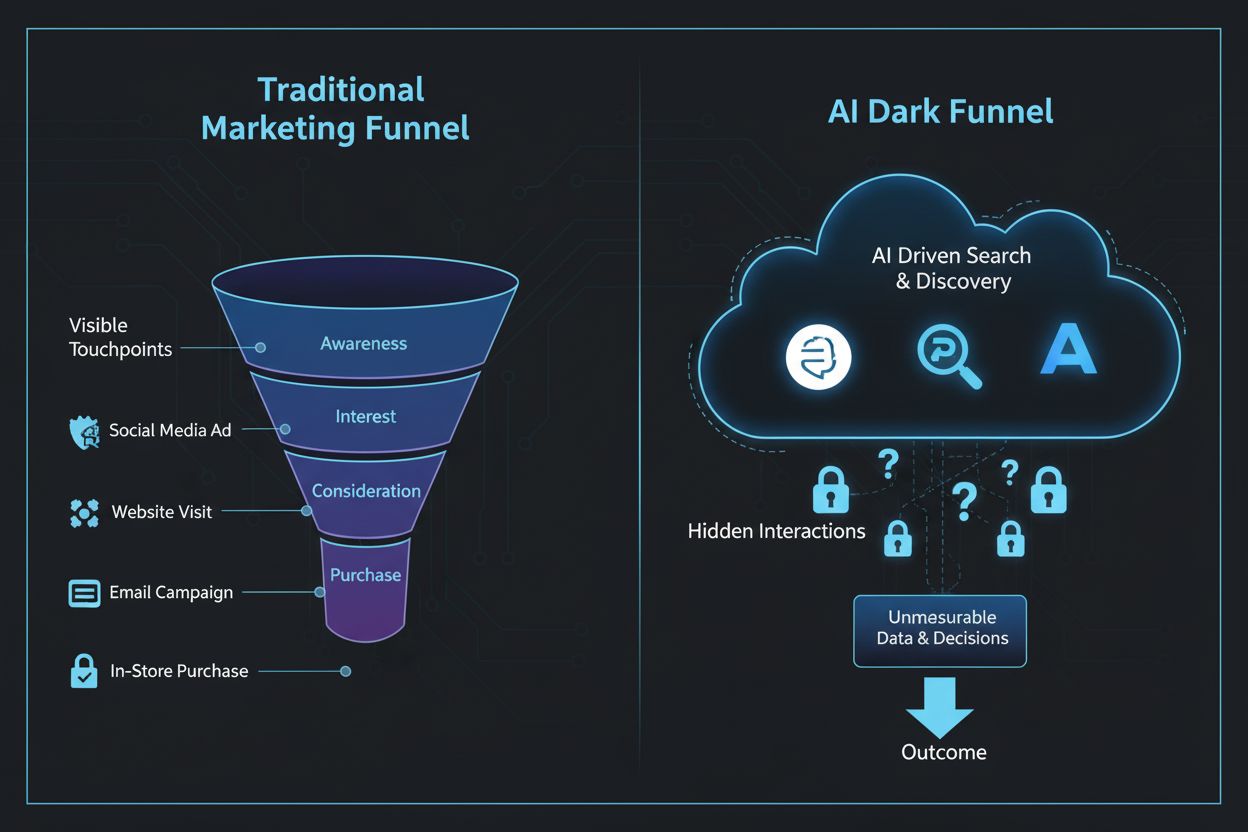
The AI dark funnel is the unseen and untracked part of the customer journey where potential customers research, compare products, and make decisions inside AI systems like ChatGPT, Perplexity, and Google's AI Overviews - without leaving any digital footprints that traditional marketing analytics can measure.
The AI dark funnel represents a fundamental shift in how customers discover, research, and make purchasing decisions. It refers to all the customer research, comparisons, and decision-making that occurs inside Large Language Models (LLMs) and AI-powered search engines like ChatGPT, Google’s Gemini, Perplexity, and Microsoft Copilot - interactions that leave zero visible traces in traditional marketing analytics tools. This invisible portion of the buyer’s journey is expanding rapidly as millions of users leverage AI daily for product research, recommendations, and purchasing guidance, making it increasingly critical for brands to understand and monitor.
The concept extends beyond just AI systems. The dark funnel more broadly encompasses any customer touchpoint that cannot be easily measured with traditional attribution methods. However, the emergence of LLM-powered dark funnels has dramatically amplified this challenge. When a potential customer asks ChatGPT “What’s the best project management tool for remote teams?” and receives a synthesized recommendation without ever visiting your website, your marketing analytics remain completely blind to this critical decision-making moment. The customer may later search for your brand directly or visit your site, but by then, the pivotal influence has already occurred within the AI black box.
Consider a realistic scenario: Jane needs a new dishwasher and instead of using Google Search, she asks her preferred AI assistant: “Recommend a quiet, highly energy-efficient dishwasher suitable for a small family, under $800.” The AI processes information synthesized from reviews, manufacturer specifications, and consumer reports, then replies with a specific recommendation. Convinced by the AI’s analysis, Jane later searches directly for that brand on Google and completes the purchase. From the dishwasher manufacturer’s perspective, Jane appears to have materialized from “direct traffic” or a generic retailer referral. The pivotal AI interaction that drove her decision remains entirely invisible, lost in the dark funnel.
This scenario is replicating across industries at massive scale. Millions of users leverage LLMs daily for product research and comparisons. These AI systems are increasingly integrated into primary discovery interfaces including search engines with AI Overviews, messaging platforms, smart devices, and vehicle infotainment systems. Key stages of information gathering and decision-making are migrating to these AI-powered platforms where marketers cannot place tracking pixels, analyze server logs, or directly measure engagement. The traditional “Zero Moment of Truth” - when customers researched your brand via search - now happens inside the AI black box, completely hidden from measurement.
The expansion of the AI dark funnel is not a minor marketing concern - it represents a seismic shift in customer behavior with measurable business impact. Research indicates that 78% of companies now use AI in at least one function, with 71% specifically using generative AI. Nearly half of ChatGPT interactions are information-seeking and practical guidance, making them direct substitutes for traditional search behavior. This behavioral shift is already impacting click-through rates and traffic patterns across industries.
| Impact Metric | Measurement | Business Implication |
|---|---|---|
| CTR Decline (AI Overviews) | 34% drop for position #1 | Reduced organic traffic visibility |
| Publisher Traffic Loss | 26% average decline | Significant revenue impact for content sites |
| MailOnline CTR Drop | 13% to below 5% on desktop | Over 50% reduction in click-through |
| Unexplained Traffic Loss | 64% of marketers reported | Attribution models breaking down |
| Marketing Budget Erosion | 5-10% potential loss | Could reshape industries within 2 years |
With marketing budgets averaging 7.7% of revenue according to Gartner (2024), even a modest 5-10% erosion from the dark funnel could fundamentally reshape industries within two years. The challenge is that these losses are often invisible - they appear as rising branded search traffic and direct traffic, which executives interpret as signs of stronger brand equity, when in reality they may simply be echoes of AI decisions made outside their measurement systems.
The fundamental reason the AI dark funnel remains invisible is that traditional marketing analytics tools were designed for a different era of customer behavior. Google Analytics, CRM systems, and attribution platforms track specific, measurable actions: website visits, form fills, email clicks, ad impressions, and conversions. These tools excel at measuring the customer journey when it occurs on owned channels or through trackable paid media.
However, the AI dark funnel operates in an entirely different environment. When a customer interacts with ChatGPT, Perplexity, or Google’s AI Overviews, no tracking pixels fire. No cookies are set. No server logs record the interaction. The AI system synthesizes information from across the internet, generates a response, and presents it to the user - all without any mechanism for the original brand to know it was even mentioned. This is fundamentally different from traditional dark funnel activities like word-of-mouth or private conversations, which at least occur in the physical world where some indirect signals might be detected.
The LLM dark funnel is a true black box - a substantial and growing portion of the traditional top and middle marketing funnel activity is occurring within environments where marketers cannot place tracking pixels, analyze server logs, or directly measure engagement. While you can indirectly influence what happens inside this LLM dark funnel through AI Engine Optimization (AEO), monitoring the user’s path through it with traditional tools is often impossible.
Operating with significant blind spots in the customer journey presents considerable risks that extend far beyond simple measurement challenges. The first major risk is missed insights and misallocated resources. Understanding discovery and evaluation paths is fundamental to effective marketing strategy. If the LLM dark funnel obscures these paths, attributing success becomes guesswork. A surge in sales for a particular product might be credited to a recent ad campaign or SEO improvement, when the real driver was a favorable shift in how major LLMs started recommending it. Misunderstanding the true drivers can lead to misallocating budgets away from the factors that are actually influencing AI recommendations - such as positive third-party reviews, clear product data, and structured information.
The second critical risk is that customer relationships are being initiated and owned by AI rather than your brand. In the LLM funnel, the primary interaction during the crucial consideration phase is often between the customer and the AI, not the customer and your brand. This means the AI shapes the initial perception, potentially underemphasizing your unique brand features or overstating minor drawbacks based on its data synthesis. The customer’s trust is initially placed in the AI’s recommendation. If the product ultimately disappoints, the negative association might be stronger with the perceived “faulty” AI recommendation than with your brand itself, complicating reputation management and customer lifetime value.
A third significant risk is reduced opportunity for brand differentiation. If customers bypass your website content, community forums, and brand storytelling initiatives, you lose invaluable opportunities to convey brand personality, highlight unique values, or build emotional connections early in the journey. If the AI primarily summarizes functional specifications, brands whose strength lies in experience, service, or ethos may struggle to differentiate themselves effectively within the dark funnel. This is particularly problematic for premium or lifestyle brands that depend on emotional resonance rather than feature comparison.
Finally, there is the risk of potentially misleading traditional metrics. Key performance indicators like website traffic, time on site for informational content, or top-of-funnel lead counts might decline, not necessarily because of decreased interest, but because user journeys are being completed within the LLM dark funnel. Marketers might mistakenly interpret these drops as campaign failures and prematurely cut budgets for activities like creating comprehensive, factual content that are actually vital for “feeding” the AI accurate information and positively influencing dark funnel outcomes.
While perfect visibility into every AI interaction is unlikely, the key is to shift focus from lamenting what cannot be tracked to strategically influencing what can be shaped. This requires adopting an “Accept and Adapt” mindset that recognizes the dark funnel as a permanent feature of the marketing landscape, similar to how marketers have always contended with unmeasurable word-of-mouth influence.
The first strategic priority is to prioritize AI-friendly signals by doubling down on the foundational elements of AI Engine Optimization (AEO). These are your primary levers to influence the dark funnel. Ensure information about your brand online is accurate, clear, comprehensive, and easily interpretable by machines. Implement robust structured data using Schema.org markup so AI systems can reliably parse key facts about your products, services, and company. Encourage reviews on reputable platforms and seek mentions in authoritative sources - these third-party validations are what AI systems synthesize when generating recommendations. Maintain consistent messaging and factual accuracy across all platforms, as these signals are what AI systems use to build their understanding of your brand.
The second strategic approach is to use proxy metrics and correlation analysis to infer impact even when direct attribution is challenging. Monitor your AI Share of Voice - how often you’re mentioned favorably versus competitors - and AI Sentiment using specialized monitoring tools. Changes in these proxy metrics can signal shifts within the dark funnel. Look for correlations between your AEO efforts (improving structured data, securing positive reviews) and overall business outcomes like brand search volume, direct traffic, and overall sales lift. While not direct proof of causation, strong correlations can inform strategy and justify continued investment in dark funnel optimization.
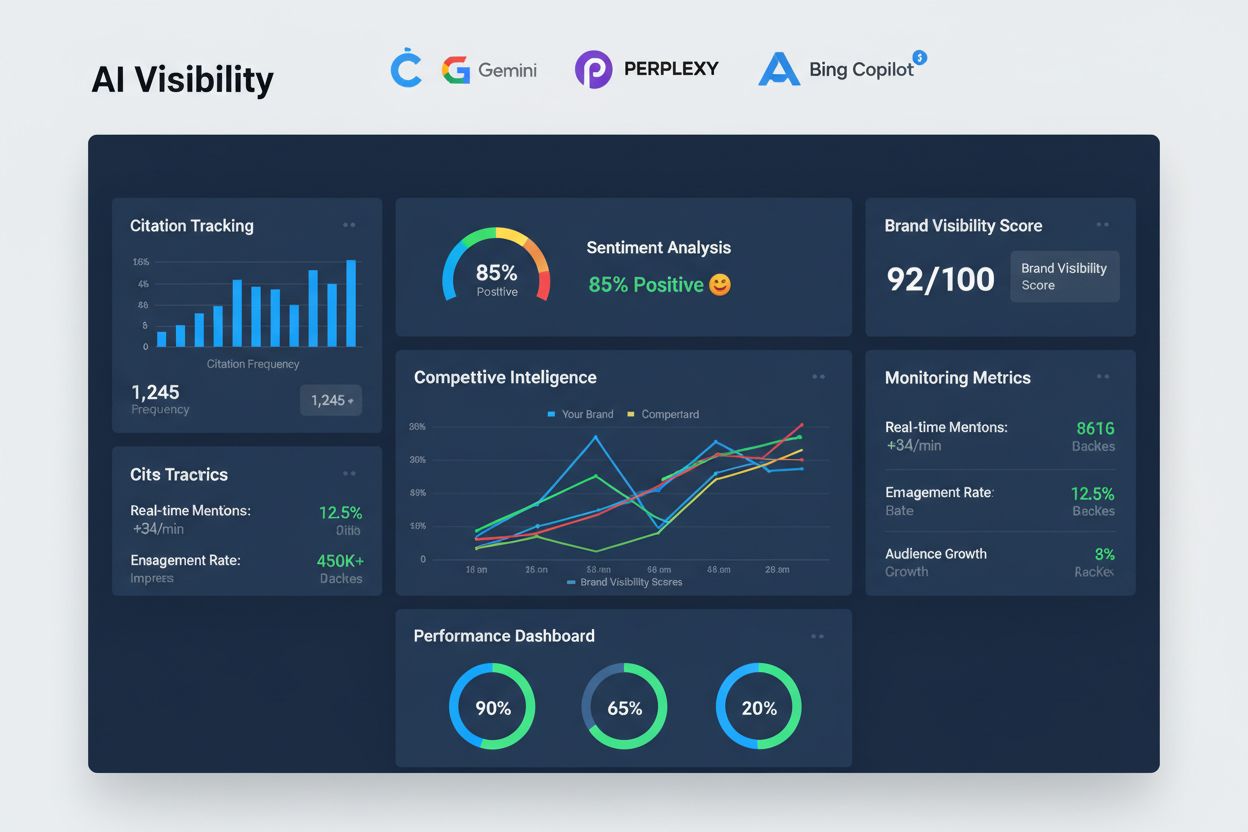
The third critical strategy is continuous monitoring and iterative improvement using AI visibility monitoring tools. These tools provide crucial visibility into the output of the dark funnel, allowing you to understand how your brand narrative is being framed within AI answers, how you stack up against competitors, and where information gaps exist. By monitoring how AI platforms represent your brand, you can diagnose issues and strategically refine the inputs - your content, data, and online presence - to steer the AI’s understanding over time.
The emergence of the LLM dark funnel represents a fundamental shift in the marketing landscape, demanding adaptation beyond traditional analytics and attribution models. The winners in this new era will not be brands that shout the loudest or spend the most on paid media. Instead, they will be brands that become machine-readable authorities in their categories - companies that ensure AI systems consistently cite them as trusted sources.
This requires a new mandate for marketing leadership: to become the chief architect of machine-readable authority. Rather than optimizing for clicks and conversions through traditional funnels, the focus must shift to ensuring your brand is the foundation of the AI’s answer. This means investing in high-quality, factual content; maintaining accurate structured data; building third-party validation through reviews and mentions; and continuously monitoring how AI systems represent your brand. By mastering this indirect influence through the dark funnel, companies can maintain competitive advantage even as customer journeys become increasingly invisible to traditional measurement tools.
Don't let your brand disappear in the AI dark funnel. Track how often your brand appears in AI-generated answers and monitor your visibility across ChatGPT, Perplexity, and other AI search engines.
Learn what the AI Dark Funnel is, how it impacts marketing attribution, and why 35% of brand visits are influenced by unmeasurable AI interactions. Discover mea...
Master AI visibility for your SaaS company. Learn GEO strategies, structured data optimization, and how to get recommended by ChatGPT, Gemini, and Perplexity. C...

Understand how AI search funnels work differently from traditional marketing funnels. Learn how AI systems like ChatGPT and Google AI collapse buyer journeys in...