

How to Appear in Google AI Overviews: Complete SEO Guide
Learn how to optimize your website to appear in Google AI Overviews. Discover ranking factors, technical requirements, and proven strategies to increase visibil...
10 min read

Learn what Google AI Overviews are, how they work, their impact on search traffic, and how to optimize your content to appear in AI-generated summaries.
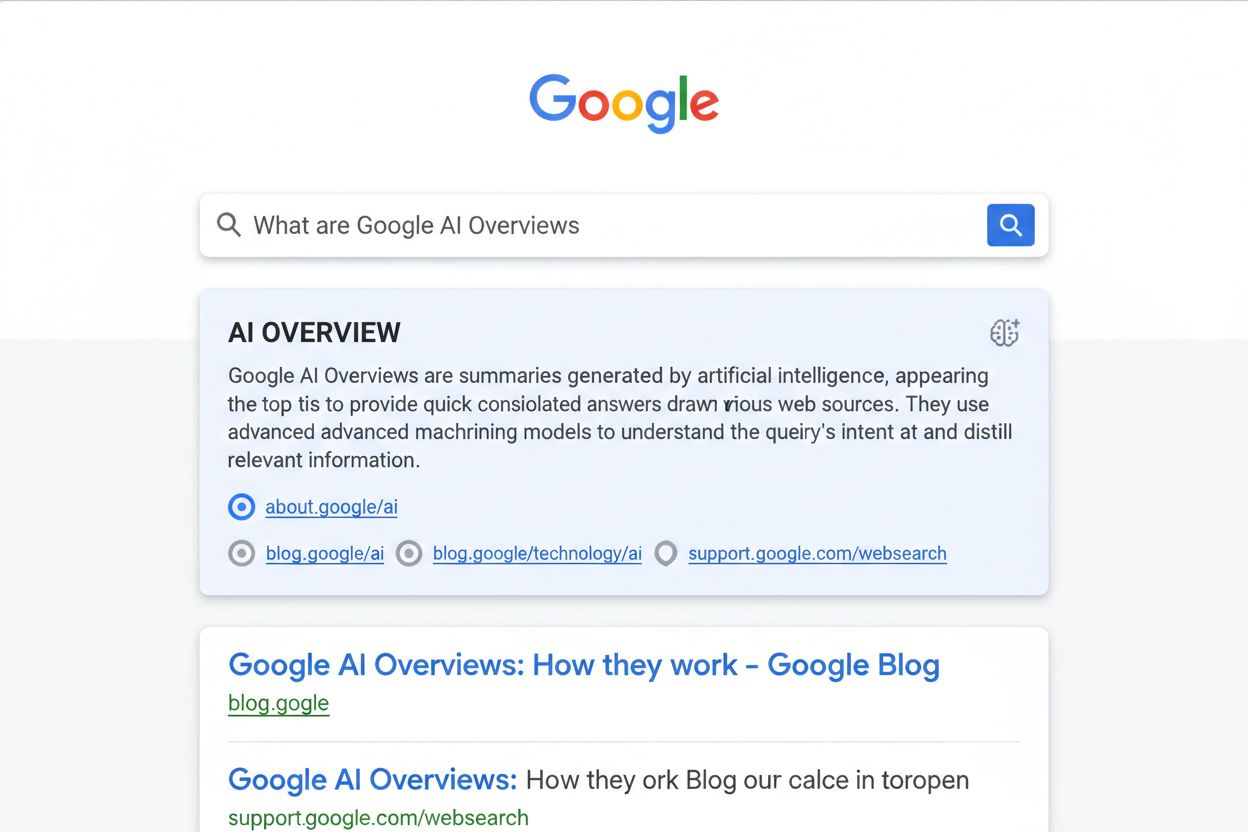
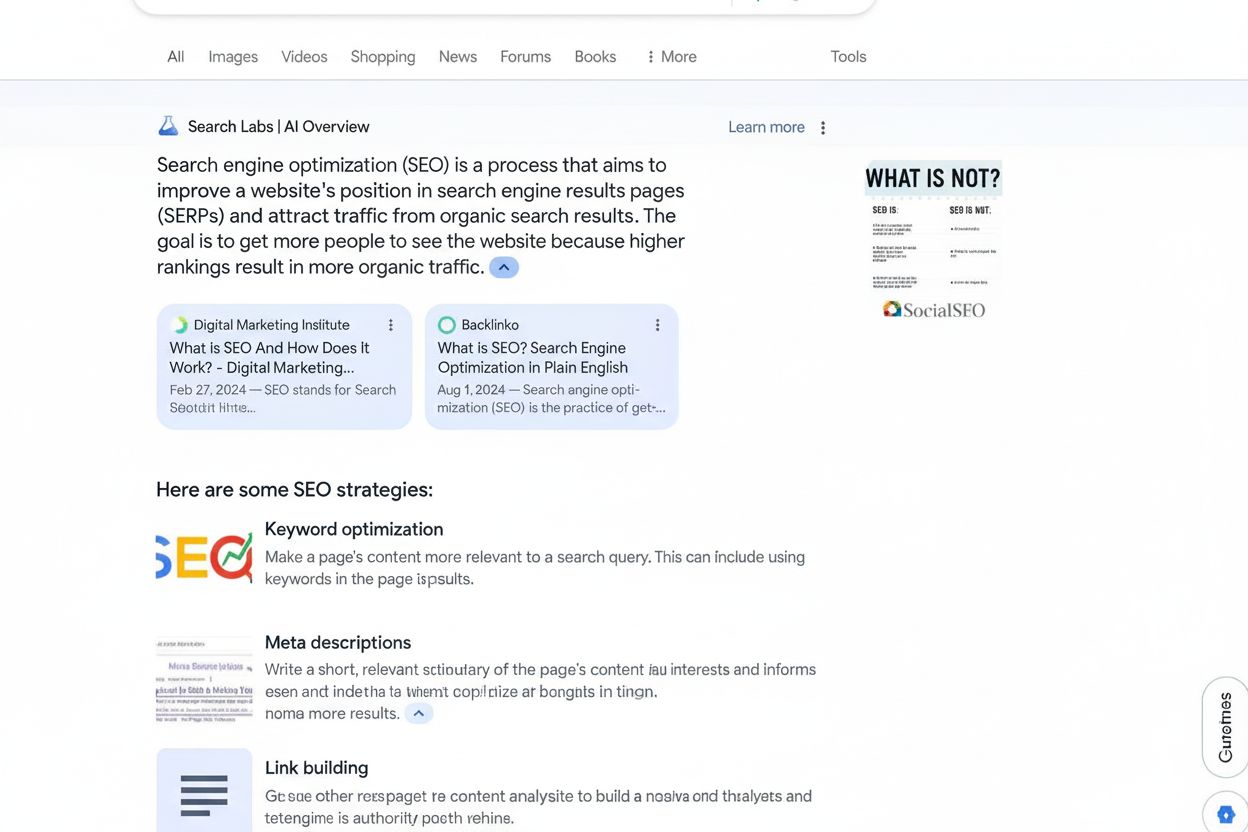
AI Overviews are AI-generated summaries that appear at the top of Google Search results, providing quick answers to user queries using Google's Gemini model. They display key information with links to source websites, appearing in position zero above traditional organic results.
AI Overviews represent a fundamental shift in how Google Search delivers information to users. These are AI-generated summaries that appear at the very top of search results in “position zero,” above all traditional organic listings and paid advertisements. Originally introduced as “Search Generative Experience” (SGE) during Google’s I/O 2023 conference, AI Overviews became a live feature in May 2024 and have since expanded to over 120 countries and territories, supporting 11 languages. The feature leverages Google’s custom Gemini large language model (LLM) to synthesize information from multiple web sources and present it in a concise, user-friendly format that directly answers the searcher’s query.
The significance of AI Overviews cannot be overstated for digital marketers and content creators. These summaries occupy substantial visual real estate above the fold on search results pages, meaning users encounter them before scrolling to see traditional organic results. This positioning fundamentally changes how search visibility works and requires a new approach to search engine optimization and brand monitoring strategies.
The technology behind AI Overviews differs significantly from traditional featured snippets, which simply extract and display exact text from webpages. AI Overviews use generative AI to create entirely new summaries based on Google’s Gemini model’s understanding of a topic. The process involves multiple sophisticated steps that combine artificial intelligence with traditional search indexing.
When a user submits a search query, Google’s systems determine whether an AI Overview would provide additional value beyond traditional search results. If the query qualifies, the Gemini model analyzes information from multiple sources within Google’s organic search index to generate a comprehensive answer. Importantly, the AI-generated text is not extracted directly from any single source but rather synthesized from the collective knowledge the model has learned during training. This means the overview text cannot be traced back to a specific, linkable source, which is why Google pairs each AI Overview with a curated list of linked websites that best match the generated content.
The query fan-out technique represents an advanced feature of AI Overviews. Rather than analyzing only the exact query submitted, Google’s systems issue multiple related searches across subtopics and data sources to develop more comprehensive responses. This approach allows the system to display a wider and more diverse set of helpful links than would appear in traditional web search results, creating new opportunities for websites to gain visibility even if they don’t rank in the top positions for the exact query.
A complete AI Overview typically contains four distinct components that work together to provide users with both quick answers and pathways to deeper exploration:
| Component | Description | Purpose |
|---|---|---|
| Google Generative Overview | Short AI-generated response created by Gemini model | Provides immediate answer to user query |
| Key Points | List of main ideas, each linked to a website | Breaks down complex topics into digestible segments |
| Expanded AI Answer | Full, detailed answer accessible via “Show More” | Offers comprehensive information for deeper understanding |
| Linked Overview | List of source websites with “show all” option | Directs users to original sources for further research |
The Google generative overview serves as the headline answer, often hidden until users click to expand it. This component is generated entirely by the AI model and synthesizes information from multiple sources. The key points section breaks down the answer into digestible segments, with each point linked to a relevant website from Google’s search index. These links are not automatically generated but carefully selected based on how well each website’s content aligns with the specific point being made. The expanded AI answer provides users with the complete, detailed response when they click “Show More,” allowing for more nuanced exploration of complex topics. Finally, the linked overview displays the source websites that contributed to the AI Overview, typically drawn from the top 12 organic search results for that query.
The adoption rate of AI Overviews has been remarkably rapid since their full rollout. Currently, AI Overviews appear for approximately 59% of searches with informational intent, where users are seeking knowledge or answers to questions. For commercial intent searches, where users are actively looking to make purchases or compare products, AI Overviews appear in about 19% of cases. This distinction is important because it shows that Google’s systems are selective about when AI Overviews add value, avoiding their use when traditional shopping results and product listings would be more appropriate.
The global expansion has been substantial. As of late 2024, AI Overviews are available in over 120 countries and territories and support 11 different languages. Google has publicly stated its intention to bring AI Overviews to over one billion people by the end of 2024, representing an unprecedented scale of deployment for a new search feature. This rapid expansion means that businesses and content creators worldwide must quickly adapt their strategies to account for this new search landscape.
Research into how AI Overviews affect user behavior reveals important insights for website owners. Studies show that users are more likely to end their browsing session entirely after visiting a search page with an AI summary compared to pages without AI Overviews. This suggests that the feature successfully answers many user queries directly on the search results page, reducing the need for users to click through to websites.
However, there is a counterintuitive positive finding: links included in AI Overviews actually receive more clicks than if the same page had appeared as a traditional web listing for that query. This indicates that being featured in an AI Overview, while potentially reducing overall click-through rates for some queries, actually increases the quality and engagement of clicks that do occur. Users who click from an AI Overview are more likely to spend time on the destination website and engage with the content, suggesting higher-quality traffic overall.
Additionally, Google has reported that AI Overviews can boost impressions for websites, as the feature generates summaries that cite a greater diversity of sources than traditional search results. The query fan-out technique means that websites may appear in AI Overviews for related queries they might not rank for in traditional organic search, expanding their visibility across the search landscape.
Contrary to what many marketers initially feared, there are no special requirements or additional optimizations necessary to appear in AI Overviews. Google has explicitly stated that the same foundational SEO best practices that help websites rank in traditional search results are sufficient for AI Overview visibility. This means that websites do not need to create special AI-optimized content, add unique markup, or implement any new technical requirements.
However, certain conditions must be met for a website to be eligible for inclusion:
The emphasis on traditional SEO fundamentals means that the path to AI Overview visibility remains consistent with established best practices: create high-quality, comprehensive content that genuinely answers user questions, ensure your website is technically sound and easily crawlable, and build authority through quality backlinks and user engagement signals.
Website owners can track the performance of their content in AI Overviews through Google Search Console, where AI Overview traffic is included in the overall search traffic data. Specifically, AI Overviews appear in the Performance report under the “Web” search type, allowing site owners to see how many impressions and clicks their pages receive from AI Overview features.
It’s important to note that AI Overview clicks are counted as regular search traffic in Search Console, meaning they are not separated into a distinct category. This integration into standard reporting makes it easier for site owners to track overall search performance without needing separate tools or dashboards. However, it also means that site owners must use additional analytics tools like Google Analytics to understand the specific behavior of users coming from AI Overviews versus traditional organic results.
Research indicates that users clicking from AI Overviews spend more time on destination websites compared to users from traditional search results, suggesting that while the overall click volume may decrease for some queries, the quality of traffic improves. This quality metric is crucial for understanding the true impact of AI Overviews on business outcomes, as higher engagement often correlates with better conversion rates and user satisfaction.
Website owners who wish to limit how their content appears in AI features have several options available through existing Google Search controls. The nosnippet, data-nosnippet, max-snippet, and noindex directives can be used to control what information Google displays from your pages in search results, including AI Overviews.
These controls work through the same mechanisms that have governed traditional search snippets:
It’s important to understand that these controls affect how your content appears across all Google Search features, not just AI Overviews. Implementing these directives requires careful consideration, as they may impact your visibility in traditional search results as well. Google recommends using the URL Inspection tool in Search Console to verify that your implementation is correct and that Googlebot is receiving the proper directives when crawling your pages.
As Google’s AI capabilities continue to improve, AI Overviews are expected to become even more prevalent and sophisticated. The company has indicated that these features will expand to handle increasingly complex queries, including multi-step reasoning for nuanced questions and planning capabilities for tasks like meal planning and vacation itineraries. The integration of video understanding capabilities is also underway, allowing users to search using video content and receive AI-powered troubleshooting and explanations.
The evolution of AI Overviews represents a broader transformation in how search engines deliver information. Rather than simply ranking pages, search engines are increasingly synthesizing information to provide direct answers. This shift requires content creators and marketers to think beyond traditional keyword rankings and consider how their content contributes to the broader information ecosystem that AI models draw from. The emphasis remains on creating comprehensive, authoritative, and user-focused content that genuinely serves the needs of searchers, regardless of whether that content appears in traditional rankings or AI-generated summaries.
Track how your brand, domain, and URLs appear in AI Overviews across Google Search, ChatGPT, Perplexity, and other AI answer generators. Get real-time insights into your AI visibility.
Learn how to optimize your website to appear in Google AI Overviews. Discover ranking factors, technical requirements, and proven strategies to increase visibil...
Master Google AI Overviews optimization in 2025. Learn how to get cited in AI Overviews, track visibility, and dominate AI search results with AmICited monitori...
Learn what AI Overviews are, how they impact SEO and organic traffic, and strategies to optimize your content for visibility in Google's AI-generated search sum...