
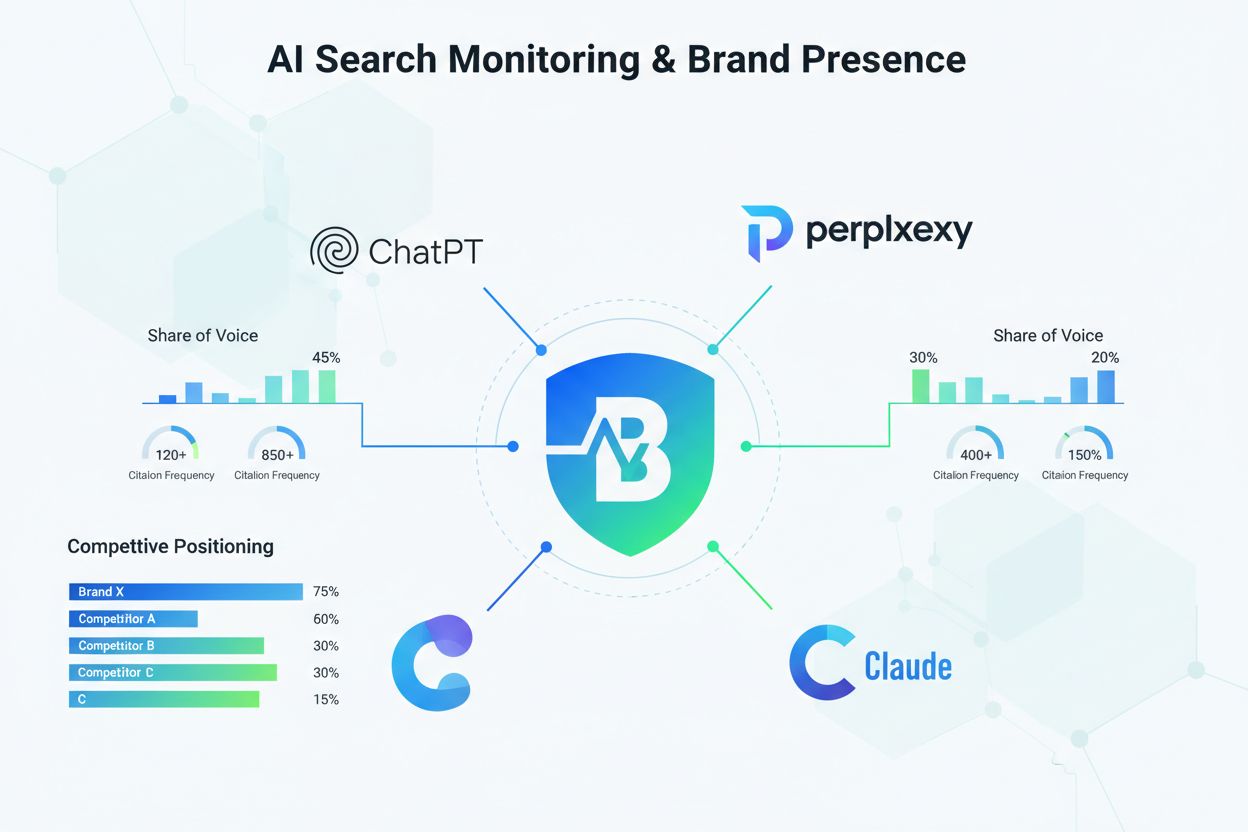
Share of Voice in AI Search: How to Measure Your Brand's Presence
Learn how to measure and improve your brand's share of voice in AI search across ChatGPT, Perplexity, Gemini, and other AI platforms. Complete guide with metric...
12 min read

Learn what AI share of voice is, how to measure it across ChatGPT, Perplexity, and Google AI Overviews, and strategies to increase your brand’s visibility in AI-generated answers.
AI share of voice measures how often your brand is mentioned, cited, or recommended in AI-generated answers compared to competitors across platforms like ChatGPT, Perplexity, and Google AI Overviews. It represents your brand's percentage of total visibility in AI search results.
AI share of voice is a critical metric that measures the percentage of total visibility or mentions your brand earns in AI-generated answers compared to your competitors. Unlike traditional share of voice which tracks visibility across paid ads, organic search, and social media, AI share of voice specifically focuses on how often large language models like ChatGPT, Perplexity, Claude, and Google’s Gemini mention, cite, or recommend your brand when answering user queries. This metric has become increasingly important as AI-powered search platforms now process billions of queries monthly, fundamentally changing how customers discover and evaluate brands.
The shift toward AI-driven search is accelerating rapidly. ChatGPT now attracts nearly 800 million weekly active users with over 1 billion queries processed daily. Perplexity hit 780 million queries in May 2025 with usage growing approximately 20% month-over-month. Google’s AI Overviews appear in roughly 30% of U.S. search queries, and this percentage continues to expand globally. When users ask these AI platforms questions about products, services, or solutions in your industry, your brand’s presence in those responses directly impacts customer awareness, trust, and purchasing decisions.
| Metric | Focus | Measurement | Success Indicator |
|---|---|---|---|
| Traditional Share of Voice | Visibility across paid ads, organic search, social media, PR | Ad impressions, keyword rankings, mentions | Clicks and traffic to website |
| AI Share of Voice | Brand mentions in AI-generated answers | Citation frequency and prominence in LLM responses | Brand mentions and authority recognition |
| SEO Share of Voice | Organic search result visibility | Keyword rankings and estimated traffic share | Organic traffic and SERP features |
| AI Share of Voice | Presence in synthesized AI answers | How often AI cites your brand vs competitors | Brand authority and AI recommendations |
The fundamental difference lies in the outcome. Traditional metrics optimize for clicks and website traffic, while AI share of voice optimizes for brand authority and recognition. When an AI system recommends your brand without the user ever visiting your website, that’s still a win—it’s brand-building at scale. The user may not click through immediately, but they remember your brand as the authority in that category. This phenomenon, called zero-click optimization, means many users get their answers directly from AI without visiting any website, making visibility in those AI responses more valuable than ever.
The importance of monitoring and improving your AI share of voice cannot be overstated in today’s digital landscape. As more users rely on AI platforms for research, recommendations, and decision-making, your brand’s presence in these AI-generated answers directly influences market perception and customer acquisition. When prospects ask ChatGPT “What’s the best project management tool for remote teams?” and your competitor gets mentioned while you don’t, that’s not just a missed click—it’s a missed customer who never even knew you existed.
Research from Nielsen demonstrates that brands with a share of voice higher than their market share are more likely to grow revenue over time. This principle applies equally to AI search. Brands that dominate AI share of voice in their category establish themselves as the default answer, the trusted authority that AI systems reference first. This creates a compounding effect: the more you’re mentioned by AI, the more you’re recommended, and the more your brand becomes embedded in the AI model’s understanding of your industry.
Additionally, approximately 65% of searches now end without a click, with projections suggesting this number will reach 70% by the end of 2025. This zero-click phenomenon means your traditional SEO strategy alone is insufficient. You need visibility where users are actually getting their answers—inside AI-generated responses. Brands that ignore AI share of voice are essentially invisible to an entire generation of searchers who never click through to traditional search results.
Measuring your AI share of voice requires a systematic approach that combines manual testing with specialized tools. The process begins by identifying the relevant queries your target audience asks on AI platforms, then tracking how often your brand appears in responses compared to competitors.
Step 1: Build a Bank of Relevant Prompts
Start by creating a comprehensive list of targeted prompts that reflect real-world user queries. These should mirror the kinds of questions your ideal customers would naturally ask AI platforms. Effective prompts span the entire customer journey:
Aim to build a diverse and comprehensive list of at least 20-50 prompts that cover different aspects of your business, customer pain points, and competitive comparisons. These prompts should be solution-focused and brand-agnostic, giving you a perfect opportunity to track your brand visibility and positioning compared to competitors.
Step 2: Test Across Multiple AI Platforms
Once you have your prompt list, systematically test them across the major AI platforms: ChatGPT, Perplexity, Claude, Gemini, Google AI Overviews, and Microsoft Copilot. For each response, document:
Step 3: Calculate Your AI Share of Voice
Use this straightforward formula to calculate your AI share of voice:
AI Share of Voice (%) = (Number of AI responses mentioning your brand ÷ Total number of prompts or responses scanned) × 100
For example, if you tested 20 prompts and your brand was mentioned in 10 of the AI answers, your AI SoV would be: (10 ÷ 20) × 100 = 50%
Run the same analysis for your key competitors to understand your competitive positioning. If competitors dominate across certain prompts or platforms, those become opportunity areas where you can optimize your content and brand positioning to gain ground.
Several specialized platforms have emerged to automate AI share of voice tracking and provide deeper insights than manual testing alone:
HubSpot’s AI Share of Voice Tool analyzes queries across GPT-4o, Perplexity, and Gemini simultaneously to measure your digital share of voice comprehensively. The tool simulates real customer research patterns, tracking brand mentions in AI responses to queries like “best [product category] for [use case]” and “compare [brand] vs competitors.” It provides a share of voice score (0-20), competitive benchmarking, sentiment analysis, and specific recommendations for improving your visibility.
Profound is a platform built specifically for tracking brand visibility in AI-generated search results. It monitors how often your brand is mentioned, cited, or recommended across AI platforms like ChatGPT, Perplexity, and Claude. Key features include AI referral traffic tracking, sentiment analysis, identification of top queries powering AI mentions, visibility comparison against competitors, and recommended actions to improve your AI visibility.
Semrush’s AI Toolkit shows which AI platforms are mentioning your brand, the sentiment of those mentions, strategic opportunities to improve your positioning in AI search, and how your brand stacks up against competitors in AI-generated answers. The Market Share vs. Sentiment analysis feature is particularly valuable, showing not just what percentage of AI mentions your brand captures, but also comparing that percentage against how positively or negatively your brand is perceived by AI.
OtterlyAI provides automated AI search monitoring across ChatGPT, Google AI Overviews, Perplexity, Google AI Mode, Gemini, and Microsoft Copilot. It tracks brand mentions, website citations, and share of voice with weekly automated reports, GEO auditing capabilities, and actionable insights for improving your AI search visibility.
Improving your AI share of voice requires a multi-faceted approach that addresses how AI systems understand, evaluate, and recommend your brand.
Establish Strong Brand Positioning
Strong and consistent brand positioning is essential to increasing your share of voice in AI search. AI platforms need structured, reliable data to determine which businesses are credible, relevant, and worth recommending. If your messaging is unclear or inconsistent, you’re far less likely to be surfaced in AI responses, especially compared to competitors that have nailed their positioning.
Ensure AI understands your brand by making your value proposition crystal clear. Communicate what you do, who you serve, and why it matters throughout your digital presence. Use consistent branding across your site and assets, referencing your brand name alongside your niche, sector, or core offering. This helps AI tools associate your name with your area of expertise. Add credibility through trust signals including testimonials, case studies, client logos, partnerships, certifications, press features, and awards. These reinforce your authority and legitimacy in the eyes of AI systems.
Create AI-Optimized Content
To increase your share of voice in AI search, you need to create content that’s optimized for AI and genuinely useful to humans. This is how you become a credible, citable source in AI-generated answers. Optimizing for AI and humans simultaneously means:
Structure your content with answer-first architecture—don’t bury your key insight in paragraph six. Start with a direct, concise answer in the first 50-100 words, then expand. Use structured formatting with clear headings (H2, H3), bullet points, numbered lists, and tables. AI models extract structured data better than dense paragraphs. Implement schema markup like FAQPage schema for Q&A content, HowTo schema for guides, and Organization schema for brand information.
Build Multi-Platform Authority
AI platforms don’t rely solely on your website to understand your brand. They reference third-party sources to assess credibility, expertise, and relevance when generating responses. News publications, industry directories, review platforms, and high-authority blogs are often used as sources by ChatGPT, Perplexity, Claude, Google’s AI Overviews, and more.
Getting featured on these trusted platforms helps you in two major ways: it strengthens your off-site authority, signaling to AI that your brand is recognized and reliable, and it increases your chances of being cited, especially when AI pulls content or references from those external sources. To boost your AI share of voice, aim to contribute expert insights to high-authority publications in your niche, get listed in credible directories and independent review platforms, and secure coverage through digital PR or guest posts on respected blogs.
To effectively manage your AI share of voice, establish clear metrics and track them consistently over time. Your baseline AI share of voice score (0-20 or as a percentage) should be documented using your chosen tracking tool. Monitor this monthly to identify trends and measure the impact of your optimization efforts.
Track brand impression growth by monitoring branded search volume and AI mentions. If your AI visibility increases but branded searches don’t, you’re not creating enough recall. Measure citation quality by noting not just whether you’re mentioned, but how prominently. Being mentioned in passing is different from being positioned as the authoritative source. Analyze sentiment in AI responses to understand what tone AI uses when mentioning you—positive, neutral, or critical. AI models reflect the sentiment patterns they’ve learned from the web.
The businesses that will dominate the next decade aren’t the ones with the best Google rankings today. They’re the ones building authority systems that work across every platform where AI pulls information. By monitoring and optimizing your AI share of voice, you’re not just improving visibility—you’re becoming the default answer in your category, the source AI trusts, and the authority that gets cited when it matters most.
Start tracking how often your brand appears in AI-generated answers across ChatGPT, Perplexity, and Google AI Overviews. Get real-time insights into your competitive positioning and identify opportunities to increase your visibility in AI search.
Learn how to measure and improve your brand's share of voice in AI search across ChatGPT, Perplexity, Gemini, and other AI platforms. Complete guide with metric...
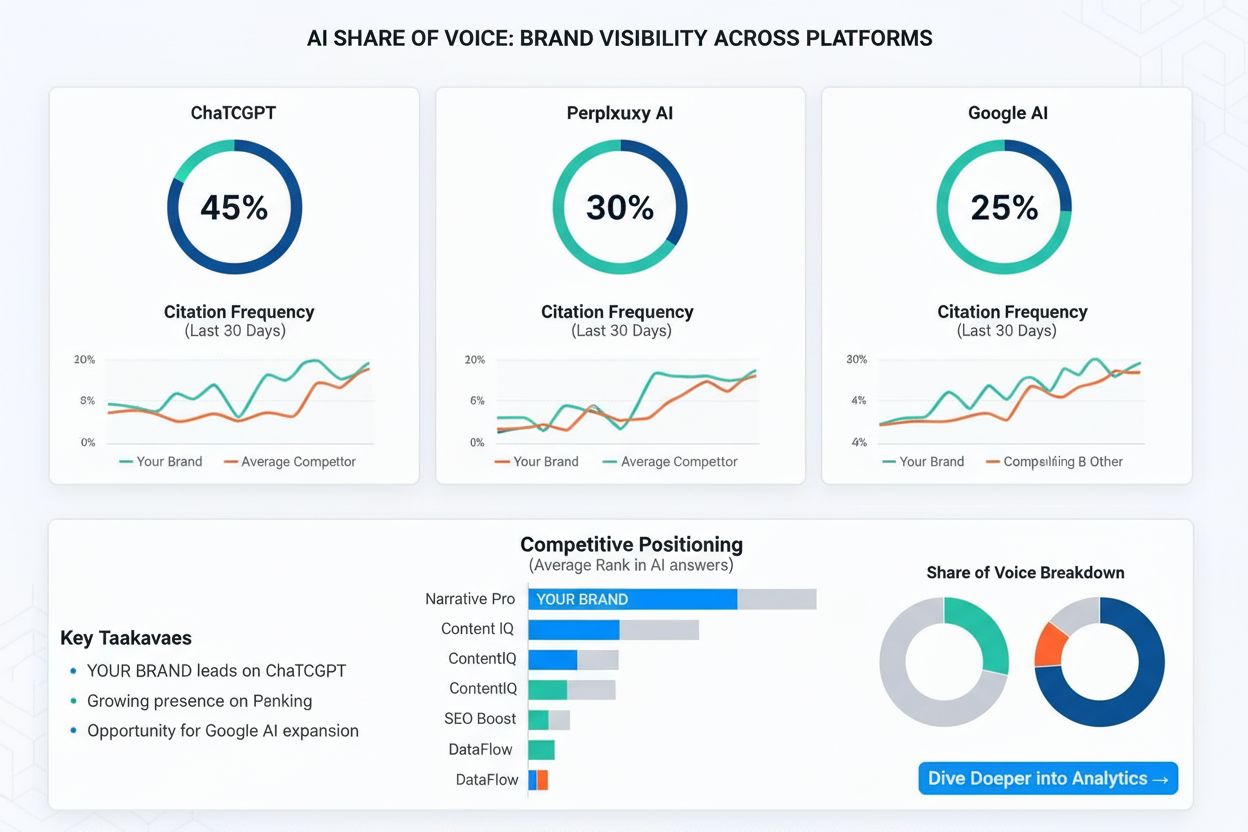
AI Share of Voice measures brand visibility in AI-generated responses. Learn how to track, calculate, and improve your presence across ChatGPT, Perplexity, and ...
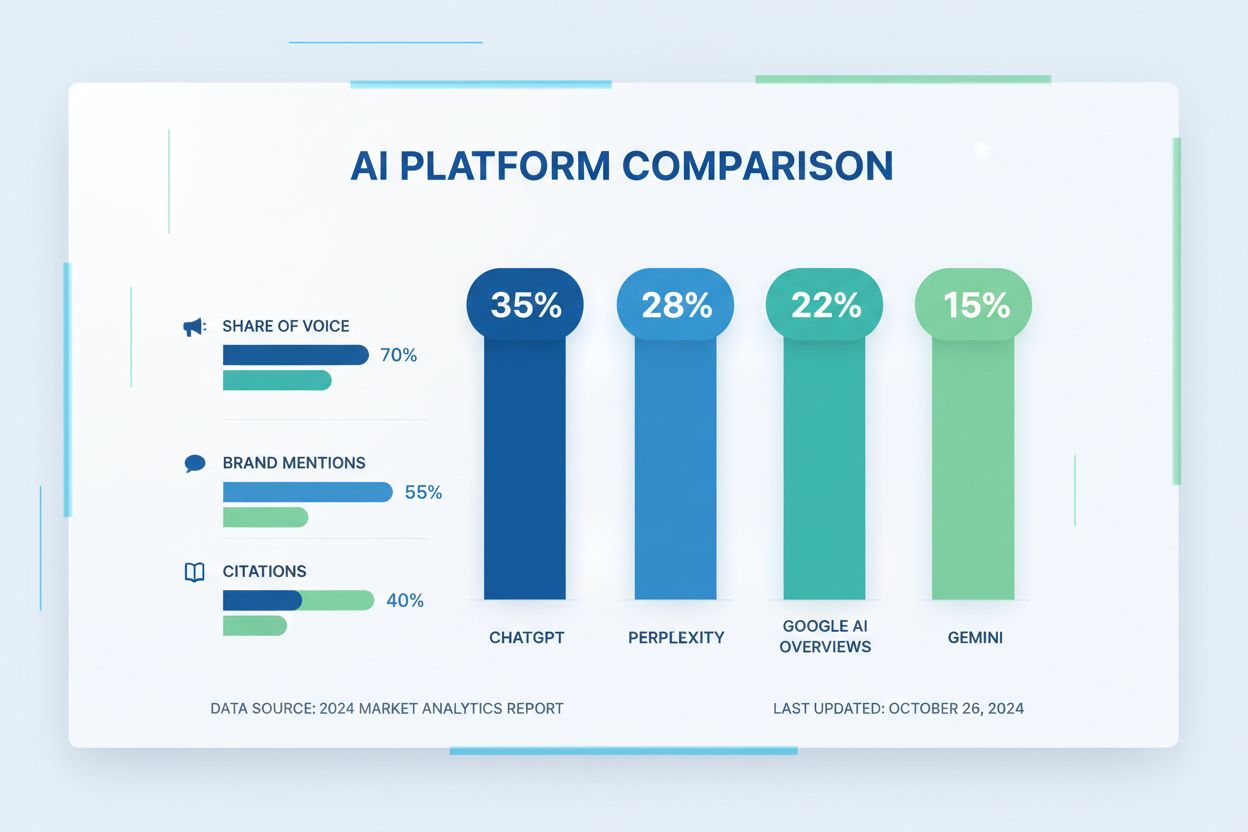
Learn how to analyze competitor AI visibility, identify share of voice gaps, and optimize your brand presence across ChatGPT, Perplexity, and Google AI Overview...