
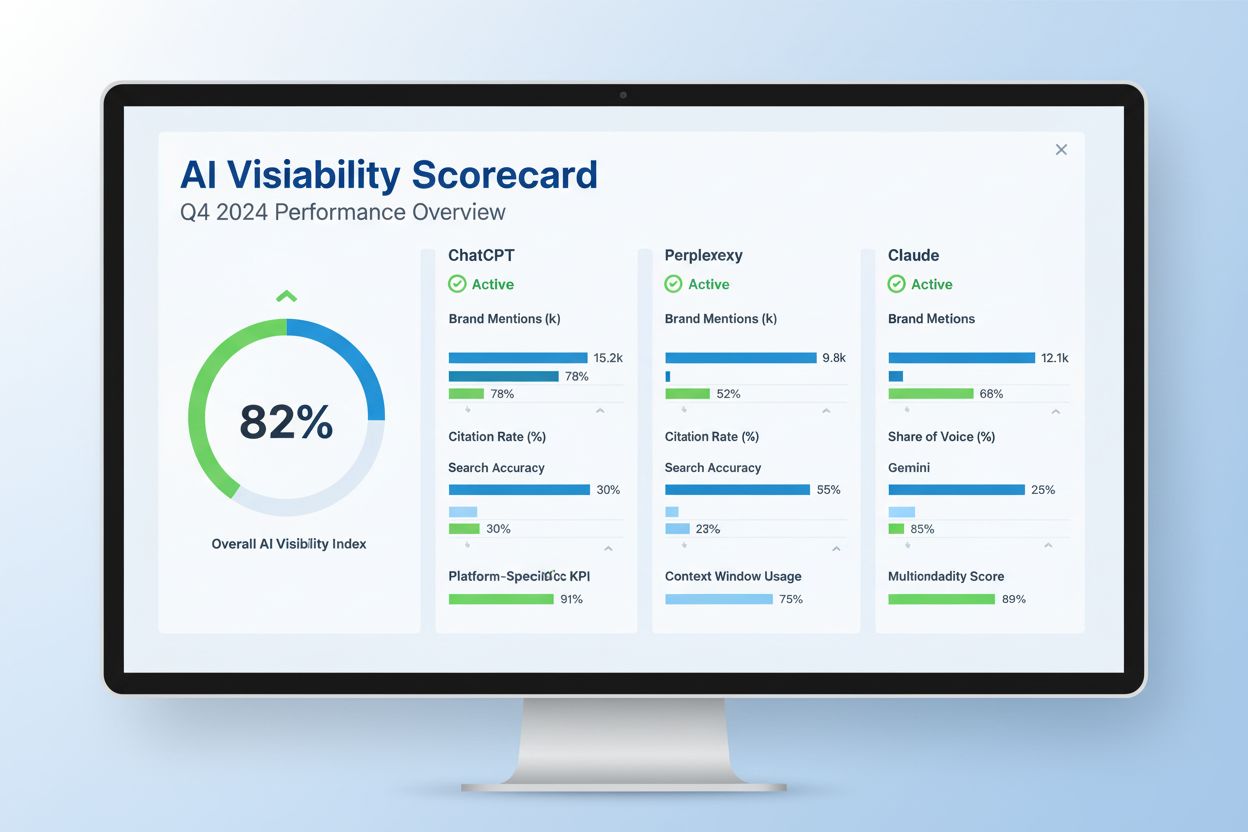
AI Visibility Score
Learn what an AI Visibility Score is and how it measures your brand's presence across ChatGPT, Perplexity, Claude, and other AI platforms. Essential metric for ...
14 min read

Learn what an AI visibility score is, how it measures your brand’s presence in AI-generated answers across ChatGPT, Perplexity, and other AI platforms, and why it matters for your digital strategy.
An AI visibility score is a benchmark metric (0-100) that measures how often your brand appears in AI-generated answers and summaries across platforms like ChatGPT, Perplexity, Gemini, and Claude. It tracks your brand's presence, mentions, and citations in AI responses to buyer-intent queries.
An AI visibility score is a benchmark metric that quantifies how prominently your brand appears in AI-generated answers and summaries across modern AI platforms. Unlike traditional search engine rankings that measure your position on a results page, an AI visibility score reflects whether your brand is mentioned, cited, or recommended when users ask AI tools like ChatGPT, Perplexity, Gemini, or Claude about topics related to your industry. This metric operates on a scale of 0 to 100, with higher scores indicating stronger brand presence and authority within AI ecosystems. The score represents a fundamental shift in how digital visibility is measured—moving from keyword rankings to actual brand mentions and citations in AI-generated content.
The emergence of AI visibility scores reflects a critical change in how people discover information. Decision-makers increasingly bypass traditional search results entirely, instead asking AI tools direct, conversational questions to get synthesized answers. When an AI system generates a response to a user’s query, it may mention dozens of brands, cite specific sources, or recommend particular solutions. Your AI visibility score measures whether your brand is part of that conversation. This is fundamentally different from SEO visibility because it doesn’t matter if your website ranks first on Google if the AI never mentions your company when answering relevant questions.
An AI visibility score is built on three primary components that work together to create a comprehensive picture of your brand’s presence in AI ecosystems. Understanding these components helps you recognize what the score actually measures and where to focus improvement efforts.
Brand mentions represent the raw count of how often your company name, products, or key personnel appear within AI-generated responses. Each mention—whether linked or not—reinforces your brand’s association with specific topics and builds recognition within the AI’s knowledge base. A mention might appear as a simple reference like “many experts, including those at [Your Brand], recommend this approach” or as a direct recommendation in a list of solutions. The frequency of these mentions across different AI platforms and query types contributes significantly to your overall visibility score.
Summarization presence measures whether your brand appears as a formally cited source in AI-generated summaries, such as Google’s AI Overviews or Bing Copilot’s answers. This component carries more weight than simple mentions because being an attributed source signals that the AI has deemed your content reliable enough to use as a foundation for its answer. When an AI summary includes a clickable source link pointing to your domain, that’s a clear instance of summarization presence. This is a higher-value interaction because it provides direct traffic potential and demonstrates explicit authority recognition.
Entity frequency across models tracks how consistently your core business entities—your company name, product names, key technologies—appear in responses across different AI models like Gemini, GPT-4, and Claude. High frequency across multiple models indicates that your authority is not dependent on a single platform’s algorithm but is widely recognized across the entire AI ecosystem. This component demonstrates that you have built true, model-agnostic expertise that multiple AI systems independently recognize and reference.
| Component | What It Measures | Why It Matters | Example |
|---|---|---|---|
| Brand Mentions | Raw presence and conversation volume | Builds brand recall and establishes recognition | “…many experts recommend this approach” |
| Summarization Presence | Explicit authority and trustworthiness | Signals AI deems your content reliable | Clickable source link in AI summary |
| Entity Frequency | Consistency across AI platforms | Shows model-agnostic expertise | Mentioned in ChatGPT, Perplexity, and Gemini |
The distinction between AI visibility scores and traditional SEO rankings represents a fundamental shift in digital marketing strategy. Traditional SEO rankings measure your website’s position on a search engine results page (SERP) for specific keywords. If your website ranks first for a particular query, you receive the most visibility in that traditional search context. However, this metric becomes increasingly irrelevant when users never see the search results page because they’re reading an AI-generated summary instead.
An AI visibility score measures something entirely different: whether your brand is mentioned or cited within the AI’s synthesized answer. A user might ask ChatGPT “What’s the best solution for [problem]?” and receive an answer that mentions five companies. Your ranking on Google for that keyword is irrelevant if you’re not one of those five companies mentioned in the AI’s response. Conversely, you could rank tenth on Google but still appear in the AI’s top recommendations. This represents a complete inversion of traditional visibility metrics.
The shift from rankings to AI visibility also changes the nature of competition. In traditional SEO, you compete for position on a results page with a limited number of slots. In AI visibility, the competition is about being recognized as an authoritative source that the AI should mention when answering relevant questions. This requires a different approach to content strategy, entity recognition, and brand authority building. Your AI visibility score captures this new competitive landscape more accurately than any traditional ranking metric.
The rise of AI-powered search and answer generation has fundamentally altered how buyers discover and evaluate solutions. Decision-makers increasingly turn to AI tools as their primary research method, asking conversational questions and trusting the synthesized answers they receive. If your brand doesn’t appear in those AI-generated answers, you’re effectively invisible to a growing segment of your target audience. An AI visibility score quantifies this critical gap and provides a measurable way to track your presence in this emerging channel.
Monitoring your AI visibility score helps you understand whether your brand is part of the conversation when buyers turn to AI for recommendations. High AI visibility indicates that your company is recognized as an authority worth mentioning, which builds trust and credibility with potential customers. When an AI system recommends your solution alongside competitors, it provides a powerful third-party endorsement that influences buyer decisions. This is particularly valuable in B2B contexts where decision-makers rely heavily on expert recommendations and trusted sources.
Beyond brand recognition, AI visibility scores reveal strategic opportunities for growth. By tracking which topics and queries mention your competitors but not your brand, you can identify content gaps and authority-building opportunities. You can see which AI platforms recognize your expertise and which ones don’t, allowing you to tailor your strategy accordingly. This data-driven approach to AI visibility helps you allocate resources more effectively and focus on initiatives that will actually improve your presence where buyers are searching.
Measuring your AI visibility score requires a multi-pronged approach that combines manual testing with automated tracking systems. No single method provides a complete picture, but together they create a comprehensive understanding of your brand’s presence across AI platforms.
Manual prompt testing is the foundational method for gathering qualitative data about your AI visibility. This involves creating a curated list of your most critical business-related prompts—typically 20 to 30 queries that represent how your target audience actually searches. On a regular schedule, you manually input these prompts into your target AI interfaces like Google, ChatGPT, and Perplexity, then log the results in a structured spreadsheet. You note every mention, citation, and competitor appearance. While this method is time-consuming and not scalable for comprehensive tracking, it provides rich qualitative insights and requires no special software. The main drawback is that it’s prone to personalization bias, as AI systems often tailor responses based on user history and location.
Third-party visibility trackers automate the process of testing thousands of prompts and aggregating the data into actionable metrics. These specialized platforms use APIs and advanced crawlers to monitor your presence in AI Overviews and chat interfaces for a large set of tracked prompts. They automatically calculate your Summarization Inclusion Rate (SIR), AI Mention Velocity, and Share of Voice compared to competitors. This approach is scalable and objective, providing historical data and trend analysis that manual testing cannot match. The trade-off is that these platforms require subscription costs and may not cover all niche AI platforms.
API integration for continuous tracking offers the ultimate in flexibility and control for technically advanced teams. This involves developing a script that connects directly to the APIs of models like OpenAI’s GPT or Google’s Gemini, feeding your extensive prompt library to the script, which programmatically sends each prompt to the APIs and parses the responses for mentions of your brand and competitor keywords. Results are logged automatically into a database for analysis in business intelligence tools. This approach provides complete control over prompts, models, and data, and can be more cost-effective at massive scale, but requires significant development and maintenance resources.
An AI Visibility Index is a single, composite score that rolls up all your core visibility metrics into one number, making it easy to track and report on overall progress. Rather than juggling multiple metrics, you can focus on one primary indicator that reflects your overall performance across AI platforms. Creating this index involves normalizing your component metrics into a 0-100 scale, assigning weights based on strategic importance, and calculating a weighted average.
The typical formula for an AI Visibility Index is: AI Visibility Index = (SIR × Weight_SIR) + (AI Mention Score × Weight_Mentions) + (Entity Frequency Score × Weight_Frequency). To create your index, first normalize each of your component KPIs into a 0-100 scale. For Summarization Inclusion Rate, your score could be the rate itself (a 25% SIR becomes a score of 25). For mentions, you might set a goal like 500 mentions per month equals 100 and score yourself against that benchmark. Next, assign weights to determine the relative importance of each component. A common starting point is 50% weight for Summarization Presence, 30% for Brand Mentions, and 20% for Entity Frequency, though you should adjust these based on your strategic priorities.
Once you have your AI Visibility Index established, use it as a goal-setting framework for your AI visibility strategy. Calculate your baseline index at the beginning of a quarter, then set a realistic but ambitious target for the end of that period. Work backward to determine what improvements in your component KPIs are needed to hit that target. If your goal is to increase your index from 41 to 50, you might need to increase your SIR to 25%, boost mentions to 400, and maintain entity frequency. This deconstruction gives your team a clear, actionable mission with specific metrics to track and improve.
Improving your AI visibility score starts with building the kind of content and authority signals that AI tools recognize and trust. This requires a different approach than traditional SEO, focusing on clarity, consistency, and credibility across multiple dimensions.
Publish buyer-intent content that directly answers the questions your audience is asking AI tools. Use conversational phrasing that mirrors how people actually search and ask questions. Instead of optimizing for keywords, focus on creating comprehensive answers to the specific problems your target audience faces. When you create content that thoroughly addresses buyer questions, AI systems are more likely to cite your pages as authoritative sources in their generated answers.
Strengthen your entity relationships through structured markup and consistent naming conventions. Entities are clearly defined “things”—people, companies, products, or concepts—that search engines and AI tools can recognize and connect to your brand. Schema markup provides AI systems with a clear map of who you are, what you offer, and how your content demonstrates expertise. Use internal linking and consistent naming conventions to help AI engines easily connect your brand to your products, industries, and areas of expertise.
Expand your topical authority by developing interconnected content around your key offerings. Rather than creating isolated articles, build a comprehensive content ecosystem where multiple pages support and reference each other. This helps AI recognize depth and expertise—not just surface-level coverage—across your focus areas. When AI systems see that you have extensive, interconnected content on a topic, they’re more likely to recognize you as an authoritative source worth citing.
Build credible brand mentions by earning citations from reputable sites, partners, and media outlets. The more trusted sources reference your brand, the more confidence AI has in including you in its answers. This might involve PR outreach, partnership announcements, industry awards, or expert contributions to respected publications. These external mentions signal to AI systems that your brand is recognized and trusted by other authoritative sources.
Audit and update regularly because AI ecosystems evolve quickly. Routinely assess where your brand appears (and doesn’t) across platforms like Claude, Copilot, and others, then refine your strategy to fill those gaps. Set up regular monitoring schedules to track changes in your AI visibility score and identify emerging opportunities or threats.
The rise of generative AI doesn’t replace traditional SEO—it evolves it. Traditional search still matters, but the way buyers discover and evaluate information is shifting toward AI-driven summaries, recommendations, and insights. Instead of scanning ten search results, your prospects are reading one trusted answer generated by AI. The question isn’t just “Can people find us on Google?” anymore; it’s “Does AI recognize us as an authority worth mentioning?”
Over time, we’ll see SEO and AI visibility merge into a unified view of digital authority. Structured data, topical depth, and trusted citations will continue to drive success, but the brands that understand how AI perceives them will lead the next wave of organic growth. Your AI visibility score reveals whether your brand is part of that conversation or left on the sidelines. By monitoring this metric and implementing strategies to improve it, you position your company as a recognized authority in the age of AI-powered search and decision-making.
Track how your brand appears across AI search engines and AI answer generators. Get real-time insights into your AI visibility score and discover opportunities to increase your presence in AI-generated answers.
Learn what an AI Visibility Score is and how it measures your brand's presence across ChatGPT, Perplexity, Claude, and other AI platforms. Essential metric for ...

Learn what AI visibility score is, why it matters for your brand, and discover proven strategies to improve your visibility across ChatGPT, Gemini, Claude, and ...

Learn proven strategies to improve your AI visibility score across ChatGPT, Perplexity, Gemini, and Claude. Discover how to optimize content, build authority, a...