
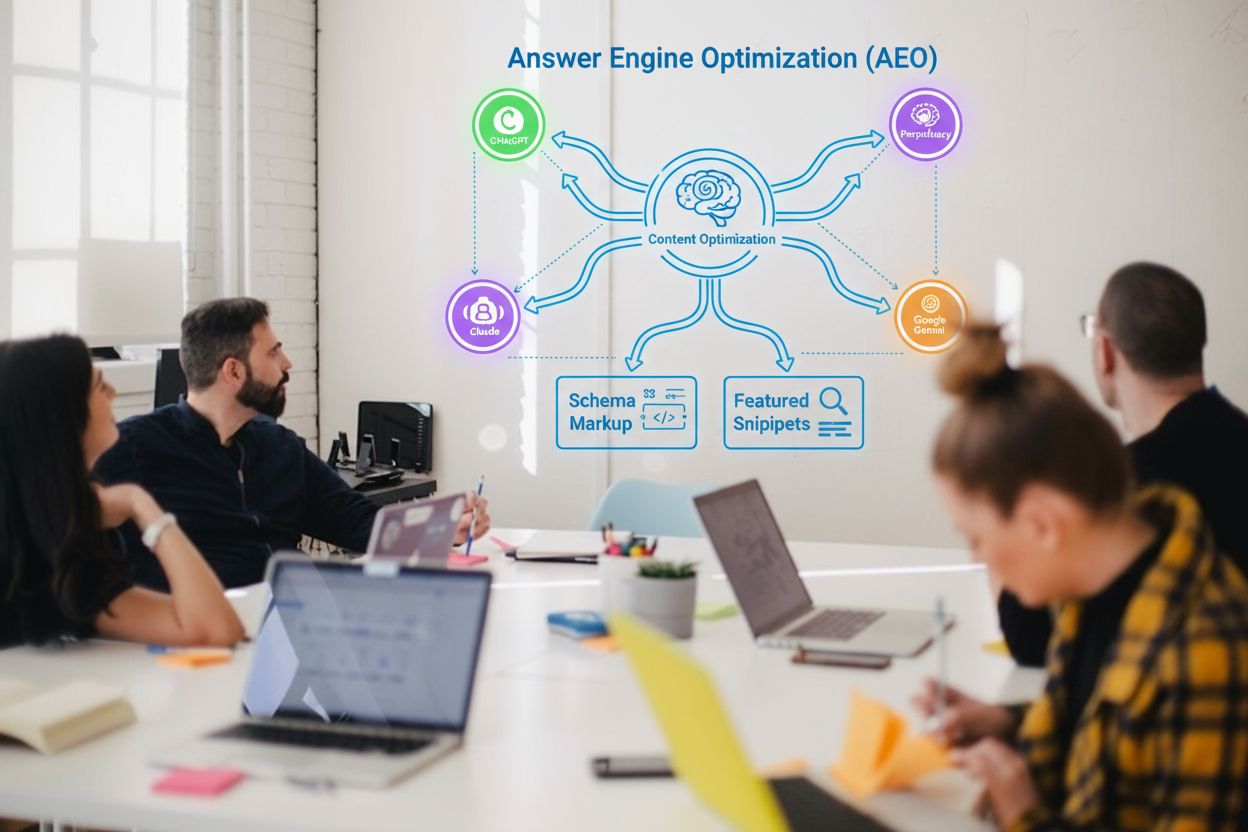
Answer Engine Optimization (AEO)
Answer Engine Optimization (AEO) is the practice of optimizing content for AI-powered platforms. Learn how to earn citations in ChatGPT, Perplexity, and Google ...
12 min read

Learn what Answer Engine Optimization (AEO) is and how it helps your brand appear in AI-powered answers from ChatGPT, Perplexity, and Google AI Overviews. Discover AEO strategies and best practices.
Answer Engine Optimization (AEO) is the practice of optimizing your content so that AI-powered platforms like ChatGPT, Perplexity, and Google AI Overviews can easily find, understand, and cite your brand in their generated answers. Unlike traditional SEO which focuses on ranking in search results, AEO emphasizes direct answers, structured data, and authority signals to earn visibility in zero-click AI responses.
Answer Engine Optimization (AEO) is the strategic practice of structuring and optimizing your content so that AI-powered systems can easily extract, understand, and present it as authoritative answers to user queries. As artificial intelligence continues to reshape how people search for information, AEO has become essential for brands that want to maintain visibility in this new landscape. The fundamental difference from traditional search engine optimization is that AEO focuses on earning citations and mentions in AI-generated responses rather than simply ranking high in search engine result pages.
When someone asks ChatGPT “What are the best marketing strategies?” or queries Google for a quick definition, AEO determines whether your brand gets cited in the response. Unlike traditional search engines that provide ranked lists of resources, answer engines synthesize information from multiple sources and present a single, comprehensive answer directly to the user. This shift represents a fundamental change in how information discovery works online, with 25% of organic search traffic predicted to move to AI chatbots and virtual agents by 2026 according to Gartner research.
The importance of AEO cannot be overstated. Recent studies show that nearly 60% of searches now end without a click as users get what they need directly from AI Overviews, featured snippets, or knowledge panels. ChatGPT alone has nearly doubled its weekly average users to 800 million, demonstrating the massive scale at which AI answer engines are operating. This means your brand can be mentioned thousands of times in AI conversations without generating a single website visit, yet still building significant brand awareness and influence.
The distinction between Answer Engine Optimization and Search Engine Optimization is critical for understanding modern digital marketing strategy. While both approaches share similar foundational principles, they diverge significantly in execution and measurement.
| Aspect | Traditional SEO | Answer Engine Optimization (AEO) |
|---|---|---|
| Primary Goal | Rank high in search engine results pages (SERPs) | Get cited and mentioned in AI-generated answers |
| Content Focus | Broad, long-form content targeting keyword groups | Precise, question-answer style content with direct answers |
| Key Signals | Backlinks, domain authority, keyword metrics | Mentions, citations, semantic markup, structured data |
| Success Metrics | Impressions, clicks, CTR, organic traffic, conversions | Citation rate, share of AI voice, brand mentions, AI impressions |
| User Interaction | Users click through to your website | Users get answers without visiting your site (zero-click) |
| Content Format | Whole-page optimization | Content chunk and snippet optimization |
| Platform Strategy | Google-centric approach | Multi-platform (ChatGPT, Perplexity, Google AI Overviews, Copilot) |
| Backlink Importance | Critical ranking factor | Reduced importance; focus on content quality and authority |
| Personalization | Low to medium personalization | High personalization based on user context and history |
The most significant difference is that SEO gets traffic while AEO owns the answer. A well-optimized answer might get cited thousands of times in ChatGPT conversations or Google AI Overviews without generating a single session in your analytics. This challenges traditional attribution models but extends your brand’s reach into entirely new contexts where buying decisions increasingly begin. However, it’s crucial to understand that AEO is not a replacement for SEO — rather, it’s a complementary strategy that builds on strong SEO foundations.
The internet is fundamentally shifting from a click-based economy to an answer-based one, and brands that ignore AEO risk becoming invisible in the most important moments of customer discovery. The evidence supporting this shift is compelling and undeniable. According to recent research, 400+ million people use OpenAI products every week, while 4x growth in Bing mobile app downloads occurred after integrating AI capabilities. Additionally, 45% of Millennials use social media for search, indicating that traditional search engine dominance is fragmenting across multiple platforms.
The impact on established websites has been dramatic. Stack Overflow, a site built entirely around question-and-answer content, experienced a 14% decrease in visits in March 2023 following ChatGPT’s launch, followed by an 18% decrease in April 2023. However, this doesn’t necessarily mean revenue decline — companies like NerdWallet grew revenue by more than 35% in 2024 while experiencing a 20% decrease in monthly website traffic. This paradox reveals that users aren’t shopping less; they’re shopping differently through AI-mediated experiences.
The strategic advantage goes to early adopters. Companies that shift their strategy now are:
Understanding how answer engines retrieve and present information is essential for effective AEO strategy. Unlike traditional search engines that rank entire pages, answer engines operate through a fundamentally different process. When you ask ChatGPT a question, the system doesn’t simply retrieve your entire article — instead, it identifies answer-like structures such as short paragraphs following questions, numbered steps, comparison tables, and other modular content blocks that directly address the query.
Large language models prioritize content that presents information in clear, scannable, and extractable formats. During training and retrieval, these systems learn to recognize and favor content that can be confidently cited. This means generic guidance that anyone could provide won’t cut it anymore — answer engines prioritize specificity and original insights. The system predicts the next most likely word that might appear in response to a user request, and each subsequent word after that, building responses probabilistically rather than retrieving pre-ranked results.
The training process for these models involves using publicly available internet data and private information from third-party partners. Importantly, 25% of the highest-quality sites in ChatGPT’s dataset have excluded themselves from future training, emphasizing the need and opportunity for businesses to produce original and authoritative content. This creates a competitive advantage for brands that invest in unique, high-quality content that answer engines can confidently cite.
Effective Answer Engine Optimization requires a comprehensive approach that spans content creation, technical implementation, and authority building. Each practice below includes specific workflows and actionable strategies to help your team execute with confidence.
AEO is extremely question and answer-focused, requiring a fundamental shift in how you approach content strategy. Start by building a question inventory that captures what your audience typically asks at every stage of their buyer journey. Connect with your sales and customer service teams to understand the questions prospects and customers frequently ask. Mine Google’s “People Also Ask” (PAA) boxes for your core topics, as these reveal what users want answered and what Google’s algorithm considers relevant.
Once collected, audit your existing content to identify gaps or opportunities to update content and answer these questions. Research them in both search engines and AI tools to see how your competitors are currently performing. Segment questions by funnel stage and buyer persona using these guidelines:
When AI systems analyze your content, they don’t read linearly — they identify answer-like structures and decide if that content directly addresses a user’s query. To optimize for this behavior, lead every key section with a 40-60-word direct answer that fully addresses the question. If someone asks “What is inbound marketing?” define it in two or three sentences in your first paragraph with no fluff, just the answer. Follow that with supporting detail, examples, and context for readers wanting depth.
Use scannable formatting like bullet points, numbered lists, and tables, keeping paragraphs under four sentences when possible. This isn’t about dumbing down your content; it’s about making valuable information accessible to both busy readers and skimming algorithms. Adopt reusable content block patterns that answer engines recognize, such as definition blocks for terminology, step-by-step blocks for processes, pros-and-cons blocks for evaluations, and example blocks for illustration.
Schema markup is structured data you add to your HTML to explicitly tell search engines and AI systems what your content represents. It’s the difference between Google guessing that your page is a how-to guide and Google knowing with certainty that it is, with five specific steps, an estimated completion time, and required tools. Focus on these core schema types for maximum AEO impact:
Featured snippets and “People Also Ask” boxes are Google’s most visible answer formats, and they serve as training data for how AI Overviews select and present information. When your content appears in a featured snippet, you’ve essentially been pre-selected by Google as the authoritative answer, which significantly increases your chances of being cited by AI summaries and language models.
To win featured snippets, keep these guidelines in mind:
Recent research shows that content including citations, quotes, and statistics is 30-40% more visible in AI search results. This emphasizes the importance of backing up claims with credible sources and maintaining high editorial standards. Strengthen your content by supporting all claims with facts, including data-driven insights and expert citations to increase trustworthiness. Use trusted resources and leverage authoritative publications that AI models favor while maintaining originality in your analysis.
Update existing content regularly with new data and insights to maintain relevance and help already-ranking pages stay on top. The more your content demonstrates expertise, experience, authoritativeness, and trustworthiness (E-E-A-T), the more likely AI systems will cite it as a reliable source.
Social proof works — AI and LLMs learn what to trust based on which sources appear frequently across authoritative contexts. LLMs are more likely to treat your content as credible and worth citing if your brand is cited in reputable industry publications, discussed in high-quality forums, and referenced in academic or government sources. Develop a multichannel distribution strategy that prioritizes platforms where your audience and AI training data intersect:
Voice assistants like Alexa, Siri, and Google Assistant choose answers differently from visual search results. They need concise, factually unambiguous, and structured content that can be spoken aloud in 15-30 seconds. When someone asks their smart speaker a question, the assistant typically cites one single source — you want that to be yours.
Write answers in spoken-friendly language, avoiding jargon and long dependent clauses. Use Speakable schema markup to tell assistants which paragraphs are concise and ready to be read aloud. For local businesses, optimize your Google Business Profile with verified business name, address, phone number, complete hours, high-quality photos, and keyword-rich descriptions. Build local landing pages for each service area and ensure your local business data is accurate and consistent across all platforms.
Like SEO, AEO involves the technical setup and performance of your website and content. These foundational tasks ensure that answer engines can crawl, parse, and extract your content reliably:
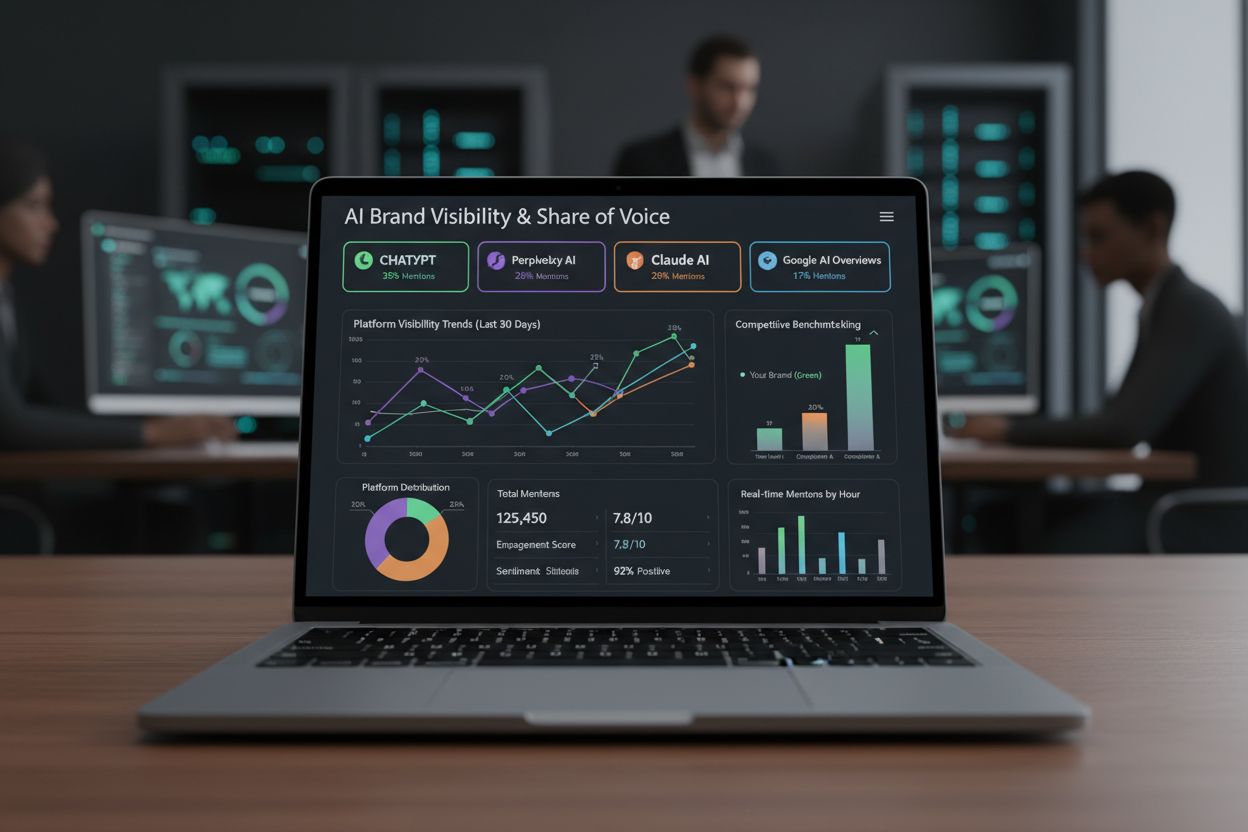
Unlike traditional SEO with its transparent metrics, AEO measurement presents unique challenges. Most AI platforms don’t provide “Search Console for LLMs” where you can see when and how often you were cited. However, you can create a simple manual tracking system by assigning a team member to periodically query major AI platforms (ChatGPT, Perplexity, Google AI Overviews, Bing Chat) with your target questions and document when your brand appears.
Create a tracking log with these columns: date, query, AI platform, whether your brand was mentioned, if you were the primary source, competitors mentioned, and notes. This qualitative data helps you understand which content formats and topics earn the most AI visibility. Use HubSpot’s AI Search Grader or similar tools to get a baseline assessment of your AI visibility across key queries. Combine this with Google Search Console to track featured snippet wins and PAA appearances, which serve as strong proxy metrics for content that AI systems find extract-worthy.
Set up branded search monitoring in Google Analytics 4 to track whether your AEO efforts increase awareness. If your AI visibility increases, you should see more users searching your brand name directly after encountering it in AI answers. Create a custom report that tracks branded organic sessions, new users from branded queries, and conversions from branded traffic.
The biggest barrier to AEO success isn’t technical — it’s organizational. Getting internal buy-in from executives accustomed to measuring success by clicks and conversions requires reframing what visibility means in an AI-first world. Frame AEO as brand awareness and category leadership, not traffic generation. When your content gets cited in thousands of ChatGPT answers, you’re shaping how buyers think about the problem space and which solutions they consider.
Attribution and ROI measurement are unclear because AI citations don’t generate sessions in Google Analytics. Build a hybrid measurement framework combining proxy metrics with directional indicators. Track your share of featured snippets and PAA appearances over time, monitor branded search volume, and survey new customers about how they first heard of you.
Content teams often lack capacity to retrofit existing content. Prioritize ruthlessly by starting with your top 20 highest-traffic pages and the 20 pages that rank on page one but don’t yet win featured snippets. Add schema and answer-first formatting to these pages first, then expand to pillar pages and core conversion content.
Answer Engine Optimization is not a replacement for SEO — it’s a complementary strategy that builds on strong SEO foundations. AI engine optimization actually complements SEO and inbound marketing; it doesn’t replace them. Strong SEO fundamentals like fast pages, clean HTML, authoritative backlinks, and crawlable structure are prerequisites for AEO success. The brands that commit to both SEO and AEO will dominate visibility across all discovery channels, from traditional search to AI-powered answers to voice assistants.
The internet is shifting, but the core principles remain: create authoritative, helpful content that serves your audience, build trust through quality and consistency, and make your information easy to find and understand. By implementing comprehensive AEO strategies alongside your existing SEO efforts, you’ll ensure your brand remains visible and influential as search continues to evolve.
Track how your brand appears in AI-powered answers across ChatGPT, Perplexity, and other AI search engines. Get real-time insights into your AI visibility and stay ahead of competitors.
Answer Engine Optimization (AEO) is the practice of optimizing content for AI-powered platforms. Learn how to earn citations in ChatGPT, Perplexity, and Google ...

Learn how to write FAQ content optimized for AI search engines like ChatGPT, Perplexity, and Google AI Overviews. Master AEO strategies, schema markup, and cont...
Compare leading GEO and AEO agencies. Find the best AI visibility partner with our comprehensive guide to industry leaders, pricing, and selection criteria.