
Article Schema
Article Schema is structured data markup that defines news and blog article properties for search engines and AI systems. Learn how to implement Article, NewsAr...
13 min read

Learn what Article schema is and how AI systems use it. Discover why Article schema matters for AI search visibility, implementation best practices, and how to monitor your brand in AI answers.
Article schema is structured data markup that helps search engines and AI systems understand article content better. Yes, AI systems use Article schema to identify, extract, and cite content more accurately in AI-generated responses, summaries, and overviews.
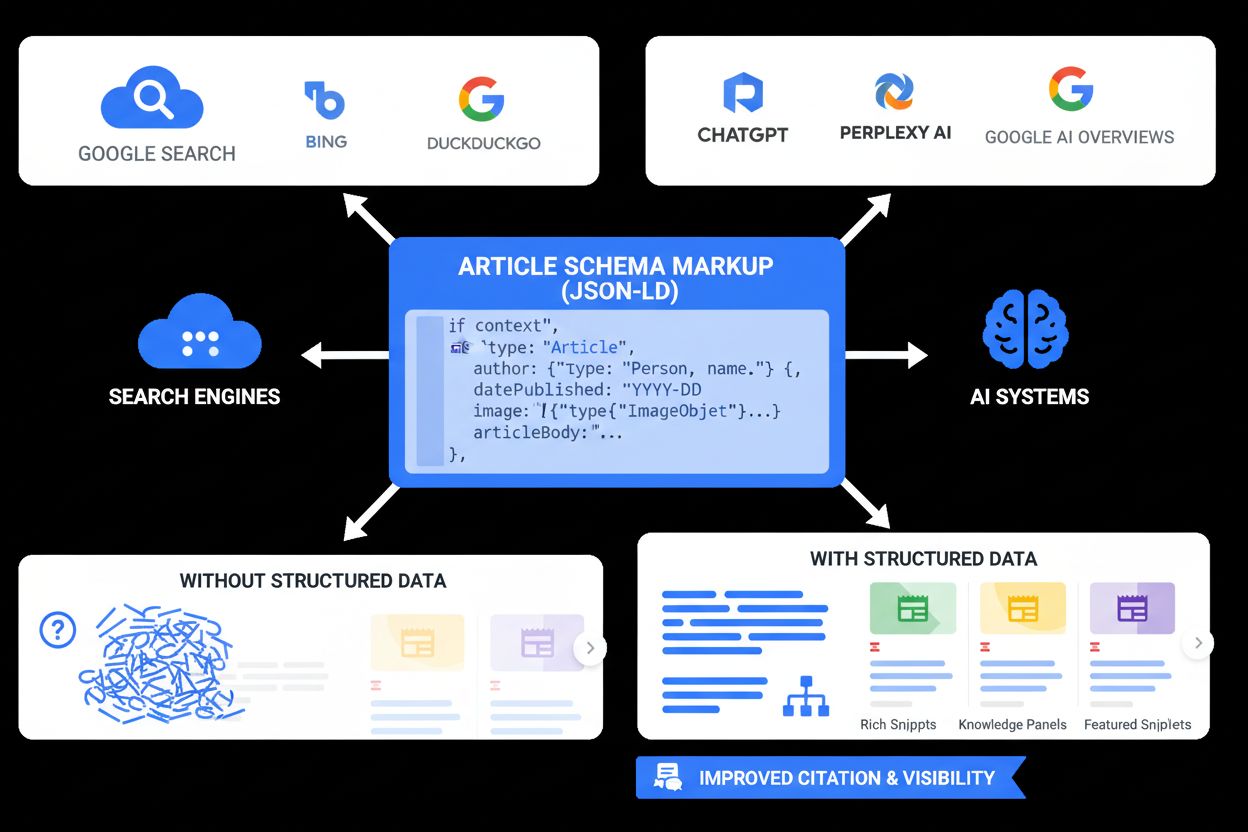
Article schema is a standardized form of structured data markup that explicitly defines the elements and properties of article content on web pages. It acts as a machine-readable label that communicates to search engines and AI systems what information represents the article’s headline, author, publication date, content body, images, and other critical metadata. Rather than forcing AI systems to guess or infer what constitutes an article, Article schema provides clear, explicit signals about your content’s structure and meaning. This structured data uses JSON-LD format, which is the preferred method recommended by Google, Bing, and other major search platforms for implementing schema markup on websites.
The primary purpose of Article schema is to bridge the gap between human-readable content and machine-readable signals. When you write an article with a headline, byline, and publication date, humans instantly understand these relationships. However, AI systems require explicit markup to recognize these same elements without ambiguity. Article schema eliminates this confusion by clearly labeling each component, making it significantly easier for AI systems to parse, understand, and extract information from your content. This becomes particularly important when AI systems need to cite sources or pull information for generating answers to user queries.
AI systems leverage Article schema in multiple ways to improve their understanding and utilization of your content. When AI models like ChatGPT, Claude, Perplexity, or Google’s AI Overviews encounter properly marked-up articles, they can immediately identify key information without having to analyze the visible text on the page. This process, known as entity recognition, allows AI systems to distinguish your brand, author, and content from other similar entities on the web. The schema markup serves as a direct communication channel between your website and AI systems, removing the need for inference or guesswork.
AI systems use Article schema for several critical functions:
Recent experiments have demonstrated that pages with well-implemented Article schema appear more frequently in AI Overviews compared to pages with poor or missing schema. In controlled tests, pages with comprehensive Article schema achieved better organic rankings and were the only pages to appear in AI-generated summaries, while pages with poor or no schema failed to rank or appear in AI results at all.
Article schema encompasses several specialized types designed for different content categories. Understanding which type applies to your content ensures you’re communicating the correct information to AI systems. NewsArticle schema is specifically designed for time-sensitive news content, journalistic pieces, and current event reporting. It includes properties like dateline, print edition information, and byline that are particularly relevant for news organizations. BlogPosting schema serves personal and corporate blogs with a more conversational tone, including properties for comment counts, publish dates, and article sections that reflect the blogging experience.
AnalysisNewsArticle schema is tailored for in-depth analytical pieces that go beyond simple reporting to provide expert interpretation and critical insights. This schema type includes properties for expert authorship, methodology, argumentation, and sources that establish credibility for analytical content. MedicalScholarlyArticle schema is specifically constructed for medical research papers and scholarly articles, emphasizing peer review status, medical specialty, abstract information, and author credentials. AdvertiserContentArticle schema is designed for sponsored or promotional content, clearly indicating the sponsor, published time, and call-to-action elements while maintaining transparency about the content’s promotional nature.
| Schema Type | Best For | Key Properties |
|---|---|---|
| NewsArticle | News stories, current events, journalistic content | Dateline, byline, print edition, headline |
| BlogPosting | Blog posts, personal articles, conversational content | Comment count, author, publish date, article section |
| AnalysisNewsArticle | In-depth analysis, expert opinions, critical insights | Expert authorship, methodology, sources, conclusions |
| MedicalScholarlyArticle | Medical research, scholarly papers, academic content | Peer review status, medical specialty, abstract, authors |
| AdvertiserContentArticle | Sponsored content, promotional articles, advertorials | Sponsor, published time, impressions, call-to-action |
AI systems prioritize Article schema because it dramatically reduces the computational effort required to understand and process content. When AI systems encounter unstructured text, they must employ complex natural language processing techniques to identify what information is important, who wrote it, when it was published, and what the main topic is. This process is computationally expensive and prone to errors. Article schema eliminates this uncertainty by providing explicit, machine-readable answers to these fundamental questions.
The importance of Article schema for AI visibility cannot be overstated. Schema markup creates a translation layer between human-readable content and machine-readable signals that AI systems are designed to understand. Google’s Knowledge Graph, which contains over 500 billion facts about 5 billion entities, relies heavily on structured data to organize and connect information. When your Article schema is properly implemented, it helps AI systems link your content to this vast knowledge network, improving the context and authority with which your information is presented. Additionally, schema markup serves as direct AI communication, whereas traditional SEO signals like backlinks require inference and interpretation.
Implementing Article schema correctly requires attention to several critical factors. First, choose the appropriate schema type that accurately represents your content’s nature and purpose. A news article should use NewsArticle schema, while a blog post should use BlogPosting schema. Mismatching schema types can confuse AI systems and reduce the effectiveness of your structured data. Second, use JSON-LD format for implementation, as it is the preferred method recommended by major search engines and is easier to maintain than alternative formats like Microdata or RDFa.
When implementing Article schema, ensure you include all recommended properties such as headline, author, datePublished, dateModified, image, and articleBody. The headline should be concise and descriptive, as it’s often prominently displayed in search results and AI summaries. Author information should include both the person’s name and a URL to their profile or biography page, helping AI systems establish author authority and expertise. Publication dates should be in ISO 8601 format with timezone information to ensure AI systems correctly understand content freshness. Images should be high-resolution (minimum 50K pixels when multiplying width and height) with multiple aspect ratios (16x9, 4x3, and 1x1) for optimal display across different platforms.
Validation is absolutely critical before deploying Article schema on your website. Use Google’s Rich Results Test and the Schema.org Validator to check for errors and ensure search engines can parse your markup correctly. These tools will identify missing required properties, invalid formatting, and other issues that could prevent AI systems from properly understanding your content. After validation, deploy a few pages with your schema and use Google’s URL Inspection tool to verify that Google can access and understand your pages. Allow time for re-crawling and re-indexing, as it may take several days for Google to fully process your structured data.
Using incorrect schema types is one of the most common mistakes that undermines Article schema effectiveness. Applying NewsArticle schema to a standard blog post or using BlogPosting for medical research articles misrepresents your content and can reduce its visibility in AI systems. Always ensure the schema type accurately reflects your content’s actual nature and purpose. Missing required properties is another critical error that prevents schema from functioning properly. If you omit essential properties like headline, image, or datePublished, AI systems may not recognize your content as a properly structured article, resulting in reduced visibility in AI-generated responses.
Implementing schema on irrelevant content is a serious mistake that can harm your site’s credibility with AI systems. Applying Article schema to contact pages, product listings, or homepages that aren’t actually articles creates misleading markup that confuses AI systems and violates search engine guidelines. Overusing schema markup by adding excessive or conflicting schema types to a single page can also backfire, creating confusion rather than clarity. Additionally, failing to test your schema before deployment means errors may go undetected, preventing AI systems from properly parsing your content. Finally, employing spammy practices like including inaccurate information, stuffing keywords into schema fields, or using markup on hidden content violates search engine guidelines and can result in penalties.
After implementing Article schema, continuous monitoring is essential to ensure it remains effective and properly configured. Use Google Search Console’s Enhancements section to monitor the health of your pages with structured data. This section displays the number of pages with valid schema markups, warnings or issues that need attention, and trends in how your content performs in search over time. If Google detects any issues with your Article schema, you’ll receive clear guidance on what needs to be fixed and can request a re-crawl once adjustments have been made.
Keep your schema updated whenever you make significant changes to your articles. If you modify an article’s author, update the publication date, or add new sections, your schema should reflect these changes immediately. Regularly review your schema implementation to ensure it aligns with current search engine guidelines and best practices. Watch for updates to schema.org specifications and Google’s structured data guidelines, as these standards evolve over time. Consider using automated tools and monitoring platforms to scale schema management across large websites, ensuring consistency and accuracy across all your content. By maintaining vigilant oversight of your Article schema, you ensure it continues to contribute positively to your AI visibility and search engine performance.
The relationship between Article schema and AI visibility will likely become even more important as AI systems become more sophisticated and prevalent in search. As more users turn to AI-powered search engines and answer generators, the ability to have your content properly understood and cited by these systems becomes increasingly critical for brand visibility. Schema markup is no longer optional for organizations serious about maintaining visibility in AI search results. The evidence increasingly shows that well-implemented structured data provides a competitive advantage in both traditional search and AI-powered search environments.
Looking forward, AI systems will likely become more dependent on structured data as they scale to process ever-larger volumes of web content. Rather than relying on complex natural language processing to infer content structure, AI systems will increasingly leverage explicit schema markup to quickly and accurately understand content. This shift means that organizations investing in proper Article schema implementation today will be better positioned to maintain visibility as AI search continues to evolve. The competitive window for establishing strong schema markup is closing, as more organizations recognize its importance and implement it across their content. By implementing Article schema now and monitoring its performance, you ensure your brand remains visible and properly cited in the AI-powered search landscape of tomorrow.
Track where your content appears in AI-generated answers across ChatGPT, Perplexity, Claude, and Google AI Overviews. Get actionable insights to improve your AI visibility.
Article Schema is structured data markup that defines news and blog article properties for search engines and AI systems. Learn how to implement Article, NewsAr...

Learn how to implement HowTo schema markup for better visibility in AI search engines. Step-by-step guide to adding structured data for ChatGPT, Perplexity, and...

Learn how product schema markup helps your e-commerce products get cited by AI shopping engines like Google AI Overviews, Perplexity, and ChatGPT Search.