
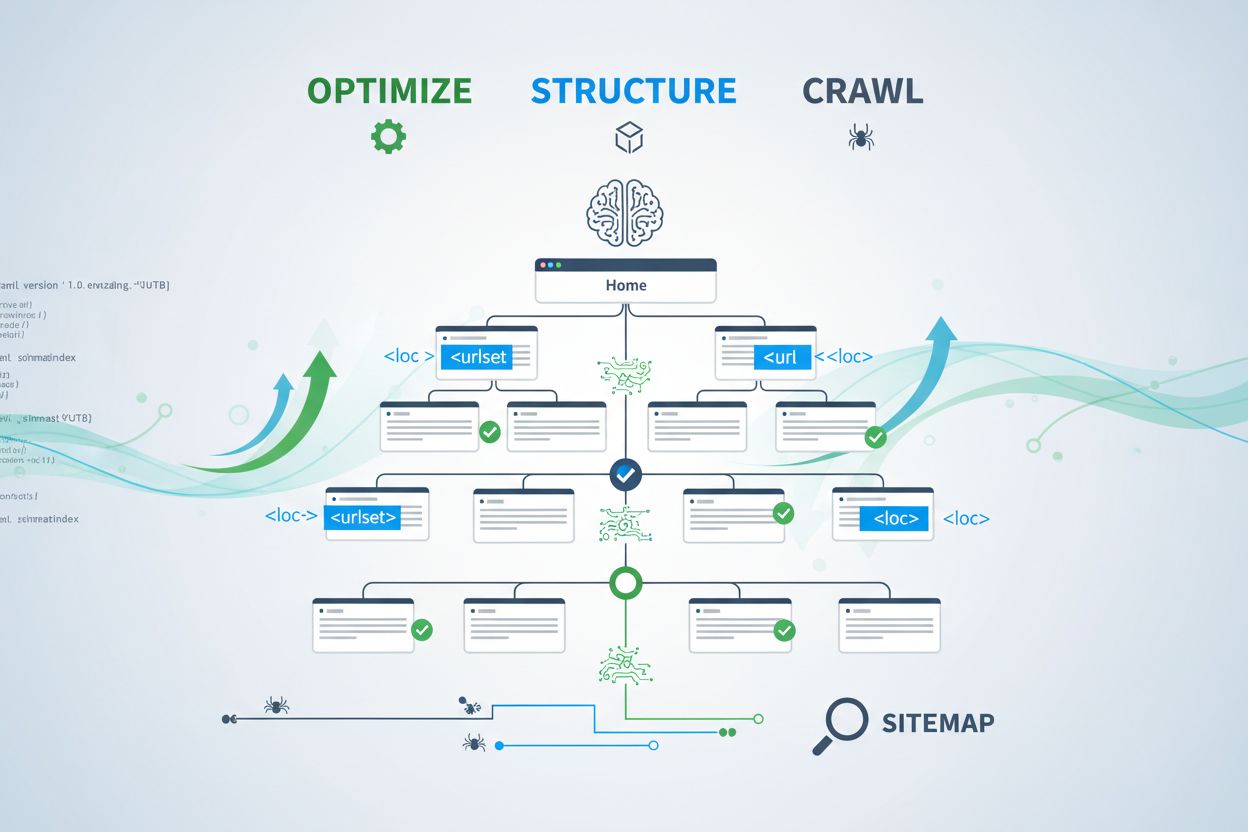
Sitemap Optimization for AI Crawlers
Learn how to optimize XML sitemaps for AI crawlers like GPTBot and ClaudeBot. Master sitemap best practices to improve visibility in AI-generated answers and LL...
11 min read

Learn how to structure your website for optimal AI crawler indexing, including semantic HTML, site architecture, content organization, and technical requirements for ChatGPT, Perplexity, and other AI search engines.
The best site structure for AI prioritizes semantic HTML, clear content hierarchy, fast loading speeds, mobile-first design, and structured data markup. AI crawlers need clean, accessible content delivered server-side with logical navigation, proper heading hierarchy, and entity-based organization that helps LLMs understand relationships between topics.
The way you organize your website has fundamentally changed. For decades, site structure was optimized primarily for traditional search engines like Google, which crawled links and ranked pages based on keywords and backlinks. Today, AI crawlers like GPTBot, ClaudeBot, and PerplexityBot are scanning the web to train large language models and power real-time answer generation. These AI systems have different requirements than traditional search engines, and your site structure must accommodate both. The best site structure for AI is one that makes your content easily discoverable, semantically clear, and extractable for synthesis into AI-generated answers.
AI crawlers don’t just index pages—they interpret content to understand meaning, context, and relationships between concepts. If your site structure buries important information, relies heavily on JavaScript, or lacks clear semantic organization, AI systems may skip your content entirely. This means that optimizing for AI visibility requires rethinking how you organize pages, structure content, and deliver information to crawlers. The good news is that many of these optimizations also improve traditional SEO and user experience.
Semantic HTML is the foundation of any site structure optimized for AI. Instead of using generic <div> tags for everything, semantic HTML uses meaningful tags like <main>, <article>, <section>, <nav>, and <aside> to clearly label different parts of your page. When AI crawlers read your HTML, they don’t just see text—they see structure. A page wrapped in proper semantic tags tells the AI exactly what each piece of content represents, making it easier for language models to extract and synthesize information accurately.
Flat, logical hierarchy matters more than ever. AI crawlers have limited resources and patience. If important pages are buried five or six clicks deep in your navigation, they may never be crawled. The best site structure keeps critical content within two to three clicks from the homepage. This applies to both your information architecture and your URL structure. Avoid deeply nested paths like /category/subcategory/sub-subcategory/page/. Instead, use flatter structures that make it easier for crawlers to discover and prioritize your most valuable content.
Mobile-first design is non-negotiable. AI crawlers simulate mobile devices when scanning websites. If your site doesn’t render properly on mobile, loads slowly, or hides content behind JavaScript interactions, AI systems won’t see the full picture. Core Web Vitals—including Largest Contentful Paint (LCP), First Input Delay (FID), and Cumulative Layout Shift (CLS)—directly impact how thoroughly AI crawlers can index your content. A slow-loading page may be abandoned before all content is retrieved.
The structure of your HTML directly influences how AI systems understand your content. Proper heading hierarchy is critical. Use <h1> for your main page topic, <h2> for major sections, and <h3> for subsections. This creates a clear outline that AI models can follow. Avoid skipping heading levels (like jumping from <h1> to <h3>) because it confuses the semantic structure. Each heading should accurately describe the content that follows, using natural language that matches how users and AI systems would search for that information.
Content should be organized in self-contained, extractable chunks. AI systems don’t just read your entire page—they extract specific passages to ground their generated answers. This means your most important information should appear early in each section, within the first 50-100 words. Follow this with supporting details, examples, and nuance. Use short paragraphs (3-4 sentences maximum) rather than dense blocks of text. This makes it easier for AI to identify and extract the core answer without having to parse through irrelevant information.
Lists and tables are your friends. Bullet points, numbered lists, and data tables are highly valuable for AI systems. They provide structured, scannable information that’s easy to extract and incorporate into generated responses. When you have multiple items, options, or comparisons, use lists or tables instead of paragraph form. This not only helps AI crawlers but also improves readability for human visitors.
| Element | Purpose for AI | Best Practice |
|---|---|---|
| Semantic HTML tags | Signal content meaning to AI | Use <main>, <article>, <section>, <nav>, <aside> |
| Heading hierarchy | Create logical content outline | H1 for topic, H2 for sections, H3 for subsections |
| Short paragraphs | Improve extractability | Keep paragraphs to 3-4 sentences |
| Lists and tables | Enable structured data extraction | Use for comparisons, steps, and multiple items |
| Alt text on images | Support multimodal AI understanding | Describe content and context, not just appearance |
Your site’s overall architecture should reflect topical relationships. Instead of organizing pages purely by product categories or business functions, consider organizing around topics and entities that AI systems can understand. This is called entity-based content architecture. For example, if you’re in the fitness industry, don’t just have pages for “Services” and “Blog.” Instead, create pillar pages around major topics like “Strength Training,” “Nutrition,” and “Recovery,” with cluster pages that dive deeper into related subtopics. Link these pages together with descriptive anchor text that explains the relationship between topics.
Internal linking strategy is crucial for AI visibility. AI crawlers follow links to discover content, but they also use link structure to understand relationships between pages. When you link from one page to another, use descriptive anchor text that explains what the linked page is about. Instead of “click here” or “learn more,” use anchor text like “Read our guide to progressive overload in strength training.” This helps AI systems understand the semantic relationship between pages and strengthens your topical authority.
Navigation should be clean and consistent. Your main navigation menu should be easy for both humans and crawlers to understand. Avoid mega-menus with dozens of links, as they can confuse crawlers about which pages are most important. Keep your navigation structure consistent across all pages so crawlers can reliably find and understand your site’s organization. Use breadcrumb navigation to show the hierarchy of pages and help crawlers understand where each page fits in your overall structure.
Avoid orphaned pages. Every page on your site should be reachable through at least one internal link from another page. Orphaned pages—pages with no internal links pointing to them—are often missed by crawlers entirely. Regularly audit your site to identify and fix orphaned pages by adding internal links to them from relevant pages.
Server-side rendering is essential. Many modern websites use JavaScript frameworks like React, Vue, or Angular to render content on the client side. While this can create dynamic, interactive experiences for users, it’s problematic for AI crawlers. Most AI systems don’t execute JavaScript, so they only see the initial HTML. If your critical content is loaded dynamically through JavaScript, AI crawlers won’t see it. The solution is to use server-side rendering (SSR) or static site generation (SSG) to ensure that important content is delivered in the initial HTML response.
Page speed directly impacts crawl efficiency. AI crawlers have limited resources and won’t wait for slow pages to load. If your site takes more than 3-5 seconds to load, crawlers may move on before all content is retrieved. Optimize your site speed by:
Clean, valid HTML is non-negotiable. Validate your HTML to ensure it’s properly structured and free of errors. Broken HTML can confuse crawlers and prevent them from parsing your content correctly. Use tools like the W3C HTML Validator to check your pages.
Ensure proper HTTP status codes. Make sure your pages return a 200 (success) status code. Pages that return 404 (not found) or 5xx (server error) codes won’t be indexed by AI crawlers. Regularly monitor your site for broken links and fix them promptly.
Structured data helps AI systems understand your content. Schema.org markup, implemented as JSON-LD, provides machine-readable information about your content. This includes details like article publication dates, author information, organization details, product specifications, and more. AI systems use this structured data to better understand what your content is about and how to incorporate it into generated answers.
Key schema types for AI visibility include:
Structured data should always match the visible content on your page. Don’t add schema markup for information that isn’t actually displayed to users, as this can confuse AI systems and damage your credibility.
Group related content into topical clusters. AI systems understand content better when related pages are grouped together and linked with descriptive anchor text. Create pillar pages that provide comprehensive overviews of major topics, then create cluster pages that dive deeper into specific subtopics. Link these pages together to show the relationships between topics. This helps AI systems understand your topical authority and makes it more likely that your content will be retrieved and cited.
Use consistent terminology and entity naming. If you refer to the same concept by different names throughout your site, AI systems may not recognize that you’re talking about the same thing. Choose a primary term for each concept and use it consistently. If you use alternative names or abbreviations, mention them explicitly so AI systems can make the connection.
Provide context and definitions. When you introduce new concepts or technical terms, define them clearly. This helps AI systems understand what you’re talking about and makes it easier for them to extract and synthesize your content. Use appositive phrases, parenthetical explanations, or dedicated definition sections to clarify terminology.
Images, videos, and other media are increasingly important for AI. Modern AI systems like GPT-4o and Google’s multimodal models can interpret images as well as text. This means that high-quality visuals can directly contribute to your AI visibility. Optimize your images by:
Videos should include transcripts and captions. AI systems can analyze video content more effectively when transcripts are available. Provide accurate transcripts for all videos, and include timestamps that link to specific sections. This makes your video content more discoverable and extractable for AI systems.
Infographics and data visualizations need machine-readable alternatives. If you present data in a visual format, also provide it in a machine-readable format like a table or CSV file. This ensures that AI systems can extract the data accurately, even if they can’t interpret the visual representation perfectly.
Minimize duplicate content. Duplicate or near-duplicate content wastes crawl budget and can confuse AI systems about which version is authoritative. Use canonical tags to indicate the preferred version of pages that have multiple URLs. Consolidate similar pages into single, comprehensive pages rather than spreading content across multiple URLs.
Fix broken links and 404 errors. Broken internal links waste crawl budget and prevent crawlers from discovering content. Regularly audit your site for broken links and fix them. If you must remove pages, use 301 redirects to point to relevant replacement pages.
Keep your sitemap updated. Submit an XML sitemap to search engines and AI crawlers. Make sure your sitemap includes all important pages and is updated whenever you add, remove, or significantly modify pages. A well-maintained sitemap helps crawlers discover and prioritize your most important content.
Optimize your robots.txt file. Use robots.txt to guide crawlers toward your most important content and away from pages that don’t need to be indexed (like login pages, duplicate content, or admin areas). However, don’t block AI crawlers unless you specifically don’t want your content used in AI systems. Most AI crawlers respect robots.txt directives, so blocking them here will prevent your content from appearing in AI-generated answers.
Establish clear authorship and expertise. AI systems evaluate the credibility of content sources. Include author bylines on all content, with links to author bios that detail their credentials, experience, and expertise. For organizational content, clearly state who wrote it and what qualifications they have. This helps AI systems assess the trustworthiness of your content.
Create comprehensive About pages. Your About page should clearly explain your organization’s mission, history, expertise, and physical location (if applicable). This helps AI systems verify that your organization is legitimate and trustworthy. Include information about your team members, their credentials, and their areas of expertise.
Link to authoritative sources. When you cite facts or statistics, link to the original source. This demonstrates that you’ve done your research and helps AI systems verify the accuracy of your claims. Linking to high-authority sources like government agencies, academic institutions, and established publications strengthens your credibility.
Keep content fresh and accurate. AI systems prefer recent, up-to-date information. Regularly review and update your content to ensure it remains accurate and relevant. Include publication dates and modification dates in your content and structured data so AI systems know how current your information is.
Track your AI visibility. Use tools to monitor whether your content appears in AI-generated answers from ChatGPT, Perplexity, Google AI Overviews, and other platforms. Track which queries your content is cited for, which sources it appears alongside, and how often it’s included in AI responses. This data helps you understand what’s working and where you need to improve.
Conduct regular site audits. Periodically audit your site to ensure it meets all the technical and structural requirements for AI crawlability. Check for broken links, slow pages, JavaScript rendering issues, and missing structured data. Use tools like Google Search Console, Lighthouse, and specialized AI SEO tools to identify and fix problems.
Test content variations. Experiment with different content structures, heading formats, and information organization to see what works best for AI visibility. Track the results and refine your approach based on what you learn. Perplexity AI’s transparency makes it an excellent testing ground for these experiments.
Stay informed about AI crawler updates. AI systems and their crawlers are constantly evolving. Stay up to date with changes to how major AI platforms work, what they prioritize, and how they handle content. Follow industry news and best practices to ensure your site structure remains optimized as the landscape changes.
The best site structure for AI is one that prioritizes clarity, accessibility, and semantic meaning. By implementing proper HTML structure, organizing content logically, optimizing for speed, and providing rich metadata, you ensure that AI systems can discover, understand, and cite your content in generated answers. This approach not only improves your visibility in AI search results but also enhances traditional SEO and user experience.
Track how your content appears in ChatGPT, Perplexity, Google AI Overviews, and other AI answer generators. Get real-time visibility into AI citations and optimize your presence across all AI platforms.
Learn how to optimize XML sitemaps for AI crawlers like GPTBot and ClaudeBot. Master sitemap best practices to improve visibility in AI-generated answers and LL...

Learn how AI crawlers process structured data. Discover why JSON-LD implementation method matters for ChatGPT, Perplexity, Claude, and Google AI Overviews visib...
Complete reference guide to AI crawlers and bots. Identify GPTBot, ClaudeBot, Google-Extended, and 20+ other AI crawlers with user agents, crawl rates, and bloc...